Key Takeaways
- Second Gmail account: click your profile picture → Add account → sign in or choose Create account; you can switch between accounts from the same menu.
- Gmailify and POP fetching are going away: Google restricts new connections during 2026 and removes both features — plus Send as for third-party addresses — in January 2027.
- Non-Gmail addresses (Yahoo, Outlook, iCloud): add them in the Gmail mobile app via IMAP, or set up auto-forwarding to see their mail in Gmail on desktop.
- All inboxes view: the Gmail app can show every added account in one list (menu → All Inboxes); there is no equivalent view in Gmail on the web.
- Account limits: Google allows multiple accounts, but creating several in a row can trigger phone-verification limits or a temporary suspension.
- Keeping them clean: the Clean Email app connects up to 10 mailboxes and lets you bulk clean, unsubscribe, and automate each one separately.
How to Create a Second Gmail Account
Listed below are the steps on how to add a second Gmail account to your Gmail app and allow Gmail to login into different user account.
- Log in to your main Gmail account.
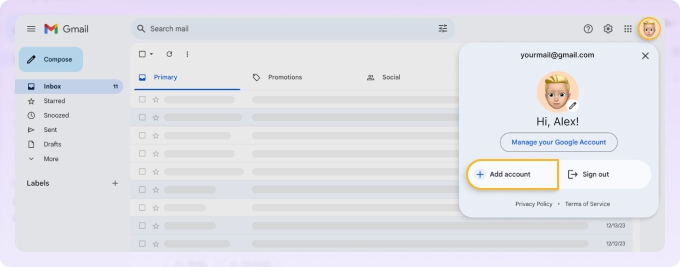
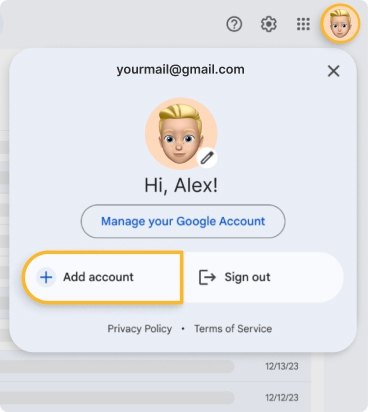
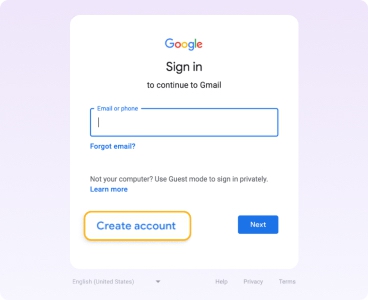
- Navigate to your profile picture (upper-right corner) and select + Add account (or + Add another account, if you're already signed in to multiple accounts).
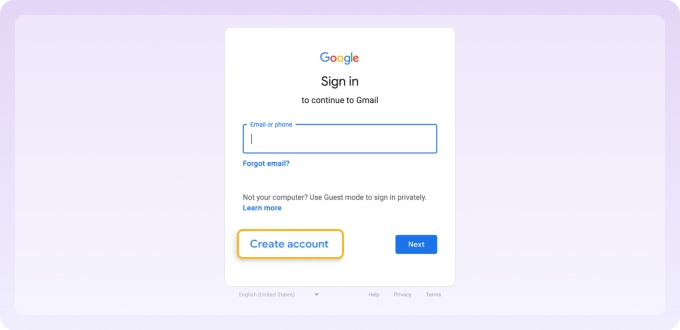
- If you don't have a second account but you want to create one—click the Create account button and follow the steps on the screen to set up one.
- If you already have an alternate Gmail address you wish to add, enter your email and password to log into the account as usual.
💡 Good to know: During sign-up, Google may require phone verification, and each phone number can only verify a limited number of accounts. If you hit that wall, see our guide on how to create a Gmail account without a phone number.
Google allows you to have multiple accounts, but creating several new ones in a short period can get an account flagged as "created or used with multiple other accounts" and temporarily disabled. To stay safe, create accounts one at a time, add real recovery information right away, and start using the new address normally before creating another.
How to Switch Between Gmail Accounts and Set a Default
Once you've added a second account, you don't need to log out to move between them:
- Click or tap your profile picture in the top-right corner.
- Select the account you want to switch to — each account opens with its own inbox, settings, and filters.
Gmail treats the account you signed in with first on that browser or device as the default — it's the one that opens when you visit gmail.com. To change it, sign out of all accounts, then sign in with the account you want as default first. Here's a detailed guide on how to change your default Google account.

How Clean Email Organizes Emails Across Multiple Accounts
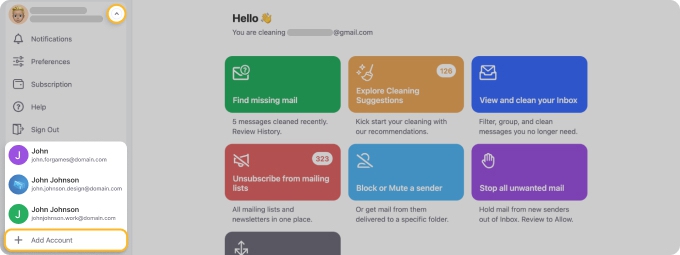
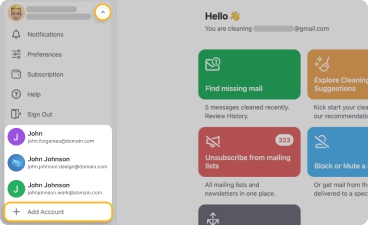
Every extra address multiplies the cleanup work: each inbox collects its own newsletters, promotions, and clutter. Clean Email connects up to 10 mailboxes — Gmail, Yahoo, Outlook, iCloud, or any IMAP account — and lets you manage each one from a single app on web, Mac, iPhone, and Android.
It's deliberately not a unified inbox: you switch between accounts inside the app and set up each mailbox separately, so work and personal mail never blend into one overwhelming pile. For every account you connect, you can:
- Bulk clean thousands of emails at once with Select All — no 50-per-page limits like in Gmail.
- Mass unsubscribe from dead newsletters in one screen with Unsubscriber.
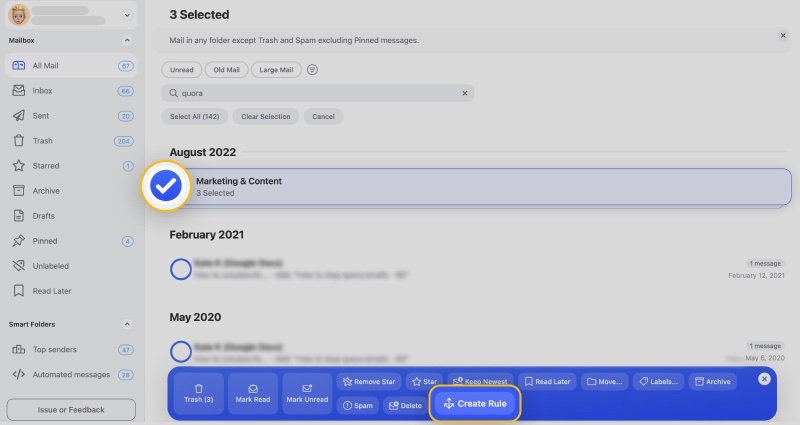
- Set Auto Clean rules per mailbox — for example, "trash promotions older than 30 days" in your personal account only. Rules run in the cloud even when the app is closed, and unlike Gmail filters, they apply to existing mail and work on mobile.
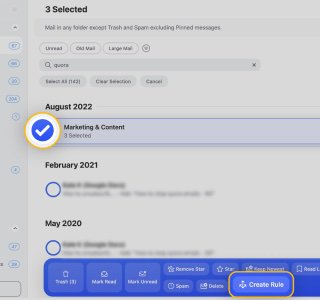
You can try it free on your first 1,000 emails; automation features like Auto Clean and Screener are part of the trial and paid plans, and one subscription covers all your connected accounts. Clean Email reads only message metadata — never contents — shows no ads, and doesn't sell your data. Sign up to Clean Email for free now.
Why Add a Second Gmail Account
Basically, you would want to create a new Gmail account and add it as your second account for:
- Setting apart personal and professional communication: Having a separate account for work-related communication can help you stay organized and avoid the confusion of mixing your correspondence.
- Keeping work-related newsletters separate: Adding a second Gmail account can be useful for subscribing to work-related newsletters without cluttering your personal or business email inbox.
- Backup and recovery: Having a backup account can be helpful in case you lose access to your primary account, as you can use it to recover your lost data and contacts.
- Privacy and security: If you are concerned about privacy and security, you can use another mail account for online shopping, signing up for social media accounts, or other activities that may involve sharing your mail address. If you are an Apple user, you may want to read more on how to benefit from their Hide My Email feature.
Overall, adding a second Gmail account can provide numerous benefits and help you stay organized and efficient in managing your emails. Still, if you would like to link another non-Google mail address to your Gmail, keep reading.
How to Link Another Email Address to Gmail From Desktop
⚠️ Important update: Google is retiring the Check mail from other accounts feature. New connections are already restricted, and in January 2027 Gmail will stop fetching mail from third-party accounts entirely — along with Gmailify and the Send as option for non-Google addresses. Accounts you linked earlier keep working until then, and all previously imported messages stay in Gmail.
That means you can no longer link a Yahoo, Outlook, or iCloud address to Gmail on desktop the way you used to. Here's what works instead:
Option 1 — Set up automatic forwarding (recommended for desktop). Turn on auto-forwarding in your other account's settings so new messages arrive in your Gmail inbox:
- Log in to your other email account (Yahoo, Outlook, iCloud, etc.).
- Open its settings and find the Forwarding option.
- Enter your Gmail address as the destination and confirm the verification email Gmail sends you.
- In Gmail, create a filter that labels or moves the forwarded messages, so they don't mix with your regular mail.
💡 Note: Forwarded messages occasionally end up in Spam. Check the Spam folder during the first weeks and mark the forwarded mail as "Not spam" to train the filter.
Option 2 — Use the Gmail mobile app. The app connects non-Gmail accounts over IMAP, and Google confirms this is not affected by the change (see the mobile steps below).
Option 3 — Use a desktop email client. Apps like Thunderbird, Outlook, or Apple Mail can combine all your accounts, including Gmail, via IMAP.
What Happened to Gmailify?
Gmailify was a feature that let you link an existing non-Google account to Gmail and get Gmail's spam protection, inbox categories, and search on top of it — a way to manage Outlook, Yahoo, or another IMAP-based Gmail alternative from the Gmail interface without giving up the old address.
Google announced it is removing Gmailify together with POP fetching. The timeline:
- During 2026: Gmail shows in-product notifications and restricts new Gmailify and POP connections.
- January 2027: both features are removed completely, along with Send as for third-party addresses.
What's not affected: the Gmail mobile app (it uses a standard IMAP connection), auto-forwarding into Gmail, reading Gmail from other clients over IMAP or POP, sending as another Gmail address or Google Workspace alias, and every message that was already synced.
If you relied on Gmailify to keep several mailboxes in one place, switch to forwarding or the mobile app before January 2027 — or manage each account directly and use a cleanup tool like Clean Email to keep every inbox decluttered.
How to Add Another Email Address to Gmail in the Mobile App
All major mail service providers have released mobile apps that let their users read and write emails on mobile devices, but not everyone is keen on having several different email apps installed on their devices.
Gmail's mobile app is actually a versatile mail client that lets you read and write messages from Yahoo, Hotmail, and other email addresses — and Google confirms this will keep working after Gmailify is gone, because the app connects over standard IMAP. This is what you need to do to add another non-Gmail address to it.
How to add another email to Gmail on Android and iPhone:
- Open the Gmail app.
- Tap your profile picture.
- Select the Add another account option.
- Choose the type of account you want to add — Google, Outlook, Yahoo, iCloud, or Other (IMAP) for any other provider.
- Follow the steps on the screen to add email account.
💡 Note: You can add up to five email addresses to the Gmail app.
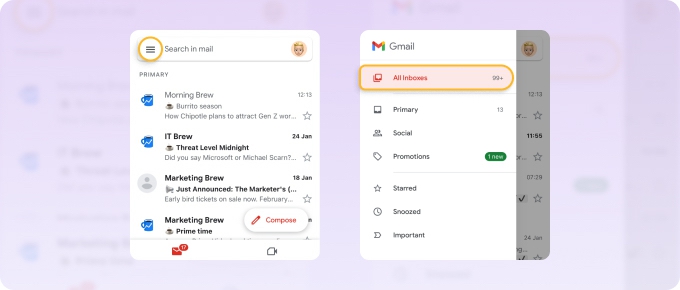
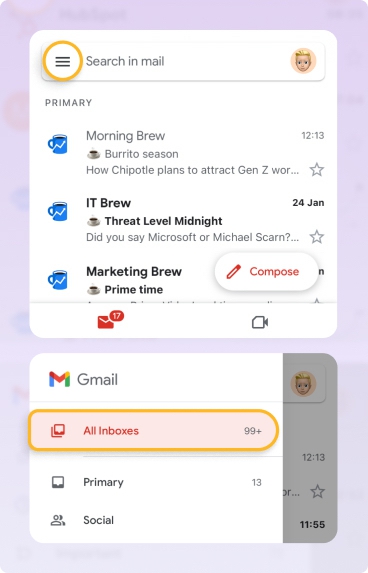
See messages from all accounts added to your Gmail app:
- On your mobile device, open the Gmail app.
- Tap the hamburger menu in the top left.
- Choose All Inboxes.
Pros and Cons of Having All Emails in One Place
Gmail allows you to manage all your mail addresses in one place. This setup is ideal for practicing Inbox Zero, a strategy to keep the inbox empty. Gmail offers familiar features for Google Accounts users, such as search by criteria, conversation view, and more. However, adding another email address to your inbox has its pros and cons.
Pros:
- Easy access and management: Adding another mail address to your primary inbox allows you to manage all emails from one interface. This avoids the inconvenience of switching between different accounts.
- Forwarding emails: You can use Gmail to forward emails from another mail address to your primary account, making it easier to manage all your emails in one place. After January 2027, forwarding becomes the only way to receive third-party mail in Gmail on the web.
Cons:
While the advantages of centralizing emails are evident, there is a notable drawback: security. Combining all mail addresses under one Gmail account poses a risk. If a hacker breaches your main account, they access all connected accounts.
The good news is that you can make your Gmail account quite secure by activating two-factor authentication and using a long password consisting of numbers, letters, and special characters. In fact, one could argue that email consolidation can improve your security, it's easier to secure one actively used account than, let's say, 10.
Is It Better to Access Another Email Address Via Gmail or Vice Versa?
Gmail isn't the only service that allows you to conveniently access other email addresses. With Outlook.com, users can add their Google Mail and Calendar accounts as additional mailboxes. However, this feature is exclusive to Microsoft 365 subscribers.
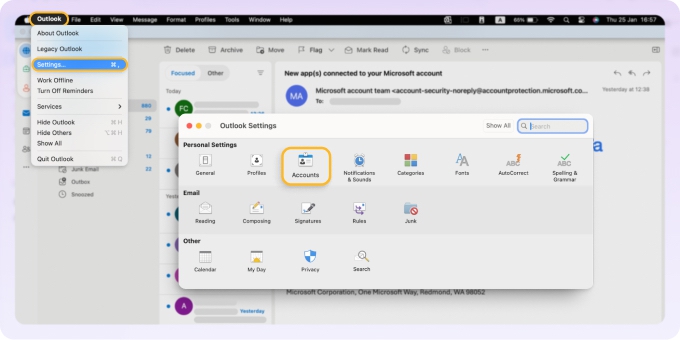
Nevertheless, you can connect your other accounts to Outlook for Windows or Outlook for Mac. For instance, let's see how you can add a Gmail account to Outlook on a Mac:
- Open the Microsoft Outlook app on your Mac.
- Go to Outlook → Settings → Accounts.
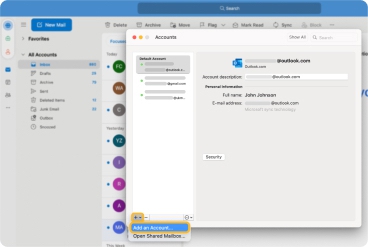
- In the window that appears, click '+' and then select Add an Account...
- Add an existing Microsoft 365, Outlook.com, Google, iCloud, IMAP, or POP account, or create and connect a new one.
- To view all your mail in one place, open folders under All Accounts.
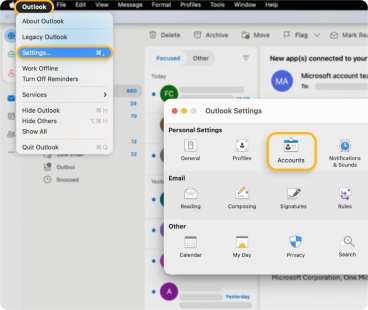
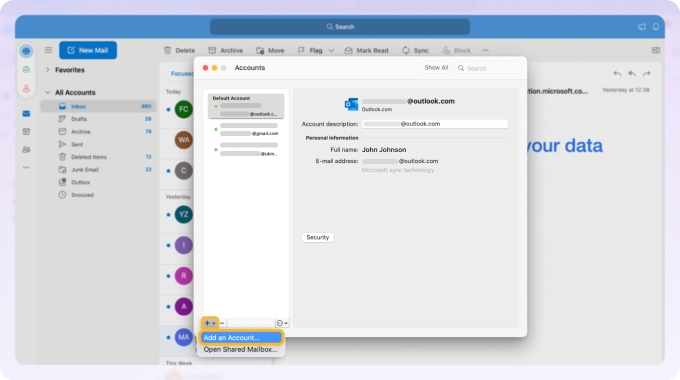
💡 Important: On May 10th, 2021, Microsoft eliminated the option of connecting any other email accounts to Outlook.com. However, accounts that had been linked before this date will remain synced as before. If you'd like to link new accounts, you can do so using Outlook for iOS or Android.
For more information, please check our article How to add Gmail to Outlook.
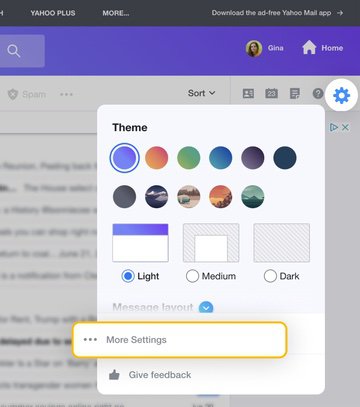
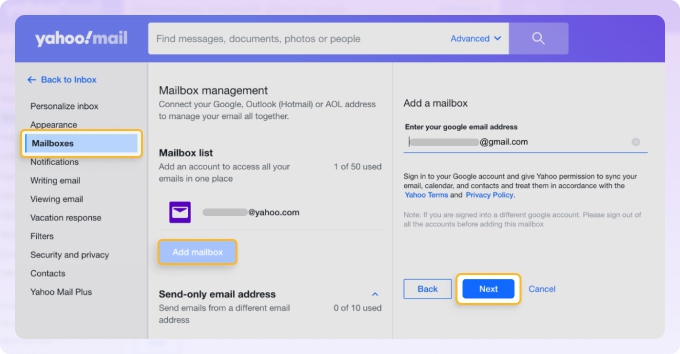
If you're using Yahoo, follow these instructions to add another email address:
- Go to mail.yahoo.com and log in with your email and password.
- Click the Settings icon and select More Settings.
- Select the Mailboxes option and click Add mailbox.
- Pick your service provider and enter your other email address.
- Click Next and follow the prompts on the pop-up window.
- Click Done when finished.
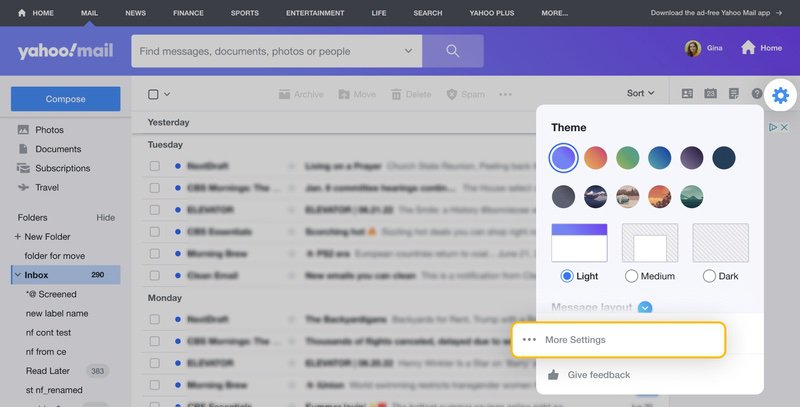
With this information in mind, you may be wondering if it's better to access another email address via Gmail or vice versa. That depends mostly on which mail address you use more. If Gmail is your primary choice, it would be practical to integrate your other addresses into it. This way, you can conveniently access all your emails in a single location.
Conclusion
There are a lot of things you can do to make your email more useful, and keeping your accounts organized is right at the top of the list. In this article, we've explained how to create a second Gmail address, how to add another email account to Gmail now that Gmailify and POP fetching are going away, and how a tool like Clean Email helps you keep every mailbox clean without merging them into one pile.
FAQs
How to set up a new email address on Gmail?
Log into your primary Gmail account, navigate to your profile picture, and select “Add account” or “Create account” if you don't have a second one.
How to add additional email to Gmail?
In the Gmail mobile app, tap your profile picture → Add another account, and choose the provider. On desktop, Gmail no longer accepts new third-party account connections — set up auto-forwarding from your other account instead.
What is Gmailify?
Gmailify was a feature that linked non-Gmail accounts to Gmail, adding Gmail's spam protection and organizational tools to them. Google is retiring it: new connections are already restricted, and the feature will be removed completely in January 2027.
Can I still add a non-Gmail address to Gmail?
Yes — in the Gmail mobile app for Android and iPhone, which connects Yahoo, Outlook, iCloud, and other accounts over IMAP. On the web, use auto-forwarding from the other account; the old “Check mail from other accounts” option is being removed.
How many Gmail accounts can I have?
Google doesn't publish a hard limit on the number of accounts you can own, but each phone number can only verify a few accounts, and the Gmail app supports up to five added addresses. Creating many accounts in a short period may trigger a temporary suspension.
Why was my new Gmail account disabled?
Google automatically flags accounts that look mass-created or bot-like — usually when several accounts are registered quickly from one device or number. Appeal the decision from the sign-in screen, and add recovery details to your remaining accounts to avoid repeat flags.
Is it better to add another email to Gmail or vice versa?
Whether it's better to add another mailbox to Gmail or vice versa depends on your primary service provider; if it's Gmail, adding other accounts to it for centralized management is practical.