What Kind of Gmail Alternative Do You Need?
People look for alternatives to Gmail for different reasons. Some want stronger privacy or end-to-end encryption. Others need professional email on a custom domain, prefer a different way to organize messages, or simply want better tools for managing an overloaded Gmail inbox.
These needs do not always require the same type of product:
- Email providers such as Outlook.com, Proton Mail, Tuta, iCloud Mail, Mailfence, and Fastmail give you a new email address and host your messages instead of Gmail.
- Business email services such as Titan, Neo, and Zoho Mail are primarily designed for custom-domain addresses, team administration, and customer communication.
- HEY combines an email service with its own inbox workflow. It normally requires adopting a HEY address rather than using it as a different interface for Gmail.
- Inbox management services such as Clean Email do not replace Gmail or provide a new address. They connect to your existing account and add tools for cleaning and organizing it.
Before choosing, decide whether you want to leave Gmail completely, replace Google Workspace for your business, or keep your Gmail address and improve how you manage it. The comparisons below explain both what each product does better than Gmail and what you would give up by switching.
Comparison of the best alternatives to Gmail:
| Provider | Product Type | Best For | Free Plan | Starting Price | Encryption |
|---|---|---|---|---|---|
| Outlook.com | Personal email provider | Microsoft users | Yes (15 GB) | Free / Microsoft 365 from $6/mo | TLS |
| Zoho Mail | Business email and marketing suite | Business teams | Yes (5 users) | From $1/user/mo | TLS + PGP option |
| Proton Mail | Privacy-focused email provider | Privacy-focused users | Yes (1 GB) | Mail Plus ~€4.99/mo | End-to-end (E2E) |
| Tuta | Encrypted email provider | Maximum security | Yes (1 GB) | From €3/mo | E2E + quantum-safe |
| iCloud Mail | Personal email provider | Apple users | Yes (5 GB) | iCloud+ from $0.99/mo | Standard TLS |
| Mailfence | Privacy-focused email and productivity suite | Non-US privacy users | Yes (500 MB) | From €3.50/mo | E2E + PGP |
| Titan | Business email hosting | Marketing & small biz | No | From ~$3/mo | Enterprise TLS |
| Neo | Business email and marketing suite | Small businesses | No | From ~$2/mo | Standard TLS |
| FastMail | Paid personal and business email provider | Speed & productivity | 30-day trial | From $5/mo | TLS (no E2E) |
| Hey | Bundled email service and inbox app | Inbox philosophy fans | 14-day trial | From $12/mo | Standard TLS |

Quick decision
- Best conventional Gmail replacement: Outlook.com or Fastmail
- Best for privacy: Proton Mail
- Best for a security-first closed ecosystem: Tuta
- Best for OpenPGP users: Mailfence
- Best for Apple users: iCloud Mail
- Best for business email: Zoho Mail
- Best for client outreach: Titan or Neo
- Best for a completely different inbox workflow: HEY
- Best when you want to keep Gmail and reduce email clutter: Clean Email
1. Outlook.com
📝 Best For Microsoft Office Users
The question of Gmail vs. Outlook is one that has been going on for over a decade. In 2013, Microsoft replaced Hotmail with the modern Outlook.com, bringing tighter integration with OneDrive, Microsoft Office, and a refreshed interface.
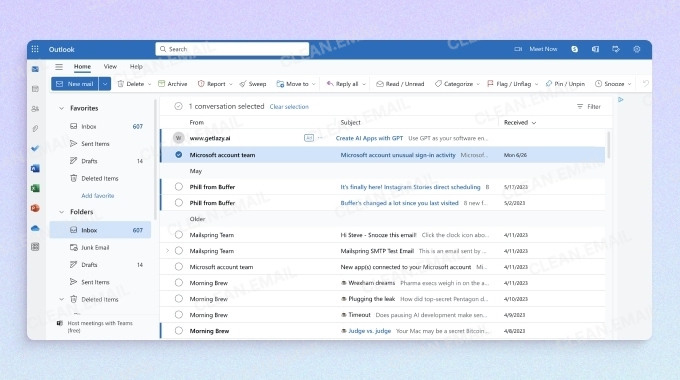
What's changed since then is significant. Outlook now ships with Copilot AI built into its web and mobile apps. In early 2026, Microsoft added a voice-based email catch-up in Outlook mobile that lets you triage your inbox hands-free, plus context-aware drafting that reads your emails and calendar to suggest replies and schedule meetings.
For users inside the Microsoft 365 ecosystem, Outlook.com is the best email alternative to Gmail in terms of productivity features.
Beyond AI, Outlook still leads on attachment size limits (up to 150 MB with Exchange, versus Gmail's 25 MB) and folder-based organization. The free Outlook.com account includes 15 GB of storage, and paid Microsoft 365 plans start at around $6/month for personal use.
Compared with Gmail
Outlook.com is the closest general-purpose Gmail replacement in this list. Both services provide free personal email, calendars, cloud-storage integrations, filters, search, and mobile apps.
The main organizational difference is that Gmail centers on labels and search, while Outlook places greater emphasis on folders, categories, and rules.
Outlook is the stronger choice when Microsoft 365, OneDrive, Teams, and Office applications are central to your work. Gmail remains the more natural option for people who depend on Google Drive, Google Calendar, Meet, and other Google services.
Will it replace Gmail? Yes. Outlook.com can provide both a new email address and a complete web and mobile inbox. Moving also means replacing much of the surrounding Google ecosystem with Microsoft services.
- Built-in Copilot AI for email drafting, triage, and scheduling
- Support for large attachments (up to 150 MB with Exchange)
- Tightly integrated with OneDrive, Teams, and Office apps
- 15 GB free storage, with upgrade options via Microsoft 365
- Some actions take more steps than Gmail users are used to
- Copilot AI features require a paid Microsoft 365 subscription
2. Zoho Mail
📝 Best for Business Users
Zoho Mail is one of the few ad-free email alternatives to Gmail that focuses mainly on businesses with a full suite of productivity tools, including calendars, tasks, notes, bookmarks, and the Streams collaboration feature, but offers professional email to individual users as well.
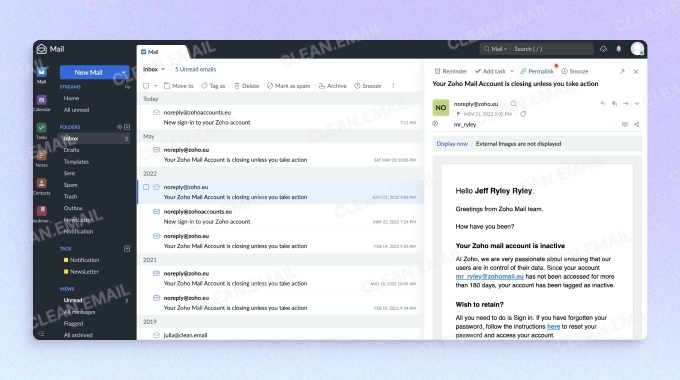
Zoho Mail makes it easy to get a custom domain email for your business so that your customers instantly recognize your emails.
The free tier covers up to 5 email addresses, which is rare among business-focused providers. Paid plans start at just $1/user/month for Mail Lite (5 GB), scaling up to Mail Premium at $4/user/month with larger attachments and white-labeling. At those prices, Zoho Mail is difficult to beat for cost-conscious teams.
Zoho also recently added Zia, its AI assistant, which can summarize long emails and auto-complete sentences as you type.
All plans include a 99.9% uptime SLA, 24/7 support, and integrations with the broader Zoho suite. If your business already uses Zoho CRM or Zoho Campaigns, the mail integration is seamless.
Compared with Gmail
Zoho Mail is one of the more direct Google Workspace alternatives for organizations. It supports custom-domain mail and includes calendars, contacts, tasks, notes, bookmarks, administration controls, migration tools, and integrations with other Zoho business applications.
Zoho’s organization model combines folders with incoming and outgoing filters. Gmail instead uses labels, inbox categories, and filters, with particularly strong search and close integration with Google Drive, Meet, Chat, and Calendar.
Will it replace Gmail? Yes. Zoho Mail can host personal or business email and can replace Gmail or Google Workspace. It is most compelling when the organization already uses Zoho CRM or other Zoho products.
📌 For a more thorough evaluation of Zoho Mail and Gmail, check out our Zoho Mail vs. Gmail head-to-head comparison.
- 99.9% uptime guarantee and 24/7 support
- Up to 1 TB storage on paid plans
- No ads to ruin the experience
- AI assistant (Zia) for email summarization and drafting
- PGP encryption support for sensitive communications
- IMAP/POP access locked to paid tiers
- Mobile app can feel slower than the web version
3. Proton Mail
📝 Best to Transfer Emails
Proton Mail is one of the best Gmail alternatives out there. It is the most widely used end-to-end encrypted email provider with over 100 million Proton accounts worldwide. Founded by scientists at CERN in Switzerland, it remains the default recommendation for anyone leaving Gmail for privacy reasons.
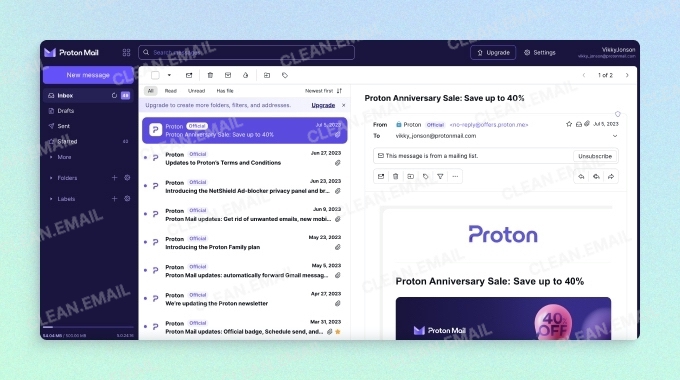
The free plan includes 1 GB of storage and one email address. Paid plans (Mail Plus at €4.99/month, or Proton Unlimited at €12.99/month) unlock more storage, custom domains, and access to the full Proton ecosystem: VPN, Drive, Calendar, Password Manager, and the new Proton Meet video conferencing tool.
The Proton Migration Tool also makes it straightforward to import all emails, calendar events, and contacts from Gmail or similar alternative emails to Gmail.
One important nuance: Proton Mail uses OpenPGP encryption, which is an open standard with broad interoperability but does not encrypt subject lines. This is worth knowing if your threat model requires complete metadata protection.
Compared with Gmail
Proton Mail’s main advantage over a standard personal Gmail account is privacy-oriented encryption. Gmail still has advantages in third-party integrations, search, and the maturity of its wider productivity ecosystem.
Will it replace Gmail? Yes. Proton Mail provides a new hosted mailbox and can import Gmail data. The strongest privacy benefits come after you begin using a Proton address rather than continuing to send through Gmail.
📌 For more information, check out our write-up on Proton Mail vs. Gmail.
- End-to-end encrypted email, calendar, and drive
- Swiss jurisdiction with strong legal privacy protections
- 100 percent open source
- Proton Migration Tool for easy Gmail import
- Growing ecosystem (VPN, Drive, Pass, Meet)
- Does not encrypt subject lines, headers, or metadata (PGP limitation)
- Free plan is limited to 1 GB and 150 messages/day
- Proton Bridge (desktop client sync) requires a paid plan
4. Tuta (formerly Tutanota)
📝 Best for Security
Tuta is the most security-forward provider on this list and a great alternative to Gmail. Based in Germany under strict EU GDPR rules, Tuta encrypts everything by default, including subject lines, contact lists, calendar metadata, and message bodies, which is more than any other provider here.
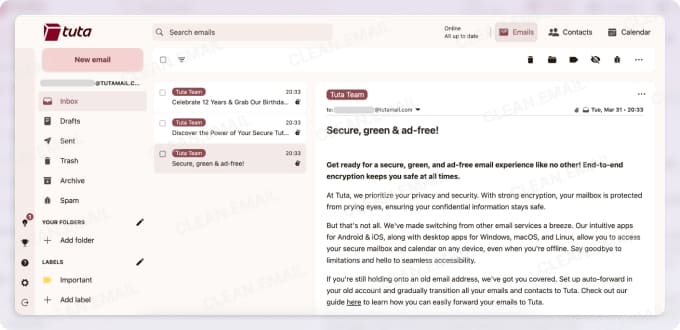
The headline update for 2026 is quantum-safe encryption. Tuta has implemented a hybrid ML-KEM protocol that protects messages against future quantum computing attacks, a threat model increasingly relevant for anyone storing sensitive communications long-term. No other major consumer email provider has moved this fast on post-quantum security.
Tuta's free plan includes 1 GB of storage and supports custom domains. Paid plans start at just €3/month, which makes it the most affordable encrypted email on this list. The trade-off is that Tuta uses its own proprietary encryption rather than PGP, which means you can't send end-to-end encrypted messages to arbitrary PGP users outside the platform.
Compared with Gmail
Tuta is intended for users who place encrypted communication above compatibility with conventional email applications.
Unlike Gmail, Tuta does not provide standard IMAP access for connecting the mailbox to arbitrary third-party email clients. Users work through Tuta’s web, mobile, or desktop applications. This controlled environment supports its security model but makes Tuta less flexible for people who rely on Outlook, Apple Mail, Thunderbird, or other external clients.
Will it replace Gmail? Yes, but it requires adopting both Tuta’s mail service and its applications. It is not simply a privacy layer that can be placed over an existing Gmail inbox.
- Quantum-safe encryption (ML-KEM) already deployed
- Encrypts subject lines, contacts, and calendar metadata
- 100 percent open source
- Clean interface with desktop clients for all major platforms
- Starting at €3/month, the most affordable encrypted option
- No third-party integration
- Proprietary encryption means no PGP interoperability with outside users
- No IMAP/SMTP access (by design, to preserve security)
5. iCloud Mail
📝 Best for Apple Users
Apple’s iCloud Mail is the natural Gmail alternative for anyone deep in the Apple ecosystem. It's accessible via IMAP from any device, and the interface is clean, fast, and consistent across iPhone, Mac, and iPad.
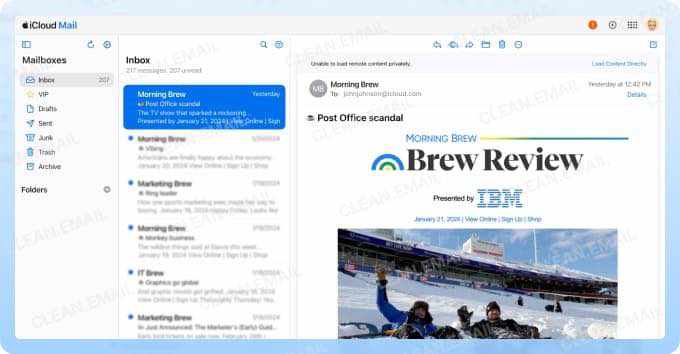
What makes iCloud Mail one of the notable Gmail alternatives is the fact that you can manage multiple mailboxes from different accounts or domains in one place.
The free account includes 5 GB of shared iCloud storage. Users can send attachments up to 20 MB directly, or use Mail Drop to send files up to 5 GB via a temporary link. Paid iCloud+ plans start at $0.99/month for 50 GB.
The standout privacy feature added in recent years is Hide My Email, available to iCloud+ subscribers. It generates random, disposable email aliases that forward to your real address, keeping your actual address private when signing up for services.
Apple Intelligence features are also being woven into Mail on iOS 18 and later, with smart reply suggestions and notification summaries.
Compared with Gmail
iCloud Mail is primarily an ecosystem alternative. It works particularly well when email, files, contacts, calendars, and device settings are already managed through an Apple Account.
Gmail offers more advanced search, filters, labels, and cross-platform Google integrations. iCloud Mail offers a simpler experience and closer integration with Apple Mail and Apple devices.
Will it replace Gmail? Yes. You can use an iCloud Mail address as your primary mailbox. It is most practical for Apple users and less compelling for people who primarily use Windows, Android, or Google Workspace.
📌 In our Gmail vs. iCloud side-by-side comparison, we look at these features more in-depth.
- Seamless sync across all Apple devices
- Hide My Email (iCloud+) for privacy-preserving sign-ups
- Ad-free, polished interface
- Mail Drop for large attachments up to 5 GB
- Not meant for people who don’t use Apple products
- Lacks business-level features
6. Mailfence
📝 Best for Users Outside the United States
Mailfence is a Belgium-based email service that, like Tuta, offers a secure Gmail alternative. With a strong focus on privacy for its users, Tuta positions itself as a full productivity suite rather than just an email client.
It combines end-to-end encrypted email with a built-in calendar, document storage (Mailfence Documents), group management, and an instant messaging feature.
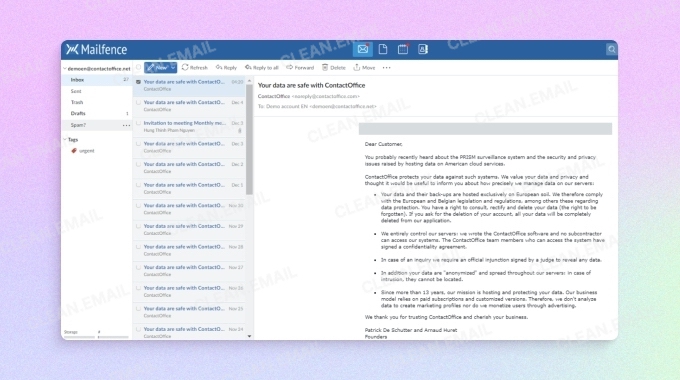
The privacy angle is genuine: Mailfence uses non-US SSL/TLS certificates, supports OpenPGP for end-to-end encryption, and doesn't track user activity. Belgian law and EU GDPR give users outside the US a clearer legal framework for data protection than many US-based services can offer.
The free plan includes 500 MB of email storage. Paid plans start at €3.50/month. The main trade-off is a plain interface and basic email formatting compared to more polished competitors.
Compared with Gmail
Compared with Gmail, Mailfence places more emphasis on user-managed encryption and avoids advertising and tracking. Gmail provides a more polished ecosystem, stronger search, and much deeper integration with mainstream workplace applications. Mailfence also requires users to understand when encryption is enabled because not every ordinary message is automatically end-to-end encrypted.
Will it replace Gmail? Yes. Mailfence supplies a mailbox and address, with custom-domain and external-client access available under supported plans. Choose it for OpenPGP and provider jurisdiction, not for Gmail-like convenience.
- Non-US SSL/TLS certificate
- End-to-end encryption with OpenPGP support
- Built-in calendar, document management, and messaging
- EU GDPR-compliant with Belgian jurisdiction
- Only basic email formatting features included
- Very plain user interface
7. Titan
📝 Best for Marketing Users
Titan is one of the best alternatives to Gmail if you want a custom email address for business marketing purposes. It is designed to help you build client relationships, not just manage a mailbox.
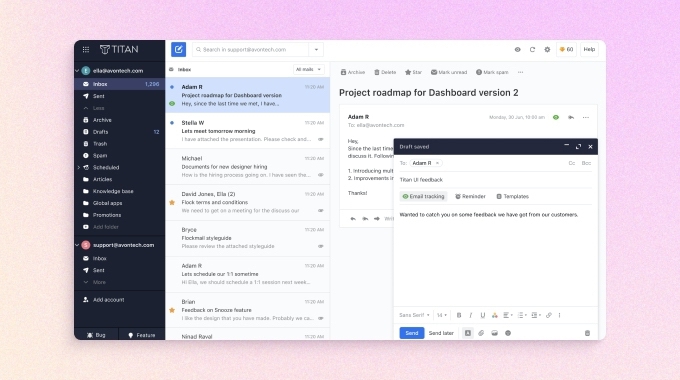
Where Titan stands out is in its outreach-ready feature set: Schedule Sends, Email Templates, Follow-up Reminders, read receipts, and advanced email tracking metrics. These are features most providers reserve for paid marketing platforms, but Titan includes them natively. Enterprise-level encryption, IP blacklist checks, and spam filtering also put it ahead of free providers for business use.
Titan also bundles calendar, contacts, and storage for a complete productivity setup inside the inbox, setting it apart as an effective Gmail alternative. Pricing starts at around $3/month per user, which is competitive for the feature depth on offer.
Compared with Gmail
Titan is not primarily a replacement for a free personal Gmail address. It competes more directly with Gmail provided through Google Workspace because both can host email on a business domain.
Titan is therefore more narrowly focused on email-based sales and client follow-up, while Google Workspace provides a broader collaboration environment.
Will it replace Gmail? Yes, when the objective is to move a business address and its mail hosting away from Google Workspace. It is less suitable as a direct replacement for someone who only wants another free personal email address.
- Cost-effective custom-domain email for small businesses
- Built-in email tracking, read receipts, and templates
- Multi-account viewing across mobile and desktop
- Enterprise-level encryption and spam protection
- Search function not as advanced as Gmail
- Not able to mass delete messages at once
8. Neo
📝 Best for Small Businesses
Neo is one of the best alternatives to Gmail for users seeking a custom email address and domain name for their small business. If users do not have their own domain, Neo offers a free Neo domain and a one-page website to help them create their brand identity and establish credibility.
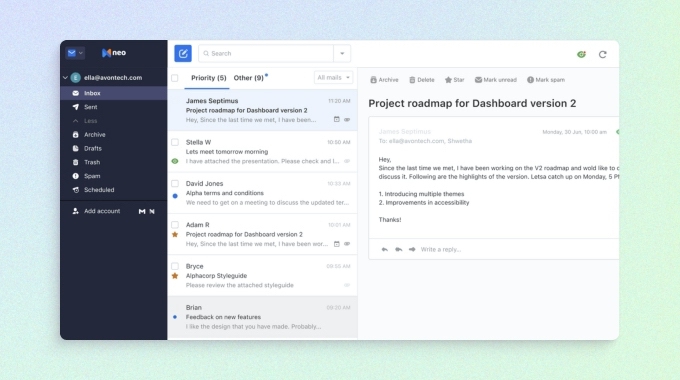
Beyond the domain bundle, Neo offers the same productivity tools you'd expect from a business provider: Schedule Sends, Email Templates, Follow-up Reminders, and read email notifications. It works on any device and OS, and supports multi-account viewing for users who manage more than one inbox.
Compared with Gmail
Neo competes with Google Workspace rather than only with the consumer version of Gmail.
Compared with Gmail, Neo brings more small-business marketing functions directly into the email interface. Gmail offers stronger integration with Google’s document, storage, meeting, and collaboration products, but Neo may reduce the need for separate tools when a small business mainly wants professional email, basic outreach, booking, and a simple web presence.
Will it replace Gmail? Yes, for a small business moving its custom-domain mail away from Google Workspace. It is not designed primarily as a free personal Gmail replacement.
- Comes with a free email, co.site domain and a one-page website
- Supports multi-account viewing
- Works flawlessly on any OS, mobile or desktop
- Unique among platforms with read email notifications
- Features geared towards small business success
- Email functionality is unavailable while offline
9. FastMail
📝 Great for Speed
FastMail is the fastest, cleanest non-encrypted email alternative on this list. It runs on lean server infrastructure without ads, tracking, or the JavaScript bloat that slows down Gmail. The result is an inbox that responds almost instantly and never tries to sell you something.
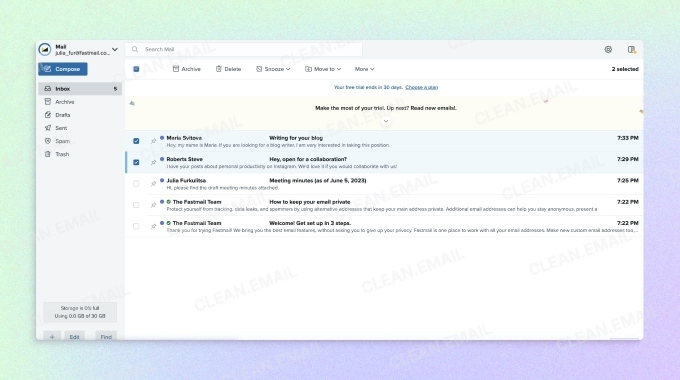
FastMail supports full IMAP/SMTP access, spam filtering, labels, folders, and automation rules. The built-in calendar and contacts are solid. One standout feature is Masked Email, built in partnership with 1Password, which lets you generate unique aliases for every service you sign up for without leaving the app.
There's no free tier, but a 30-day free trial requires no credit card. Individual plans start at $3/month on annual billing. Search quality is better than most privacy-focused providers but still falls short of Gmail's relevance ranking.
Compared with Gmail
Fastmail is a conventional hosted-email replacement that retains much of the flexibility Gmail users expect. It supports both folders and labels, filters and rules, custom domains, aliases, calendars, contacts, and standard email protocols.
The trade-off is that Fastmail does not position itself as an end-to-end encrypted email service, and it lacks Google’s broader document, meeting, and collaboration ecosystem.
Will it replace Gmail? Yes. Fastmail is one of the least disruptive options for users who want to leave Google while keeping a familiar, standards-based email workflow.
- Fast, ad-free, and tracking-free
- Masked Email for privacy-preserving sign-ups
- Full IMAP/SMTP support and strong calendar
- Custom domain support on all plans
- No end-to-end encryption
- No free subscription tier (30-day trial only)
10. Hey by 37signals
📝 Best for Email Management
Hey is a great Gmail alternative for users who prefer a clean and organized inbox. It takes a strong editorial stance on how email should work. Rather than replicating Gmail's feature set, 37signals rebuilt the inbox from scratch around their own opinionated workflow. The Imbox holds emails you've approved. The Feed holds newsletters and updates. The Paper Trail holds receipts and notifications. Everything else waits until you decide what it is.
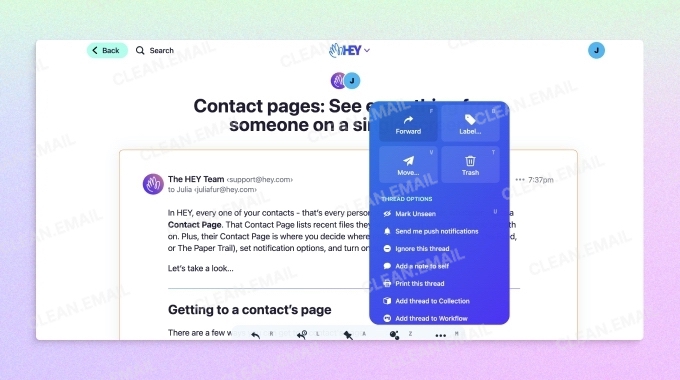
The unique tools are genuinely useful: Clips let you flag specific text within a message for later reference. Workflows let you track multi-thread projects visually. The Screener asks you to approve new senders before they reach your main inbox, a genuine spam-reduction mechanism.
Hey's personal plan starts at $12/month, with team plans at $24/user/month. That's on the expensive side for what is, at its core, an opinionated email client rather than a full-featured platform.
Unfortunately, Hey doesn't integrate cleanly with other email accounts, and the mobile app lags behind competitors, so it may not be the best Gmail alternative for users who manage multiple accounts in one place.
Compared with Gmail
HEY is not simply another interface for an existing Gmail account. It is a separate email service built around a different workflow.
Gmail lets users organize mail through labels, filters, categories, stars, archive, and search. HEY first asks whether a new sender should be allowed through its Screener.
This approach can reduce inbox decision-making, but it also gives users less freedom to construct their own system. People who depend on Gmail’s labels, complex search operators, integrations, or familiar archive-based workflow may find HEY restrictive.
Will it replace Gmail? Yes, but only by adopting HEY’s email service and workflow. It should not be presented as an email client that improves an existing Gmail account.
- Focused Imbox workflow that genuinely reduces email overload
- Clips, Workflows, and the Screener offer real organizational value
- Spy pixel blocking included
- HEY World for personal blog-style public email
- Expensive relative to feature depth ($12+/month for personal)
- No integration with other email accounts
- Mobile and desktop apps are wrappers around the web interface
When Is Switching from Gmail Worth It?
Changing your primary email address can affect logins, subscriptions, contacts, account recovery, calendars, and stored messages. A full migration to a Gmail alternative is usually worthwhile only when Gmail’s underlying service no longer meets an important requirement.
Consider switching providers when:
- You need end-to-end encrypted email as a standard part of your communication.
- You want personal email from a provider that does not depend on advertising for an ad-free experience.
- Your business needs custom-domain hosting, team administration, or built-in customer communication tools.
- You want to move away from the Google ecosystem and use another provider for mail, calendar, contacts, and storage.
- You prefer a fundamentally different inbox workflow, such as HEY’s sender screening and separate message streams.
Keeping Gmail may be the better choice when you depend on Google Search, Drive, Calendar, Meet, or third-party services connected to your Google Account. Gmail also already supports labels, filters, categories, forwarding, archive, and 15 GB of storage shared across Gmail, Google Drive, and Google Photos.
When the primary problem is clutter rather than Gmail itself, use an inbox management service instead of changing providers.
Organize Your Inbox with Clean Email
Switching email providers does not automatically fix years of accumulated messages, unwanted subscriptions, or an inbox that requires constant manual sorting.
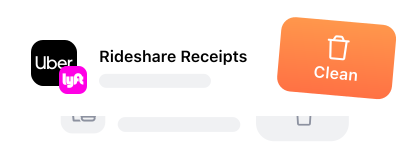
Clean Email is an inbox management service that connects to Gmail, Outlook, Yahoo, iCloud, and other IMAP-compatible services, allowing you to organize and clean them without changing your email address.
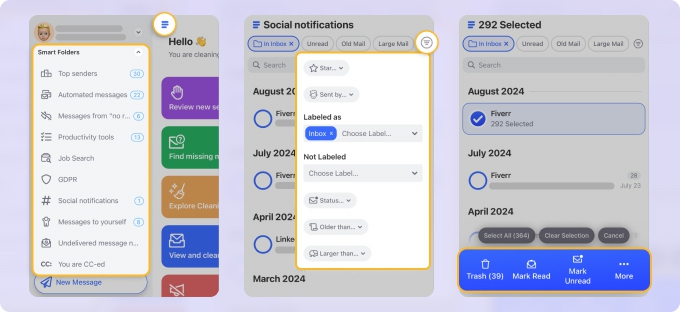
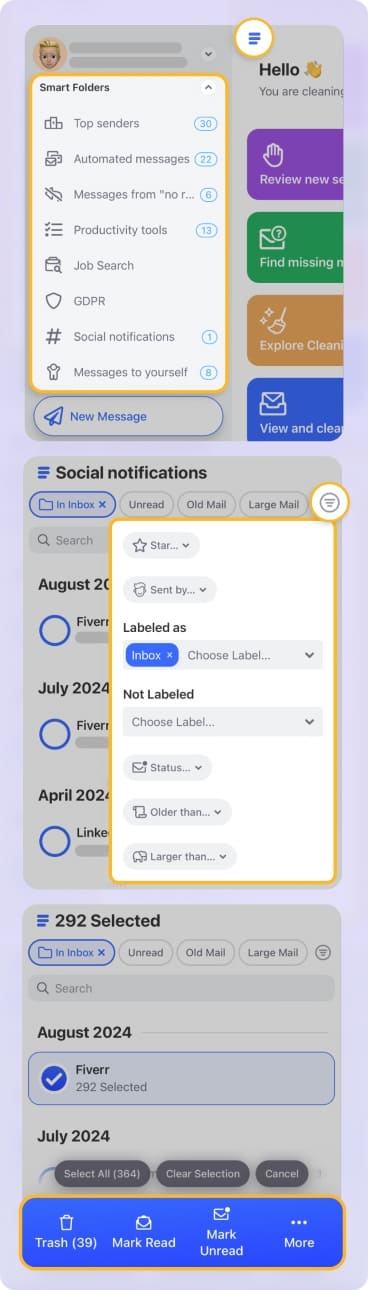
Its Smart Folders automatically group related messages into predefined views such as Online Shopping, Social Notifications, Automated Messages, or Top Senders. You can find and manage entire categories of email without creating filters manually.
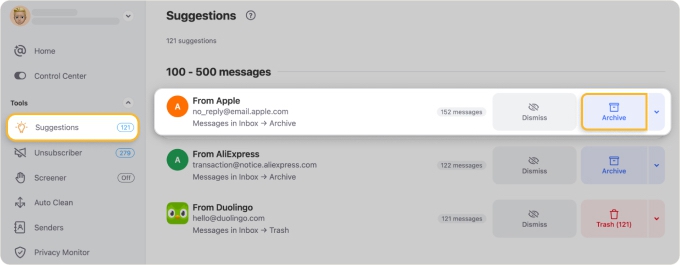
Cleaning Suggestions are personalized recommendations that identify email groups you can safely archive, delete, or organize to help keep your inbox clean.
Clean Email also provides:
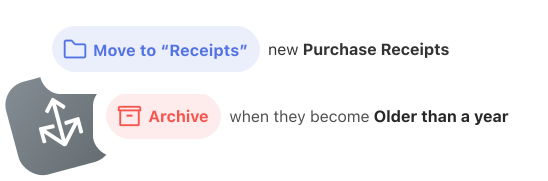
- Auto Clean rules that automatically archive, move, label, mark as read, or delete future messages matching your conditions.
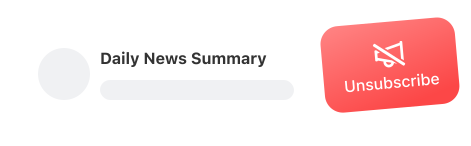
- Unsubscriber for reviewing and leaving multiple mailing lists from one place.
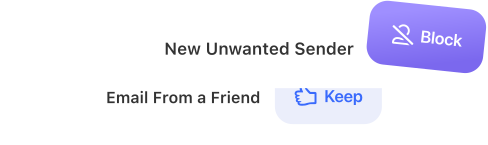
- Sender controls for blocking, muting, or prioritizing messages from specific senders.
- Multi-account management through the same web, macOS, iOS, and Android interface.
Will it replace Gmail? No. Clean Email works alongside Gmail and other email providers. It is the more relevant option when the main problem is inbox clutter, repetitive cleanup, or managing several accounts rather than the email provider itself.
Which Gmail Alternative Should You Choose?
The right choice depends on what you are trying to replace.
➡️ Choose Outlook.com when you want a familiar general-purpose email service and already use Microsoft products.
➡️ Choose Proton Mail when privacy is the priority but you still want a relatively accessible migration path from Gmail. Choose Tuta when you are prepared to accept a more controlled ecosystem in exchange for a security-focused design. Choose Mailfence when OpenPGP interoperability and Belgian jurisdiction matter.
➡️ Choose Fastmail when you want a paid, ad-free email provider with custom domains, standards-based access, and an organization system that can remain similar to Gmail.
➡️ Choose iCloud Mail when most of your devices and services already use the Apple ecosystem.
➡️ For professional email, choose Zoho Mail when you need a broader business suite, Titan when customer follow-up is central to your email workflow, or Neo when you also want lightweight marketing, booking, and website tools.
➡️ Choose HEY only when you want to replace Gmail’s inbox philosophy, not merely its interface. HEY requires adapting to its Screener, Imbox, Feed, and Paper Trail workflow.
Finally, do not switch providers solely because your Gmail inbox is cluttered. When you still want your Gmail address and Google integrations, a management service such as Clean Email can address organization and cleanup without requiring a new mailbox.