Types of Email Archiving Solutions
There are two different types of email archiving:
- Archiving for email inbox organization
- Archiving for compliance & legal retention
These tasks solve different problems.
Inbox archiving moves messages out of your primary inbox to reduce visible email clutter. It usually keeps messages inside the same email account, in an Archive folder or label. Examples include Gmail’s or Outlook’s Archive action and third-party inbox management tools.
Compliance and legal archiving captures and preserves business communications for the long term. It uses retention policies, audit trails, permissions, legal holds, and eDiscovery, and it often keeps a separate, protected copy outside the active mailbox. Examples include Mimecast, Barracuda, Google Vault, and Microsoft Exchange Online Archiving.
| Type | Main purpose | Where email is stored | Typical users | Important capabilities | Example tools |
|---|---|---|---|---|---|
| Inbox archiving | Declutter and organize a mailbox | Usually the same account (Archive folder or label) | Individuals, small teams | Bulk archive, rules, search | Gmail/Outlook Archive, Clean Email |
| Compliance archiving | Preserve records and meet retention needs | Often a separate, protected archive | IT, legal, compliance | Retention, legal hold, eDiscovery, audit trails | Mimecast, Barracuda, Proofpoint, Google Vault, Microsoft EOA, Jatheon |

Best Solution for Personal Inbox Email Archiving
For personal inbox organization, the best archiving solution should make it easy to move emails out of sight in bulk or automatically while keeping them searchable when needed.
Clean Email
Clean Email is an email management app designed for people who want to organize a cluttered mailbox, not preserve business communications for legal or regulatory purposes. It works with Gmail, Outlook, Yahoo, iCloud, AOL, and other IMAP accounts, letting you archive large groups of emails instead of processing messages individually.
The app’s Smart Folders automatically group related messages, such as Online Shopping, Social Notifications, or Automated Messages. You can review one of these groups and archive all selected emails in a single action.
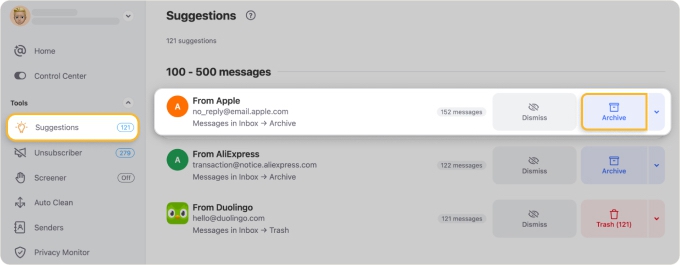
Cleaning Suggestions identify groups that may be suitable for archiving or other quick actions.
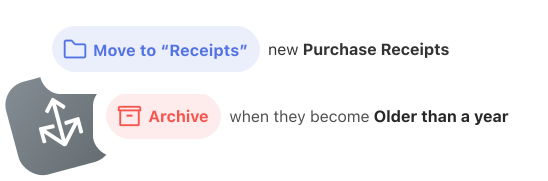
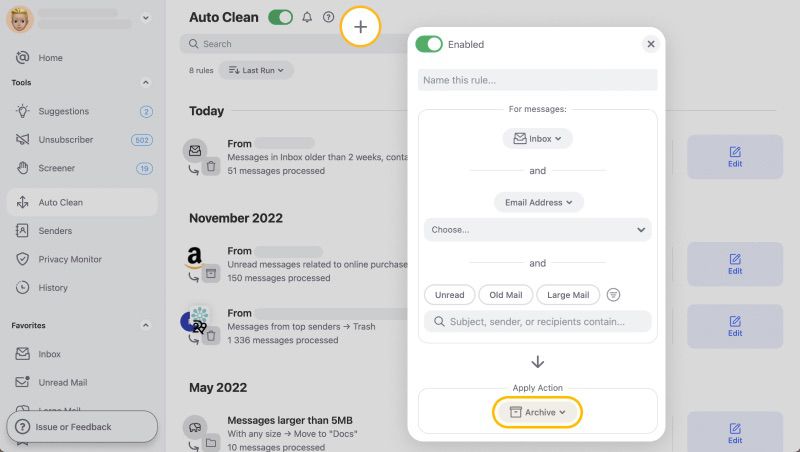
Auto Clean lets you create rules that archive matching messages automatically as they arrive or age.
Clean Email applies the Archive action within your connected mailbox, so it does not create an independent backup or compliance archive with legal holds, immutable retention, or enterprise eDiscovery.
The app is available on the web, macOS, iOS, and Android. It offers a free trial and paid plans.
Other tools for inbox archiving
A few other current apps can bulk-archive or automatically move mail out of the inbox.
- Mailstrom groups messages so you can archive them in bulk across Gmail, Outlook, Yahoo, iCloud, and other IMAP accounts.
- Shortwave archives mail as you clear it and can auto-archive low-priority threads with custom filters, though direct sign-in is limited to Gmail and Google Workspace.
- Chuck offers swipe and batch archiving for Gmail, Outlook, Yahoo, iCloud, AOL, and IMAP accounts, but only on iPhone.
However, they offer fewer inbox management features than Clean Email and don’t include tools such as Cleaning Suggestions or Smart Folders.
Email providers such as Gmail and Outlook also include built-in archiving features, but they may be less convenient for processing large volumes of messages or setting up more advanced automation.
Check out how to archive emails in various email services.
Best Email Archiving Solutions for Business Compliance
| Product | Best for | Deployment or ecosystem | Key compliance capability | Pricing |
|---|---|---|---|---|
| Mimecast Cloud Archive | Regulated enterprises | Cloud, independent of M365 | eDiscovery, supervision, legal hold | Custom quote. ~$3–5/user/mo (reported) |
| Barracuda Cloud Archiving | Microsoft shops wanting a bundle | Cloud (Email Protection suite) | Tamper-proof archive, legal hold | Premium Plus bundle; lower tiers ~$5/user/mo |
| Microsoft Exchange Online Archiving | Existing Microsoft users | Cloud, native to M365 | Archive mailbox, holds via Purview | $3/user/month |
| Proofpoint Archive | Heavily regulated firms | Cloud, multi-channel | SEC 17a-4 capture, supervision | Custom quote. ~$2–15/user/mo (reported) |
| Google Vault | Google Workspace orgs | Cloud, native to Workspace | Retention, holds, eDiscovery | Included with Business Plus (~$22/user/mo) |
| Jatheon | Orgs needing cloud or on-prem | Cloud or on-premises | Legal hold, exports, multi-channel | Custom quote. ~$3/user/mo (reported); annual fee |
How we evaluated business email archiving software
We compared these products based on official documentation, current product capabilities, and reputable independent sources rather than hands-on testing. We looked at retention-policy controls, search and retrieval, legal hold and eDiscovery, audit trails and tamper protection, security and access controls, Microsoft 365 and Google Workspace integrations, and the range of supported communication channels.
We also weighed cloud versus on-premises deployment, pricing transparency, and automation or documented AI capabilities. No single tool fits every organization, so the right choice depends on your ecosystem, obligations, and budget.
1. Mimecast Cloud Archive
Mimecast Cloud Archive is an independent, cloud-based archive for email and collaboration data that sits outside your primary mail environment.
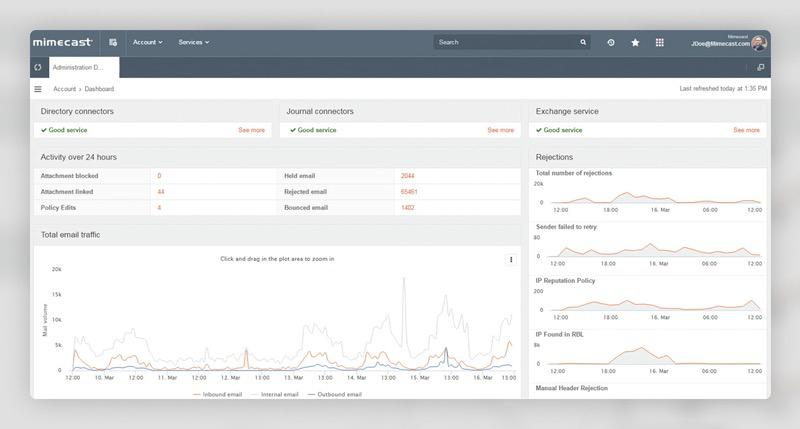
📌 Best for: Regulated enterprises consolidating email and collaboration records.
Best features:
- Self-service eDiscovery, legal hold, and case review
- Compliance supervision with review, escalation, and export
- Sync and Recover plus archiving for Microsoft Teams
Competitive advantage: Because the archive is independent of Microsoft 365, it reduces the risk of relying on one platform for both live mail and records.
Integrations: Microsoft 365 and Exchange, native Teams capture, and partner connectors for Slack, Zoom, and voice.
Security: Encrypted copies held in an independent cloud archive with role-based access and audit trails.
Price: Mimecast doesn't publish list pricing. It's sold per user per year with volume tiers, and independent pricing trackers report roughly $3 to $5 per user per month depending on seat count and modules.
- Archive separate from M365 lowers single-vendor risk
- Broad capture that reaches beyond email
- No public pricing
- Full breadth spans several modules and add-ons
2. Barracuda Cloud Archiving
Barracuda’s Cloud Archiving Service is a cloud-based, tamper-proof email archive sold within the Barracuda Email Protection suite.
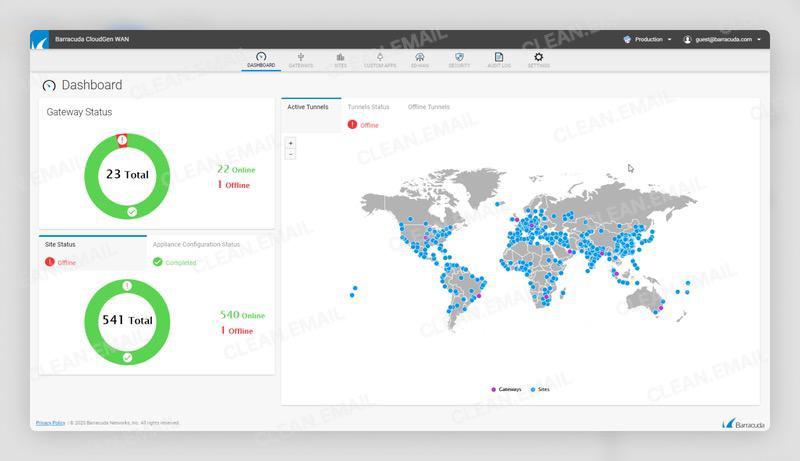
📌 Best for: Microsoft 365 or Exchange organizations that want archiving bundled with email security and backup.
Best features:
- Tamper-proof, indexed archive with per-case legal hold and export
- Policy-based retention with role-based access and audit trails
- End-user access via Outlook add-in, desktop client, and web
Competitive advantage: Archiving comes as part of an all-in-one suite, so security, backup, and archiving share one vendor and console.
Integrations: Microsoft 365 and Exchange through the Outlook add-in, within the broader Email Protection suite.
Security: Data stored outside the operational mail environment with role-based access and audit logging.
Price: Archiving is included only in the Premium Plus tier of Barracuda Email Protection, which Barracuda quotes on request. Lower Email Protection tiers are reported at around $5 per user per month, so expect Premium Plus to sit above that.
- One vendor for archiving, security, and backup
- Fully managed and cloud-only
- Archiving is gated to the top bundle
- No published standalone price
3. Microsoft Exchange Online Archiving
Exchange Online Archiving adds a per-user cloud archive mailbox to Exchange and Microsoft 365, with in-place and litigation hold.
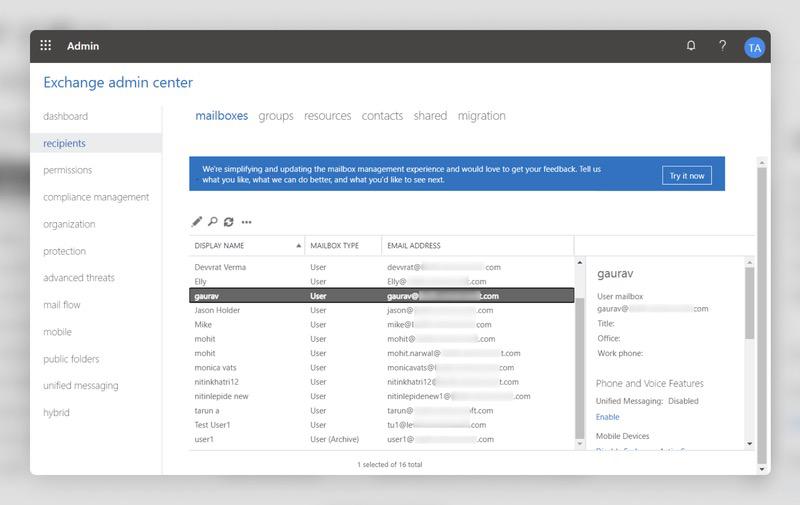
📌 Best for: Organizations already using Microsoft Exchange or Microsoft 365.
Best features:
- Auto-expanding archive mailbox that grows automatically
- In-Place Hold and Litigation Hold on primary and archive mailboxes
- Native access in Outlook and Outlook on the web
Competitive advantage: It’s native to Microsoft 365, so archiving and holds plug into the tools your admins already use.
Integrations: Exchange Online, supported on-prem Exchange with a hybrid setup, and Microsoft Purview for retention and eDiscovery.
Security: Hosted in Microsoft’s data centers with encryption in transit and support for S/MIME.
Price: $3.00 per user per month as a standalone add-on, and included in higher Microsoft 365 plans.
The archive mailbox, Microsoft Purview retention policies, and eDiscovery (Standard or Premium) are separate capabilities. Which ones you get depends on your Microsoft 365 licensing, so not every subscription includes the same features.
- Low, transparent per-user price
- Native to the Microsoft stack
- Capabilities depend heavily on your Microsoft 365 plan
- Not an independent third-party archive
4. Proofpoint Archive
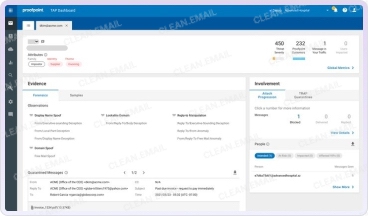
Proofpoint Archive is a cloud archive within Proofpoint’s Digital Communications Governance line, built for legal discovery and compliance supervision across many content types.
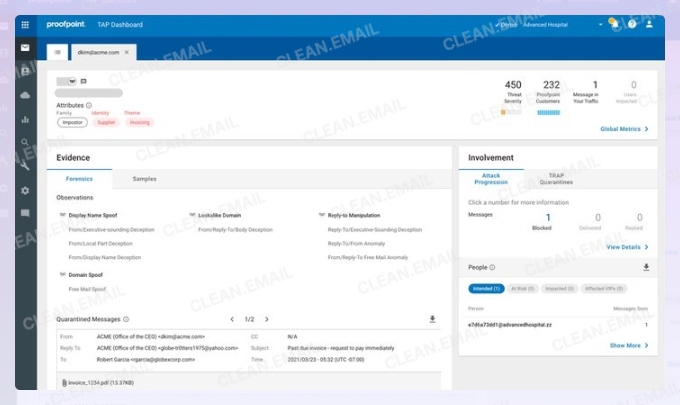
📌 Best for: Heavily regulated firms in finance, healthcare, and government.
Best features:
- Policy-driven retention with SEC 17a-4 compliant capture
- eDiscovery with legal hold, review, and export
- Supervision for regulatory monitoring of communications
Competitive advantage: It captures a broad set of channels beyond email and pairs archiving with mature supervision and eDiscovery for strict regulatory regimes.
Integrations: Captures email, instant messaging, social media, collaboration data, and SMS.
Security: SEC 17a-4 compliant capture and storage in SOC 2 Type II data centers, with optional DoubleBlind Key encryption.
Price: Proofpoint doesn't publish list pricing and charges per user or per GB. Independent trackers report Proofpoint modules from about $2 to $15 per user per month, with archiving and compliance bundles cited near $70 per user per year.
- Broad content capture with defensible eDiscovery
- Built for SEC 17a-4 and FINRA regimes
- No public pricing
- Much of the value sits in optional add-ons
5. Google Vault
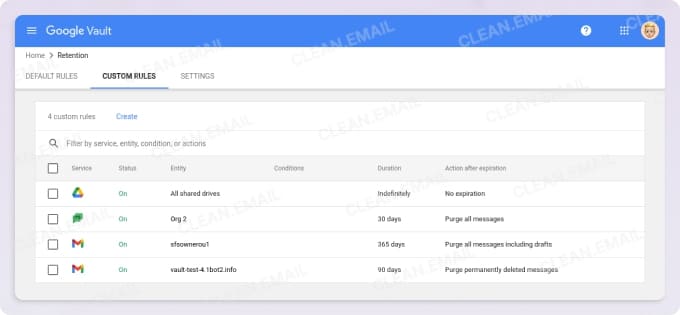
Google Vault is the retention, hold, search, and eDiscovery tool for Google Workspace. It governs your Workspace data and is not a general-purpose backup.
📌 Best for: Organizations on eligible Google Workspace editions.
Best features:
- Retention rules and legal holds by organizational unit or domain
- Search and export across covered Workspace apps
- Audit reports for searches, exports, and content views
Competitive advantage: It’s native to Google Workspace and included with qualifying editions, so there’s no third-party connector to maintain.
Integrations: Covers Workspace data such as Gmail, Drive, Chat, Meet recordings, and Groups. It does not archive third-party email platforms.
Security: Runs within Google Workspace’s admin controls and audit framework.
Price: No separate charge. Vault is included with Business Plus (about $22 per user per month billed annually), Enterprise Standard, and Enterprise Plus. It's not included in Business Starter or Business Standard.
Vault is not a backup. If you delete a user’s account or license, their data can be purged even when a retention rule existed, so Google recommends suspending accounts instead of deleting them.
- Free with qualifying editions and fully native
- Straightforward retention, holds, and export
- Covers only Google Workspace data
- Available only on higher editions
6. Jatheon
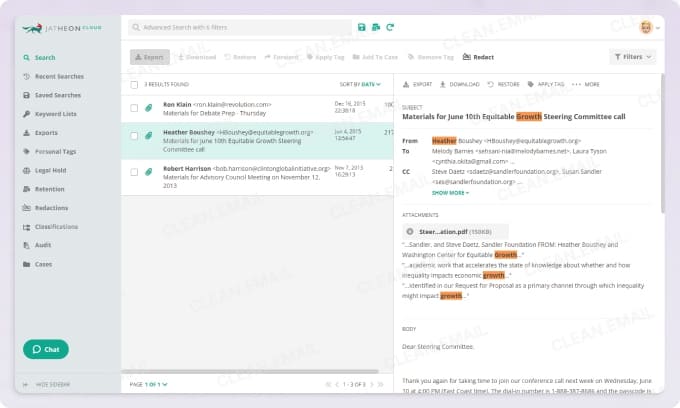
Jatheon is a dedicated archiving vendor offering email and multi-channel archiving for compliance and eDiscovery, available as a cloud service or an on-premises appliance.
📌 Best for: Regulated organizations that want a choice of cloud or on-premises deployment.
Best features:
- Search with boolean, wildcard, proximity, and fuzzy operators
- Legal hold, audit trail, and export to PST, EML, and PDF
- Optional archiving for social media, text, and chat
Competitive advantage: It offers both cloud and on-premises deployment, plus free import of legacy PST and EML data, which many cloud-only rivals don’t.
Integrations: Archives from Microsoft 365, Google, Exchange, GroupWise, and HCL Notes, with add-on channels for social, SMS, and chat.
Security: The cloud service runs on AWS, and the vendor lists GDPR, HIPAA, ISO, and SOC 2 compliance.
Price: Jatheon bills a fixed per-user, per-year fee with discounts for multi-year prepaid plans. It doesn't publish rates on its site, and independent listings report starting figures around $3 per user per month.
- Flexible cloud or on-prem deployment
- Broad platform compatibility with free legacy import
- No published pricing
- Multi-channel archiving is sold as paid add-ons
AI and Automation in Modern Email Archiving
Most archiving automation is rules-based rather than AI. Retention policies capture messages and delete them automatically once a retention period expires, and journaling can capture mail as it’s sent. A few vendors document genuine machine learning.
Proofpoint’s supervision uses natural language processing and machine learning to cut false positives in compliance review, and it offers optional ML analytics to help scope eDiscovery cases. Treat any “AI-powered” label with care and confirm it in the vendor’s own documentation, since ordinary filters and policies are not AI.
It’s also worth remembering the limits. AI can assist with discovery, classification, and review, but it does not make an archive legally compliant. That still depends on your policies, your obligations, and how the system is configured.
How to Choose Email Archiver Software
Start by deciding whether you need personal organization or regulated business retention. That single choice rules out most of the options. Then work through this checklist:
- Personal organization versus regulated business retention
- Required retention periods and legal holds
- Compatibility with your email provider and platforms
- Search, export, and eDiscovery needs
- Immutable or audit-trailed storage
- Permissions, encryption, and data residency
- Cloud, on-premises, or hybrid deployment
- Migration and export costs
- Pricing for active and former employee mailboxes
- Support for Teams, Slack, SMS, or social messages if you need it
Some firms have specific obligations to weigh. Rules like the SEC’s electronic recordkeeping requirements or FINRA Rule 4511 can shape retention for regulated businesses. These do not apply to every company.
Is Archiving in Your Email Provider Enough?
| Situation | Built-in Archive enough? | Inbox-management tool needed? | Compliance archive needed? |
|---|---|---|---|
| Individual who wants a cleaner Gmail inbox | ✅ Yes | Optional | ❌ No |
| User who wants bulk or automatic archiving | Partly | ✅ Yes | ❌ No |
| Small business with no regulated retention | Often | Optional | ❌ No |
| Company responding to legal holds or audits | ❌ No | ❌ No | ✅ Yes |
| Financial, healthcare, or government organization | ❌ No | ❌ No | ✅ Yes |
| Org needing a recoverable copy outside active mailboxes | ❌ No | ❌ No | ✅ Yes |
Gmail, Outlook, Apple Mail, and other clients usually provide a normal Archive action, and you can archive emails in Gmail, Outlook, on iPhone and in Mac Mail.
You can later find archived messages in Gmail or Outlook.
A built-in Archive folder may be sufficient for personal organization. It is not automatically a backup or a compliance archive. When records must be captured, protected, retained, audited, searched, or produced for legal purposes, a dedicated enterprise product may be necessary. Public-sector bodies can also consult guidance such as the National Archives’ rules on managing email records.
Final Verdict
Use a built-in Archive or Clean Email when your goal is a cleaner, better-organized inbox.
Use a dedicated enterprise archive when you need retention, eDiscovery, legal holds, auditability, or regulatory recordkeeping.
To pick an enterprise product, start from your existing Microsoft or Google ecosystem, then weigh your regulatory obligations, deployment requirements, communication channels, and budget.
Read more:
FAQs
What’s the difference between email archiving and backup?
An archive is organized for long-term retention, policy enforcement, search, retrieval, and sometimes eDiscovery. A backup mainly supports recovery after deletion, corruption, or system failure. Some products offer both, but the two functions aren’t interchangeable.
Is email archiving required by law?
There’s no universal rule that every business must archive every email. Requirements vary by industry, jurisdiction, record type, and specific legal or regulatory obligations. If your organization is regulated, check the rules that apply to you.
Can archived emails be deleted?
Messages in a normal inbox archive can usually be deleted by the user. In a compliance archive, deletion may be controlled by retention policies, permissions, or legal holds. That control is much of the point of a dedicated archive.
How long should businesses keep archived emails?
There’s no single retention period for all businesses. The right period should follow applicable laws, industry requirements, litigation holds, and your company’s documented retention policy. Set a policy and apply it consistently.
Can I search archived emails?
Normal email providers and dedicated archives generally support search. Enterprise solutions often go further, searching across users, attachments, date ranges, metadata, and specific legal cases.