


Key Takeaways
- The steps you need to follow to stop emails from going to spam differ between Outlook.com, new Outlook, and classic Outlook.
- No setting catches every misfiled message, so the Junk folder still needs a regular check. Clean Email makes that check safer and keeps the rest of the mailbox tidy, but it can't change Outlook's spam classification.
- Safe Senders can fail due to server-side Exchange policies outranking it or because the sender lists are full.
- Safe Senders, Blocked Senders, and Safe Recipients share a limit of roughly 510 KB. Trusted contacts count toward it, and entries past the limit can fail silently.
- Marking an email as Not Junk and adding the sender to Safe Senders are the two main native fixes you should try whenever you encounter this problem.

How Do I Stop Emails From Going to Junk in Outlook?
To stop emails from going to junk in Outlook, you need to first mark the message as not junk, then add the sender to your Safe Senders list. The first step rescues the message Outlook incorrectly filed as junk. The goal of the second step is to prevent emails from going to Junk in the future.
Outlook.com
This is how to mark an email as not junk in Outlook on the web:
- Open the Junk Email folder and select the message.
- Click the arrow next to Report on the toolbar, then Not junk, and the message returns to your Inbox. An opened message also shows an “It’s not junk” button in the banner above its body.
Adding the sender to Safe senders is a separate step, so don’t assume Not junk did it for you. Here is how to do it:
- Click the gear icon, then Mail, then Junk email.
- Under Safe senders and domains, click Add safe sender.
- Type the address or a domain such as @example.com, then click OK and Save.
New Outlook for Windows and Mac
New Outlook also has a Report button that you can use to mark a message as Not junk:
- Select the message in the Junk Email folder.
- Click the arrow next to Report on the ribbon (or right-click the message) and choose Not junk.
- On Mac, Report sits in the toolbar.
In New Outlook for Windows and Mac, there’s an additional account picker that slightly complicates the steps, but otherwise the process is mostly the same as in Outlook.com:
- Go to Settings → Mail → Junk email, and pick the account at the top if you have several.
- Scroll to Senders, open Safe senders and domains, and click Add safe sender.
- Enter the address or domain, click OK, then Save.
⚠️ Important: Microsoft says new Outlook doesn’t support sender blocking for Gmail, Yahoo, iCloud, and other third-party accounts, so manage those lists in the provider’s webmail.
Classic Outlook for Windows
Classic Outlook lets you mark a message as Not junk and mark its sender as safe in one dialog, so it provides the quickest way to prevent an email from going to spam twice:
- In the Junk Email folder, select one message (it restores one at a time).
- On the Home tab, click Report, then Not Junk. Older builds have a Junk button in the same spot with Not Junk underneath.
- A “Report not junk” dialog confirms that the sender will be added to Safe Senders and that future messages won’t be sent to Junk. Click Report. In older builds, the dialog is called Mark as Not Junk, and you tick “Always trust e-mail from” instead.
To edit the list of Safe Senders directly:
- Click Block (or Junk in older builds), then Junk E-mail Options.
- Switch to the Safe Senders tab and click Add.
- Enter the address or @domain and click OK twice.
Keep in mind that the “Also trust e-mail from my Contacts” checkbox in the Safe Senders tab can make the list grow without you noticing, so think twice before you enable it. The next section of this article provides useful background information that can help with your decision-making process.
Why Do Emails From Safe Senders Still Go to Junk?
Often, emails from Safe Senders still go to the Junk folder because the list meant to prevent email from going to spam is actually only an input to Microsoft’s filtering that can be outranked by a server-side policy.
The Safe Senders list can also become full and basically stop managing messages from any senders that have been added after the list has become full.
Server-Side Policies Outrank Your List
On a work or school account, your administrator’s Exchange Online Protection policies have more authority than your personal Safe Senders list. Messages flagged as malware or phishing always go to Junk, and administrators can also add contacts to the Tenant Allow/Block List.
Personal Outlook.com accounts have a milder version of this. Microsoft has said a safe sender entry is ignored when a message from a frequently spoofed domain fails authentication, and that bulk or automated mail can still be filtered.
The Sender Lists Have a Size Limit
Safe Senders, Blocked Senders, and Safe Recipients share one storage limit on the server (510 KB by default). If you exceed this limit, classic Outlook will show an error (“You are over the size allowed on the server”), and server-side filtering will stop working until you remove entries from the lists.
A second limit is quieter. Exchange Online synchronizes only the first 1,024 entries from Safe Senders and Safe Recipients combined, and with “Trust email from my contacts” on, your contacts count toward that number and sync first. A large Contacts folder can use it all up by itself. Past the cap, Outlook on the web stops accepting new entries but shows no error, so a sender you added yesterday looks saved and still lands in Junk today.
Delete entries you no longer need and, if your Contacts folder is large, turn off the trust-contacts option.
Why Isn’t “Not Junk” Working in Outlook?
The name of the “Not junk” option suggests this is how to make an email not go to junk again, but that’s not really the case. Not junk only moves the message back and sends a report to Microsoft (or your company’s reporting mailbox), which improves the filter gradually. It doesn’t whitelist the sender of the message.
To actually make another email from the same sender not go to junk again, you need to add the sender to the Safe Senders list. In classic Outlook, you can do that in the same dialog where you mark a single message as Not junk. On the web and in New Outlook it’s a separate step.
What to Do If Outlook Still Sends the Email to Junk
If you’ve done all that and are still searching for how to stop emails going to spam, check for anything else acting on the sender, such as a domain blocked years ago under Blocked senders and domains. You should also check for forgotten rules or Sweep settings (Settings → Mail → Rules in Outlook.com and new Outlook, or Manage Rules & Alerts in classic Outlook) because a rule that moves the sender’s mail looks exactly like a filter problem.
Our guide to the Outlook spam filter explains protection levels and the Safe and Blocked Senders lists, and the troubleshooting article on Safe Senders not working covers the broader symptoms.
💡 Tip: If your problem is too much junk reaching the Inbox, not legitimate emails going to Junk, start with how to stop junk email in Outlook.
Can I Force Emails From a Sender to Go to My Inbox?
No. Neither Outlook nor any third-party tool can guarantee that every legitimate message stays out of Junk. While Safe Senders and Not junk do help, a sender whose domain keeps failing authentication, or whose messages look like bulk mail, can still end up in Junk.
The best you can do is to check your Junk folder regularly so important messages don’t automatically become deleted, and that’s something Clean Email can make easier and safer. Plus, you can try Clean Email for free, and it can clean up the rest of your inbox too.
Clean Email’s Spam folder shows the contents of Outlook’s Junk Email folder, and previewing a message there doesn’t mark it as read, so a spammer never gets the read signal that tells them the address is live and worth more mail. You can still recognize the misfiled invoice or newsletter at a glance, and then rescue it.
For senders whose mail does reach the Inbox, Sender Settings decide what happens to each one. You can deliver a sender’s messages to a folder of your choice, star or mute them, keep only the newest, or block the sender outright.


Auto Clean goes a step further and archives, moves, or labels matching messages the moment they arrive in a supported folder, so the Inbox stays small enough that a message you just rescued from Junk doesn’t vanish into a pile.
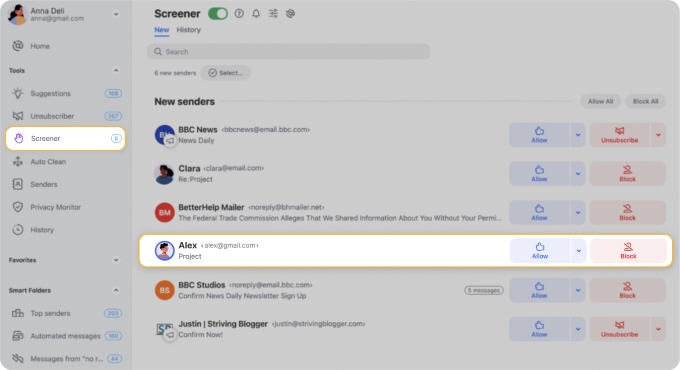
And if unknown senders worry you more than one misfiled contact, Screener holds first-time senders for review.
Protect Important Messages
Once you automate anything, it pays to fence off the mail that matters most. Clean Email's Pinned Messages list is for senders and messages that no rule should ever touch, such as your bank or your accountant, and anything pinned is skipped by every Clean Email action, Auto Clean included. Pinning works only inside Clean Email, though. It does nothing to Outlook's own spam filter, so a pinned sender can still land in Junk, and the Junk check from the previous section still applies.


