


Key Takeaways
- There is no universal rule in Outlook that can be used to delete all messages older than a specified number of days.
- The Sweep feature can be used to remove messages older than 10 days from a specific sender, and it can run on a daily basis, but you'll find it only in Outlook on the web and new Outlook.
- Rules are triggered when messages arrive, so they can delete a sender's future messages but they don't help with emails that are already sitting in your inbox.
- AutoArchive deletes old items on a schedule, but only in classic Outlook for Windows. Retention policies do the same on work accounts that are under IT's control.
- Clean Email adds sender, domain, and age-based rules that work on the mailbox itself, so they apply in every Outlook app.
- This guide covers ongoing deletion. For a one-time purge, follow our guide to deleting old emails in Outlook.

Which Auto-Delete Method Works in Your Outlook Version?
| Method | Outlook on the web | New Outlook for Windows | Classic Outlook for Windows | Outlook for Mac | Outlook mobile |
|---|---|---|---|---|---|
| Sweep | ✅ Yes | ✅ Yes | ❌ No | ❌ No | ❌ No |
| Rules | ✅ Yes | Microsoft accounts only | ✅ Yes | ✅ Yes | Copilot only, where available |
| AutoArchive | ❌ No | ❌ No | ✅ Yes | ❌ No | ❌ No |
| Retention policies | Work/school | Work/school | Work/school | Work/school | Work/school |
| Deleted Items cleanup | Empty on sign-out | Provider cleanup only | Empty on exit | Depends on account | Provider cleanup only |
| Clean Email | ✅ Yes | ✅ Yes | ✅ Yes | ✅ Yes | ✅ Yes |
💡 Note: Rules created on the web or in a desktop app run on the server, so they work even when your device isn't turned on.

Auto-Delete Emails With Sweep in Outlook on the Web and New Outlook
Sweep is the closest thing Outlook has to a built-in auto-delete feature, and it's very easy to use. Basically, you just pick a sender, choose what exactly you want Sweep to do, and Outlook applies it once a day.

You can tell Sweep to delete the messages you have now, delete current and future messages, keep only the latest message, or delete anything older than 10 days. Unfortunately, there is no field for 30 or 90 days, which is the most common complaint users have about Sweep.

Since Sweep is a newer feature, you won't find it in Classic Outlook, and Microsoft still hasn't implemented it even in the Mac version of Outlook. The good news is that the users of those two versions can create Sweep rules by signing in to the web version, and the rules then apply to the mailbox everywhere.
For more information, our guide on Outlook Sweep rules covers each option with screenshots and shows where to manage existing Sweep rules.
Auto-Delete Incoming Emails With Rules
Rules are how to auto delete emails in Outlook from a specific sender, subject, or keyword. They are triggered when a message arrives, and that's also their biggest limitation because a rule can't delete an email for having sat in your inbox for, let's say, a month.
For future mail from a sender, though, they are the right tool. Here is an Outlook rule to delete emails from a sender in each version.
Outlook on the Web and New Outlook for Windows
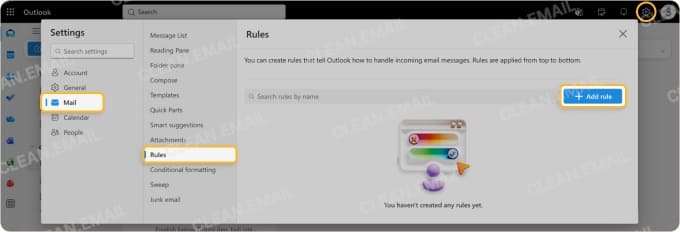
- Open Settings, then Mail, then Rules.
- Click Add new rule.
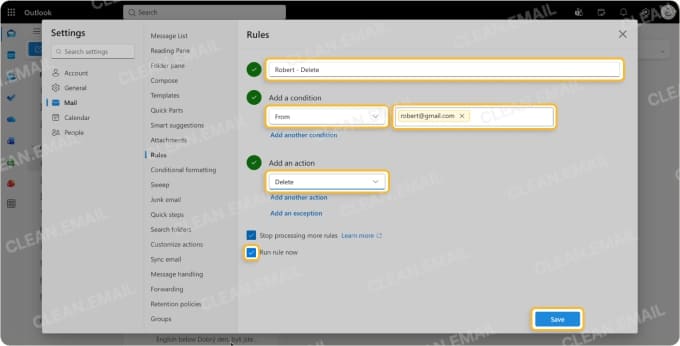
- Name the rule. Under Add a condition, choose From and enter the sender's address.
- Under Add an action, choose Delete.
- Tick Run rule now, and click Save.
Keep in mind that New Outlook for Windows currently doesn't support rules for Gmail, Yahoo, iCloud, and other third-party accounts.
Classic Outlook for Windows
- Go to File, then Manage Rules & Alerts.
- Click New Rule and choose "Apply rule on messages I receive."
- Tick "from people or public group" and pick the sender.
- Choose "delete it" as the action and finish the wizard.
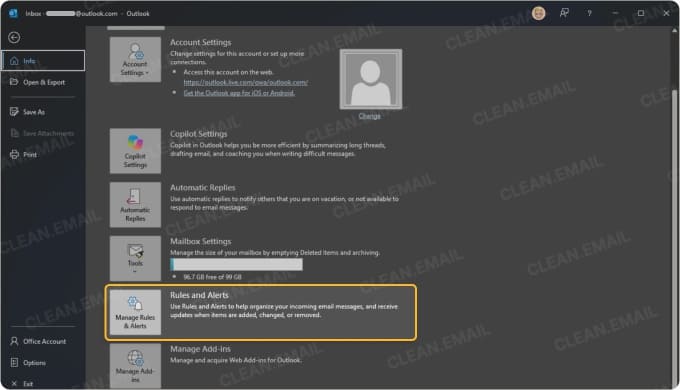
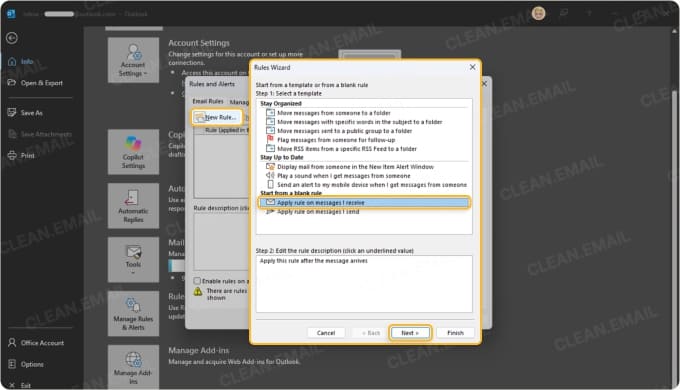
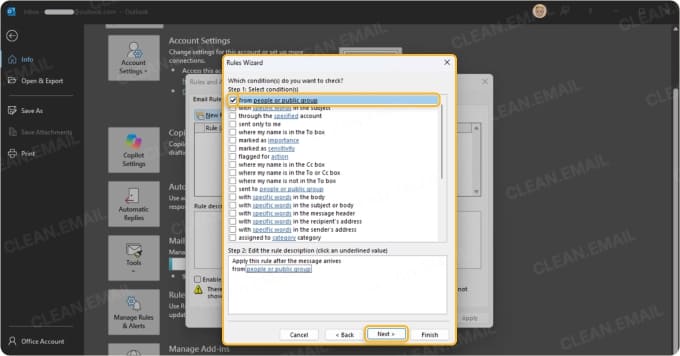
It's generally recommended to choose "delete it" rather than "permanently delete it" since the permanent option is client-only and runs while classic Outlook is open on that PC and at no other time (and it skips Deleted Items).
Outlook for Mac
- Open Outlook, then Settings, then Rules.
- Click the Add rule (plus) button.
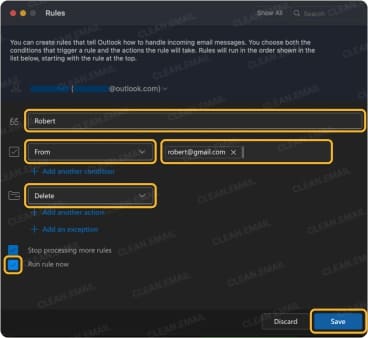
- Name the rule. Set the condition to From and enter the address.
- Set the action to Delete and click Save.
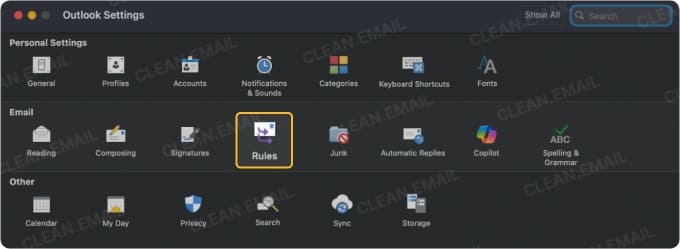
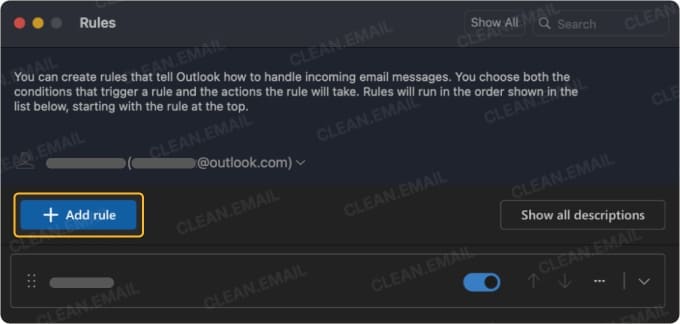
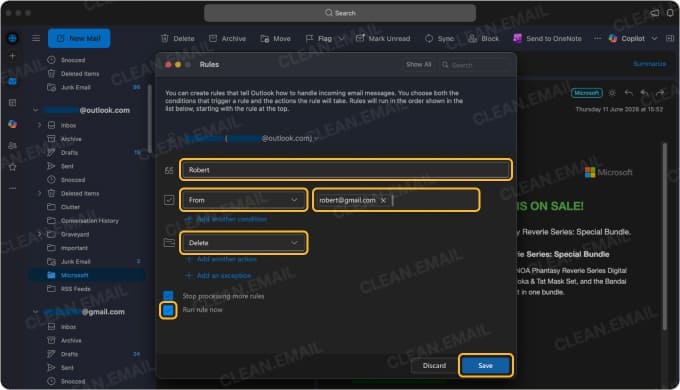
The current version of Outlook for Mac creates server rules only, and they apply on every device.
Outlook Mobile
The iOS and Android apps have no Rules page in Settings. Rules created elsewhere still apply on your phone, but you can't build one in the app. The only exception is accounts with access to Copilot. If you have such an account, then you can ask Copilot in Outlook mobile to create, view, or delete rules.
Auto-Delete Old Emails With AutoArchive in Classic Outlook for Windows
The only native Outlook feature that deletes by age is AutoArchive, and it exists only in classic Outlook for Windows. New Outlook, the web version, and the Mac app don't have it.
When using AutoArchive, there are three settings you need to understand:
- The run interval (File → Options → Advanced → AutoArchive Settings) decides how often the cleanup pass happens.
- The age threshold decides which items qualify, in days, weeks, or months.
- If you choose "Permanently delete old items," then AutoArchive will remove relevant messages instead of moving them to an archive file.
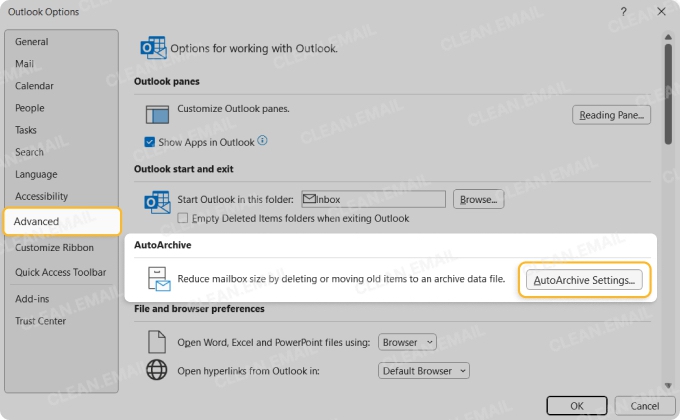
Keep in mind that Outlook measures age from the later of the received date and the last modified date, meaning that marking an old email as unread resets its clock. And because AutoArchive runs inside the desktop app, a PC that stays off runs no cleanup passes.
Every setting is explained in our Outlook AutoArchive guide. If you're unsure whether to delete old mail or keep a copy, read Outlook archive vs delete before switching on permanent deletion.
Retention Policies for Work and School Accounts
On Microsoft 365 work and school accounts, age-based deletion usually already exists in the form of retention policies, and your administrator sets them. A policy might empty Deleted Items after 30 days or clear the Inbox after a year, on the server, without any app being open.
In Outlook on the web, right-click a folder or message and look for Assign policy. If your admin has published optional labels, you can pick one there. Required policies can't be removed, and personal Outlook.com accounts don't have this menu at all.
Automatically Empty Deleted Items and Junk in Outlook
Deleted Items and Junk are the folders where Outlook already deletes mail on its own.
On Outlook.com, messages in Deleted Items are removed after 30 days, with a further 30 days to recover them. Junk is emptied automatically too, but Microsoft's own pages state 10 days on one and 30 on another. On Microsoft 365 accounts, the time for which messages remain in Deleted Items or Junk depends on the retention policy.
You can also configure cleanup to be automatically triggered when you leave Outlook:
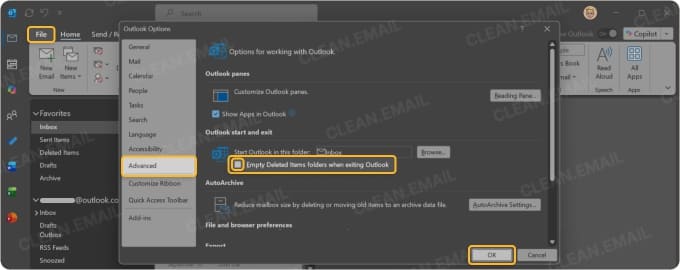
- Classic Outlook for Windows: File → Options → Advanced → then tick Empty Deleted Items folders when exiting Outlook.
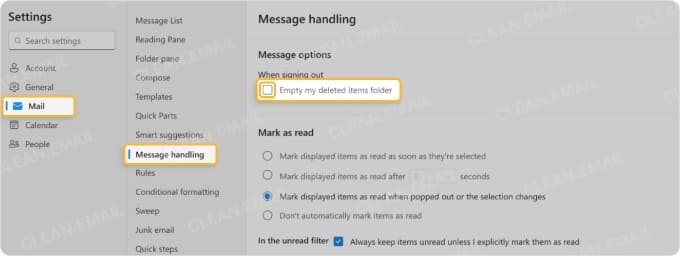
- Outlook on the web: Settings → Mail → Message handling → then tick the option to empty Deleted Items when you sign out. Closing the tab doesn't count.
- New Outlook for Windows and Outlook for Mac: there is no exit trigger. You rely on the provider's cleanup or empty the folder yourself.
Don't worry, the clean-on-leave feature only shortens how long deleted mail stays recoverable (it never deletes anything from your inbox folder). To clear the Deleted Items or Junk immediately, you need to learn how to empty the trash in Outlook and other providers.
Auto-Delete Emails With Clean Email
Clean Email is the tool you should use when you want to automatically delete emails in Outlook after 30 days, or by sender, domain, folder, size, or read status, in any combination. It connects to the mailbox rather than to a specific app, and any rule you create in it applies whether you open Outlook on the web, on the desktop, or on your phone.
📌 Important: Auto Clean and Sender Settings are premium features. They are included in the free trial, and several subscription tiers are available after that. Clean Email connects to Outlook.com, Hotmail, and Microsoft 365 accounts, though a company administrator can block the connection.
Keep only the newest email from a sender
Keep Newest suits senders whose messages replace each other, like daily reports. Once enabled, each new message from that sender sends the older ones to Trash.
- Select a message group, or a sender on the Senders page.
- Click the Settings button to open Sender Settings.
- Switch on the Keep Newest toggle.
- Decide whether to apply it to existing messages, then click Confirm.


The same dialog has a Trash After option. Pick a period and the sender's messages move to Trash once they pass that age, a sender-only version of the 30-day rule Outlook lacks.
Create a rule that deletes emails older than 30 days
Auto Clean rules combine a scope with an action and run until you switch them off. This is how I would set one up for a newsletter folder.
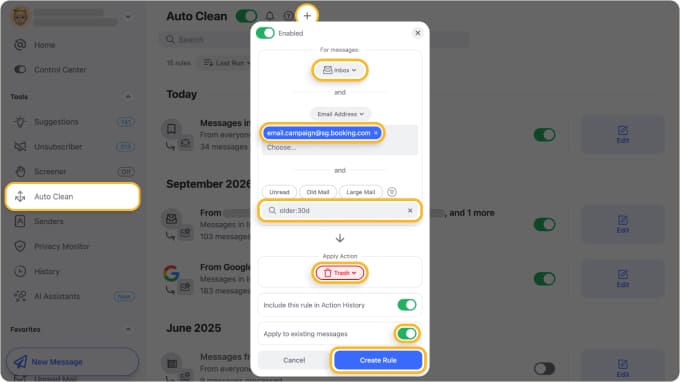
- Click Auto Clean in the left menu, then Create Rule.
- Under "For messages," pick the folder, then narrow it by sender, email address, or email domain if needed.
- Set the age. For an exact 30-day cutoff, type older:30d in the search field instead of using the 1 month preset.
- Under "Apply Action," choose Trash.
- Leave "Apply to existing messages" off for the first run, then click Create Rule.
📌 Good to know: The Trash action moves messages to your Outlook Deleted Items folder, where they stay recoverable for as long as your provider keeps them. While the Delete action removes them permanently, with no undo from Clean Email's side. Start with Trash, check the Auto Clean history after a few days, and only then consider switching.
Every rule gets its own on/off toggle on the Auto Clean page, plus a pause button for all rules at once.
How to Stop Outlook From Automatically Deleting Emails
If messages are vanishing and you didn't ask for it, one of the features described earlier in this article is responsible. Here is how to stop Outlook automatically deleting emails, in the order I check when someone asks me.
- Rules: open Settings, Mail, Rules (web and new Outlook), Manage Rules & Alerts (classic), or Settings, Rules (Mac). Turn off anything with a delete action.
- Sweep: go to Settings, Mail, Sweep in Outlook on the web and remove the rule for the affected sender.
- AutoArchive: in classic Outlook, open AutoArchive Settings and clear "Run AutoArchive every." Check folder-level settings too, since those override the global ones.
- Retention policies: on a work account, inspect the assigned policy. Only your admin can change a required one.
- Deleted Items cleanup: untick the exit or sign-out option for your version.
- Clean Email: pause Auto Clean, and separately reset Keep Newest or Trash After in Sender Settings.
Before any of that, search All Folders. A message that moved to Archive or Junk, or is hidden by a view filter, only looks deleted.
Turning a rule off doesn't bring anything back. Check Deleted Items first, then Outlook's Recover deleted items option, and read our guide on how to recover deleted emails if the message isn't there either.
Which Method Should You Use?
The version table says what works where. This list says what to pick for your goal.
- Delete future messages from one sender: an inbox rule.
- Keep only the latest message from a sender: Sweep on the web, or Keep Newest in Clean Email.
- Clear a sender's mail after 10 days: Sweep, using the ongoing option.
- Delete a folder's contents after a set age in classic Outlook: folder-level AutoArchive with permanent deletion.
- Apply a company-wide deletion schedule: a retention policy, set by IT.
- Delete by age, sender, domain, or size across every Outlook app: Clean Email Auto Clean, with Trash as the action.
FAQs
Do emails delete themselves in Outlook?
Not in the Inbox. Outlook only removes mail on its own from Deleted Items and Junk, or when a rule, Sweep, AutoArchive, or retention policy tells it to.
Why is Outlook automatically deleting emails?
Usually because of a rule, a Sweep setting, AutoArchive, or a retention policy on a work account. Check those in the order above, and confirm the message isn't simply in another folder.
Can I auto-delete emails from one specific sender?
Yes. Create a rule with the sender's address and the Delete action, use Sweep on the web to delete their messages after 10 days, or set up auto delete in Outlook for that sender through Clean Email's Trash After setting with any period you choose.
If emails are auto-deleted, can I get them back?
Often, but not always. Mail sent to Deleted Items stays recoverable until the folder is emptied or the provider's window runs out. Permanently deleted mail depends on Recover deleted items, and messages removed by AutoArchive's permanent-delete mode are gone for good.
Do auto-delete rules work on the Outlook mobile app?
Yes, because rules run on the server, not in the app. The mobile app itself can't create rules, except through Copilot on accounts that have it.


