How Automatic Folder Moves Work
To save time and increase organization in Yahoo Mail, you can move emails to folders automatically using filters. But the way that these mailbox rules work can be unclear.
Yahoo Mail filters only work on future incoming emails. They do not apply to existing emails.
This is one of the most important yet misunderstood functions of the automated filters.
For instance, when you create a rule to move emails from your boss into a Work folder, only new messages you receive will be moved. If you want the existing emails from your boss in that folder as well, you’ll need to move them manually.
Other aspects of filters in Yahoo Mail include the following:
- There’s a 500-filter limit. While this seems like a lot of filters, many people simply continue setting up rule after rule as new situations arise. This can make the filter system unmanageable over time. Instead, try to avoid too many narrow filters and consolidate them where possible.
- Filter order matters. The order in which you list your filters in Yahoo Mail determines their priority. This means that the rule at the top of the list runs first, the second rule runs next, and so on. Luckily, you can change the order of your filters as needed.
- Filter priority: If an email matches the criteria for two separate filters, the filter higher on the list is the one that applies (as described above). Review your rules often for potential conflicts and be careful not to overlap filters when creating them.
- Platform setup: Currently, you can only create, edit, and manage filters in Yahoo Mail on the web. This feature is not available in the Yahoo Mail mobile app. However, rules you create on the web do apply to emails you receive on mobile.

How to Move Emails to a Folder in Yahoo Mail Automatically
If you’re ready to set up a Yahoo Mail filter to move to a folder those emails that should be better organized, we’ll walk you through it.
- Visit Yahoo Mail and sign in.
- Select More → Settings in the left-hand menu.
- Choose Filters and click Add.
- Complete the filter setup by entering a name, picking the conditions, and selecting a destination folder. Notice that you can create a new folder right in the filter setup window.
- Click Save.
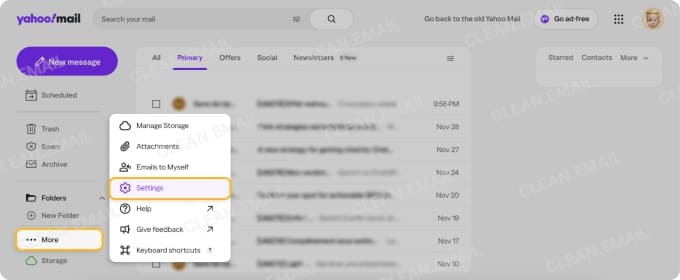
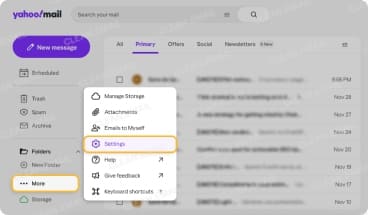
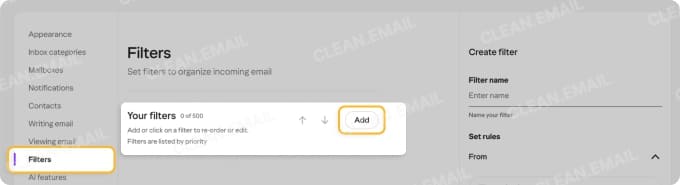
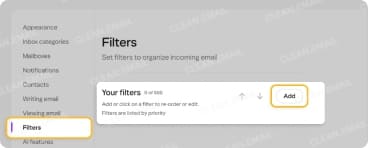
You’ll see your new filter added to the bottom of the list. To reorder your filters, select a rule and use the up and down arrows to reposition it.
Create a More Complete Automation Workflow With Clean Email
Yahoo Mail’s limitations can inhibit you from maintaining a clean Yahoo inbox and creating a solid and efficient workflow.
Clean Email is a supplementary email management tool that you can use alongside Yahoo Mail to automate with broader options and on any device without platform limitations.
With Clean Email’s Auto Clean feature, you can:
- Create rules based on sender, folder or Smart Folder, message age, size, read status, keywords, and more.
- Use rules to move, archive, trash, delete, mark as read, star, and perform other actions.
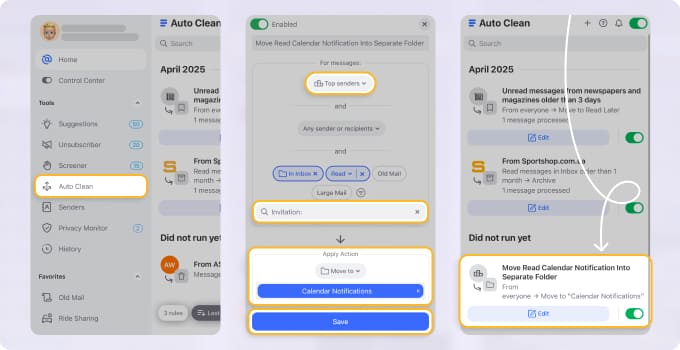
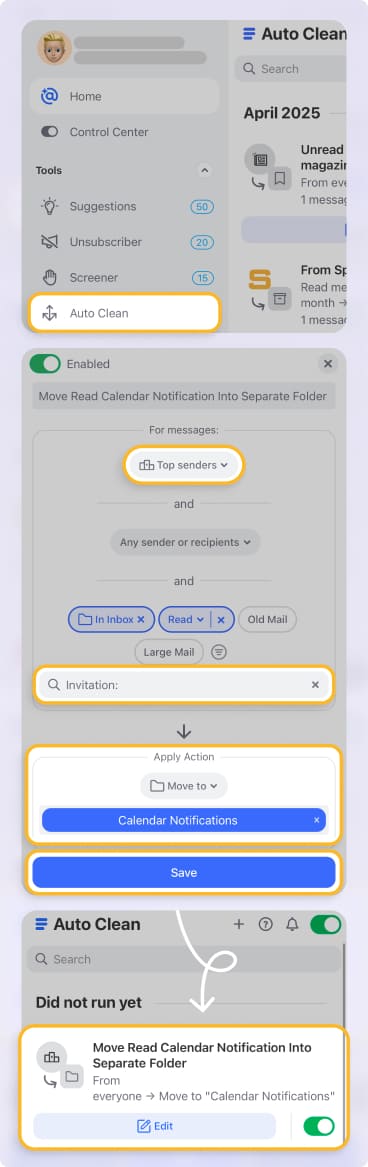
- Apply a newly created rule to both new and existing emails.
- Pause a rule at any time without deleting it.
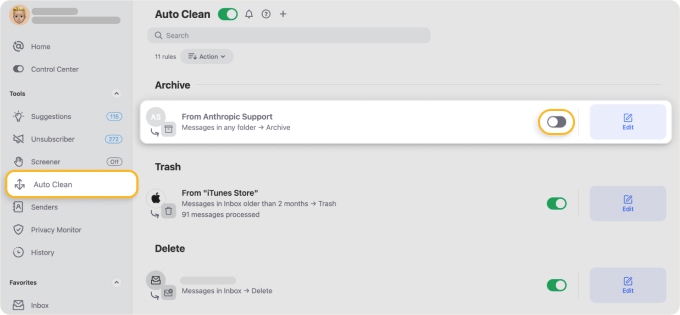
To stay up to date on your automations, Clean Email provides you with an Action History Summary. This tool informs you about the emails processed via Auto Clean Rules so that you don’t miss anything important.
Clean Email is available on the web and mobile devices for any IMAP provider, giving you flexibility and control no matter where you use it.
Fix Automatic Email Folder Rules in Yahoo Mail
If you set up filters in Yahoo Mail to automatically move emails to folders and are experiencing issues, there are several common problems with simple explanations and/or fixes.
Filters not applying to old emails: Remember, Yahoo Mail filters only apply to future incoming emails, not existing messages.
- Move the emails to folders manually using drag-and-drop or the Move button.
Changed sender address: Email addresses can change and some senders even rotate addresses within the same domain.
- Edit the filter to use the new sender address or use Clean Email to create rules based on sender domain.
Wrong condition: If your filters don’t work as expected, it could be that you’re using the wrong criteria.
- Review the filter, edit the rule conditions, and send yourself a test message to make sure the rule applies correctly.
Conflicting filters: When you believe an email should be moved to a particular folder, but find it in a different one instead, you likely have two filters battling for attention.
- Delete or edit the incorrect rule and consolidate filters if possible.
Filter order: As mentioned earlier, filter order is important. It determines which rules will run first, second, third, and so on.
- Arrange your filters to put specific, high-priority rules at the top of the list with more generic, low-priority rules below.
Filter can’t perform the action you want: Yahoo Mail filters can’t mark messages as read, star them, delete them automatically, or perform multiple actions at once.
Here’s a brief overview of the supported functions for Yahoo Mail’s filters.
| Yahoo filter action | Supported? | Notes |
|---|---|---|
| Move new emails to a folder | Yes | Main native filter function |
| Apply to existing inbox emails | No | Only future incoming messages are affected |
| Delete matching emails automatically | No | Yahoo filters are not deletion rules |
| Mark emails as read | No | Not available as a native filter action |
| Star or flag emails | No | Must be done manually or through another workflow |
| Apply multiple actions at once | No | Yahoo filters are limited compared with advanced rule systems |
FAQ
Why are emails going to the wrong Yahoo folder?
Yahoo Mail filters run in the order they’re listed in the Settings. You may have more than one rule that can apply to an incoming message, and in this case, the filter highest on the list prevails.
Can one Yahoo Mail rule move emails to multiple folders?
No, you can only choose one folder to move emails to with Yahoo Mail rules.
Can I automatically move emails based on keywords in Yahoo Mail?
Yes, you can use filters to automatically move emails to folders based on keywords in the Subject or Body. If you choose these conditions for your rule, you just add the keyword directly beneath.