The Best iPhone Email App by Need
Here is the short answer:
- For most iPhone users: Apple Mail
- For Google ecosystem users: Gmail
- For Microsoft 365 users: Outlook
- For privacy: Proton Mail
- For inbox management: Clean Email
Apple Mail is the default for good reason. It is free, built in, and works well for everyday email across iCloud, Gmail, Outlook, and other accounts. But if your main account lives in Google Workspace or Microsoft 365, or if privacy and inbox cleanup matter more than native simplicity, a dedicated app can do more.
This guide breaks down the strongest options by category, so you can match an app to your actual needs instead of working through a generic ranking. Each app wins its own use case, and we explain the trade-offs so you know when Apple Mail is enough and when something else is worth installing.
iPhone Email Apps Compared at a Glance
| App | Best For | Free Plan | Multiple Accounts | AI Features | Privacy Focus | Customization | AppStore Rating |
|---|---|---|---|---|---|---|---|
| Apple Mail | Most iPhone users | Yes (built in) | Yes | Yes, on supported devices | Medium to High | Low to Medium | 4.6/5 |
| Gmail | Gmail and Google Workspace | Yes | Yes | Yes | Low to Medium | Medium | 4.7/5 |
| Outlook | Microsoft 365 and business | Yes | Yes | Yes | Medium | Medium | 4.8/5 |
| Spark | Inbox Zero and productivity | Yes | Yes | Yes (paid plans) | Medium | Medium to High | 4.6/5 |
| Proton Mail | Privacy | Yes (limited) | Within Proton | Limited | High | Low to Medium | 4.7/5 |
| Airmail | Advanced customization | Yes (limited) | Yes | Limited | Medium | High | 4.3/5 |
| Clean Email | Email cleanup and management | Trial, then paid | Yes | Rule based automation | High | Medium | 4.5/5 |
How We Tested the Apps
We evaluated these apps through hands-on use on iPhone rather than from spec sheets. Testing covered three common account types so the results reflect how real inboxes behave:
- Gmail accounts
- Outlook and Microsoft 365 accounts
- iCloud accounts
For each app, we looked at the things that actually shape daily use:
- Search speed and reliability, including how quickly results appear and whether older messages surface correctly
- Support for multiple accounts and how cleanly the app handles a unified inbox
- Notification behavior, including per-account control and how often alerts felt accurate
- Smart inbox and filtering features for sorting and prioritizing mail
- Privacy and security features, such as encryption and tracking protection
- Ease of setup when adding an account for the first time
- Customization options like swipe actions and layout
- Inbox management capabilities for handling large volumes of mail
This is practical testing, not a lab benchmark. The goal was to see how each app feels over a normal week of email, where search reliability and notification accuracy matter more than feature checklists.
Setup mattered too, since how easily you can add an email account to iPhone shapes your first impression of any client.
Best Free Email App for Most iPhone Users: Apple Mail
Why we picked it
Apple Mail is the obvious starting point for most people because it is already installed, free, and tied directly into iOS. It works with iCloud, Gmail, Outlook, Yahoo, and standard IMAP accounts, so you can run several inboxes in one familiar place without learning a new interface.
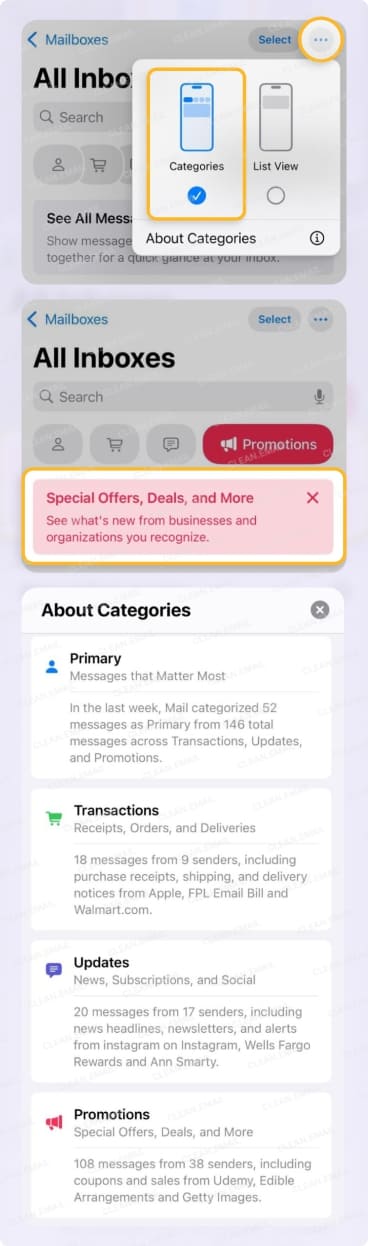
For everyday email, reading, replying, searching, and basic organizing, it covers what most users need. Recent versions also add automatic categories that sort mail into Primary, Transactions, Updates, and Promotions, which cuts down on inbox noise without any setup.
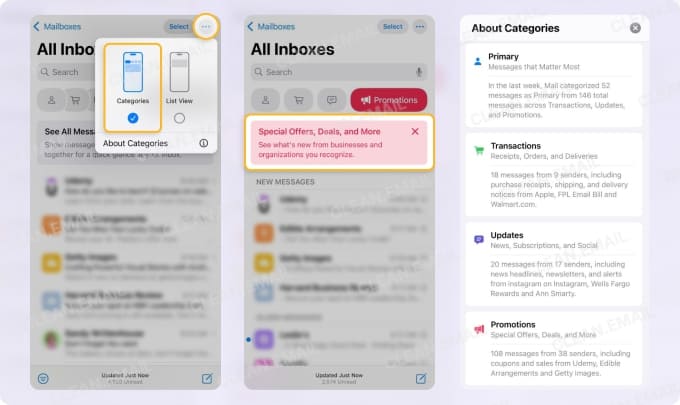
Apple Intelligence adds summaries, Priority Messages, Smart Reply, and Writing Tools on top of that. These features are useful, but availability depends on your device model, region, language, and iOS version, so not every iPhone will see them. You can read more in our overview of Apple Intelligence in the Mail app.
Where Apple Mail falls short is advanced inbox cleanup and power-user tooling, which is where dedicated apps and management tools earn their place.
- Built in, free, and deeply integrated with iOS
- Works with iCloud, Gmail, Outlook, Yahoo, and other accounts
- Familiar interface with almost no learning curve
- Automatic inbox categories reduce clutter
- Apple Intelligence features on supported devices
- Limited tools for bulk cleanup and unsubscribing
- Fewer power-user features than dedicated apps
- Less capable for heavy Gmail or Microsoft workflows
- Apple Intelligence availability varies by device and region
Best for
iPhone users who want a free, reliable, built-in mail app that handles everyday email without extra setup.
Pricing
Free. It comes with iOS, and there is nothing to buy. Apple Intelligence features are included on supported devices at no cost.
Notable features
- Native integration with Contacts, Calendar, and system search
- Automatic categories: Primary, Transactions, Updates, Promotions
- Tracking-protection options for sender privacy
- Summaries and Priority Messages on supported devices
Why Apple Mail Is the Benchmark
For iPhone users, Apple Mail is the default that every other app is measured against. It is free, pre-installed, and built into the system, so the real question is rarely "is there something better in the abstract" but "does another app solve a problem Apple Mail leaves open." For basic email on iCloud, the answer is usually no.
The apps below earn their place by doing something specific that Apple Mail does not, whether that is deeper Gmail search, Microsoft 365 workflows, end-to-end encryption, or large-scale cleanup. If you ever need to adjust account behavior or fix sync issues, the email settings on your iPhone are where you control how each account behaves.
Best Email App for Gmail Users: Gmail
Why we picked it
If Gmail is your main account, the official Gmail app gives you features that generic clients cannot fully replicate.
The app connects naturally to the wider Google ecosystem, including Drive, Meet, and Calendar, which matters if your work or personal life already runs on those tools. Handling several Gmail accounts in one place is smooth, with quick switching and per-account settings.
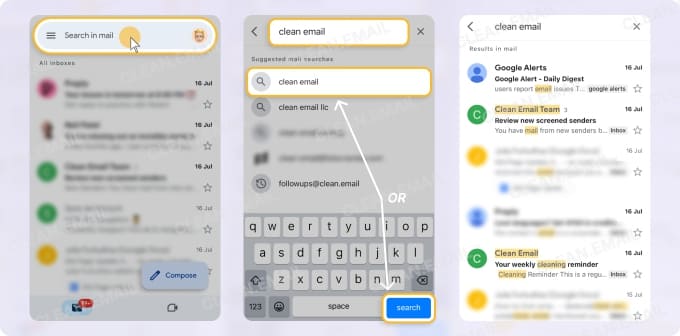
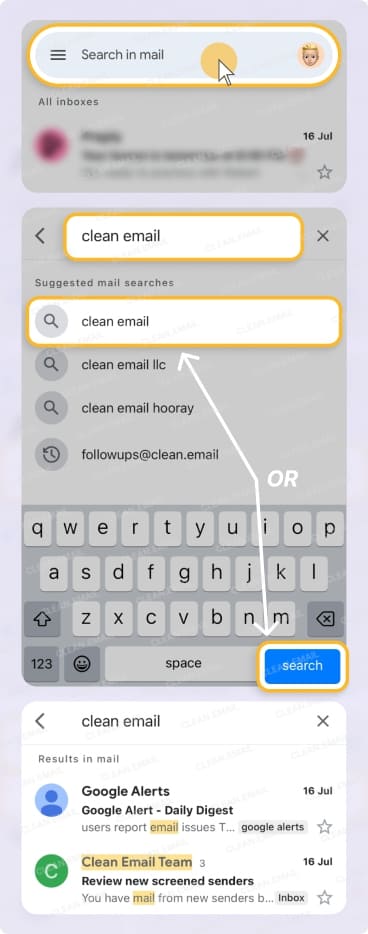
Server-side search is fast and accurate across years of mail, and labels and categories work exactly as they do on the web. Spam filtering is consistently strong.
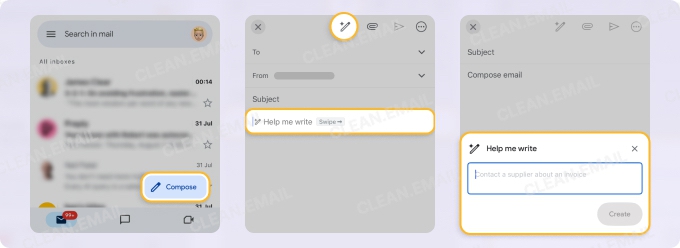
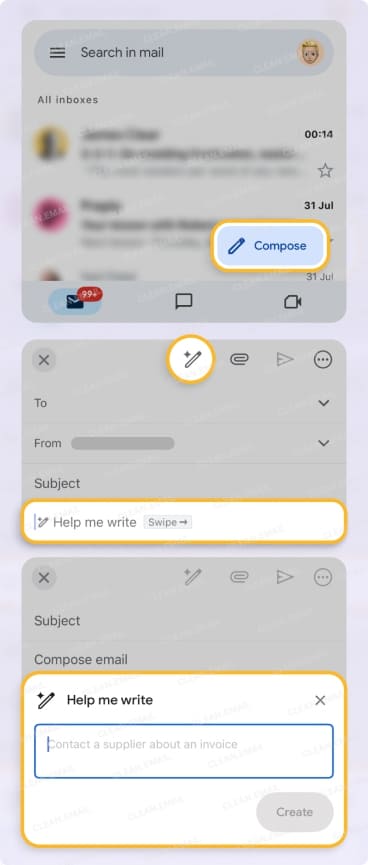
Gmail also folds in Google's Gemini-powered AI, with tools to summarize long threads, draft and refine replies, and surface information from your inbox. Availability can depend on your account type and region, so not every user sees the full set.
The trade-offs are real. Gmail feels less native than Apple Mail on iPhone, it is less ideal for non-Gmail accounts, and some users are cautious about how much sits inside Google's data ecosystem.
If you are weighing the two directly, our comparison of Gmail versus Apple Mail goes deeper on the differences.
- Fast, reliable server-side search across large mailboxes
- Full support for Gmail labels and categories
- Tight integration with Google Workspace and Google apps
- Strong, consistent spam filtering
- Clean handling of multiple Gmail accounts
- Less native feel than Apple Mail on iOS
- Weaker fit for non-Gmail accounts
- Ties you further into Google's data ecosystem
Best for
People whose primary email lives in Gmail or Google Workspace and who want full access to labels, search, and Google integrations.
Pricing
Free for personal use. Paid options exist only through Google Workspace or expanded storage, not the app itself.
Notable features
- Label and category management identical to the web version
- Powerful search operators
- Confidential mode and built-in spam protection
- Integration with Google Calendar, Drive, and Meet
How it compares with Apple Mail
| ✅ Better Than Apple Mail | ❌ Worse Than Apple Mail |
|---|---|
| Stronger Gmail search and label handling | Less native to iOS and system features |
| Deeper Google Workspace integration | Heavier reliance on Google's data ecosystem |
Best Email App for Microsoft 365 Users: Outlook
Why we picked it
Outlook is the natural choice if your email and calendar live inside Microsoft 365, Exchange, or a work account. It connects to those services cleanly and brings calendar, contacts, and email together in one app, which suits people who schedule as much as they correspond.
Focused Inbox is the standout. It separates important messages from everything else, which helps when a work inbox fills up quickly. For business users juggling meetings, attachments, and shared calendars, that organization saves real time.
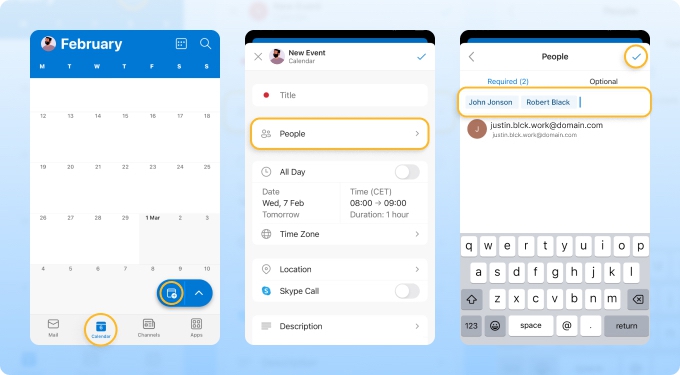
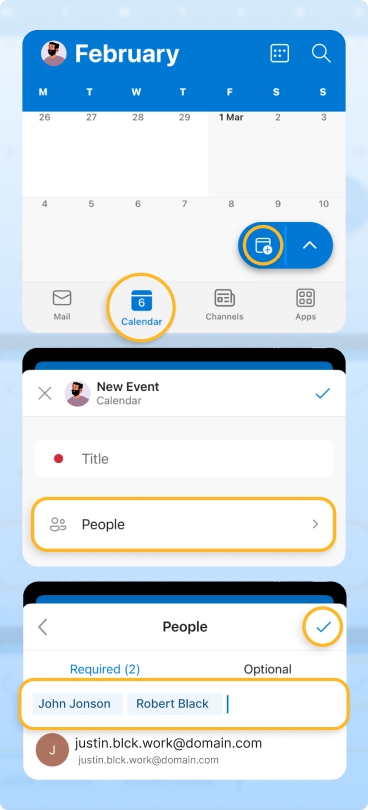
The latest version of Outlook app also includes Microsoft's Copilot AI, with tools to summarize threads, draft and rewrite emails, and suggest replies. The fuller AI capabilities are tied to a Microsoft 365 Copilot subscription, so what you get depends on your plan.
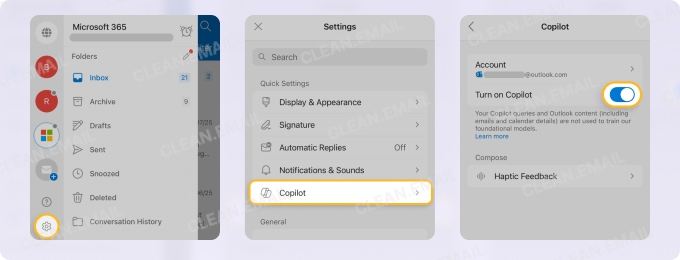
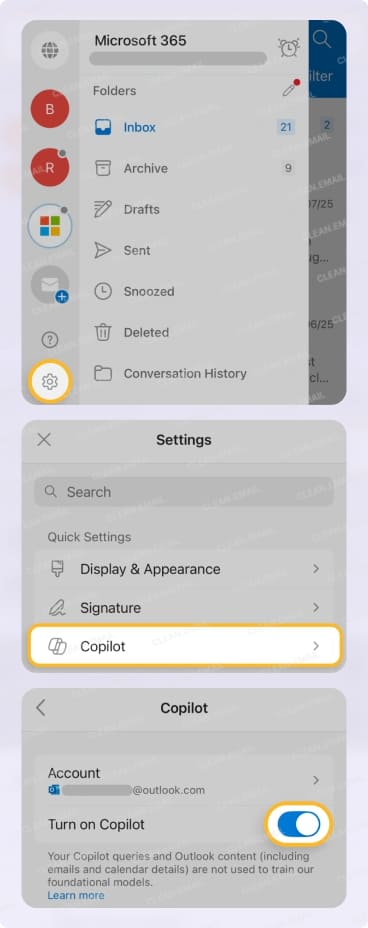
Outlook is heavier than Apple Mail, and it is built around Microsoft's way of working. If you do not use Microsoft 365 or rarely touch a shared calendar, much of its strength goes unused.
- Excellent support for Microsoft 365 and Exchange accounts
- Focused Inbox separates priority mail from the rest
- Built-in calendar and scheduling integration
- Strong fit for business and shared-calendar workflows
- Heavier and busier than Apple Mail
- Designed around the Microsoft ecosystem
- More features than casual users need
Best for
Microsoft 365, Exchange, and business users who want email and calendar working together in one app.
Pricing
Free to download and use. Advanced capabilities come with a Microsoft 365 subscription rather than the app on its own.
Notable features
- Focused Inbox prioritization
- Integrated calendar and meeting scheduling
- Strong attachment handling from OneDrive and SharePoint
- Reliable support for work and Exchange accounts
How it compares with Apple Mail
| ✅ Better Than Apple Mail | ❌ Worse Than Apple Mail |
|---|---|
| Microsoft 365 integration and Focused Inbox | Heavier interface with more to learn |
| Built-in calendar and business scheduling tools | Overbuilt for users outside the Microsoft ecosystem |
Best Email App for Inbox Zero: Spark
Why we picked it
Spark is built for people who actively process email rather than just read it. Its Smart Inbox groups messages so you can clear newsletters, notifications, and personal mail in separate passes, which fits an Inbox Zero routine well.
The app adds tools that support fast triage, including snoozing, send later, follow-up reminders, and email prioritization. For teams, it offers collaboration features like shared drafts and comments, which set it apart from standard clients.
Spark also layers in its own AI through Spark +AI, with assistance for composing, rephrasing, summarizing threads, and translating. These tools are off by default and run on paid plans with monthly usage quotas, so they are an add-on rather than part of the free experience.
Spark can feel more complex than Apple Mail, and some of the more advanced features sit behind paid plans. Privacy-conscious users may also prefer Apple Mail or Proton Mail, since Spark relies on server-side processing to power parts of its experience.
- Smart Inbox groups mail for faster processing
- Snooze, send later, and reminders support triage
- Team collaboration with shared drafts and comments
- Unified inbox across multiple providers
- More to learn than Apple Mail
- Advanced and AI features require paid plans
- Server-side processing may not suit privacy purists
Best for
People who want to actively work through their inbox toward Inbox Zero and value triage and collaboration tools.
Pricing
Spark offers a free plan that covers core inbox features and multiple accounts. Paid individual and team plans add advanced AI and collaboration tools. Prices vary, so check the current plans before subscribing.
Notable features
- Smart Inbox auto-categorization
- Snooze and scheduled send
- Follow-up reminders
- Shared drafts and team commenting
- Built-in calendar for viewing and scheduling alongside email
How it compares with Apple Mail
| ✅ Better Than Apple Mail | ❌ Worse Than Apple Mail |
|---|---|
| Triage tools and team collaboration features | Steeper learning curve for casual use |
| Smart Inbox grouping for active processing | Some features locked behind paid plans |
Best Email App for Privacy: Proton Mail
Why we picked it
Proton Mail is the choice when privacy is the priority. It is built around end-to-end encryption within the Proton ecosystem, and it is based in Switzerland under strict privacy laws. The company does not run on advertising or data collection, which shapes the whole product.
For users who want encrypted mail and a privacy-first account model, Proton Mail delivers in a way mainstream clients do not. Messages between Proton users are encrypted by default, and the service is designed so that the provider cannot read your inbox.
The trade-off is convenience. Proton Mail is strongest as a home for a Proton account, not as a universal client for managing existing Gmail, Outlook, and iCloud inboxes in one place. If most of your mail lives elsewhere, you gain privacy but give up some flexibility compared with Apple, Google, or Microsoft apps.
- End-to-end encryption within the Proton ecosystem
- Privacy-first model with no ad-based data use
- Based in Switzerland under strong privacy laws
- Clear, privacy-focused account design
- Not built to manage all your existing third-party inboxes
- Some convenience trade-offs in daily use
- Smaller ecosystem than Apple, Google, or Microsoft
Best for
Privacy-focused iPhone users who want an encrypted, privacy-first email account rather than a universal client.
Pricing
Proton Mail has a free plan with limited storage and features. Paid plans add more storage, custom domains, and extra tools. Pricing changes over time, so confirm current tiers before committing.
Notable features
- End-to-end and zero-access encryption
- Encrypted messages to non-Proton users with a passphrase
- Privacy-focused aliases and address management
- No advertising or inbox data mining
How it compares with Apple Mail
| ✅ Better Than Apple Mail | ❌ Worse Than Apple Mail |
|---|---|
| Stronger, default end-to-end encryption | Less suited to managing existing Gmail or Outlook inboxes |
| Privacy-first model with no data monetization | Smaller ecosystem and fewer everyday conveniences |
Best Email App for Advanced Customization: Airmail
Why we picked it
Airmail is aimed at power users who want to shape the app around their own workflow. Custom swipe actions, multi-step actions, and integrations with task apps let you build routines that go well beyond what a standard client offers.
It supports multiple accounts and connects to tools like Todoist, Trello, Notion, and others, so you can send an email to a task manager or run several actions with one gesture. For people who treat email as part of a larger system, that flexibility is the draw.
The cost of all that control is complexity. Airmail has dozens of settings, and it can feel like an app you tune rather than simply install. It is not the right fit for users who want simplicity, and some features sit behind a paid plan.
- Deep customization of swipes, actions, and layout
- Multi-step custom actions for advanced routines
- Integrations with task and note apps
- Support for multiple accounts and an Apple Watch app
- Steep learning curve and many settings to configure
- Not a good fit for users who want simplicity
- Advanced features require a paid subscription
Best for
Power users who want to customize swipes, actions, and integrations to build their own email workflow.
Pricing
Airmail offers a free version with basic functionality and a paid Pro subscription that unlocks advanced features. Prices vary by region and can change, so check current rates in the App Store.
Notable features
- Custom and multi-step actions
- Configurable swipe gestures
- Integrations with task managers and note apps
- Apple Watch support for triage
How it compares with Apple Mail
| ✅ Better Than Apple Mail | ❌ Worse Than Apple Mail |
|---|---|
| Far deeper customization and automation | Much steeper learning curve |
| Integrations with task and note apps | Overcomplicated for users who want simplicity |
Best Email App for Email Cleanup: Clean Email
Why we picked it
Clean Email is an inbox management tool, not a traditional iOS email client like Apple Mail, Gmail, or Outlook. While it includes essential email client functions such as reading, replying to, composing, and forwarding emails, its primary focus is inbox management.
Where traditional email apps are built around daily communication, Clean Email is built around cleaning, organizing, unsubscribing, and automating at scale. Download Clean Email for iPhone on the App Store, connect it to your existing inbox, and use it to handle the bulk management tasks that standard email clients are not designed for.
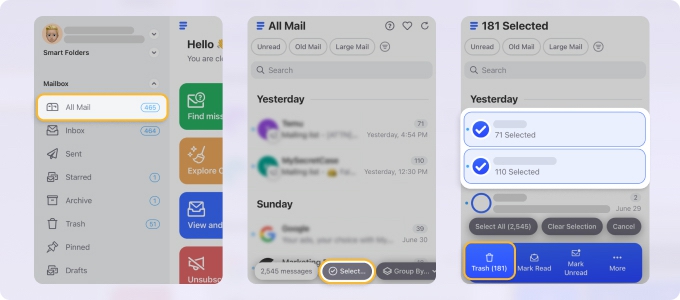
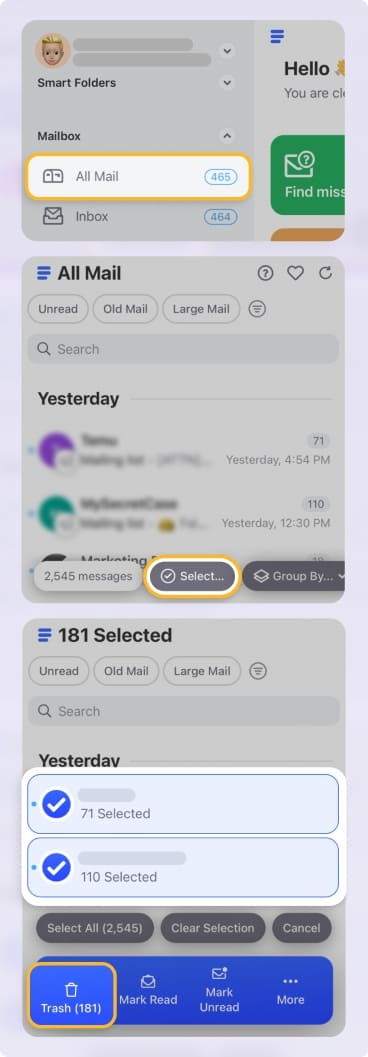
That distinction matters. When your problem is a backlog of clutter, old newsletters, and thousands of unread messages, a standard client is not built to clear it quickly.
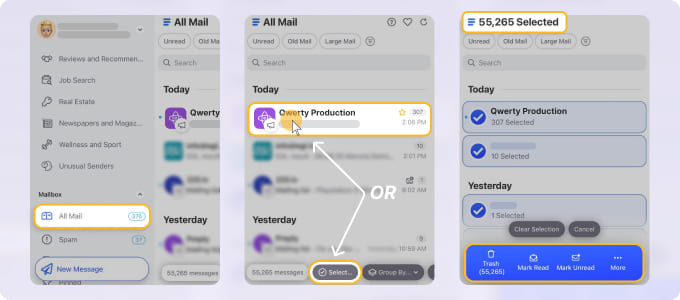
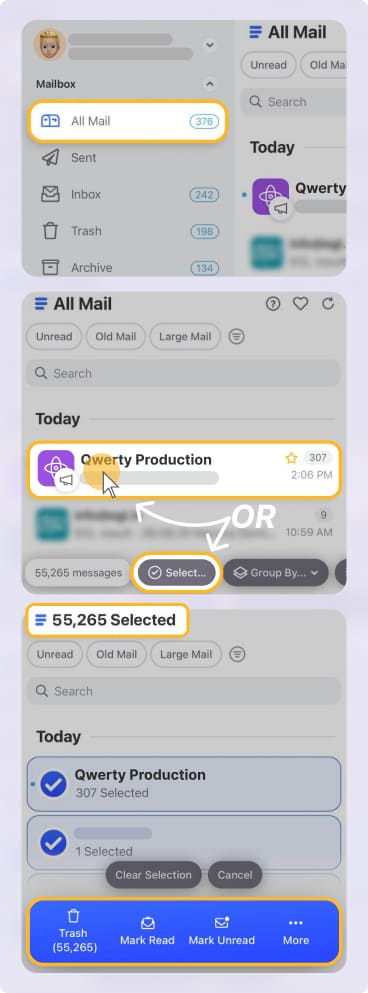
Clean Email handles mail in bulk, grouping messages by sender, subject, or type so you can act on whole categories at once. It works like email filters, but applied across your whole mailbox at scale rather than one rule at a time.
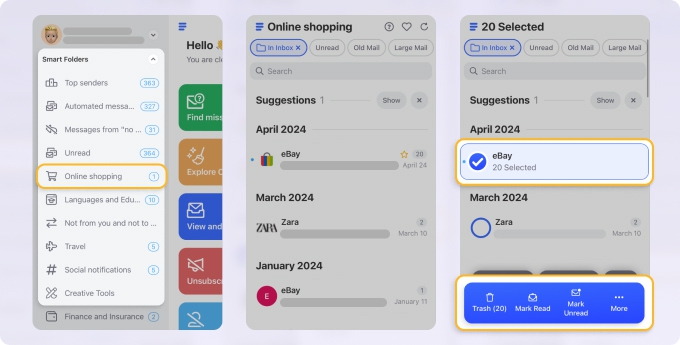
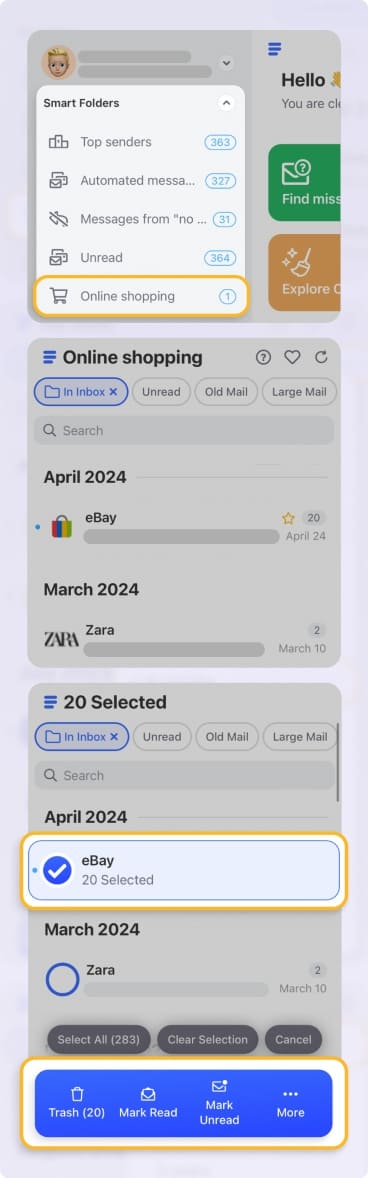
The app connects with major providers, including Gmail, Outlook, iCloud, Yahoo, and others. Once connected, Auto Clean rules keep applying your decisions automatically, and Smart Folders organize mail without manual sorting every day. When an inbox is overloaded, being able to delete bulk emails on iPhone in a few steps pairs well with these tools.
- Bulk cleanup across thousands of messages at once
- Unsubscribe tools for newsletters and promotions
- Auto Clean rules that keep working automatically
- Smart Folders and sender-based management
- Works with major email providers
- Basic email client features only
- Subscription based after the trial period
Best for
iPhone users whose main problem is clutter and volume, and who want to clean and automate an inbox alongside their regular free email app.
Pricing
Clean Email is a subscription service with a limited free trial, and plans scale by the number of mailboxes you manage. Pricing can change, so review current plans before subscribing.
Notable features
- Screener for quarantining emails from unknown senders
- Keep Newest for deleting all but the latest email
- Privacy Monitor for protecting your email account from data breaches
- Cross-provider support for Gmail, Outlook, iCloud, and more
How it compares with Apple Mail
| ✅ Better Than Apple Mail | ❌ Worse Than Apple Mail |
|---|---|
| Bulk cleanup, unsubscribing, and automation at scale | Not a full-featured email client |
| Sender-based management and Smart Folders | May require a separate everyday free email app |
💡 Tip: Check out our broader walkthrough on how to clean your mailbox on iPhone.
Should You Switch from Apple Mail?
Apple Mail is enough for a large share of iPhone users. Switching, or adding a second app, only makes sense when you have a specific need it does not cover.
➡️ Apple Mail is enough if:
- You want a simple, free app with no setup
- You mainly use iCloud
- You do not need advanced cleanup or automation
- You prefer native iOS integration
➡️ Switch or add another app if:
- Gmail is your main account and you want full label and search support
- Microsoft 365 is your main account and you rely on calendar-heavy workflows
- Privacy is your top priority and you want encryption by default
- Your inbox is overloaded and clutter is the real problem
- You need stronger automation, filtering, or cleanup than Apple Mail offers
One clarification worth repeating: You do not have to replace Apple Mail to use Clean Email. The apps work side by side, letting you keep Apple Mail for reading, writing, and replying to emails while using Clean Email for inbox cleanup, organization, unsubscribe management, and automation. This way, you get powerful email management features without giving up the free email client already built into your iPhone.
If you do decide to make a different app your primary client, you can also change the default email app so it opens email links instead of Apple Mail.
How to Choose the Best iPhone Email App
Use this as a quick decision framework:
- Choose Apple Mail for native simplicity and everyday iCloud email.
- Choose Gmail for Gmail and Google Workspace accounts.
- Choose Outlook for Microsoft 365 and business email.
- Choose Proton Mail for privacy and encryption.
- Choose Spark for Inbox Zero and active email processing.
- Choose Airmail for deep customization and workflow control.
- Choose Clean Email if your main problem is clutter, subscriptions, and bulk cleanup.
FAQs
What is the best mail app for iPhone?
Apple Mail is best for most users because it is free, built in, and reliable for everyday email. Gmail, Outlook, Proton Mail, Spark, Airmail, and Clean Email are better for specific needs like Gmail features, Microsoft 365, privacy, Inbox Zero, customization, and cleanup.
Is Apple Mail better than Gmail?
It depends on your account. Apple Mail is better for native iOS simplicity and for using several providers in one place. Gmail is better for Gmail-specific features, search, labels, and Google Workspace integration.
What is the most secure email app for iPhone?
Proton Mail is the strongest choice for privacy-focused users, especially within the Proton ecosystem, because it offers end-to-end encryption by default. Apple Mail also benefits from Apple's privacy features, but it is not the same as a fully end-to-end encrypted email service.
Which iPhone email app is best for multiple accounts?
Apple Mail, Outlook, Spark, and Airmail all handle multiple accounts well. The best fit depends on whether your accounts are personal, business, Gmail-heavy, or Microsoft-heavy.
Is Outlook good on iPhone?
Yes. Outlook is one of the strongest iPhone email apps for Microsoft 365, Exchange, calendar-heavy workflows, and business users, largely thanks to Focused Inbox and built-in calendar integration.
What is the best iOS email app for business use?
Outlook is the strongest pick for Microsoft 365 business users, and Gmail is the better fit for Google Workspace users. Apple Mail is enough for basic business email, while Clean Email can help business users manage clutter and automate cleanup alongside their main client.