Our Picks for the Best Mac Email Clients
There are many great Mac email clients to choose from, each offering a slightly different set of features in a slightly different package.
Here is our list of the top email clients for Mac:
- Apple Mail: Free, native, and enough for most everyday email.
- Spark: Smarter triage and AI for individuals and small teams.
- Microsoft Outlook: Best if your work runs on Microsoft 365.
- Airmail: Deep customization and automation for power users.
- Edison Mail: A lighter, mobile-first inbox with quick unsubscribe.
- Canary Mail: encryption, PGP, and AI for privacy-focused users.
- Mimestream: True Gmail behavior in a native Mac app.
- Spike: A chat-style, low-clutter take on email.
- Missive: shared team inboxes and collaboration.
- Mailspring: a traditional, customizable free client for Mac.
If you want the short answer, here is the fastest match by need:
| Badge | Pick | Why it stands out |
|---|---|---|
| Editor’s Choice | Mimestream | Most polished native option for the large share of Mac users on Gmail. |
| Best Free | Apple Mail | Preinstalled and native, now with categories and message summaries. |
| Best Apple Mail Alternative | Mailspring | Familiar cross-platform client with rules and customization. |
| Best for Microsoft 365 | Microsoft Outlook | Strongest when calendar, files, and rules live in Microsoft 365. |
| Best for Teams | Missive | Shared inboxes, assignments, and internal chat on each thread. |
| Best Privacy | Canary Mail | Encryption and PGP plus optional AI, in one app. |
| Best Lightweight Option | Spike | Chat-style, low-clutter reading for people who dislike threads. |
| Best for Smart Triage | Spark | Smart Inbox sorting and AI writing, plus light team tools. |
| Best for Quick Unsubscribe | Edison Mail | Focused inbox and one tap unsubscribe in a lighter app. |
| Best for Customization | Airmail | Deep shortcuts, gestures, and automation for power users. |
📌 These picks were chosen by our editorial team based on hands-on use. We looked at how each app handles real Mac usage: setup, everyday speed, account and provider support, privacy, how useful its AI actually is, inbox management, and team features. We also weighed the practical question behind this whole list, which is whether an app gives you a real reason to replace or supplement Apple Mail. Where an app fits a specific need better than a general one, we say so.

1. Apple Mail
☑️ Best free native option with no downloads or payments required
We started here because almost everyone does. Apple Mail is free, built into macOS, and connected our Gmail, iCloud, and Outlook accounts in a couple of minutes with no fuss. For reading, replying, and searching, it held up fine in everyday use.
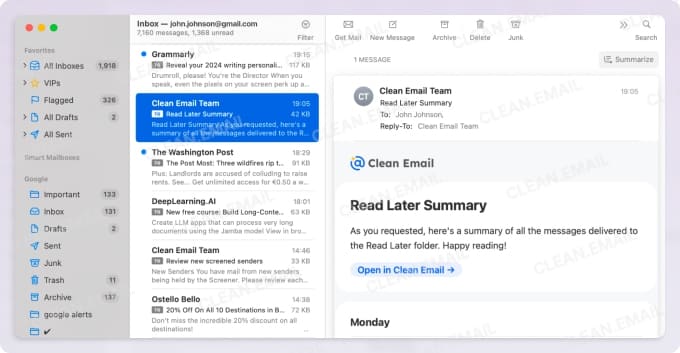
Recent versions narrowed the gap with other clients. It now includes Undo Send, Schedule Send, and Follow Up reminders, and on supported hardware Apple Intelligence adds message summaries, a Primary inbox with priority messages, and automatic categories such as Transactions, Updates, and Promotions.
Unlike most other email apps for Mac, Apple Mail gives you the option to set up custom notifications across your browser, within the OS, and other places that may be helpful to see when you have mail. You can mute these notifications at any time, which is good when you need to focus on work.
The limits show up once your inbox gets busy. The categories are fixed, so you cannot create your own, and many users find the sorting hit or miss. Rules exist but need manual upkeep, search still trails Gmail on relevance, and there is no shared inbox or deep cleanup automation.
Our take: Apple Mail is the apple email software most people should try first, and it makes a solid home base. We only reached for something else when we hit a specific need it does not cover.
Pricing: Free
- Comes built-in to Mac devices
- Easy to use
- Multi-account setup and unified inbox
- Undo Send, Schedule Send, and Follow Up reminders
- Categories and message summaries on supported Macs
- Very basic search functionality
- Cannot create custom categories, and sorting accuracy varies
- No team or shared-inbox features and limited cleanup automation
2. Spark
☑️ Great for sorting and collaboration
We reached for Spark when Apple Mail felt too plain and Outlook felt too heavy. Like Apple Mail, it’s compatible with any IMAP or POP3 email client. However, Spark Mail really stands out in terms of the features it offers in comparison to Apple Mail.
What’s so futuristic about this Mac email app is how it organizes emails. In testing, its Smart Inbox grouped our personal mail, newsletters, and notifications on its own, and Gatekeeper let us wave through or block new senders before they landed. That part we liked.
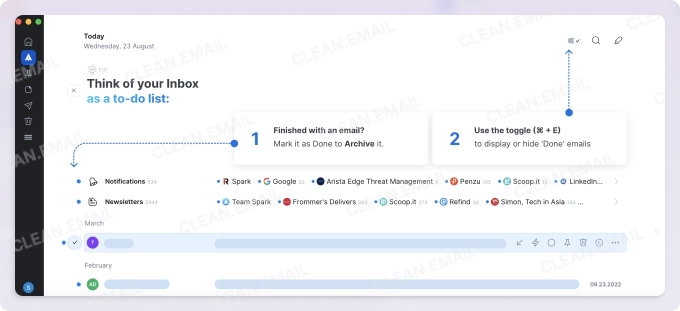
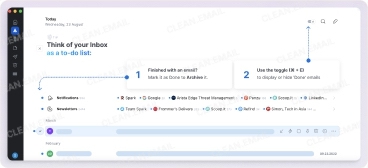
Compared with Apple Mail, the triage is more opinionated and the AI tools (summaries, drafted replies, and a writing style that learns from your sent mail) are more capable. It also adds light team features such as shared drafts and private comments, which suit individuals and small teams.
The tradeoffs: the strongest features sit behind a paid plan, the collaboration tools are wasted on solo users, and Spark processes mail on its own servers, so privacy-sensitive users should review how their data is handled. It runs on macOS, Windows, iOS, and Android.
Pricing: Free for 5 GB of team file storage and only 2 active collaborators. Spark Plus costs $8.25/month per user billed annually ($99/year), or $10/month and it includes everything teams need to take full advantage of email as the most reliable and versatile communication tool in the world.
- Smart inbox makes it easy to sort emails
- Prevents mail from unknown senders (Gatekeeper)
- Great tools for team collaboration
- Useful AI writing and summaries
- Cross-platform availability
- Best features require a paid plan
- Very few app integrations
- Mail is processed on Spark's servers, a privacy consideration
📌 Read more: Spark Mail AI: Features, Pricing & Review
3. Microsoft Outlook
☑️ Best for Microsoft Office Users or Professionals
Outlook clicked for us only once we tested it inside a Microsoft 365 account. With calendar, contacts, and files tied together, it worked like a control center, and the new Outlook for Mac runs natively on Apple Silicon, so it felt quicker than the older build we remembered.
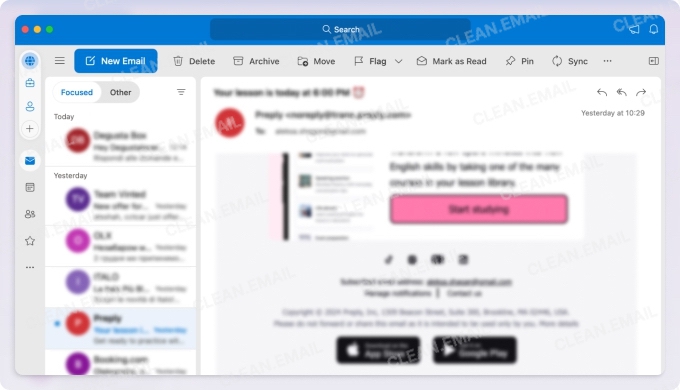
It is now free with personal accounts such as Outlook.com, Gmail, iCloud, and Yahoo, with ads in the free version. A Microsoft 365 subscription removes the ads and unlocks the wider Office tie-ins.
Compared with Apple Mail, Outlook is more powerful for filtering, rules, and business workflows, but also busier. If you want a light, Mac-native feel and do not live in Microsoft tools, it can be more than you need.
Pricing: Free to use with ads; premium features and an ad-free experience require a Microsoft 365 subscription.
- Best compatibility with Microsoft 365 and Office integration
- Many customization options
- Advanced search and filtering options
- Ability to automate inbox tasks
- Free for Mac users with personal accounts
- Cluttered view compared to simpler email apps
- Free version is limited in features
4. Airmail
☑️ Best for customization and power users
Airmail is an award-winning best Mac email client. With support for iCloud, MS Exchange, Gmail, Google Apps, IMAP, POP3, Yahoo!, AOL, Outlook.com, and Live.com, Airmail brings to the table a unified inbox that’s optimized from the ground up for performance. The developers of Airmail claim that it brings email to the 21st century, and we can’t but agree.
Custom swipe actions, keyboard shortcuts, rules, and AppleScript gave us a lot to set up, and once it was dialed in it moved fast. Power users will enjoy that, and we did.
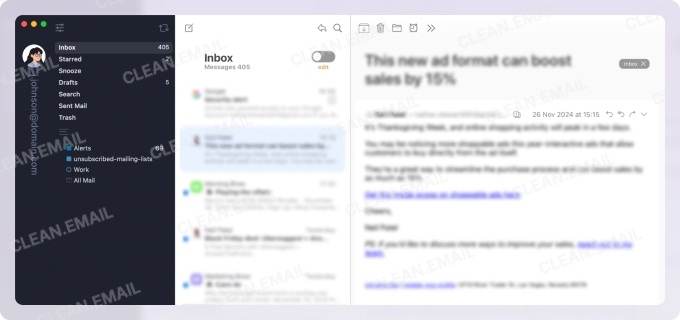
With the latest version of Airmail, you’ll find many features that aren’t available in Apple Mail or several of the other options on this list. For example, Airmail now offers an AI composer, which can help you save time with quick reply messages. It also offers more advanced search functionality and app integrations, neither of which are available with Apple Mail.
It is not for everyone, though. We spent real time in settings before it felt right, so anyone who wants sensible defaults may find it fussy. It is Apple only, and in testing we hit the occasional sync hiccup and a slow update pace, so we would trial it with your own accounts first.
Pricing: Many features are free. Airmail Pro subscription has two options: $9/month or $49/year. Airmail for Business costs $49.99.
- Unified inbox and automation rules
- AI composer and AppleScript automation
- Deep customization, shortcuts, and gestures
- Not completely free
- Can feel complex if you want simple defaults
- Apple only, no Windows or Android
5. Edison Mail
☑️ Best for quick unsubscribe and a lighter inbox
We liked Edison Mail for a lighter, mobile-first inbox. The focused view, one tap unsubscribe, snooze, and pin all ran smoothly in testing, and the assistant pulling out travel, receipts, and deliveries was a nice touch. It runs on iOS, Android, and Mac.
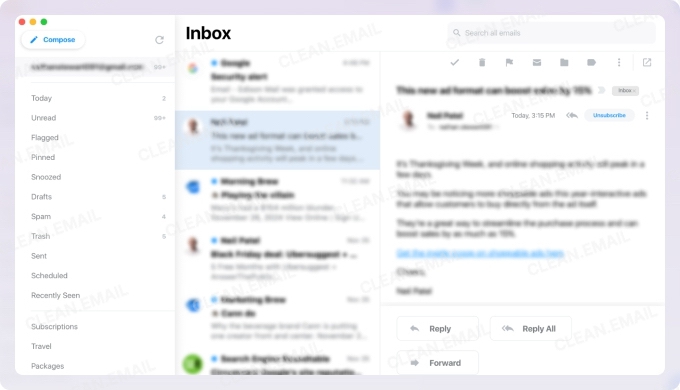
Unlike Apple Mail, Edison Mail offers a focused inbox, which lets you separate important messages from subscriptions and other automated messages. You can also pin messages and come back to them later when you’re ready to respond or snooze certain messages during hours when you’re busy.
The free app is funded by analyzing commercial emails such as receipts and promotions to build de-identified shopping data that Edison sells to research subscribers. Edison says it skips personal and work mail and offers an opt out, but it is worth deciding whether that trade is acceptable before you sign in.
And when we pushed it on deep, recurring cleanup across senders and categories, the built-in tools ran out of room fairly quickly.
Pricing: Free. However, Edison Mail+ is available for $14.99/mo., or $99.99/yr., and is 'available in all locations but is currently optimized for use in the USA,' as stated on the vendor's website.
- Focused inbox
- Unsubscribe and block features
- Options to snooze and pin messages
- Free model relies on de-identified commercial data
- Mobile-first and lighter on Mac
- Not built for deep recurring cleanup
6. Canary Mail
☑️ Best for privacy and encryption
Canary Mail is a modern, AI-powered email client designed for professionals who want faster email management without compromising privacy. One click encryption and PGP worked without much ceremony in testing, and the natural language search handled a query like emails from dad better than we expected. It runs on macOS, iOS, Windows, and Android.
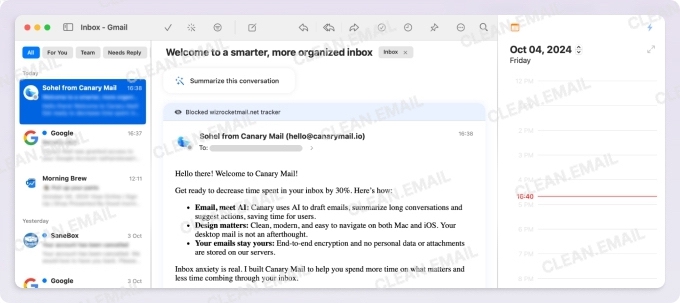
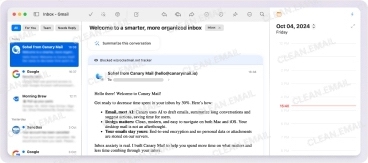
Besides encryption, Canary Mail has many other features to help you focus on what’s important and ignore everything that isn’t. With Smart Filters, you can quickly isolate unread emails or find emails with unopened attachments. Natural Language Search makes it possible to find emails using natural search queries such as “emails from dad” or “newsletters this month.”
The AI summaries and replies were solid, but our honest reaction was this: if Apple Mail already covers your basics, the encryption and AI can feel like more than the job needs. The strongest security also sits on the higher tier, and this is not a shared team inbox.
Pricing: Free plan with core features. Paid plans start at $36/year for the Growth plan, while the Pro+ plan costs $100/year.
- AI-powered email assistant for faster replies
- End-to-end encryption and PGP support
- Smart filters to isolate messages
- Natural language search
- Unified inbox for multiple email accounts
- Takes time to learn for new users
- AI suggestions may feel unnecessary at times
- Doesn’t offer a shared team inbox
7. Mimestream
☑️ Best Gmail experience on Mac
Mimestream made the strongest impression on us, as long as you live in Gmail. Because it talks to the Gmail API instead of plain IMAP, our labels, categories, and server-side filters behaved exactly as they do in Gmail, inside a fast native Mac app. That is the detail most other clients miss.
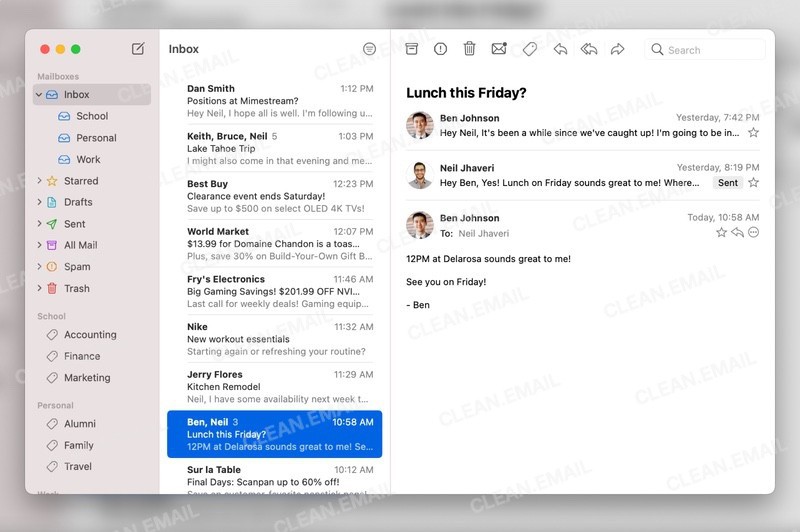
One of Mimestream’s greatest strengths lies in its new additions, including a beautiful dark mode, push notifications, advanced keyboard shortcuts, and more. Constant improvement and innovation are at the heart of Mimestream, making it not just another email app for Mac but a solution that grows and evolves with your needs.
Mimestream opts for the Gmail API instead of a traditional IMAP protocol, ensuring a lightning-fast, feature-rich experience. It brings the Gmail experience to your desktop with the speed and style of an Apple app and delivers a powerful set of Gmail-specific features to make managing your inbox both simple and enjoyable.
Where it stopped for us was clear. We could not add an Outlook or iCloud account, and there is no iOS app yet, so if Gmail is not your main inbox, this is not your client.
Pricing: A fully functional 14-day trial is available for download exclusively from the website. After the trial period, pricing for Mimestream is $49.99/year or $4.99/month, with team and company plans available.
- Designed exclusively for Mac and Gmail users
- Built on the Gmail API, so labels, categories, and filters stay accurate
- Fast and lightweight, with Apple Intelligence writing tools
- Multiple account support with a unified inbox
- Pricing is subscription-based
- Gmail and Google Workspace only
- macOS only, with no mobile app yet
8. Spike
☑️ Best for Chat-Like Email Experience
Spike split the room when we tested it, and that is rather the point. It hides headers and signatures and lays messages out like a chat by person, so email reads like texting. We cleared short back-and-forths faster than usual, and the Priority Inbox kept newsletters out of the way. It works with Gmail, Outlook, iCloud, Yahoo, and IMAP.
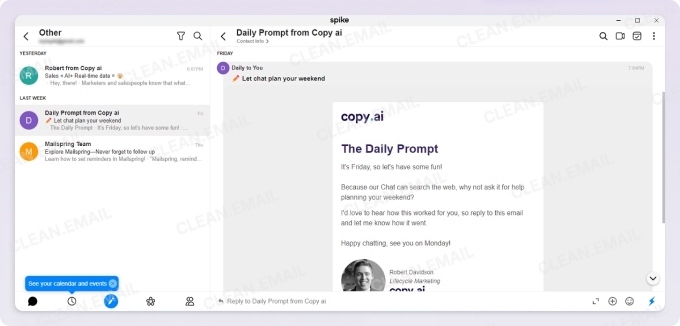
Spike has a Priority Inbox that sorts your mail by importance. It identifies and separates your personal messages from newsletters, notifications, and other promotional content.
Spike also has features for teams, such as group chats, file sharing, video meetings, and notes.
Finally, Spike’s AI features help you save time on email management. The AI Feed summarizes all unread messages, and you can also summarize entire email conversations, and AI reply suggestions help you reply faster.
Whether you like it comes down to taste. The testers who prefer a normal mailbox bounced off it quickly. Two practical notes from use: the free plan limits search history, and Spike adds its own signature to your outgoing mail.
Pricing: Free plan for basic features. Pro plans start at $5/month for advanced features and unlimited AI access.
- Turns emails into a simple chat-like interface
- Unified inbox for all your email accounts
- Built-in notes and tasks
- Priority Inbox sorts important mail
- Seamless collaboration with non-Spike users
- Powerful AI features for summarizing and replies
- Different interface from traditional email
- Free plan limits history and adds Spike branding
- Offline access is limited
9. Missive
☑️ Best for teams and shared inboxes
Missive is built for teams that work out of the same mailbox. Several people can read, assign, and reply to shared inboxes such as support@ or sales@, discuss a message in an internal chat attached to the thread, and avoid duplicate replies. It also pulls in other channels like SMS, WhatsApp, and social.
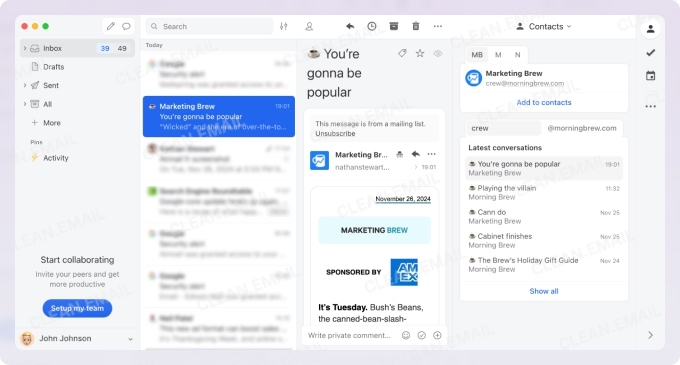
For a solo Mac user who only needs personal email, this is more tool than the job requires. The value appears when ownership, assignments, and visibility across a team matter. AI features use your own API key rather than being bundled in.
Pricing: A free plan covers up to three users. Paid plans start around $14 per user per month billed annually, rising with automation and admin features, after a 30-day trial. Pricing may vary; check the current plan page.
- Shared inboxes with assignments and internal chat on each thread
- Multi-channel: email, SMS, WhatsApp, and social
- Free tier for very small teams
- Overkill for solo users
- Per-seat cost adds up as the team grows
- AI requires your own API key
10. Mailspring
☑️ Best traditional cross-platform alternative
Mailspring is a familiar desktop email client for people who want more than Apple Mail without changing how email works. It is free and open source, runs on Mac, Windows, and Linux, and supports Gmail, iCloud, Outlook.com, Office 365, Yahoo, and any IMAP account. It adds a unified inbox, snooze, send later, templates, rules, themes, and Gmail-style search.
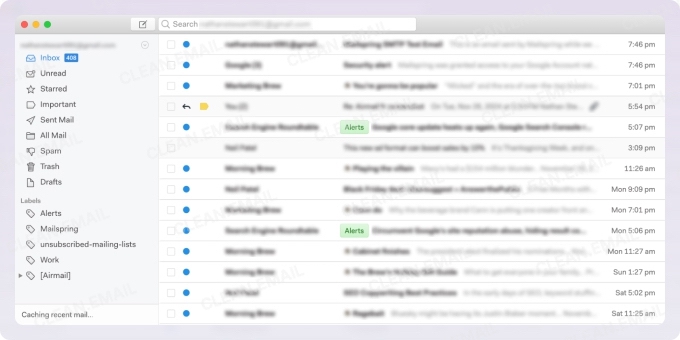
It is a good fit if you move between operating systems or want a clean classic client with customization. The limits are clear: it runs on Electron rather than native code, so it does not feel as Mac-native as Apple Mail or Mimestream, it has no mobile apps, and it is not as Gmail-deep as Mimestream or as Microsoft-deep as Outlook. Note that Pro adds read receipts and link tracking, which some recipients may not expect.
Pricing: Free for full email use; Mailspring Pro is about $8 per month for tracking, reminders, and mailbox insights. Pricing may vary; check the current plan page.
- Free and open source, on Mac, Windows, and Linux
- Unified inbox, rules, templates, and fast search
- Affordable Pro tier
- Electron app, not fully Mac-native
- No mobile apps
- Tracking features may be unwelcome to recipients
So Why Switch from Apple Mail?
Apple Mail is already on your Mac, so the useful question is what a second app actually adds. Here is the short version for each pick:
| App | Main reason to choose it over Apple Mail | Main reason to stay with Apple Mail |
|---|---|---|
| Spark | Smarter triage and AI, plus light team tools | Apple Mail is free, native, and simpler |
| Outlook | Deep Microsoft 365, calendar, and rules | You do not use Microsoft tools and want a lighter app |
| Airmail | Heavy customization and automation | You prefer simple defaults over tuning |
| Edison Mail | Fast unsubscribe and a lighter mobile inbox | You want all mail handled without a data-driven free model |
| Canary Mail | Encryption, PGP, and AI in one app | You do not need encryption or AI |
| Mimestream | True Gmail behavior on a Mac | You also use non-Gmail accounts |
| Spike | Chat-style, low-clutter reading | You prefer a traditional mailbox |
| Missive | Shared team inboxes and assignments | You only manage personal email |
| Mailspring | Cross-platform classic client with rules | You stay inside the Apple ecosystem |
What Makes a Great Email Client for Mac?
Choosing the best mail client for Mac depends on your accounts and habits, but a few things separate a good Mac client from a frustrating one:
- Account support and setup: it should connect IMAP, Gmail, Outlook, and iCloud quickly and sync cleanly across your Mac, iPhone, and iPad.
- Everyday speed and ease of use: opening, searching, and replying should feel fast, even on a large mailbox.
- Triage and email organization: a unified inbox, filters or labels, snooze, and reliable search do more day to day than any single headline feature.
- The right kind of intelligence: AI summaries and drafted replies help some workflows and get in the way of others, so they should be optional.
- Fit for your situation: Gmail-native behavior, Microsoft 365 depth, team features, privacy, or cross-platform support matter only if you actually need them.
- Pricing: The app’s cost and the availability of a free version.
Now that you've seen our picks and know what to look for, the best email client for Mac is the one that fits your workflow best.
Keep your Inbox Organized with Clean Email
A good Mac email client makes messages easier to read and reply to. It does not solve a different problem: an inbox already buried under old subscriptions, automated alerts, and senders you no longer want to hear from. That is where an email organizer for Mac comes in.
Clean Email for Mac is not a replacement for Apple Mail, Outlook, Spark, or Mimestream. It can read and send basic mail, but its real value is organization, and it works alongside whatever client you already use.
A few things it does that most clients do not match well:
- Smart Folders group mail into practical categories automatically, such as Top Senders, Automated Messages, Seasonal Deals, Online Shopping, Social Notifications, and more. They work like labels and don't move your emails unless you choose to.
- Screener quarantines emails from unknown senders and lets you review them before reaching your inbox.
- Cleaning Suggestions surface cleanup recommendations based on patterns in your mailbox.
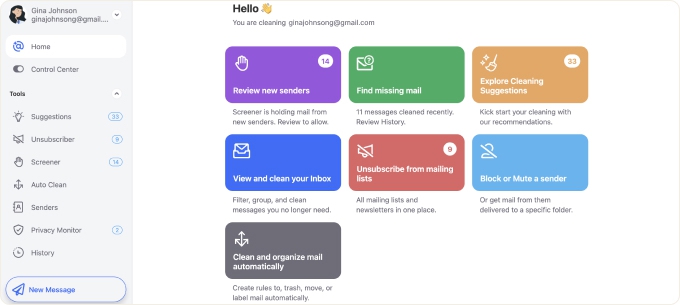
This app analyzes only headers and metadata rather than message content, and it works on the web, macOS, and mobile with Gmail, Outlook, Yahoo, iCloud, AOL, and other IMAP accounts. If your client is fine but your inbox is not, pairing the two usually beats switching clients.
Decision Shortcuts
If you want a direct answer by situation, start here. A single need can point to more than one app.
- Use Gmail heavily and want a native Mac feel: choose Mimestream.
- Live in Microsoft 365: choose Outlook.
- Want email to feel lighter and more conversational: consider Spike.
- Manage shared inboxes or team workflows: consider Missive or Spark.
- Want encryption and privacy-first workflows: consider Canary Mail.
- Want a traditional, customizable free client across platforms: consider Mailspring.
- Like Apple Mail but your inbox is still chaotic: add Clean Email instead of replacing your client.
Check out our article about The best email app for iPhone in 2026.
Conclusion
If Apple Mail already handles your accounts and you mostly send, read, and search, you may not need to replace it, especially now that it adds categories and summaries on newer Macs. The reason to switch is usually specific.
Choose Mimestream for true Gmail behavior on a Mac. Choose Outlook if you live in Microsoft 365. Pick Canary Mail for encryption and privacy, Spike for a lighter conversational inbox, Missive for shared team inboxes, and Mailspring if you want a traditional client across Mac, Windows, and Linux.
For many people the better move is not changing clients at all. If the real problem is volume, old subscriptions, and senders you no longer want, keep your client and add an email organizer for Mac like Clean Email to handle cleanup, sender control, and recurring maintenance.
💡 Read more: How I Cleaned Up My Mac And Got My Storage Back
FAQs
Can I switch email clients without losing my emails?
No. With IMAP, Gmail, Outlook, iCloud, and Yahoo, your mail lives on the provider's servers, so a new client just connects to the same account. You see the same messages, folders, and history.
Will changing my Mac email client change my email address?
No. The client is only how you read and send. Your address and provider stay the same.
Which Mac email client works best with Gmail filters?
Gmail's own filters work most reliably in Gmail and in Gmail-native clients like Mimestream, which use the Gmail API. Other clients show labels and folders but may handle them differently.
Do I need an AI-powered email client?
No. AI can help with summaries, drafting, and triage, but it is optional. Plenty of people manage email well without it.
Can I use more than one email client on my Mac?
Yes. You can connect the same account to several clients. Just watch for conflicting rules and duplicate notifications.
Which email client is best if I use both macOS and Windows?
Cross-platform options like Outlook, Mailspring, Spark, Canary Mail, Spike, and Missive fit better than Apple Mail, which is Apple only.
Is Apple Mail enough for most Mac users?
For everyday sending, reading, and search, yes. It tends to fall short for advanced Gmail workflows, Microsoft 365, team inboxes, privacy-specific needs, and deep inbox cleanup.