Editor's Picks at a Glance
- Best for watching several Gmail accounts at once: Checker Plus for Gmail
- Best for follow-up reminders and response tracking: Boomerang
- Best for turning email into tasks: Todoist for Gmail
- Best for plain email open tracking: Mailsuite
- Best for a calmer Gmail interface: Simplify Gmail
- Best for writing quality: Grammarly
- Best for a support inbox that should stay in Gmail: Hiver
- Best for shared inboxes that need automation: Gmelius
- Best for sales sequences run from Gmail: Mixmax
- Best Gmail-native CRM: Streak
- Best for teams that don't live in Google Drive: Dropbox for Gmail
- Best for consistent branded signatures: WiseStamp
- Best lightweight bundle for solo senders: Right Inbox
- Best for ongoing inbox cleanup outside Gmail: Clean Email

Gmail Add-Ons Compared
Tool names link to their full review. Prices are the lowest published paid rate; "annual" means the rate requires annual billing. All figures were checked in August 2026.
The Type column predicts more than price does: it determines where the tool appears, whether it survives a Gmail redesign, and whether it exists on your phone. The three types are explained after the reviews.
| Tool | Best for | Type | Gmail mobile app | Free tier | Starting price |
|---|---|---|---|---|---|
| Checker Plus | Multi-account notifications | Chrome extension | No | Everything; donation optional | Free; optional contribution for extra features. |
| Boomerang | Follow-up reminders, send later | Extension + add-on | Via Boomerang app (paid) | 10 credits/month | $4.98/mo annual (personal Gmail only) |
| Todoist | Email to task | Workspace add-on | Yes (phones, not tablets) | 5 projects, 3 filters | $5/mo billed yearly |
| Mailsuite | Open tracking only | Extension + add-on | Yes, after desktop setup | Unlimited tracking, first open only, promo signature | $6.99/user/mo |
| Simplify Gmail | Interface clutter | Browser extension | No | None (1-month trial) | Paid subscription |
| Grammarly | Writing quality | Browser extension | Via Grammarly Keyboard | 100 AI prompts/month | $12/user/mo annual |
| Hiver | Support and shared inboxes | Chrome extension + apps | Yes, Hiver's own apps | 1 inbox, 1 tag, 1 template | $25/user/mo annual, 2-seat minimum |
| Gmelius | Shared inbox automation | Extension + add-on | Web app only | None | $19/user/mo annual |
| Mixmax | Sales sequences | Chrome extension | No | 20 tracked emails, 50 sequence recipients/mo | $29/user/mo annual |
| Streak | CRM inside Gmail | Chrome extension + apps | Yes, Streak's own apps | Email tools only, no free CRM | $49/user/mo annual |
| Dropbox for Gmail | Non-Google file sharing | Workspace add-on | Yes | Add-on free; 2 GB Dropbox Basic | Storage plan from $9.99/mo |
| WiseStamp | Branded signatures | Web app + extension | Signature applies everywhere | None | $9/mo annual |
| Right Inbox | Solo sender bundle | Browser extension | No | 5 emails/month per feature | $7.95/user/mo annual |
| Clean Email | Bulk cleanup and ongoing organization | Connected app | Its own apps | First 1,000 emails | $9.99/mo or $29.99/yr per account |
How We Evaluated These Tools
This guide is editorial research, not a lab test. Every claim comes from a primary source checked in August 2026: vendor pricing pages, Chrome Web Store and Google Workspace Marketplace listings, and Google's own documentation.
Where a vendor's blog and its pricing page disagree, we used the pricing page. Where we couldn't confirm a figure, we say so.
Tools were judged on:
- Whether it solves a problem Gmail doesn't. Anything duplicating snooze or scheduled send has to justify itself elsewhere.
- Current maintenance. We checked every listing's last update date. Anything untouched for over a year was cut or flagged.
- Honest free tiers. A free plan that appends promotional text to your outgoing mail is not free.
- Integration type and mobile reach. A browser extension and a Workspace add-on are not interchangeable.
- Permission footprint and price shape. How much of your mailbox it asks for, and whether seat minimums change the answer for a freelancer versus a support desk.
The 13 Best Gmail Add-Ons and Extensions
1. Checker Plus for Gmail
Verdict: The strongest free tool in this guide, and the only one with no revenue model beyond voluntary donations.
Pricing: Free, with every feature included. An optional donation unlocks a few extras. No paid tier.
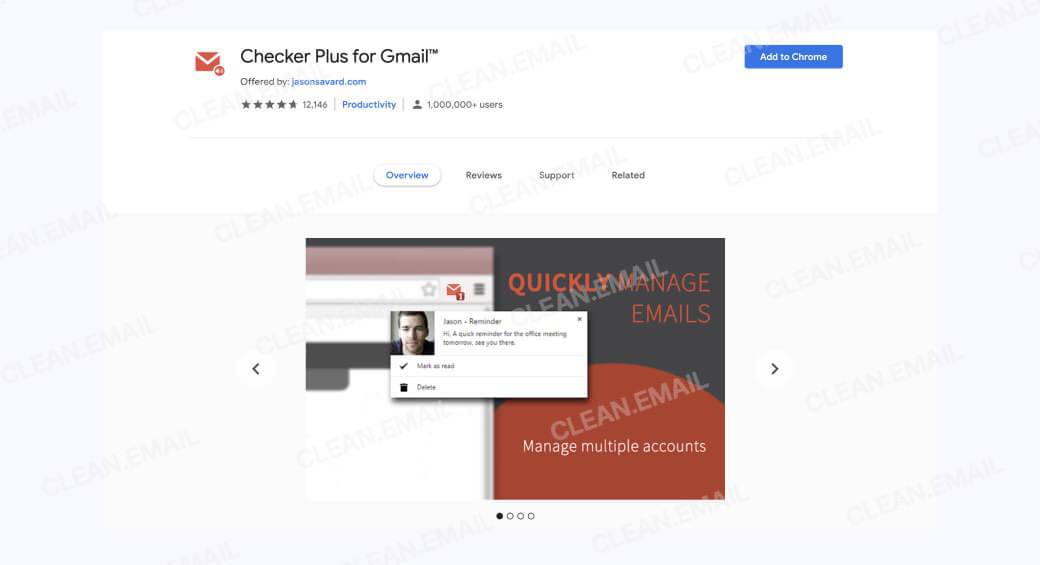
Checker Plus puts a Gmail button in the Chrome toolbar showing unread counts across every account you are signed into. Desktop notifications include sender, subject, and a preview.
You can read, archive, delete, mark as read, or reply from the notification itself, without opening a Gmail tab.
What it really changes is the tab habit. If you keep Gmail pinned all day so you don't miss anything, this lets you close it.
Skip it if you have one Gmail account and already leave Gmail open. The benefit scales with the number of inboxes you monitor.
- No feature gate, no ads, and no signature injected into your mail
- Handles multiple Gmail accounts cleanly, which is where Gmail's own account switching gets tedious
- Triage actions directly from the notification popup
- Actively maintained: 4.65 on the Chrome Web Store across roughly 12,700 ratings, about 900,000 users
- A browser extension, so nothing carries to your phone
- It notifies and triages. It does not schedule, track, or organize
- Desktop notification permissions must be granted at the OS level, which trips people up on managed work machines
2. Boomerang
Verdict: Worth paying for only if you send emails that need chasing. Gmail has absorbed the rest.
Pricing: 10 credits per month on the free plan. Paid from $4.98/mo billed annually – but that rate covers personal @gmail.com addresses only; Google Workspace accounts start at Pro, $14.98/mo. 30-day trial. Mobile apps are paid-tier only.
Boomerang's original selling point, send later, is now a Gmail feature. What still justifies the subscription is conditional logic Gmail has no equivalent for.
You can return a message to your inbox if nobody replies in three days, get reminded when a thread goes quiet, or pause your inbox until 2pm.
Inbox Pause is the underrated one. It genuinely stops new mail from appearing rather than hiding a badge, and it is the closest thing here to a focus mode for Gmail.
Choose Boomerang if you want follow-up logic and inbox pausing on a personal Gmail account. Choose Right Inbox if you are on Google Workspace, where Boomerang's price jumps and Right Inbox's stays flat.
- Conditional "if no reply" follow-ups that Gmail's snooze cannot replicate
- Inbox Pause, with an option to let through messages matching a filter
- Recurring scheduled messages for weekly reports and check-ins
- Available as both a browser extension and a Workspace add-on
- Much of what once made it essential (send later, snooze) is now native to Gmail
- Mobile access means Boomerang's own app rather than anything appearing inside Gmail
- Its Chrome Web Store rating, 4.2 across roughly 2,100 ratings, is the lowest of the scheduling tools here
3. Todoist for Gmail
Verdict: the cleanest fix for "my inbox is my to-do list," and one of the few tools here that works properly on a phone.
Pricing: 5 projects, 3 filters on free plan. Pro from $5/mo billed yearly ($7 monthly). 7-day trial.
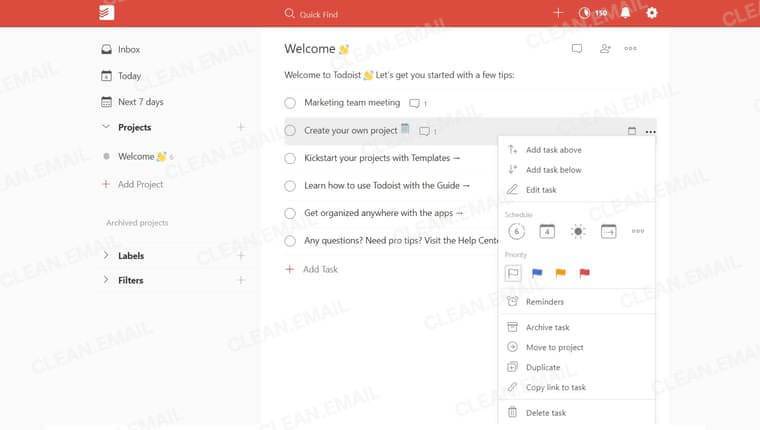
Gmail's built-in Tasks panel can capture an email, but it is web-only and Google Tasks is deliberately minimal. Todoist's add-on captures the message into a real task manager with due dates, projects, labels, priorities, and recurring schedules. The task keeps a deep link back to the thread.
Because it is a Workspace add-on rather than an extension, the capture button appears in the Gmail mobile app too. Note that Todoist retired its separate Gmail Chrome extension in mid-2026; the Marketplace add-on is the supported path.
Choose Todoist if you want a full task manager fed by email. Stick with built-in Gmail Tasks if your list is short, personal, and lives on the desktop.
- Works on desktop and on Gmail for Android and iOS from a single install
- Requests narrow, per-message access rather than standing mailbox permissions
- The task retains a link to the thread, so context is one click away
- Captured tasks carry due dates, projects, labels, and priorities that Google Tasks doesn't offer
- The add-on does not appear on iPadOS or Android tablets, only on phones
- It only helps if you genuinely work out of Todoist. A second task system makes things worse, not better
4. Mailsuite (formerly Mailtrack)
Verdict: the right pick when you want to know whether an email was opened and nothing more.
Pricing: Unlimited tracking on free plan, but it reports only the first open and appends a promotional signature to every message you send – a real cost for client-facing email. Paid from $6.99/user/mo. No trial on paid tiers.
Mailtrack rebranded to Mailsuite, but the product is unchanged in spirit: double check marks next to sent messages, one for delivered and two for read, with an optional dashboard of open history.
It does one thing, which is exactly why it belongs alongside heavier platforms like Mixmax and Streak that bundle tracking into much larger suites.
Choose Mailsuite if tracking is the only thing you need. Choose Mixmax if tracking is one part of a sequenced outreach workflow.
- Double check marks appear inline in your sent list, so status is visible without opening a dashboard
- 4.4 on the Chrome Web Store across roughly 11,800 ratings and about 3 million users, the most widely installed tracker here
- Works in the Gmail mobile app through a companion Workspace add-on once the desktop extension is set up
- Actively maintained, with a store update in August 2026
- Open tracking is unreliable by nature. Image proxying and blocked remote content produce false negatives, and some recipients find it intrusive
- No sequences, no CRM, no scheduling
- The rebrand from Mailtrack means older comparisons and documentation still point at a domain that no longer represents the product
5. Simplify Gmail
Verdict: the only tool here that makes Gmail do less, built by a designer who worked on Gmail's own interface.
Pricing: One-month free trial, no card or account required. From $2/mo billed annually ($3 monthly), covering 10 email accounts per person. Domain-wide plans from $9/mo.
Simplify hides the chat and meet panels, collapses the label sidebar, removes the ad row from the Promotions tab, and tightens spacing until Gmail is close to a plain message list.
It is the clearest example of what a browser extension can do that an add-on cannot: it changes the page itself.
It also stands out on trust. It requests no Google account access at all, because it never touches the Gmail API, only restyles the page in your browser.
Skip it if Gmail's density already suits you, or you read most of your mail on a phone where the extension has no effect.
- No OAuth grant, no mailbox access, no data leaving your browser
- Removes Gmail's inline ads and interface clutter in one install
- 4.5 on the Chrome Web Store across roughly 625 ratings, updated August 2026
- Desktop browser only, and exactly the kind of extension that can break when Gmail ships a redesign
- It changes appearance only. Nothing about how Gmail sorts, filters, or searches is different
6. Grammarly
Verdict: still the default writing assistant, but free Gemini in Gmail has narrowed the gap for US users.
Pricing: Pro is $12/user/month annually, hard to justify if you only write email.
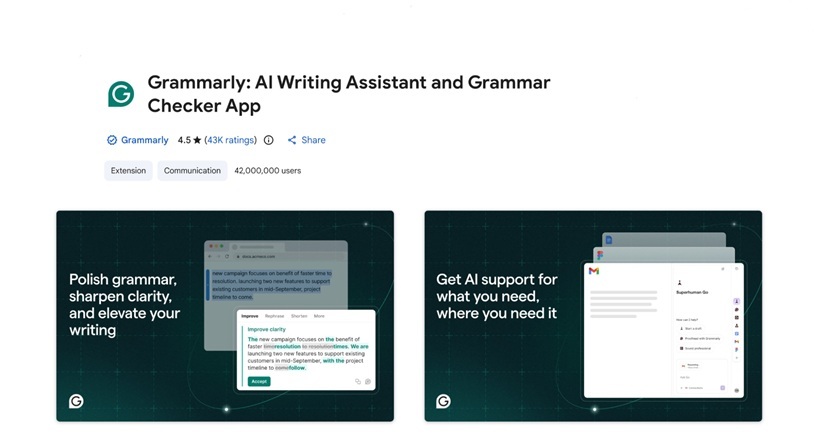
Grammarly's extension surfaces grammar, clarity, and tone suggestions as you compose in Gmail.
Its real advantage was never Gmail-specific: the same assistance follows you into Slack, LinkedIn, Google Docs, and every text field in the browser.
Two 2026 changes are worth knowing. Grammarly's parent company rebranded to Superhuman, though the product keeps its name, and the old Premium and Business tiers folded into a single Pro plan.
Skip it if you are in the US on a personal Google account, write almost exclusively in Gmail, and find Gemini's "Help me write" sufficient. That combination is now free.
- Works across the whole browser, not just Gmail, which is the main argument against relying on Gemini alone
- Tone detection and rewrite suggestions well beyond spellcheck
- 4.5 on the Chrome Web Store across roughly 43,100 ratings, with about 36 million users
- Catches issues in the compose window as you type, so nothing has to be pasted elsewhere
- As a browser extension it reads what you type in the compose window, a broader permission surface than most tools here
- Overlaps heavily with Gemini's built-in writing help if Gmail is the only place you write
- Nothing carries into the Gmail mobile app; on a phone you need the separate Grammarly Keyboard
7. Hiver
Verdict: the shortest path from a shared support@ address to a working help desk, if your team is happy with Gmail as the interface.
Pricing: Free plan: 1 shared inbox, 1 tag, 1 template. Paid from $25/user/mo billed annually with a two-seat minimum, putting the practical floor at $50/mo. 7-day trial on the top tier.
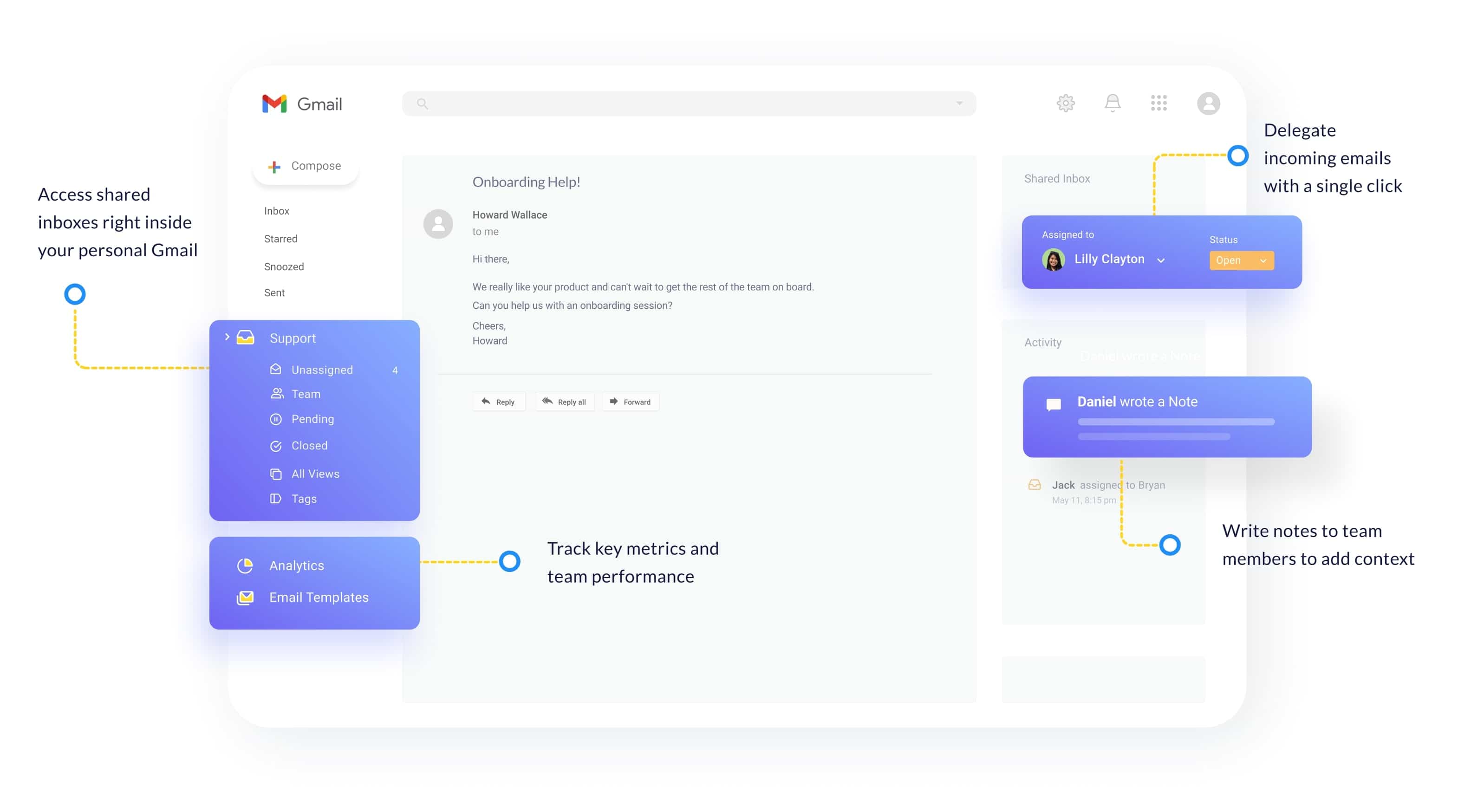
Hiver layers shared inboxes, assignment, internal notes, collision detection, SLA tracking, and reporting directly into Gmail.
Agents keep working in an interface they already know. That is the entire pitch: onboarding a non-technical support team onto Hiver is far easier than migrating them to Zendesk.
The change is visible immediately. Shared inboxes appear in the left sidebar, each email carries an assignee and a status, and internal notes sit in the thread where replies would go.
Choose Hiver if your priority is getting a support team productive quickly. Choose Gmelius if you need automation rules, Kanban boards, and deep Slack or Trello integration.
- Genuinely low onboarding friction for teams that do not want a separate help desk product
- Collision detection prevents two agents replying to the same customer
- Native Hiver mobile apps for iOS and Android, so agents are not tied to a desktop browser
- 4.6 on the Chrome Web Store, with a listing updated in August 2026
- Built entirely around teams; there is no meaningful single-user configuration
- Automation is deliberately simpler than Gmelius. Teams wanting branching rules will hit the ceiling
- Everything runs through Gmail, so a Gmail outage takes your help desk with it
8. Gmelius
Verdict: Hiver's more configurable counterpart, and the better choice when the workflow matters more than the onboarding.
Pricing: No free plan. Paid from $19/user/mo billed annually ($21 monthly); 7-day trial.
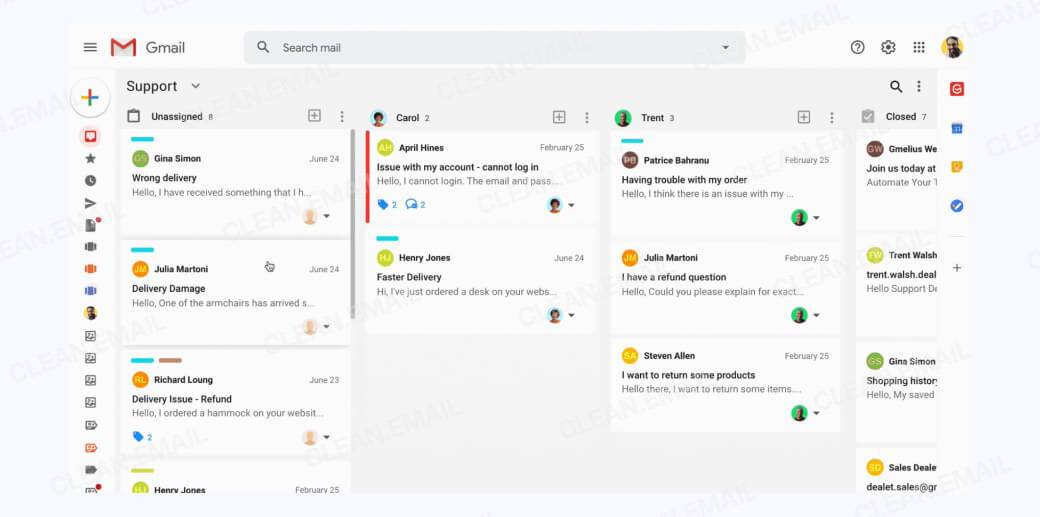
Gmelius covers the same shared-inbox ground as Hiver, then adds rule-based automation, visual Kanban boards built from email threads, sequences, and two-way sync with Slack and Trello.
A team can route incoming mail by keyword, escalate on SLA breach, and mirror a thread into a Trello card without leaving Gmail.
The cost of that flexibility is setup time. Gmelius rewards a team that will sit down and design its workflow.
Choose Gmelius if you want the inbox to run rules on your behalf. Choose Hiver if you want agents answering tickets on day one and mobile parity matters.
- Automation rules that meaningfully reduce manual triage on a busy shared inbox
- Kanban boards that turn an email queue into a visible pipeline
- Slack and Trello sync that keeps email work visible where the team already works
- Sequences and shared templates sit alongside the shared-inbox features, so support and outreach live in one tool
- On mobile it offers a progressive web app rather than an integration inside the Gmail app
- More configuration surface means more that can be set up badly
- Its breadth overlaps with tools a team may already run, which can duplicate work rather than replace it
9. Mixmax
Verdict: a full sales engagement platform that happens to live in Gmail, and priced accordingly.
Pricing: 20 tracked emails and 50 sequence recipients per month on free plan. Paid from $29/user/mo billed annually ($34 monthly); 14-day trial, no credit card.
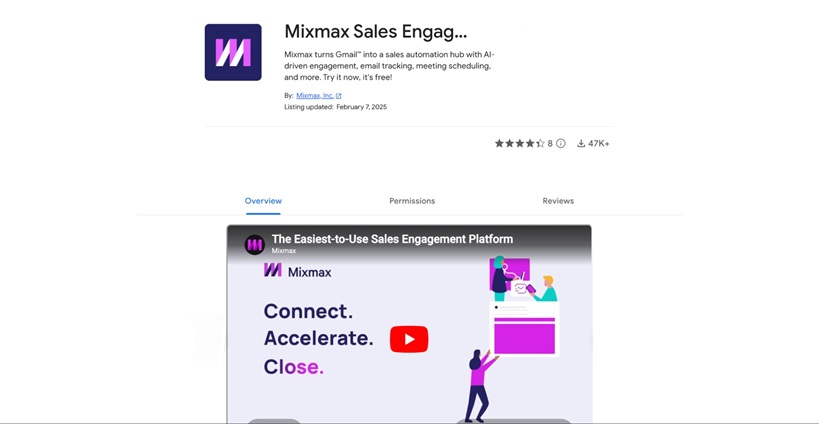
Mixmax combines multi-step sequences, templates, open and click tracking, one-click meeting scheduling, in-body polls, and CRM sync.
For a rep who works out of Gmail, it removes the need for a separate outreach tool entirely.
It is also the tool most likely to hit Gmail's own ceilings. Sequences sent through your account are subject to Gmail's daily sending limits, and exceeding them gets your account temporarily restricted.
Choose Mixmax if outbound sequences are your job. Choose Streak if your problem is tracking relationships over months rather than campaigns over days.
- Sequences with conditional branching based on opens, clicks, and replies
- Embedded scheduling that removes the back-and-forth of finding a meeting time
- Deep Salesforce and HubSpot sync, so activity logs itself
- Polls, surveys, and calendar availability embed directly in the message body
- Overkill for anyone not doing outbound – most of the platform goes unused
- A Chrome extension that does not work in the Gmail mobile app; the vendor confirms this
- Sending through your Gmail account means Google's limits, not Mixmax, set your real ceiling
- Setup is substantial. This is a platform, not a utility
10. Streak
Verdict: still the most natural CRM for people who refuse to leave their inbox, but the 2024 removal of the free tier changed who it is for.
Pricing: The free plan covers email power tools only (the free CRM tier was discontinued in 2024). CRM plans from $49/user/mo billed annually ($59 monthly), by a wide margin the most expensive recommendation in this guide. 14-day trial.
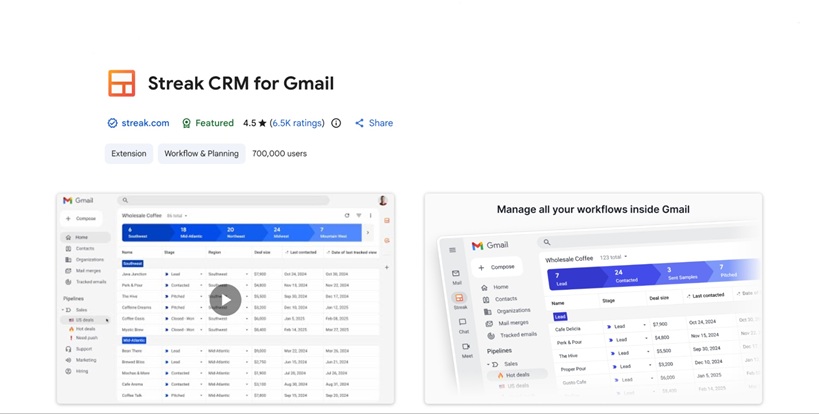
Streak builds pipelines directly into Gmail. Threads become entries with custom stages and fields, contact history is visible in the thread, and the whole thing is shareable.
For hiring, fundraising, partnerships, and long-cycle sales, where the relationship is the record and email is the medium, it fits better than a standalone CRM nobody updates.
Be clear-eyed about scale. If your real need is emailing the same set of people repeatedly, you can create a group email in Gmail and skip the CRM entirely.
Choose Streak if Gmail is genuinely where your deals live and the budget isn’t a constraint.
- Pipelines that live where the conversations already happen, which is why the data actually gets updated
- Streak's own iOS and Android apps, plus a companion Workspace add-on
- 4.5 on the Chrome Web Store across roughly 6,500 ratings and about 600,000 users
- Flexible enough to model non-sales processes, which is where it beats a conventional CRM
- Pipeline data lives inside Streak, so leaving means exporting rather than simply uninstalling
- The core product is a Chrome extension, so the desktop experience is browser-bound
- Reporting is thin next to a real CRM. Streak manages relationships; it does not analyze a funnel
11. Dropbox for Gmail
Verdict: narrow, free, well-maintained, and genuinely useful to exactly one audience.
Pricing: The add-on is free. Useful storage requires a paid Dropbox plan: Dropbox Basic is 2 GB, and paid storage starts at $9.99/mo (annually) or $11.99/mo (monthly).
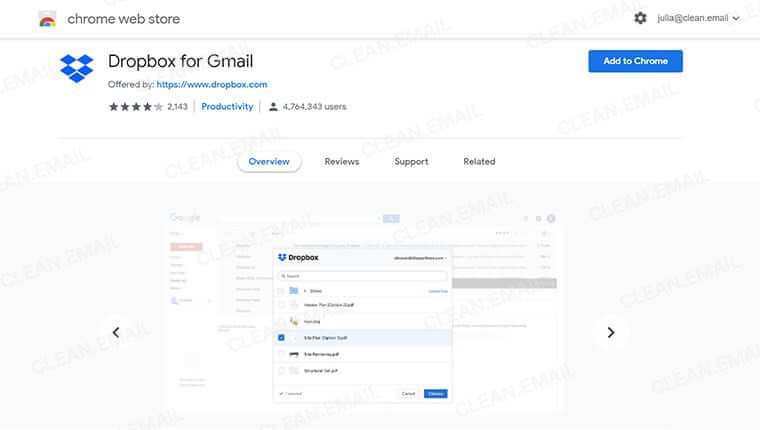
The add-on inserts Dropbox files as links from the compose window and saves incoming attachments to Dropbox without downloading them first.
If your organization standardized on Dropbox while your email standardized on Gmail, this closes an irritating daily gap. If you are on Google Drive, Gmail's native integration already does it better.
Skip it if Drive is your file store. There is no reason to add a second integration for the same task.
- A Workspace add-on, so it works in the Gmail mobile app on both Android and iOS
- Sending links rather than attachments sidesteps Gmail's 25 MB ceiling
- Actively maintained: listing updated January 2026, with over two million installs
- Entirely redundant if your files are in Google Drive
- It surfaces files and saves attachments. It does not preview, comment, or manage permissions from inside Gmail
12. WiseStamp
Verdict: solves a real branding problem that Gmail solves badly, but check the pricing before recommending it internally.
Pricing: There is no free plan. Legacy free accounts are grandfathered but can no longer be created, and many published comparisons still list one incorrectly. Paid from $9/mo billed annually for a single seat; 14-day trial, no credit card.
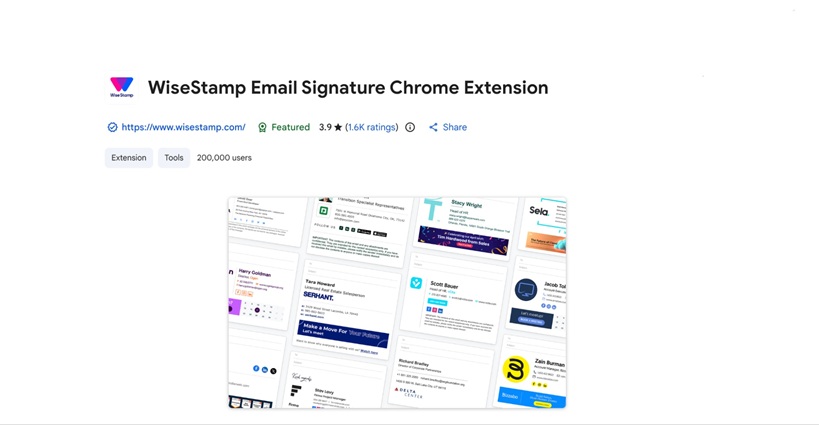
Gmail supports multiple signatures on the web and a single plain-text signature on mobile, and formatting anything elaborate in its editor is miserable.
WiseStamp builds designed signatures with logos, social icons, disclaimers, and promotional banners, and deploys a consistent one across a team.
Skip it if you are one person who needs one tidy signature. Gmail's built-in editor handles that for free.
- Signature templates that look professional without hand-written HTML
- Campaign banners in the signature, a low-effort marketing channel most teams ignore
- Central deployment, so departures and title changes are updated once
- Handles legal disclaimers and per-department variants without each person editing their own HTML
- Its 3.91 Chrome Web Store rating across roughly 1,600 ratings is the lowest of anything recommended here
- The signature is written into your Gmail settings, so you are buying a design and management tool rather than a live integration
- Gmail keeps a separate mobile signature, so a designed signature won't appear on mail you send from your phone
13. Right Inbox
Verdict: a competent all-in-one for individuals, but it now sits behind more focused tools rather than ahead of them.
Pricing: 5 emails per month per feature on free plan. Paid from $7.95/user/mo billed annually ($9.95 monthly) – the same rate on personal Gmail and Google Workspace, which is where it beats Boomerang for business accounts.
Right Inbox bundles tracking, send later, follow-up reminders, templates, sequences, notes, and a signature builder into one extension at a flat per-user price.
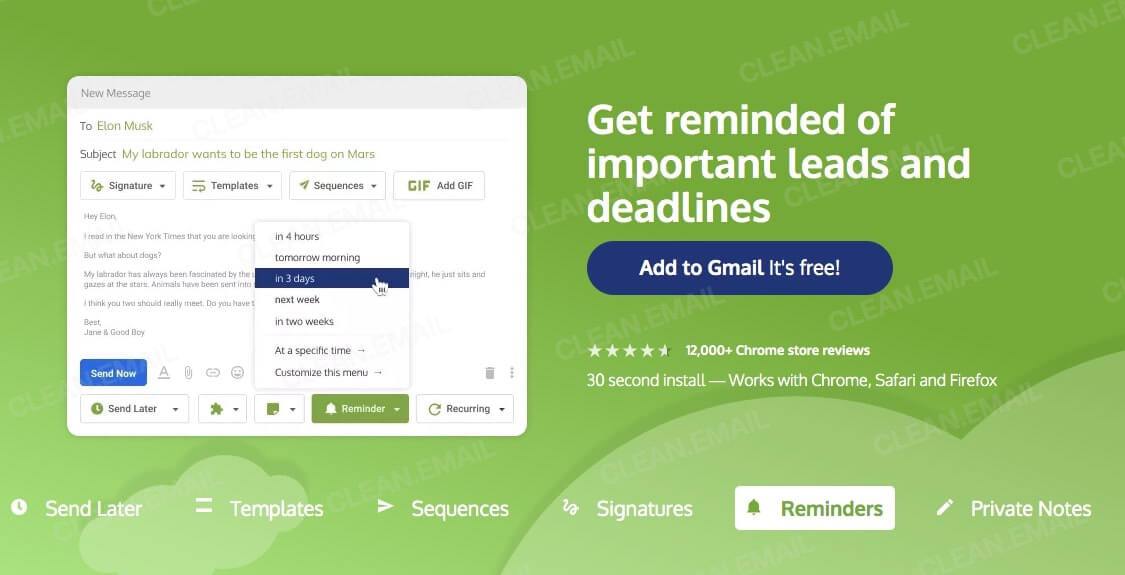
Nothing in it is best-in-class, and that is the point. A freelancer who needs a bit of each is better served by one subscription than by four.
Choose Right Inbox if you want one modest subscription covering several needs. Choose other specialized add-ons if one of those needs clearly dominates.
- One tool covers tracking, scheduling, reminders, templates, sequences, notes, and signatures
- 4.6 on the Chrome Web Store across roughly 12,300 ratings; listing updated January 2026
- Available for Chrome, Firefox, and Safari, unusual in this category
- Productive within minutes, unlike Mixmax
- A browser extension, so it does not appear in the Gmail mobile app
- Every individual feature is beaten by a specialist: Mailsuite tracks better, Boomerang's conditional logic is stronger, Mixmax's sequences are far more capable
- Built for one sender. There is nothing here for a shared or team workflow
Which Gmail Add-On Should You Choose?
Work from the problem, not the product:
- You miss messages across several Gmail accounts: Checker Plus, free.
- You send emails that people don't reply to: Boomerang on personal Gmail, Right Inbox on Workspace.
- Your inbox has become your to-do list: Todoist's add-on if you already use Todoist; Gmail Tasks if you don't.
- You just want to know if an email was opened: Mailsuite.
- Gmail feels visually noisy: Simplify Gmail.
- You share a support@ or sales@ address: Hiver for speed of adoption, Gmelius for automation.
- You run outbound campaigns: Mixmax.
- Gmail is effectively your CRM: Streak if the price is justified.
- Your writing needs a second pair of eyes: Gemini in Gmail first, Grammarly if you write outside Gmail too.
- You have 60,000 unread emails and no storage left: None of the above. See our comparison of tools for cleaning up a Gmail inbox.
When Gmail Add-Ons Aren’t Enough
Everything above improves email going forward. None of it touches the 40,000 messages already in your account. That is structural, not a gap in any one product. Add-ons act on the message you have open. Extensions act on what is rendered on screen. Neither is built to evaluate a mailbox in bulk.
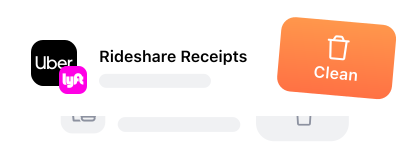
Clean Email is a connected app, not an add-on or an extension. It does not appear inside Gmail. It connects to your mailbox and gives you its own interface, where mail is grouped into bundles you act on together.
The features that matter at scale:
- Smart Folders group mail by sender type, topic, or message purpose, so you could view related messages together without manually creating folders or moving emails.
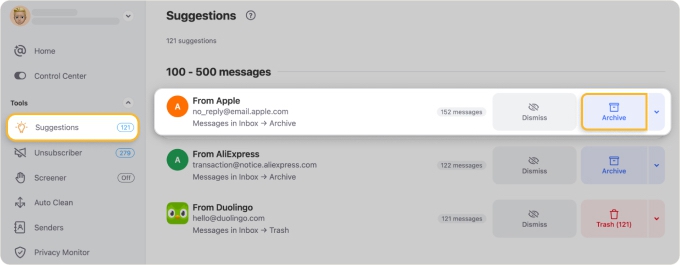
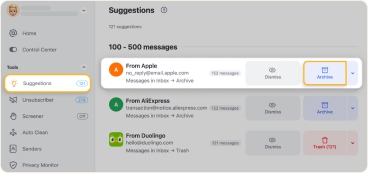
- Cleaning Suggestions identify groups of emails you may want to clean up based on your previous actions.
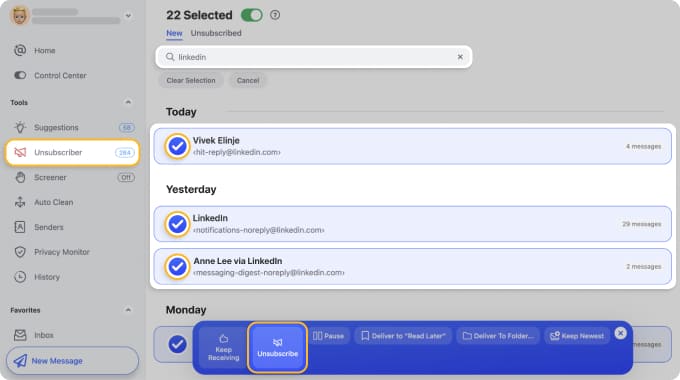
- Unsubscriber lets unsubscribe from emails in bulk and remove the messages they have already sent.
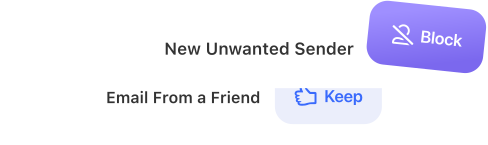
- Screener holds mail from senders you have never received from until you choose to allow or block them.
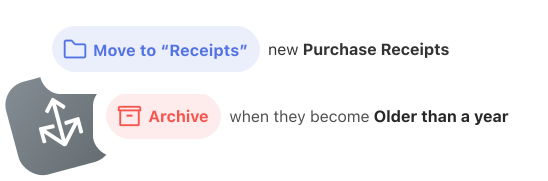
- Auto Clean automatically applies predefined actions to incoming mail, helping keep the inbox organized over time.
It works with Gmail and any IMAP account, as a web app and as native macOS, iOS, and Android apps.
Privacy note: Clean Email accesses email headers and metadata needed to organize your inbox, but not message bodies or attachments. It doesn’t sell user data, uses OAuth2 for Gmail access, and complies with GDPR and CCPA.
✅ Use Clean Email when the problem is volume. Use the Gmail extensions above when the problem is workflow.
If the browser itself is the problem
Every extension here is tied to a desktop browser, which is a real constraint if you would rather not run Gmail in a tab at all.
A dedicated desktop client is often the better answer, giving you unified accounts, offline access, and native notifications without a single extension. We compare the options in our reviews of the best Gmail apps for Mac and the best Gmail clients for Windows.
⚠️ The tradeoff: most third-party clients cannot render Gmail's add-on panel, so you gain a native app and lose the integrations.
Do Gmail add-ons work on mobile?
It depends entirely on the type:
✅ Workspace add-ons: yes. They appear as a row of icons at the bottom of an open message. Install once on the web and they follow your account. Here: Todoist, Dropbox, and Mailsuite's companion add-on.
❌ Browser extensions: no. Not in the Gmail app, and not in mobile Chrome. Checker Plus, Simplify, Mixmax, and Right Inbox are desktop-only.
✅ Connected apps: yes, if the vendor ships one. Hiver, Streak, Boomerang, and Clean Email all have their own mobile apps, which is a different thing from working inside Gmail. For example, here is the Clean Email app for iPhone.
How many should you install?
Fewer than you want to. There is no hard limit, but three costs accumulate:
- Permission surface: Every grant is a standing key to your mailbox. Five tools with mailbox access is five vendors whose security is now your security.
- Browser performance: Extensions all inject code into the same page. Several at once measurably slows a heavy inbox and makes breakage harder to diagnose.
- Overlap: Mixmax, Streak, Right Inbox, and Mailsuite all track opens. Running more than one produces duplicate pixels and contradictory data.
The Bottom Line
Install less than you think you need. Check Gmail's native features first: scheduled send, snooze, templates, subscription management, and free Gemini writing help on US personal accounts now cover a large share of what this category used to sell.
Then add one tool for the problem you actually have. Checker Plus if you juggle accounts. Boomerang or Right Inbox if your emails need chasing. Hiver or Gmelius if a team shares an inbox. Streak if Gmail is your CRM.
And if the real issue is that there are simply too many emails, no add-on will fix that. Clean the mailbox first, then decide what is worth installing on top of it.
If the answer turns out to be something bigger than a Gmail integration, our wider roundup of email productivity tools compares clients, schedulers, and cleanup services side by side.