Quick Summary
- Install Gmail as a web app from Safari or Chrome if the Gmail interface suits you and the only problem is that it lives in a browser tab. This costs nothing and takes under a minute.
- If you want a native Mac client, start with Apple Mail, which is already installed and supports every account you own. Choose Mimestream if all of your accounts are Google accounts and you want the closest match to Gmail's own behavior, or Thunderbird if you want a free client with a complete local archive. Canary Mail, MailMate, and Spark address narrower requirements, each covered below.
- If the interface is not the difficulty and the volume of mail is, an inbox management tool such as Clean Email addresses that directly.

How We Evaluated These Apps
Each option was assessed against six criteria that determine everyday use on a Mac:
- Availability and development activity. Applications with no release in the past two years were excluded from the recommendations.
- Pricing & prices and system requirements change. Every figure in this article was verified in August 2026.
- Minimum macOS version and Apple Silicon support.
- Gmail feature coverage, specifically labels, category tabs, search operators, and server-side filters.
- Offline access to mail.
- Account types supported, since several of these applications accept Google accounts only.
Gmail Apps for Mac at a Glance
Each row matches a requirement to the option that meets it most directly.
| Requirement | Recommended option | What the free version allows | Paid price | Main limitation |
|---|---|---|---|---|
| The Gmail interface in a dedicated window | Gmail installed as a web app | Everything, permanently | - | Offline mail requires a Chrome browser window |
| A free client that is already installed | Apple Mail | Everything, permanently | - | Labels become mailboxes and category tabs are unavailable |
| A native Mac client for Google accounts | Mimestream | 14-day trial only | $49.99 per year or $4.99 per month | No free tier and no support for other providers |
| A free client with a full local archive | Thunderbird | Everything, permanently | - | Labels appear as folders, so tagged mail is listed twice |
| Gmail alongside other providers, with encryption | Canary Mail | Unlimited accounts on 2 devices, permanently | $36 or $100 per year | Encryption and AI features require a paid plan |
| Extensive rules, filtering, and keyboard control | MailMate | All features, permanently, with a line added to outgoing mail | $10 per quarter | Significant learning curve |
| Automated sorting across several mailboxes | Spark | Unlimited accounts, permanently | $99 or $199 per year | AI features require a paid plan |
| Bulk cleanup and mailbox automation | Clean Email | Free tier with up to 1,000 emails cleaned, 14-day trial of Premium features | Per mailbox, monthly or yearly | Organizes the mailbox, does not replace the client |
Ways to Run Gmail on a Mac
The term "Gmail app" covers three different arrangements on macOS. The distinction determines what carries over and what does not.
- Browser tab. Gmail runs in Safari or Chrome alongside everything else you have open. Nothing is installed.
- Installed web app. Safari and Chrome can install the Gmail site as standalone software with its own window, Dock icon, and notifications. The page itself is unchanged, so the Gmail interface behaves as it does in the browser. Offline access is the exception and is covered separately below.
- Desktop email client. A separate application such as Apple Mail, Mimestream, or Thunderbird connects to your Google account and presents its own interface. Clients add local storage and native performance, and they alter how Gmail labels and categories are displayed.
A fourth category sits outside these three. Inbox management tools such as Clean Email connect to the account and reorganize the mailbox itself, independently of the application used to read mail.
Best Apps for Gmail on Mac
1. Gmail as a Mac web app
Price: Free, with no account or usage limits
- Requires macOS 14 Sonoma or later for Safari, any current version for Chrome
- Apple Silicon: Yes
- Accounts: Google only
- Offline: Chrome browser window only
Verdict: The closest equivalent to an official Gmail app for Mac, and the appropriate starting point for most users.
Safari and Chrome can both install mail.google.com as standalone software. It opens in a dedicated window, appears in the Dock, and supports macOS notifications and unread badges.
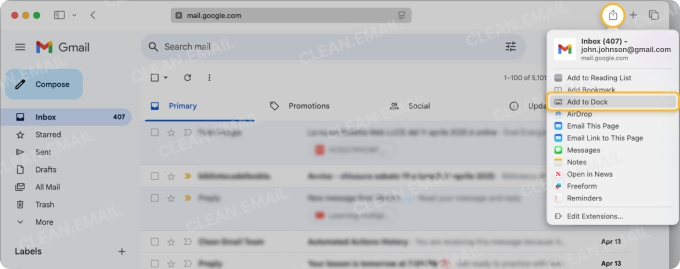
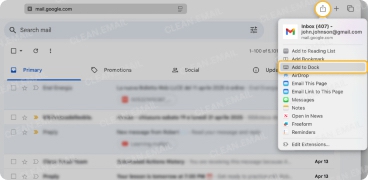
Install Gmail as a web app in Safari (macOS Sonoma or later)
- Open mail.google.com in Safari and sign in.
- In the menu bar, select File, then Add to Dock.
- Adjust the name if required, then click Add.
- Gmail opens in a dedicated window and the icon remains in the Dock.
Install Gmail as a web app in Google Chrome
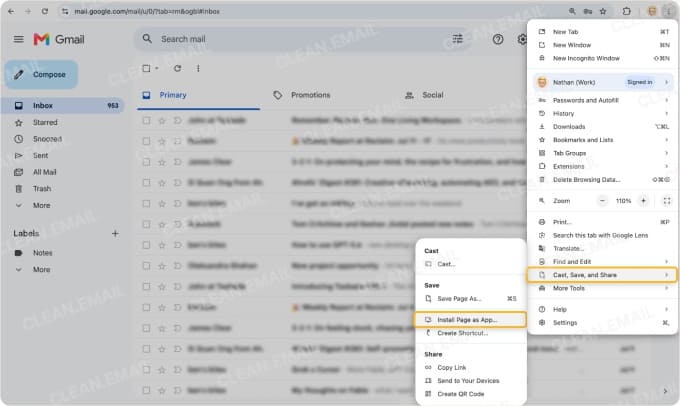
- Open mail.google.com in Chrome and sign in.
- Click the three-dot menu at the top right.
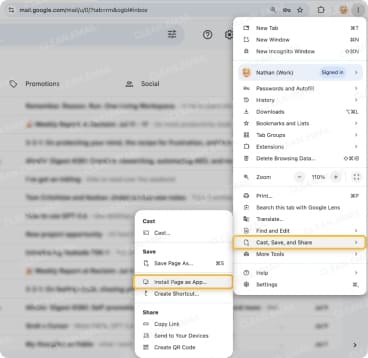
- Select Cast, save, and share, then Install page as app.
- Confirm the name and click Install.
- Control-click the Gmail icon in the Dock and select Options, then Keep in Dock.
Enable Gmail notifications on macOS
- In Gmail, click the gear icon and open See all settings.
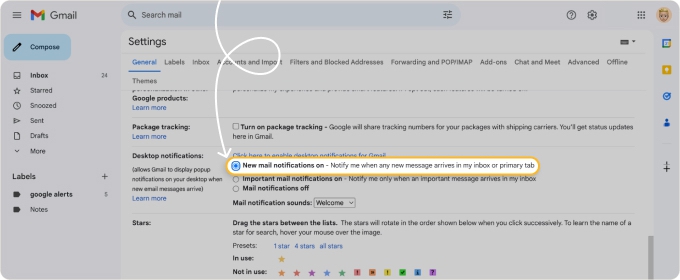
- On the General tab, locate Desktop notifications and enable alerts for all new mail or for important mail only. Select a sound if required.
- Click Save Changes at the bottom of the page.
- Open System Settings, select Notifications, choose the Gmail web app or your browser, and enable Allow notifications.
Approve the permission prompt inside the Gmail web app rather than in the browser, otherwise the Dock icon will not show an unread badge.
📌 Some browsers list a separate Helper process below the main entry, and notifications require both to be enabled. The Gmail window must remain open, although it can be minimized.
Use Gmail offline on a Mac
The one Gmail feature that does not survive the web app route on Safari is offline access. Google supports it in a Chrome browser window only, and not in Incognito or Guest windows, or where Chrome is set to clear cookies on exit.
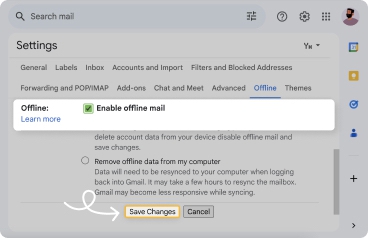
Open Gmail in Chrome, go to Settings → See all settings → Offline → select Enable offline mail, and choose how many days of mail to synchronize.
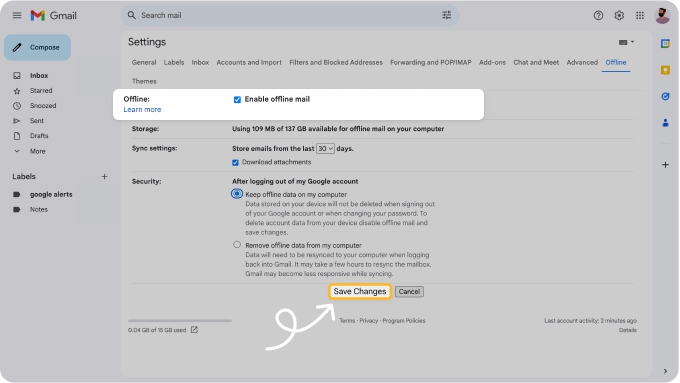
Offline mail applies to the account that was signed in when the setting was enabled. Attachments download but cannot be previewed, and messages written offline are held in an Outbox until the connection returns.
💡 If you regularly work without a connection, a client that stores mail locally is the more reliable choice: Apple Mail, Thunderbird, MailMate, or Mimestream.
Because the interface is Gmail itself, labels, category tabs, search operators, keyboard shortcuts, and add-ons behave exactly as they do in a browser tab, along with any Google Workspace policy applied by your organization.
This is also the only option that receives Gmail's newer features on the day they ship. The thread summaries and inbox search overviews Google added through 2026 exist in the Gmail interface and are not available through IMAP, so no third-party client can display them.
One documented limitation applies. Google supports Gmail offline mode in a Chrome browser window only, so a web app installed from Safari cannot open mail without a connection.
- No cost and no configuration required
- The Gmail interface with no feature translation
- First access to new Gmail features
- Runs on any Mac with a current browser
- Offline access is limited to Chrome
- Cannot combine accounts from other providers
- No local archive of mail
2. Apple Mail
Price: Free, included with every Mac
- Requires any supported version of macOS
- Apple Silicon: Native
- Accounts: Google, iCloud, Microsoft, Yahoo, any IMAP
- Offline: Yes
Verdict: The fastest free option and the only native Apple client, provided you do not depend on Gmail labels or category tabs.
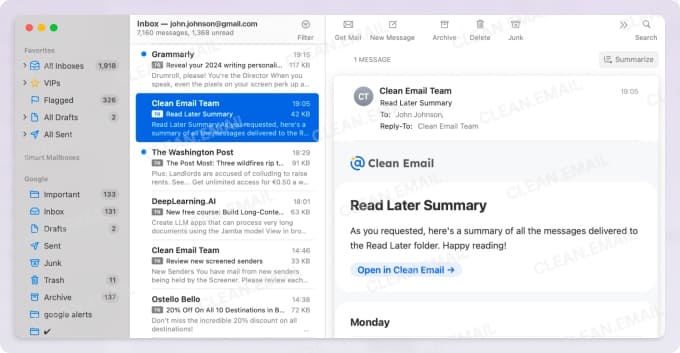
Apple Mail is preinstalled on every Mac and connects to Gmail through Google sign-in. It synchronizes mail, and optionally contacts, calendars, and notes. Messages are stored locally, so reading and search work without a connection, and accounts from other providers sit alongside Gmail in the same window.
Add Gmail to Apple Mail
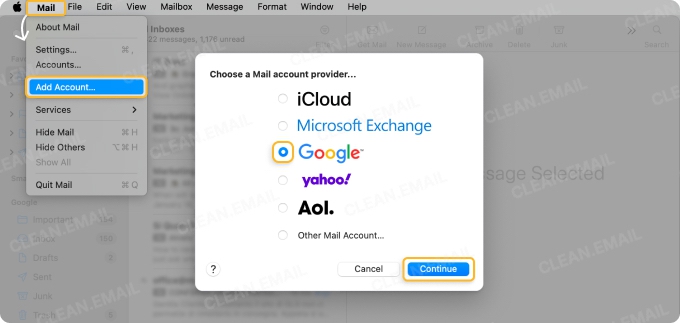
- Open Mail and select Mail, then Add Account.
- Select Google and click Continue.
- Sign in through the Google window that opens and approve the requested permissions.
- Leave Mail selected, add Contacts, Calendars, or Notes if required, then click Done.
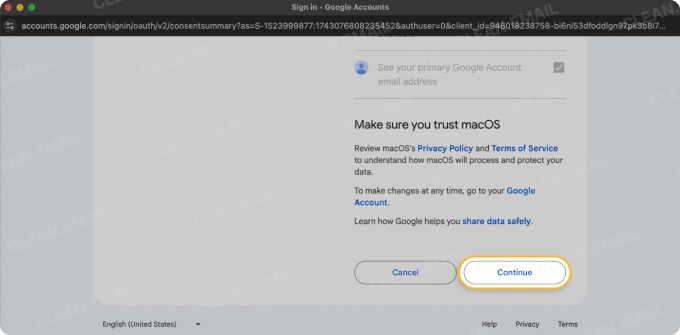
The compromises are specific. Apple Mail maps Gmail labels to mailboxes rather than to labels, and it does not display the Primary, Social, and Promotions tabs. macOS 26 Tahoe applies its own categorization instead, sorting mail into Primary, Transactions, Updates, and Promotions.
Apple Mail also has no snooze function and no way to view or edit Gmail's server-side filters. Scheduled send and undo send are both built in, so those two Gmail habits transfer without difficulty.
- Free and preinstalled on every Mac
- Native performance and full macOS integration
- Full offline access
- Supports every major provider in one window
- Send Later and Undo Send included
- No native Gmail label or category support
- No snooze function
- Cannot manage Gmail server-side filters
📌 Check out our comparison of Gmail vs Apple Mail app to learn the differences between these products.
3. Mimestream
Price: 14-day free trial, then $49.99/year or $4.99/month. No free version after the trial
- Requires macOS 12 or later
- Apple Silicon: Native, universal binary
- Accounts: Google only
- Offline: Yes
Verdict: The strongest paid option for users whose accounts are all Google accounts.
Mimestream is the best Gmail app for Mac because it combines everything you love about this service provider with the convenience and power of a native Mac app.
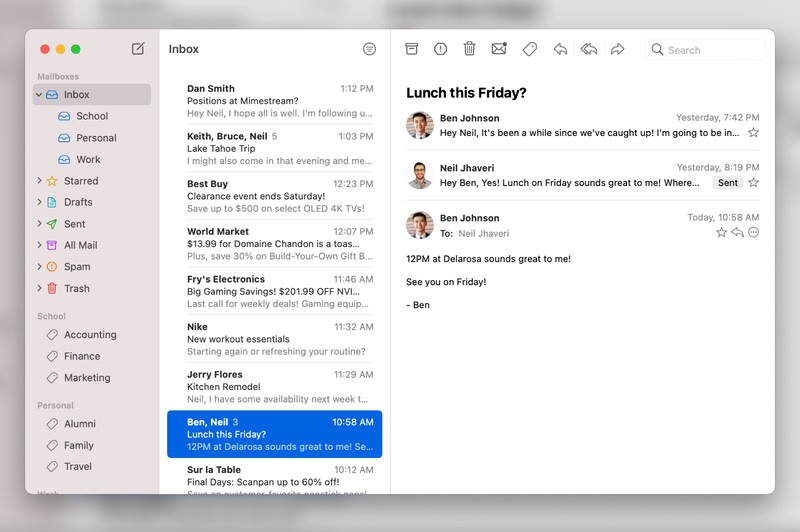
Unlike regular email clients, Mimestream supports only one email service: Gmail. Because this Gmail app for Mac doesn’t attempt to be a Jack of all trades, it leverages the full power of both Gmail and macOS to deliver an instantly familiar experience and a wealth of extra features to boot.
For example, Mimestream lets you easily work with multiple Gmail inboxes, set up email signatures, work with aliases, use keyboard shortcuts, create server-side filters, quickly unsubscribe from unwanted subscriptions, and more.
Server-side filter editing is the detail that separates Mimestream from general-purpose clients, including Apple Mail. It reads and writes the filters stored in your Google account rather than applying its own local rules, so a change made on the Mac takes effect everywhere you read mail.
Releases in 2026 introduced Private Push, which delivers new mail notifications without passing Google credentials through a third-party server.
Its constraints follow from its focus. Mimestream supports Google accounts only, and no free version is available once the trial ends.
- Highly intuitive
- Optimized for latest versions of macOS
- Apple Silicon ready
- Familiar keyboard shortcuts
- Blocks common tracking
- Subscription only, with no free version after the trial
- Google and Google Workspace accounts only
4. Thunderbird
Price: Free and open source, with no paid version
- Requires macOS 10.15 or later
- Apple Silicon: Native
- Accounts: Google, Microsoft Exchange, any IMAP, POP, JMAP
- Offline: Yes
Verdict: The best free client for users who want a complete local archive of their mail.
Thunderbird authorizes with Google and then pulls a full copy of the mailbox onto the Mac, so search and reading remain available offline. It places no limit on the number of accounts and is maintained by MZLA Technologies, a Mozilla subsidiary.
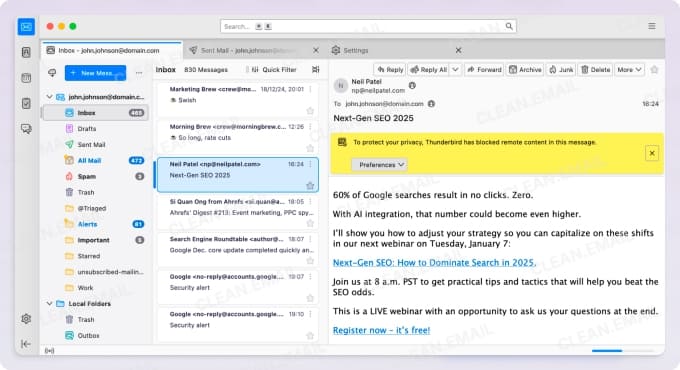
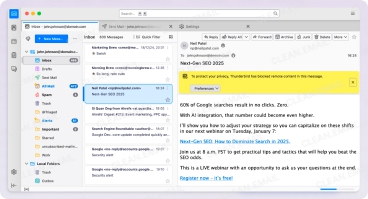
Version 153, released in July 2026, moved the Google sign-in flow into your default browser and added a redesigned account setup screen, which removes most of the friction that older versions were criticized for.
Gmail labels are presented as folders, which means a message carrying two labels is listed in two places. The interface is more utilitarian than the paid alternatives, and initial configuration takes longer.
- Free with no account limits and no paid tier
- Complete offline archive stored on the Mac
- Compatible with any provider
- Open source and actively maintained
- Labels appear as folders
- Utilitarian interface
- Requires more configuration than the alternatives
5. Canary Mail
Price: Free for up to 2 devices with unlimited accounts. Growth $36 per year, Pro+ $100 per year
- Requires macOS 10.15 or later
- Accounts: Google, Microsoft 365, Exchange, iCloud, any IMAP
- Offline: Local sync
Verdict: Suited to users who combine Gmail with other providers and require encryption.
Canary Mail addresses the limitations of traditional Mac email clients by providing solutions to productivity gaps and design shortcomings. Critical features of Canary Mail include seamless encryption for enhanced user security and a suite of productivity tools, including read-tracking and snooze functions.
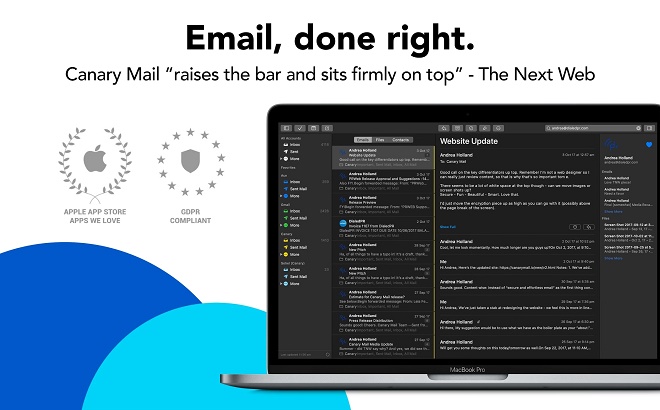
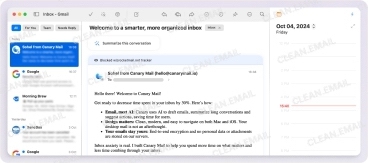
It offers a minimal server footprint, prioritizes data privacy, has universal IMAP support for seamless integration with various email services, and has a stunning design tailored for an intuitive and modern user experience.
The free version covers two devices and an unlimited number of accounts, which is more generous than most free plans in this category. PGP encryption, phishing and impersonation protection, and the Copilot writing tools are limited to the Growth and Pro+ plans.
- Universal IMAP Support
- Unified Inbox
- Advanced Security Features
- Limited third-party integration
- Encryption and AI features require a paid plan
6. MailMate
Price: 14-day trial, then $10 per quarter, approximately $40 per year. A free mode keeps every feature indefinitely and adds one line to outgoing messages. Commercial use requires the paid mode
- Requires macOS 10.12 or later for the 2.0 beta
- Apple Silicon: Native
- Accounts: Any IMAP
- Offline: Yes, full local store
Verdict: The most configurable email client available for macOS, intended for experienced users.
When advanced Mac users are asked how to get a Gmail app on Mac, they often recommend MailMate, a sophisticated email client for macOS whose long list of features includes everything from cryptographic encryption/signing (OpenPGP and S/MIME) to automatic signature handling to flexible integration with third party applications.
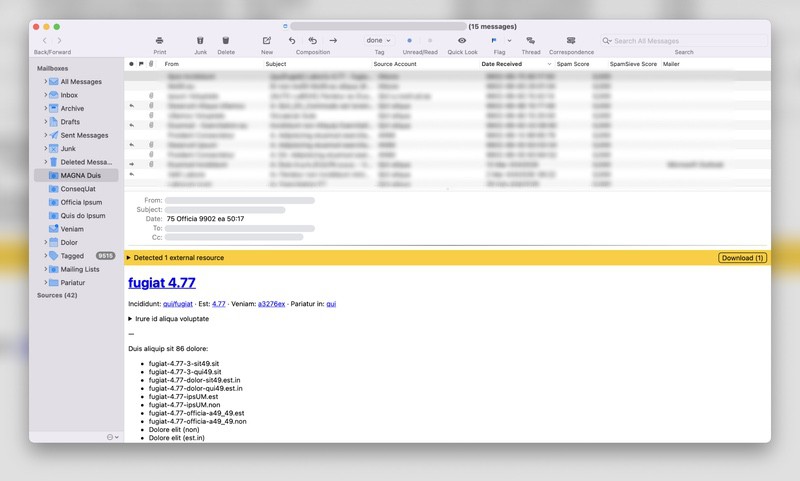
MailMate supports all IMAP-based email services, so you can use it not just with Gmail but also with Outlook, Yahoo Mail, Yandex, and others. Just know that it takes some time to learn its ins and outs, so don’t let the steep learning curve discourage you.
New users should install the 2.0 beta rather than the last public release, which targets considerably older versions of macOS.
The free mode is worth understanding before dismissing the price. Every feature stays available indefinitely, and the only difference is a line added to outgoing messages, which makes MailMate the least expensive way to run a full local mail archive on a Mac.
- Rules and smart mailboxes beyond any comparable client
- Messages stored locally
- Remains usable indefinitely without payment
- Steep learning curve
7. Spark
Price: Free with unlimited accounts and no time limit. Plus $99 per year, Pro $199 per year
- Accounts: Google, Microsoft, iCloud, Yahoo, any IMAP
- Offline: Local cache
- Mobile: iPhone and iPad apps included
Verdict: The most capable free client for users managing several mailboxes at once.
Spark combines Gmail and other accounts in a single inbox and sorts incoming mail automatically. The free plan includes unlimited accounts, the unified inbox, and filtered notifications, with no time limit attached.
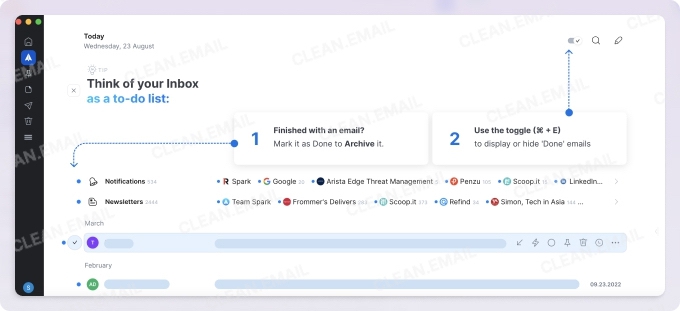
Paid plans add the AI assistant, meeting notes, and shared drafts. Spark also displays Gmail labels, which most clients built outside the Google ecosystem do not.
One point to weigh before adopting it: sorting and AI features are processed on Spark's servers rather than on the Mac. For personal mail this is unremarkable, but it is worth checking against your employer's policy for work accounts.
- Substantial free plan with unlimited accounts
- Unified inbox across providers
- Displays Gmail labels
- iPhone and iPad apps included
- AI and collaboration features require a paid plan
- Message sorting is processed in Spark's cloud
Gmail Feature Compatibility
The four differences that most often surface in the first week after switching:
| Application | Native Mac app | Other providers | Offline access | Labels and category tabs |
|---|---|---|---|---|
| Gmail as a web app | ❌ No, runs in Safari or Chrome | ❌ No | Chrome browser window only | Fully preserved |
| Apple Mail | ✅ Yes | ✅ Yes | ✅ Yes | Labels become mailboxes, no category tabs |
| Mimestream | ✅ Yes | ❌ No | ✅ Yes | Fully preserved |
| Thunderbird | ✅ Yes | ✅ Yes | ✅ Yes | Labels become folders, no category tabs |
| Canary Mail | ✅ Yes | ✅ Yes | Partial | Labels displayed, no category tabs |
| MailMate | ✅ Yes | ✅ Yes | ✅ Yes | Labels as smart mailboxes, no category tabs |
| Spark | ✅ Yes | ✅ Yes | Partial | Labels displayed, no category tabs |
How to Choose the Right Gmail App for Mac
Six questions resolve most cases:
- Do you want the Gmail interface or a different one? If Gmail is satisfactory as it stands, install the web app and no further comparison is necessary.
- Which Gmail features must be preserved? Labels, category tabs, and server-side filters are the three most commonly lost when moving to a general-purpose client.
- Do accounts from other providers need to appear in the same application? If so, Mimestream is not suitable.
- How often do you work offline? Only clients that download mail address this reliably, and the web app route depends on Chrome.
- Which version of macOS are you running? Mimestream requires macOS 12 or later. Thunderbird and Canary Mail require macOS 10.15 or later.
- Is the account managed by an employer? If so, confirm the client is permitted under your organization's Workspace API controls before paying for a license.
What You Give Up by Leaving the Gmail Interface
Every client on this list connects over IMAP or the Gmail API, and both carry a subset of what the Gmail interface does. Four things do not travel.
- Category tabs. Primary, Social, Promotions, and Updates are a Gmail interface feature. No third-party client on macOS reproduces them.
- Server-side filters. Only Mimestream reads and edits the filters stored in your Google account. Every other client, including Apple Mail, applies its own local rules, which run only while that application is open.
- Gmail's newer AI features. Thread summaries and search overviews were added to Gmail through 2026 and are not exposed through IMAP, so a client cannot display them.
- Label structure. Gmail applies several labels to one message. Clients that model mail as folders, including Apple Mail and Thunderbird, have to list that message more than once.
None of this is a reason to avoid a native client. It is the reason to install Gmail as a web app first and confirm which of these you actually use before paying for anything.
When changing clients will not help
Changing your email client changes the interface, not the contents of the mailbox. Archived messages, unread newsletters, and automated notifications synchronize into any new application on first launch, because every client reads the same account. Where the difficulty is volume rather than interface, the appropriate tool is one that reduces the mailbox itself.
Organize Your Gmail Inbox with Clean Email
Even with a dedicated Gmail app for Mac, keeping your inbox organized can still be a challenge as emails continue to accumulate. Clean Email complements any Gmail setup by simplifying inbox management and helping you stay in control without constant manual effort.
Clean Email offers a native Mac app, so you can manage your inbox directly from your desktop. It helps you process large volumes of emails, making ongoing cleanup faster and more consistent over time.
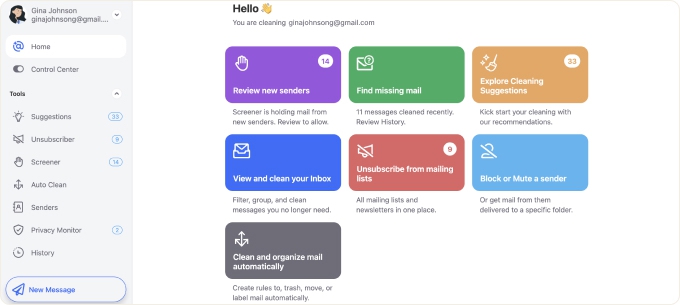
Clean Email is not a full-featured email client and does not replace one. It operates on the mailbox alongside whichever application you select above. The app’s key features include:
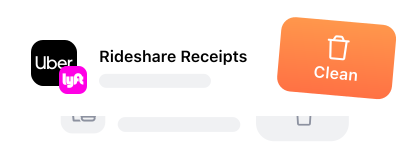
- Smart Folders automatically sort messages into more than thirty predefined groups, including travel, finance, and online shopping, with no manual folder setup.
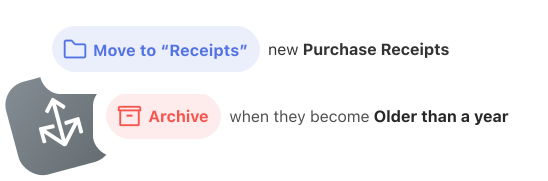
- Auto Clean applies your rules to messages as they arrive, using matching conditions that Gmail filters do not support.
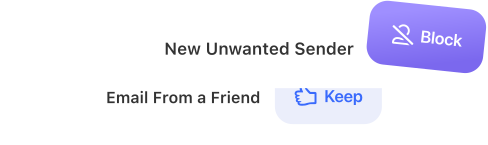
- Screener holds mail from unrecognized senders for review before it reaches the inbox.
- Unsubscriber removes you from multiple mailing lists at once, pauses subscriptions temporarily, and resubscribes on request.
Because these actions are applied to the account rather than to one application, the results are visible in Gmail, in Apple Mail, and on your phone at the same time. The app is also available on the web and mobile, so you can manage your inbox consistently across devices.
Troubleshooting Gmail on Mac
The problems that follow a switch are consistent, and most have a single cause.
❌ Mail will not sync in a new client
Confirm the account was added through Google sign-in rather than with a password. On a work account, check the Workspace API controls described above.
❌ Labels are missing or duplicated
Clients that map labels to folders list a message once per label. In Apple Mail, hide the labels you do not need by deselecting them under the account's Mailbox Behaviors settings.
❌ The Primary, Social, and Promotions tabs have disappeared
Category tabs exist only in the Gmail interface. Use the web app for the tabs, or replace them with rules in the client.
❌ Notifications never appear
Approve the notification request inside the Gmail web app rather than in the browser, then confirm the app is enabled in System Settings, Notifications. Enable the browser Helper process if one is listed.
❌ Gmail opens in a browser tab instead of its own window
The web app was created as a bookmark rather than installed. Repeat the Safari or Chrome steps above.
❌ The account is out of storage
The free 15 GB is shared across Gmail, Drive, and Photos, so large files in Drive can stop mail from arriving. Clearing large attachments in Gmail frees the same quota.
❌ Search returns fewer results than Gmail does
Local search covers only the mail a client has downloaded. Increase the synchronization window in the client, or run the search in the Gmail web app.
Conclusion
For most users, installing Gmail as a web app from Safari or Chrome resolves the original problem at no cost and with no loss of Gmail functionality.
Where a native client is required and every account is a Google account, Mimestream is the strongest option, and the only one that manages Gmail's server-side filters. Where cost is the constraint, Apple Mail is already installed, Thunderbird provides a complete local archive, and Spark handles several accounts in one inbox.
Where the difficulty is the quantity of mail rather than the application used to read it, reduce the mailbox first with Clean Email, then use whichever client you prefer.
Best Gmail App for Mac - FAQs
Is there an official Gmail app for Mac?
No. Google has never released a Gmail desktop application for macOS and has announced no plans to do so. The alternatives are to install Gmail as a web app from Safari or Chrome, or to use a client such as Mimestream, Apple Mail, or Thunderbird.
What is the best Gmail app for Mac?
Apple Mail is the best free option preinstalled with macOS. But for most users, the best option is Mimestream, because it feels native, it is fast, and the only Mac client that manages Gmail's server-side filters. Thunderbird is the best free client with local storage, and MailMate is the most configurable choice for experienced users.
What is the best free Gmail app for Mac?
Gmail installed as a web app costs nothing and behaves identically to Gmail in the browser. Among full clients, Apple Mail is already installed on every Mac, Thunderbird is free and open source, and Spark offers a free plan with unlimited accounts.
Which is better: Apple Mail or Gmail?
The two are not directly comparable. Gmail is the service that holds the mail, and Apple Mail is one of several applications that can display it. Many Mac users run both. Note that the Gmail figure is shared across Gmail, Drive, and Photos, so the space available for mail alone is usually lower.
Why doesn't Gmail have an app for Mac?
All modern Macs come with a web browser, Safari, so Google doesn’t see the development of a native desktop client as a priority, especially since the company already has to support their apps on Android and iOS.
Does Gmail work offline on a Mac?
Google supports Gmail offline in a Chrome browser window only, enabled under Settings → See all settings → Offline. It does not work in Incognito or Guest windows, and a web app installed from Safari has no offline access. For reliable offline use, choose a client that stores mail locally, such as Apple Mail, Thunderbird, MailMate, or Mimestream.
Can I use Gmail labels and filters in a Mac email client?
Labels appear in every client on this list, though clients that model mail as folders list a message once per label. Gmail's server-side filters are different. Only Mimestream reads and edits the filters stored in your Google account. Other clients apply their own local rules, which run only while the application is open.
Can I use Google Docs and other Google apps on Mac?
Google does not publish Mac applications for Docs, Sheets, Slides, Calendar, or Keep. Each can be installed as a web app from Safari or Chrome using the same steps as Gmail, which gives every service its own Dock icon and its own window.