About Categories in iPhone Mail
Similar to Google’s categories for Gmail, Apple introduced categories for Mail with iOS 18.2. This feature allows you to view messages on your iPhone based on four categories. Using these categories, which work like automatic email filters on iOS and Mac, you’ll hopefully have a more organized inbox.
The categories currently include the following:
- Primary: Time-sensitive or personal emails.
- Transactions: Purchase confirmations, shopping receipts, and shipping notifications.
- Updates: Newsletters, social media updates, and news.
- Promotions: Sales, discounts, and coupon-related messages.
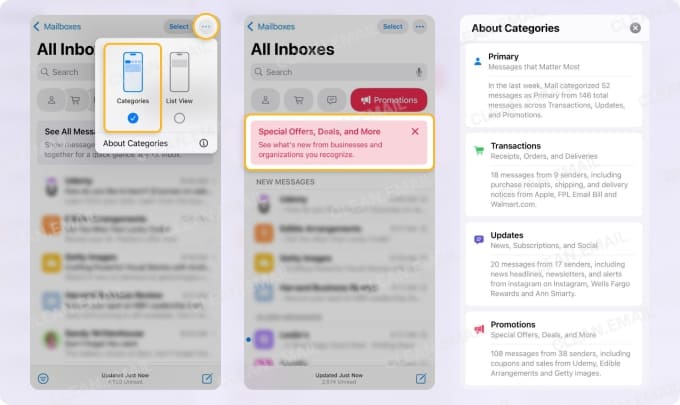
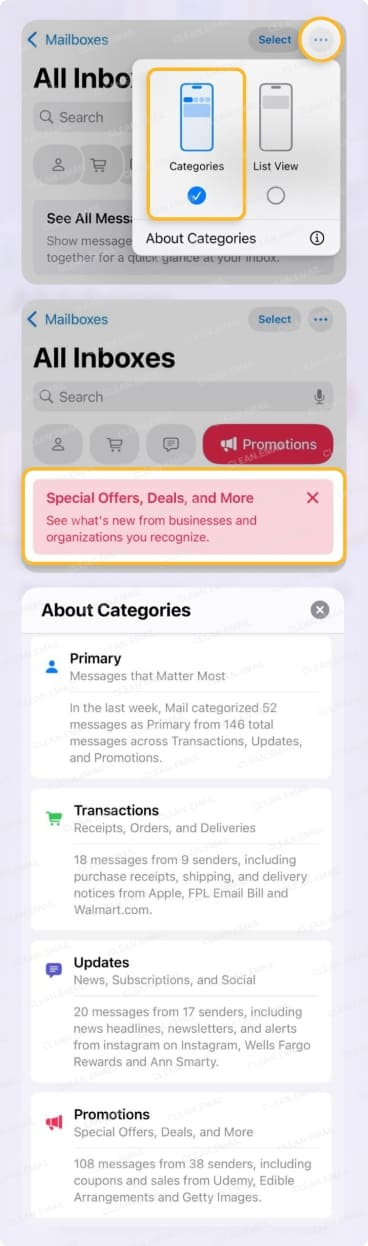
These categories display along the top of your mailbox. Simply tap one and you’ll see all emails that fall into that category. You can also group messages in a category by sender or manually recategorize emails as needed.
How to Turn Off Email Categories on iPhone
While Apple has good intentions with this update to the Mail app, the email categories feature on iPhone isn’t for everyone. Some users find themselves reclassifying messages and others simply believe the categories are distracting.
If you’re in one group or the other, or just don’t want to use them, here’s how to get rid of categories on iPhone email.
- Open the Mail app on your iPhone.
- Choose All Inboxes or a particular mailbox.
- Tap the three dots on the top right and select List View.
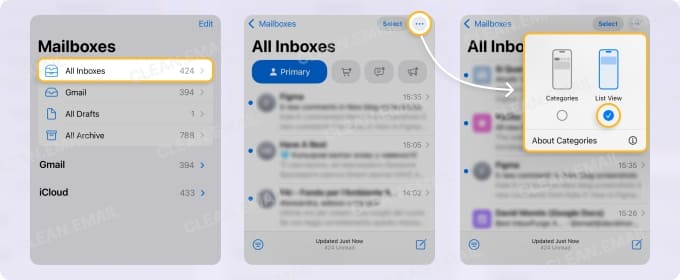
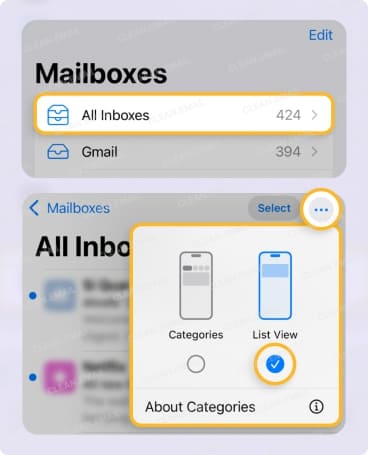
You should see your mailbox refresh to remove the email categories on iPhone and can use the app as you did before. Well, sort of.
You may notice that although you’re using List View instead of Category View that the category icons remain next to your emails. If you find these annoying or consuming excessive screen space, read on for how to get rid of the category icons on iPhone.
Remove Category Icons in iPhone Mail
Before we walk through the steps to remove the category icons in Mail, be aware that there are two caveats.
First, you’ll no longer see the contact photos next to your emails. Second, the setting only applies to icons and photos in your message list, not on individual messages. Unfortunately, these are limitations at the time of this writing.
To remove the category icons, follow these steps:
- Open the Settings app on your iPhone.
- Select Apps and choose Mail.
- Scroll down to the Message List section and turn off the toggle for Show Contact Photos in the Message List section.
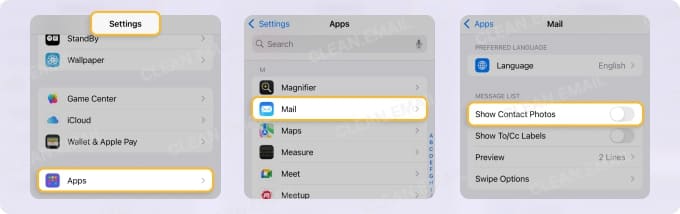
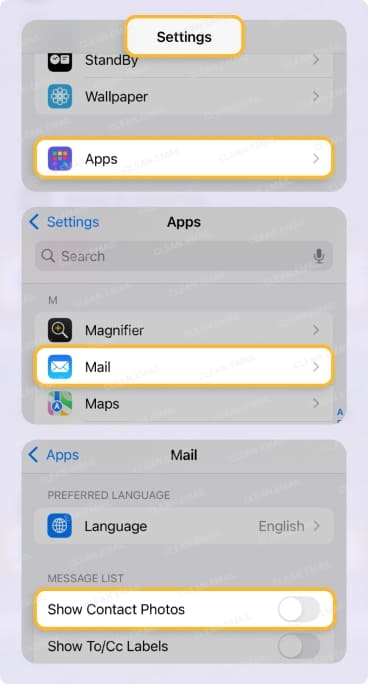
When you return to the Mail app, you’ll no longer see category icons or contact photos next to emails in your message list. But as mentioned, you will still see photos and icons when you open individual emails which is the default.
Clean Email: A Smart Inbox Organizer for iPhone
Whether you like the idea of email categories but find those in Mail too limited or would like alternative ways to organize your mailbox, Clean Email is the solution for you. Using smart features and automations, you can maintain a tidy inbox without sacrificing your time or useful tools.
The app offers Smart Folders as another way to organize your iPhone inbox. These pre-made folders filter related messages, things like Travel, Online Shopping, Newsletters, and Job Search, without moving anything out of your inbox or taking up screen space. Compared with Apple Mail's categories, there are over 30 to choose from rather than four, you view them only when you want to, and you can attach an Auto Clean rule to any folder to move or archive its messages automatically.
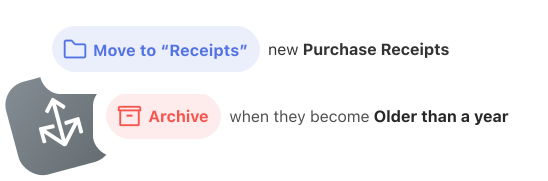
If you'd rather skip categories altogether, Clean Email also helps keep things tidy with rules that handle new and existing mail automatically, cleanup suggestions based on common actions, bulk unsubscribing from mailing lists, and a Screener tool for unknown senders, with more to explore.
Wrap-Up
As mentioned, Apple introduced categories in Mail to provide automatic sorting, mailbox organization, and faster message management. For many, the biggest problem with the feature is the implementation.
Sure, most people would like help with sorting, organization, and email management. But there are alternative email apps for iPhone that provide those functions while offering less limitations and more useful features.