Start With the Problem, Not the Tool
Most inbox tools get picked by brand name. A better approach is to name the problem first, then choose the type of AI that fixes it.
Use the table below as a quick map:
| Inbox problem | What helps | Example tools |
|---|---|---|
| Too many things to act on | AI triage and draft replies | Fyxer, Inbox Zero |
| Too much volume and noise | Automatic sorting and persistent rules | Clean Email, Inbox Zero |
| Messages land in the wrong place | AI labels and email filters | Fyxer, Shortwave |
| Threads too long to read | AI summaries | Gemini, Copilot, Shortwave |
| Work inbox in Gmail or Microsoft 365 | Built-in AI first | Gemini, Copilot |
| Sensitive content in the inbox | Review access before enabling AI | See the privacy section |
💡 Note: You can combine tools. You can use rules to organize routine mail and an AI assistant to review what needs attention.

Which AI Email Organizer Should You Try First?
There is no single best AI email organizer. The right one depends on whether you need summaries, labels, inbox triage, or automatic sorting.
- Use Gmail or Outlook for work? Try the built-in AI first, before installing a separate AI email organizer app. Google Gemini and Microsoft Copilot live inside the email app you already use.
- Have a sorting problem? Try an AI labeling tool. Fyxer and Shortwave focus on automatic labels and filters.
- Too many things to act on? Try a triage tool. Inbox Zero and Fyxer surface what needs a reply and draft responses.
- Want AI help without generative AI reading full messages? Clean Email lets ChatGPT or Claude build persistent organization rules from metadata and sender information.
- Looking for a free AI email organizer? Shortwave has a free tier with usage limits.
What an AI Email Organizer Actually Does
“AI email organizer” is a loose label. Most AI email organizer tools mix several of these functions:
- AI summarizer: Condenses long threads into a few lines, also called email summarization.
- AI sorter: Groups or routes messages by topic, sender, or priority. This is the core of AI email sorting.
- AI labeler: Tags incoming messages with categories automatically, often called auto-labeling.
- AI email filter: Takes actions from plain-English rules, such as label, star, or archive.
- AI email manager: A broader assistant that triages, drafts replies, and helps with scheduling.
- AI inbox assistant: Works across several of these tasks and can act on your behalf when you allow it.
📌 Note: A summary does not change where an email lives. If you want AI tools that organize your inbox automatically, check whether they apply labels, move messages, or maintain rules after the conversation ends.
AI Email Organizers, Tool by Tool
Here is how the main options compare on organization, access, and price. Prices are in USD; annual billing and feature-specific plans are identified where relevant. Plans and features change often, so check the current pricing on each product website before you commit.
| Tool | Best for | AI organization feature | Works with | Privacy / access note | Price and limits |
|---|---|---|---|---|---|
| Gmail + Gemini | Built-in AI for Gmail users | Search, summaries, priority views; label actions where available | Gmail, Google Workspace | Built-in; AI processes message content | Free features; AI Plus $4.99/mo, Pro $19.99/mo; Gmail feature eligibility varies |
| Outlook + Copilot | Built-in AI for Microsoft 365 | Summaries, inbox prioritization, rule assistance where available | Outlook, Microsoft 365 | Built-in; AI processes message content | M365 Personal $9.99/mo; work features depend on license |
| Perplexity | Existing Email Assistant users | Legacy labeling and triage; being deprecated | Gmail or Outlook; Outlook folder limits | Mailbox access; service retirement announced | Max $200/mo or $2,000/year; retiring feature |
| Notion Mail | Former Notion users | Discontinued Gmail client with AI labels and views | Formerly Gmail / Google Workspace | Inbox shut down September 22, 2026 | No current standalone inbox plan |
| Fyxer | Label and priority workflows | Auto-labels, priority inbox, drafts | Gmail or Outlook | Reads messages to organize mail and learn style | Pro $49/person/mo or $37 annually; Free excludes sorting; trial terms vary across vendor pages |
| Inbox Zero | Open-source email automation | Sorts and labels mail through plain-English rules | Gmail, Google Workspace, Outlook | Hosted service or self-hosting; inspect model-provider access | $20 / $35 / $50 per user/mo; 7-day trial, card required |
| Shortwave | Natural-language AI filters | AI filters, bundles, summaries, search | Gmail, Google Workspace; others by forwarding | Full client; AI uses email content | Free; Pro $18/seat/mo without AI filters; Business $30 for 3 filters; 14-day trial |
| Superhuman | Fast triage, organized tabs | Split Inbox, AI auto-labels, triage | Gmail or Outlook | Full client; broad mailbox access | Starter $30/mo; Business $40/mo for Custom Auto Labels |
| SaneBox | Sorting without switching clients | Moves less important messages into folders | Gmail, Outlook, iCloud, other supported IMAP accounts | Sorting uses headers and interaction patterns | Snack $9.49/mo; 1 account, 2 features; 7-day trial |
| Cora | Keeping attention-worthy mail visible | Screens incoming mail; archives the rest for twice-daily Briefs | Gmail, Google Workspace | AI processes email content; standard screening archives mail and prepares drafts for manual sending | $20/mo for 2 accounts or $39/mo unlimited, billed annually |
| Clean Email | AI-assisted rule creation | Claude/ChatGPT rule building + deterministic metadata-based organization | Gmail, Outlook, iCloud, IMAP | Connector uses headers and metadata, not bodies or attachments | Free: 1,000 messages; paid from $9.99/mo for 1 account; 14-day trial, no card |
💡 Note: Other email apps, such as Apple Mail and Spark, add AI writing help and smart inbox touches. Their AI leans toward composing and summarizing rather than sorting, labeling, or triaging your mail, so they fall outside this list.
Gmail + Gemini: best built-in AI for Gmail users
Best for: Gmail and Google Workspace users who do not want to install a new email app.
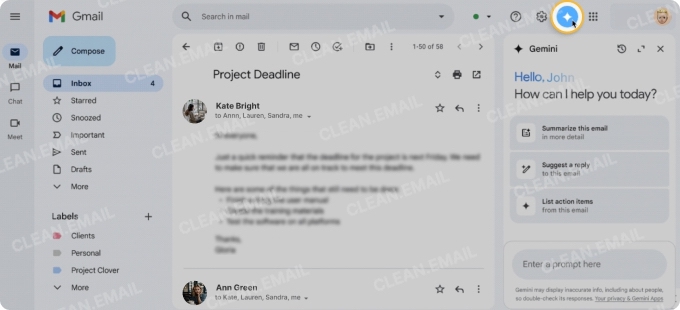
How it organizes email: It works inside Gmail. Gemini does not replace Gmail labels or filters, it adds AI on top.
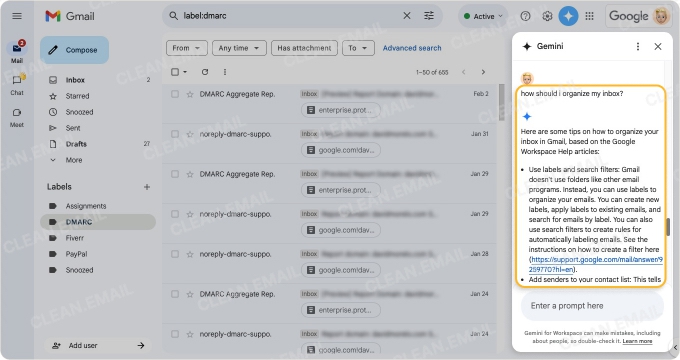
Where AI helps: Gemini in Gmail can summarize threads with AI Overviews, draft messages with Help Me Write, suggest replies, perform Gmail AI search, and answer questions about past emails. AI Inbox highlights to-dos and important updates, but a priority view is not the same as automatically applying labels.
Main limitation: It is mainly an assistant, not a dedicated AI email sorter. Deeper automatic sorting still leans on Gmail categories and filters. Google also describes prompted label actions, but organizational features may not be available to every account.
Who should skip it: People who want hands-off, rules-based labeling across the whole inbox.
Price: Some features are free. Eligible Google AI Plus plans start at $4.99/month, while Google AI Pro is $19.99/month. Workspace access depends on your plan and administrator settings, and Gmail features vary by country and account.
Outlook + Copilot: best built-in AI manager for Microsoft 365
Best for: Outlook and Microsoft 365 users with busy work inboxes.
How it organizes email: It works inside Microsoft Outlook, alongside existing rules and folders.
Where AI helps: Copilot in Outlook can summarize threads, draft messages, and help prioritize your inbox; rule assistance depends on your license and rollout. For supported actions and account requirements, see our guide to AI for Outlook email.
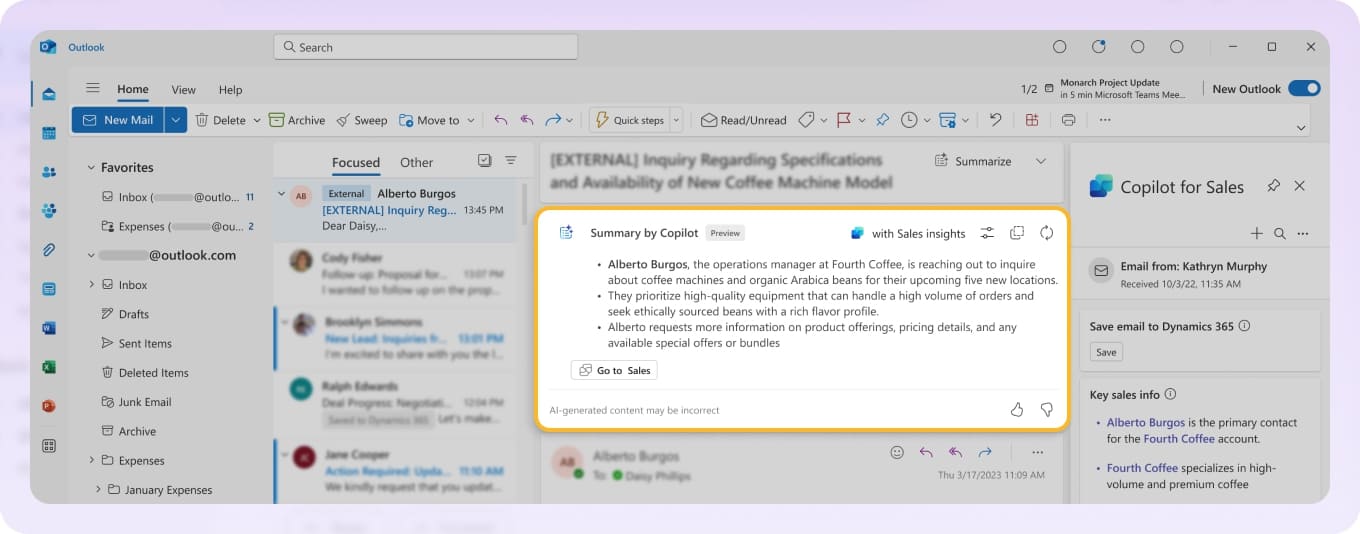
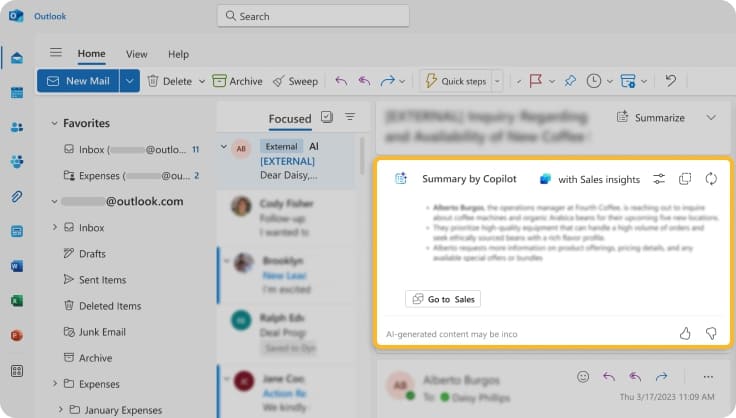
Main limitation: It is a built-in assistant rather than a standalone AI email manager that reorganizes your mailbox on its own.
Price: Microsoft 365 Personal starts at $9.99/month with a one-month trial, but that price does not guarantee every work-account organizing feature.
Perplexity Email Assistant: being retired
Status: Perplexity says its Email Assistant will soon be deprecated. It is included here for existing users, rather than as a new recommendation.
How it organizes email: It was built to label and prioritize messages in Gmail or Outlook, with reply drafts and scheduling alongside organization.
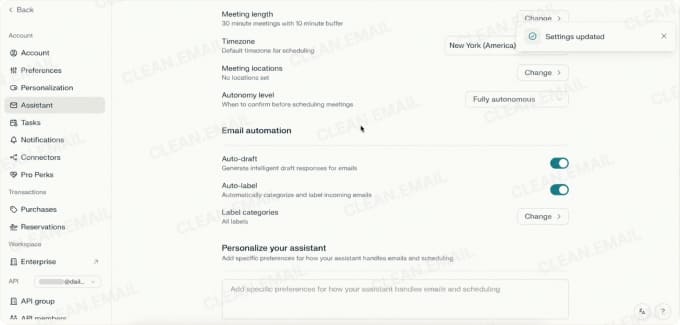
Main limitation: The retirement notice does not give a shutdown date. In Outlook, Email Assistant can categorize Inbox messages and some Sent mail, but not custom folders or messages moved out of the Inbox by rules.
Price: Perplexity Max costs $200/month or $2,000/year. Email Assistant was a Max feature; do not buy the plan solely for this retiring tool. See Perplexity’s retirement notice for the current status.
Notion Mail: discontinued Gmail inbox
Notion Mail used AI to label incoming Gmail messages and organize them into custom views. Its standalone inbox shut down on September 22, 2026, so it is no longer a current AI email organizer to choose; existing mail remains in Gmail. Our Notion Mail review covers the former client.
Fyxer: best for AI labels and priority inbox workflows
Best for: Professionals who want automatic labels and a clear priority inbox.
How it organizes email: Fyxer reads each incoming message and files it into preset action categories such as To Respond and FYI, so your inbox is grouped by what each email needs from you rather than by sender or date.
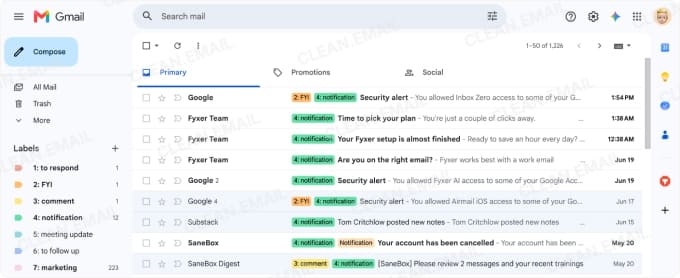
Where AI helps: It auto-labels messages, filters promotional noise, drafts replies in your style, and can summarize. It is an AI email assistant with labeling, not only a sorter.
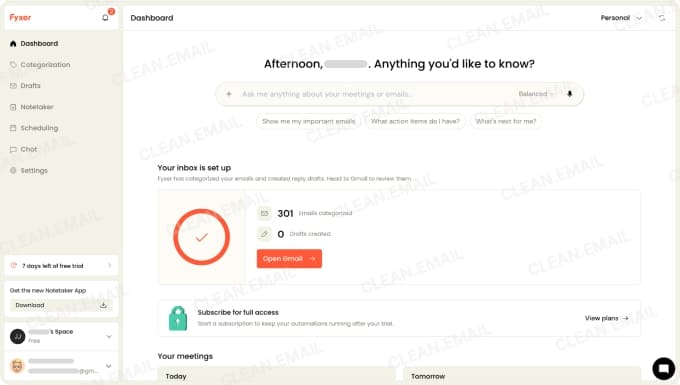
Main limitation: Categories are largely fixed, so you cannot fully customize the labeling logic.
Who should skip it: People who need custom label rules they control directly.
Price: Pro is $49/person/month, or $37/month billed annually. Free excludes automatic labeling and drafted replies. Pro includes 3,000 monthly credits after the introductory unmetered period, with five labeled emails per credit and other actions sharing the allowance. Fyxer advertises a free trial, but its pages conflict on duration and renewal; check the terms presented at signup.
Inbox Zero: best for open-source email automation
Best for: People who want an open-source AI email assistant with the option to self-host.
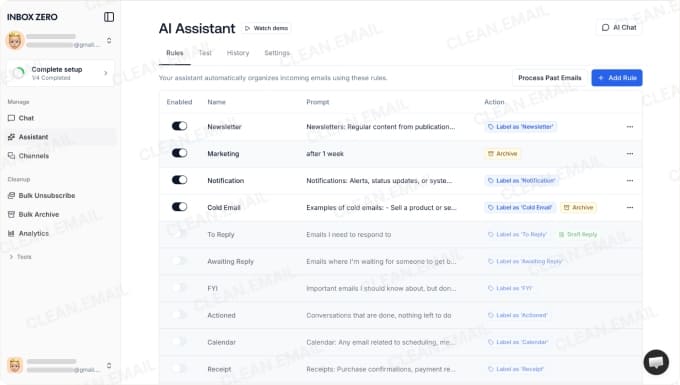
How it organizes email: It works alongside Gmail or Outlook rather than replacing your client, and can act on rules you describe in plain English.
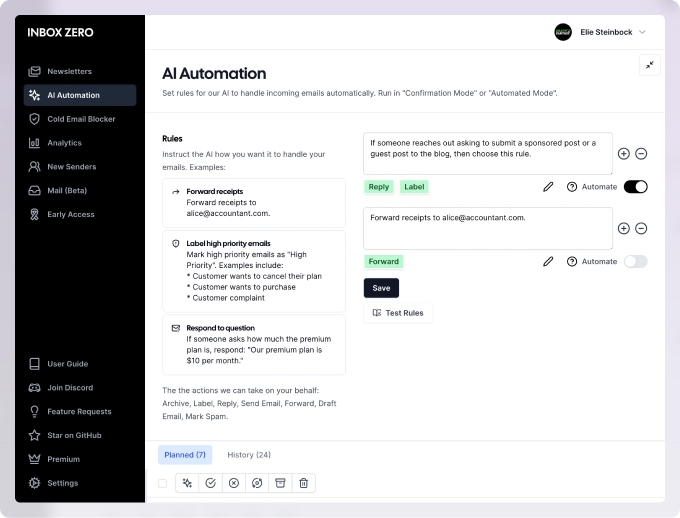
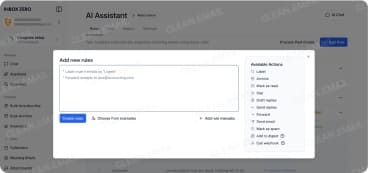
Where AI helps: It sorts and labels incoming mail and drafts replies in your voice. Self-hosting gives you control over deployment, but privacy also depends on which AI provider you configure and where it processes messages.
Main limitation: The hosted service has no permanent free tier. Starter is $20/user/month, Plus $35, and Professional $50; the seven-day trial requires a credit card. The software is free to self-host, but hosting and AI usage can still cost money. Plus includes two email accounts per user.
Who should skip it: People who want a full email client rather than an assistant layered on their existing inbox.
Shortwave: best for natural-language AI filters
Best for: Gmail users who want filters written in plain English.
How it organizes email: It is a Gmail client that bundles similar messages and applies AI filters. Its AI email filter can label, star, archive, and organize messages from a description rather than rigid rules.
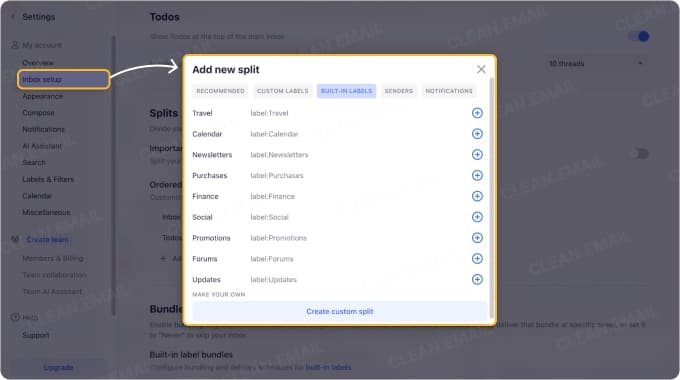
Where AI helps: Its AI email filter can label, star, archive, and organize messages from a description rather than rigid rules. It also summarizes threads and answers questions about your mail.
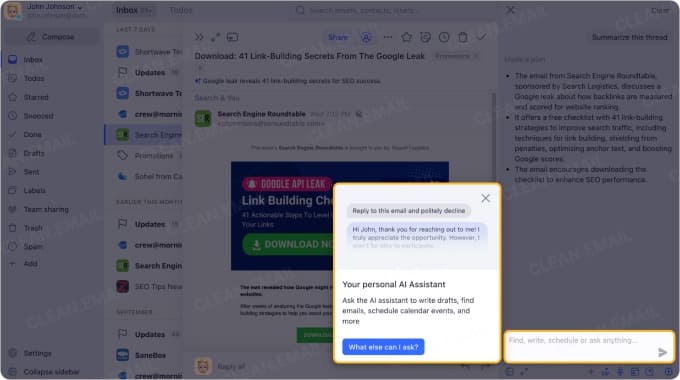
Price and limits: Free has limited AI usage, 90 days of search history, and up to 15 threads per AI search. Pro is $18/seat/month with 50-thread AI searches, but no persistent AI filters; those start with Business at $30 for three filters. Premier is $45 with 10 filters and 100-thread searches; Max is $120 with 50 filters and 150-thread searches. A 14-day trial is available.
💡 Tip: See our Shortwave review for more detail.
Superhuman: best premium AI inbox for organized tabs and fast triage
Best for: People who live in email and want speed plus structure.
How it organizes email: Split Inbox separates messages into tabs such as team, VIPs, news, and tools, so priority mail stays visible.
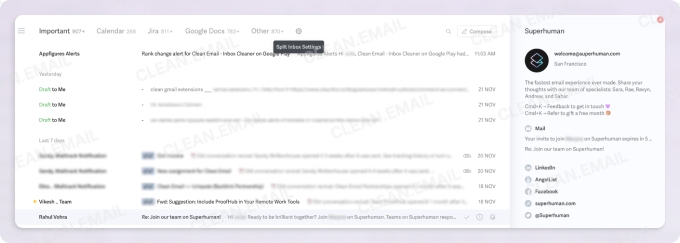
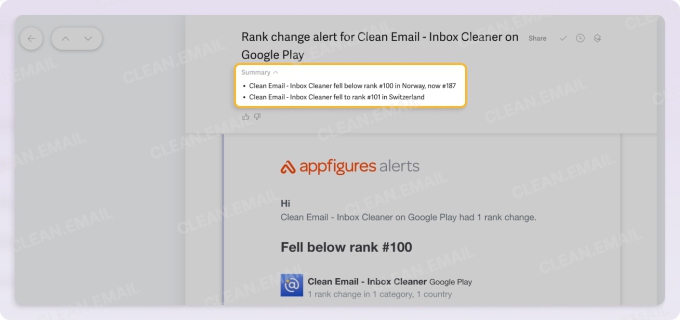
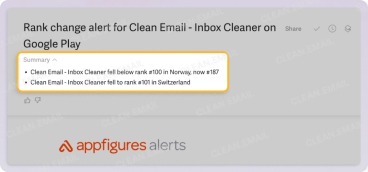
Where AI helps: It adds AI auto-labels, inbox triage, thread summaries, and quick drafts, which help you focus on important messages and respond faster. It is a paid client, so you switch to it as your main inbox.
Price: Starter is $30/month or $300/year; Business is $40/month or $396/year. Custom Auto Labels require Business. See our Superhuman review for more detail.
SaneBox: best for sorting without switching email clients
Best for: People who want less important email filed away while keeping their current email app.
How it organizes email: SaneBox moves lower-priority messages into folders such as SaneLater and newsletters into SaneNews. You train its sorting by moving incorrectly filed messages back to the right place.
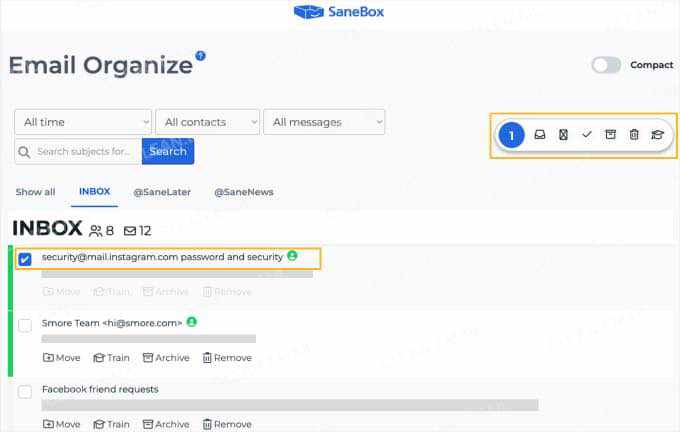
Where AI helps: Its sorting learns from email headers and your interaction patterns, rather than requiring a separate prompt for every message.
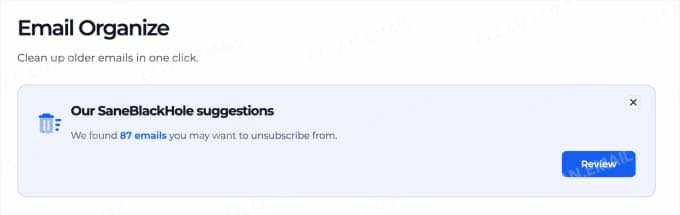
Main limitation: You still need to check its folders for false positives. Snack covers one account and two selected features; Lunch covers two accounts, and Dinner covers four.
Price: Snack starts at $9.49/month, with a seven-day trial and no permanent free plan.
Cora: best for screening new Gmail messages
Best for: Gmail and Google Workspace users who want messages needing attention to stay visible.
How it organizes email: Cora keeps messages it considers important in your inbox and archives other mail into a twice-daily Brief. Archived messages remain accessible through its labels.
Where AI helps: It categorizes incoming messages and summarizes non-urgent mail. In its standard screening workflow, it prepares drafts for you to send and archives rather than deletes messages. Separate beta command-line tools support sending, so this limitation should not be assumed across every Cora interface.
Main limitation: Its standard screening only organizes mail arriving after activation, so it does not organize an existing backlog. It does not support Outlook or other providers.
Price: Professional is $20/month billed annually for two accounts; Unlimited is $39/month billed annually for unlimited accounts. A free trial is available; the homepage says seven days while its plan help article says 14, so use the terms shown at signup.
AI Features vs. Tools Your Email App Already Has
Before adding AI, check what your email app already does. Gmail, Outlook, Apple Mail, and most providers include rules, filters, labels, folders, categories, tabs, search, and unsubscribe links.
AI adds a different layer on top:
| Already built in | What AI adds |
|---|---|
| Rules and filters | Natural-language sorting |
| Labels, folders, categories, tabs | Auto-labeling by topic or priority |
| Search | Question-style search and answers |
| Unsubscribe links | Bulk unsubscribe and triage |
| Manual sorting | Summaries and draft replies |
You do not always need AI for basic organization. For many inboxes, a few filters and labels solve most of the problem.
False positives can create more work than manual rules or hide important messages. A higher price is difficult to justify if you must keep correcting categories. Start with a narrow rule, inspect what it matches, and expand only when the results are reliable.
Can ChatGPT Organize My Emails?
ChatGPT or Claude can help organize email when connected to a tool, connector, or browser workflow that can actually modify the inbox. A connection that only searches or summarizes messages cannot apply labels or move mail; check the available actions and review the proposed changes.
💡 For one browser-based example, see our guide to ChatGPT Atlas for Gmail.
AI Email Organizers for Gmail
If you want an AI email organizer for Gmail, separate tools that surface important mail from tools that maintain labels and inbox structure.
- Gemini in Gmail: Helps find messages and surface priorities. Prompted organization actions may be available, but check your account before relying on them.
- Gmail filters and smart categories: Filters automatically apply labels or archive messages that match defined conditions. Gmail’s category tabs group mail into broad buckets; they do not create a custom label system for you.
- n8n Gmail organizer workflows: Can classify new messages with an AI model and create or apply Gmail labels. You define the categories and maintain the workflow, credentials, and model settings.
- G-Sort AI: Its Chrome extension uses Gemini to categorize Gmail messages into groups such as Social, Finance, DevOps, and Promo. Review the labels it applies and test important senders before enabling broad automatic sorting.
- Trimbox: Primarily helps with mailing-list management. It is not a substitute for custom labeling rules or a complete inbox organization system.
For persistent structure, choose a tool that keeps applying your labels or filing rules as new messages arrive. If your main goal is removing unwanted messages, see our separate guide to Gmail AI cleanup and sorting tools.
Best AI Email Organizers for High-Volume Inboxes
The best AI email organizer for high volume depends on the limits you will actually hit. Most organizers do not publish an emails-per-day ceiling. Connected-account limits, AI-search depth, filter allowances, provider restrictions, backlog support, and higher-tier pricing are more useful comparisons.
Microsoft’s 2025 Work Trend Index reported approximately 117 received emails per worker per day. That is workplace context, not a product threshold. Our 2026 email industry report and email productivity statistics provide further context.
| Tool | Relevant constraint | Price in USD | Providers |
|---|---|---|---|
| Shortwave | Free: 15 threads/search; Pro: 50, no AI filters. Business: 50 / 3 filters; Premier: 100 / 10; Max: 150 / 50 | Free; Pro $18; Business $30; Premier $45; Max $120 per seat/mo | Gmail / Workspace; others by forwarding |
| Superhuman | Custom Auto Labels require Business; no published emails/day cap | Starter $30/mo; Business $40/mo; lower annual rates | Gmail / Outlook |
| Cora | 2 accounts or unlimited; standard screening excludes existing backlog | $20 / $39 per month, billed annually | Gmail / Workspace |
| Inbox Zero | Plus includes 2 accounts/user; tiers add integrations and team features; no published daily-volume threshold | $20 / $35 / $50 per user/mo | Gmail / Workspace / Outlook |
Under roughly 50 emails/day: Native filters, labels, and built-in organization may already be enough. Compare the cost of a paid organizer with the work it saves, and decide whether you want a new email app or an add-on to your current client.
Around 100+ emails/day: Evaluate automation depth, important-sender protection, editable rules, AI-search and filter limits, and support for existing mail. Test false positives before committing to a paid tier. These are reader-orientation bands, not vendor-defined thresholds.
500+ emails/day: Treat this as an extreme case. Prioritize reliability, previews of affected messages, persistent rules, multiple-account support, and backlog handling. Do not assume a vendor supports this workload simply because its plan has “unlimited” in the name.
At high volume, even a small false-positive rate can create significant review work or hide important mail. Previewable, editable, deterministic rules make recurring organization easier to inspect. Our guide to AI email filtering explains the options.
Gmail users willing to change clients can compare Shortwave; Gmail or Outlook users wanting a new client can compare Superhuman. To keep your existing client, consider Inbox Zero, SaneBox, or Clean Email, subject to provider support. Cora’s standard screening suits new Gmail arrivals, not an old backlog. If old mail is the problem, prioritize a tool that can preview and organize existing messages, and price the tier needed for your accounts and rules before committing.
Before comparing email management tools, ask:
- Which email provider do I use?
- Do I want a new email app or an add-on to my current one?
- Roughly how many emails do I receive, and do I already have a backlog?
Privacy: What AI Can See in Your Inbox
Built-in AI from Gmail and Outlook reduces the need to connect another third-party app, because it runs inside the provider you already use.
That does not remove the privacy question. Content-based summaries and drafts require access to message content; metadata-based organization does not necessarily need it. Third-party email assistants usually request broad mailbox access through OAuth. That access can include reading, labeling, and sending mail.
Be careful if your inbox holds sensitive legal, medical, HR, financial, personal, or confidential business conversations.
Before enabling AI tools for work, check what they store, whether they train models on your messages, and how long they keep content.
📌 Note: Several vendors state they do not train on user data and delete processed content after a set period. Confirm this on the vendor's own page, since policies change.
Clean Email: Build Organization Rules With Your AI Assistant
Connect Clean Email to your AI Assistant such as Claude or ChatGPT, and describe the organization you want in plain language. The assistant builds an Auto Clean rule, shows the matching conditions and affected-message count, and asks you to approve consequential changes.
Best for: People who want AI-assisted rule creation with predictable, metadata-based organization.
For example, ask:
- “File everything from my bank into a Finance folder from now on.”
- “Keep only the newest message from each daily digest.”
- “Label unread messages from my project team, but show me what matches first.”
The AI is the interface to the rule engine. Clean Email applies the saved conditions consistently instead of asking AI to read each message and choose a category. AI makes the rule easier to describe and build in plain language.
Rules can target sender, domain, recipient, date, size, folder, age, unread or starred state, and subject, sender, or recipient queries. Supported handling includes archive, move, label, mark read/unread, star/unstar, Trash, mark spam, block, Read Later, and Keep Newest, where available for the selected action.
The assistant can preview message groups, counts, Smart Folders, and Cleaning Suggestions; configure sender settings; and list, edit, or pause saved rules. A rule can apply to future mail only. Applying it to existing messages as well requires a separate choice and approval. View, edit, or pause the persistent rule later in Clean Email.
Privacy and access: The connector uses headers and metadata such as sender, subject, and recipients, not message bodies or attachments. It has no compose/send tool, and consequential actions require confirmation. Review your AI provider’s handling of the metadata it receives.
Good to know: Clean Email works with Gmail, Outlook, iCloud, and other IMAP accounts through its web app, macOS, and mobile apps. Paid plans are available for one, 5, or 10 accounts. Free cleans up to 1,000 messages; Auto Clean and Screener require a paid plan or the 14-day trial, with no card required. You can try Clean Email for free.
FAQs
What is the best AI email organizer?
There is no single best AI email organizer. The right one depends on your problem: summaries, labels, triage, or automatic sorting. Gmail and Outlook users often get the most value from built-in AI first.
Is there a free AI email organizer?
Some tools offer a free tier. Shortwave’s free plan has limited AI usage and does not include persistent AI filters, while Inbox Zero’s free option requires self-hosting. Check whether a free plan actually includes the organizing feature you need.
Can AI sort my emails automatically?
Yes. Tools like Fyxer and Shortwave can label and sort incoming mail automatically. Accuracy supposedly improves over time, but can’t be guaranteed, so review the results early on and protect important senders.
Are AI email organizers safe?
Most reputable tools use standard security and OAuth access. Safety depends on the vendor's data handling, so review storage, training, and retention policies before connecting an account, especially with sensitive content.
Can ChatGPT organize my emails?
Yes, when it is connected to a tool, connector, or browser workflow that can modify your inbox. With Clean Email, ChatGPT or Claude can help build persistent organization rules, with previews and confirmation for consequential changes.
What is the best AI email organizer for high-volume inboxes?
Choose based on your provider, account count, backlog, and the limits of the plan you need. Check previews, false positives, editable automation, and AI-search or filter allowances rather than assuming a daily email count guarantees a good fit.