1. Know Which Subscriptions You Receive
One of the most sensible first steps when deciding how to manage subscriptions is to know what you have. Which subscriptions are you receiving and how often do you get them?
Depending on your email provider, you have different options for handling subscription emails. And of course, each subscription management feature has pros and cons.
Choose your email service:
- Gmail
- Outlook
- Yahoo Mail
- Apple Mail
- Other Tools
Gmail
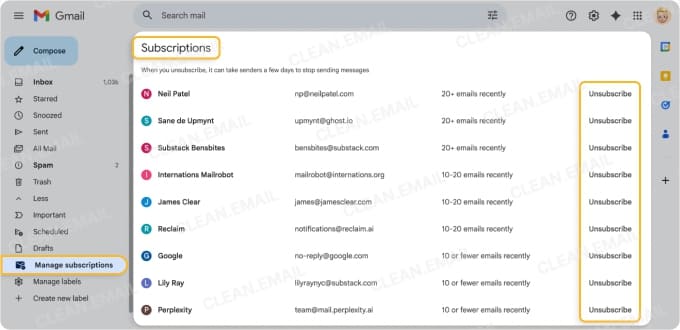
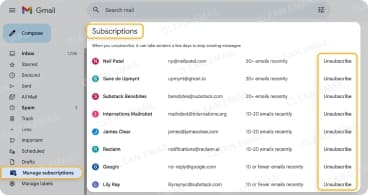
Launched in July 2025, Gmail offers a subscriptions hub. This convenient spot for seeing your subscriptions lists them by sender and ranks them by frequency. You can then hit the Unsubscribe button for each one you want to stop receiving.
If you’re looking for how to manage email subscriptions on Gmail and don’t see the feature, keep in mind that the rollout is gradual and many users still don’t have it.
Also, you can’t unsubscribe from multiple mailing lists at once or use the tool when reading Gmail with third-party email clients.
- Select Manage subscriptions in the left-hand menu.
Outlook
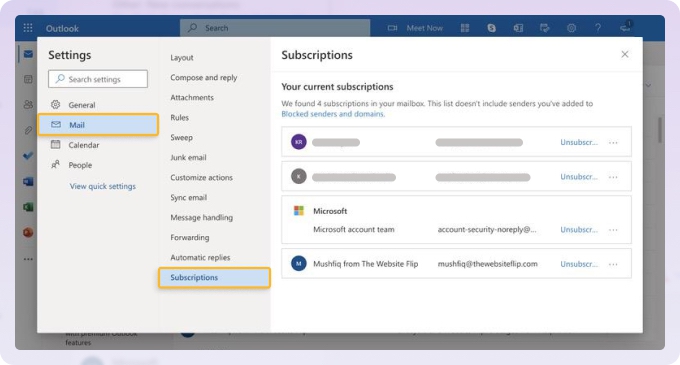
The Outlook manage subscriptions feature offers a similar hub with a list of the subscriptions in alphabetical order by sender. Like Gmail, you can click the Unsubscribe link to stop receiving the subscriptions.
Also like Gmail, there is no functionality to bulk unsubscribe and you must use the Unsubscribe link for each subscription. You do have the option to block a subscription sender; just know that Outlook caps the Blocked Senders list at 1,024 email addresses.
- Select Settings → Mail → Subscriptions.
Yahoo Mail
Rather than a distinct subscriptions section, Yahoo Mail offers the Newsletters category tab. (On mobile, the category is called Offers and provides a mixture of newsletters and special offers.) Click Unsubscribe at the top of an email to remove yourself from the mailing list.
Note that Yahoo Mail may not catch all subscriptions, so senders could be missed. There are also no management actions or bulk unsubscribe options.
You should also keep in mind the storage limit change from 1 TB to 20 GB (US) / 15 GB (UK) which makes Yahoo email subscription management more important than ever.
- Select More → Settings → Inbox categories to enable the category tabs.
Apple Mail
Like Yahoo Mail, Apple Mail does not offer a native subscription list view. Instead, it provides a category to view subscription messages. You can head to the Promotions tab to see emails you subscribe to and click the Unsubscribe button to end the subscription.
Unfortunately, the Promotions tab can include subscriptions beyond newsletters such as deals and offers. You can’t unsubscribe in bulk, and the iCloud Mail Cleanup feature only works for iCloud.com accounts.
- Select an inbox or All Inboxes and click View → Show Mail Categories to enable the category tabs.
Other Tools
Curious if there’s an app to manage email subscriptions? Clean Email’s Unsubscriber is a robust supplementary tool to consider. It lets you unsubscribe in bulk, handles senders without visible unsubscribe links, and works with all IMAP providers.
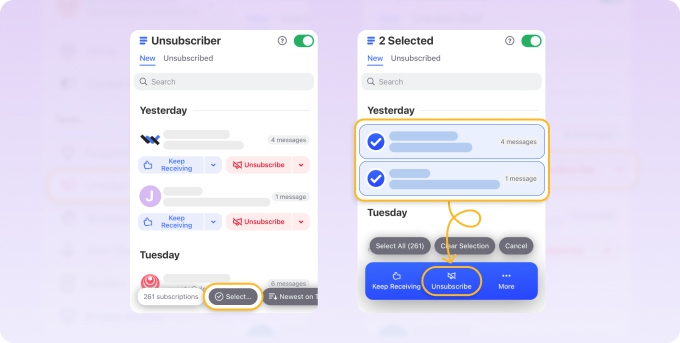
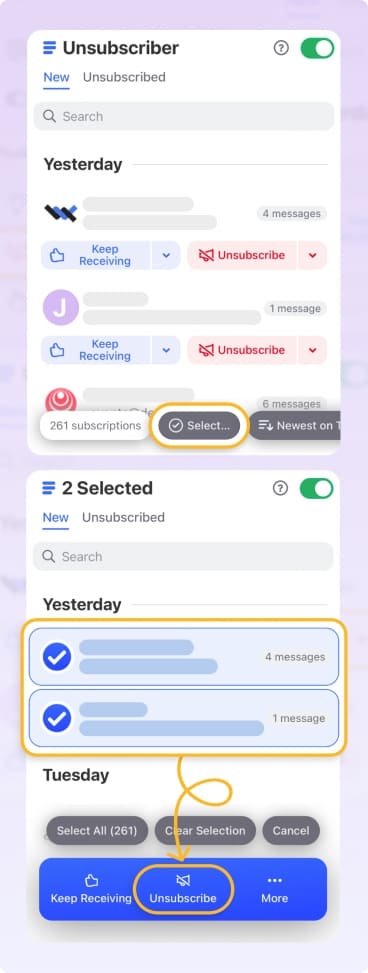
Additionally, this feature is available on both the web and mobile, so you can unsubscribe from all emails using Clean Email on any convenient device.
2. Separate the Subscription Streams
Once you have a good idea of the subscriptions you receive, you can separate the streams to stop the newsletters you want to keep from cluttering your inbox.
One tool that many users employ is a dedicated email address for newsletter signups. This stows away your subscriptions in a separate email account where they can be better managed and don’t distract from your primary inbox.
Another way to separate subscriptions is to use your email provider’s built-in tools. For instance, you can use folders for filing, labels for tagging, and automated filters or inbox rules to reroute newsletters as they arrive.
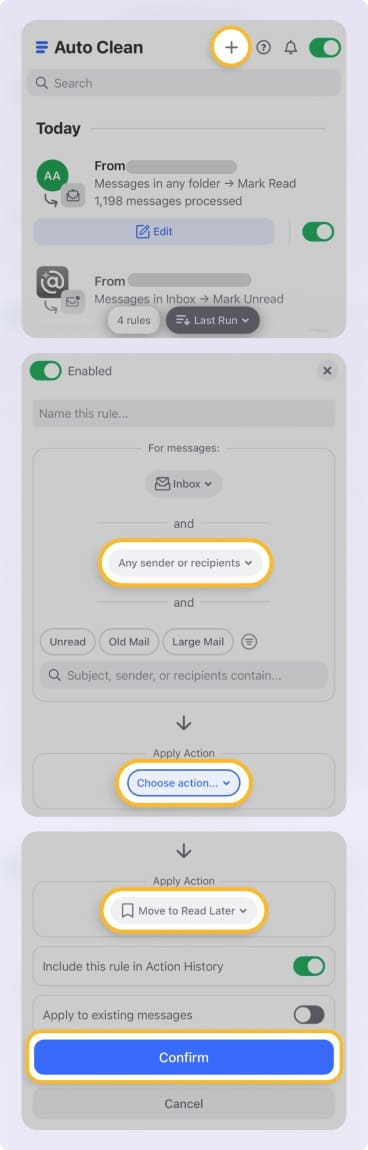
Finally, consider another Clean Email tool called Read Later. This feature lets you direct newsletters to a designated area to read when you have time.
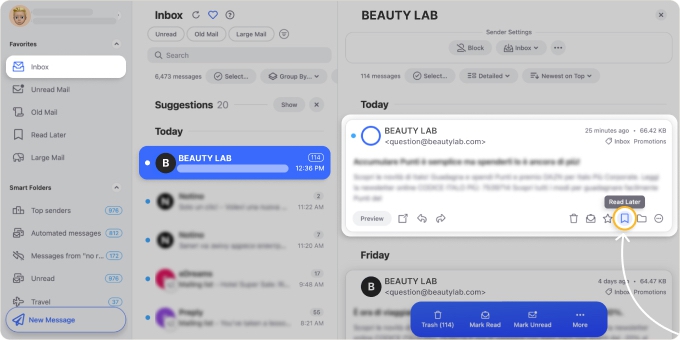
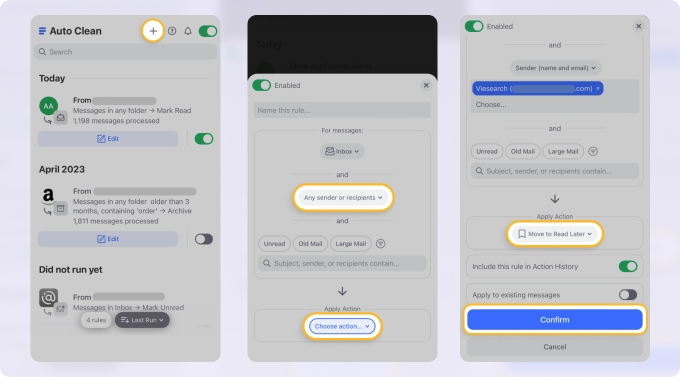
As a time-saver, you can also set up Auto Clean rules to have subscriptions automatically skip the inbox and go right to Read Later.
3. Perform a Subscription Triage
Deciding what to do with emails as soon as they arrive is considered inbox triage. And you can use a similar strategy for managing subscriptions.
If you have newsletters that you haven’t opened in two to three months, then you should unsubscribe from the messages, pause the subscription, or move the emails to a folder or Clean Email’s Read Later area.
We’ve discussed unsubscribing from emails per your provider and separating subscription streams, but what about pausing subscription emails?
While pausing subscriptions isn’t an option with most providers, it is part of Clean Email’s Unsubscriber feature and involves a simple toggle switch. Consider using this option for newsletters and such that you want to keep active, but simply turn off for a short time.
4. Manage the Subscriptions You Keep
For those newsletters and other subscriptions worth keeping but not mixing into your daily mail, Clean Email has a couple of unique features.
As mentioned, the Read Later tool is ideal for newsletters. It keeps the emails out of your inbox, but safely stows them away for when you want them. Even better, you can receive a daily or weekly digest for a nice and neat wrap-up of your subscriptions.
Another helpful feature is called Keep Newest which automatically deletes previous emails and keeps only the most recent. You can use this for those high-frequency senders when only the current newsletter issue matters. This is also perfect for news digests and daily promotional codes.
Subscription Feature Comparison
With all of the above in mind, reducing subscription overload is possible. Because picking the right tool and feature comes into play, here’s a rundown of subscription capabilities by provider.
| Capability | Gmail Manage Subscriptions | Outlook.com Subscriptions | Yahoo Mail | Apple Mail / iOS 18 and later | Clean Email |
|---|---|---|---|---|---|
| See all subscriptions in one view | Yes – Manage Subscriptions hub lists detected senders (personal & Workspace; Gmail-only UI) | Yes – Subscriptions page lists detected senders | Partly – Newsletters/Offers views; detection incomplete | No dedicated subscription list | Yes, including Senders view native tools miss |
| Bulk unsubscribe | No native bulk select; primarily one sender at a time | No bulk select; unsubscribe is per sender | No bulk unsubscribe | No – per-message unsubscribe only | Yes – bulk unsubscribe actions from the Unsubscriber view |
| Works across multiple accounts | No – per Gmail account; not for Outlook/Yahoo/iCloud | No – only Outlook.com account | No – only Yahoo Mail | No – each account handled separately in Mail app | Yes – connects multiple providers (Gmail, Outlook, Yahoo, iCloud, etc.) |
| Automatically organizes recurring subscription mail | Yes – native filters/labels and auto-archive, but not specialized per-subscription manager UI | Limited – rules and sweep can move messages, separate from Subscriptions UI | Limited – filters and views; no dedicated automation manager | Limited – rules on Mac/iCloud; no subscription-focused automation | Yes – Auto Clean rules by sender/domain to dedicated folders or Archive |
| Read-later queue with digest | No – no built-in read-later digest for newsletters | No – no read-later digest | No – no read-later digest | No – no digest-based read-later for subscriptions | Yes – Read Later folder plus daily/weekly digests per sender |
| Keep-newest automation (auto-delete older) | No – requires manual filters and is not subscription-aware | No – not provided | No – not provided | No – not provided | Yes – Keep Newest automatically deletes older messages, keeps the latest one only |
| Prevents new subscriptions going unreviewed | No – does not gate or queue new list signups | No – no pre-subscription review | No – no pre-subscription review | No – no pre-subscription review | Yes – using Screener tool |
Conclusion
If you’ve been looking for the best way to manage email newsletter subscriptions, you now have a clear picture of your options. Start by knowing which subscriptions you receive, separate them from important emails, decide whether or not to keep them, and finally, organize what you hold onto.
With a combination of your email provider’s tools and others offered by Clean Email, you can make subscription overload a thing of the past.