First: Decide How “Clean” You Want the Migration To Be
Before you touch migration tools, decide what you’re actually moving.
- Everything, including emails from 2016?
- Only the last 1–2 years?
- Mail only, or contacts and calendars too?
This matters because IMAP migrations copy everything unless you tell them not to, while export/import workflows let you be more selective—but take longer.
Most teams I’ve worked with get the best results by:
- Migrating older mail first
- Running a short “delta sync”
- Switching MX records at the end

Migrating From Zoho Mail to Google Workspace or Gmail
Zoho doesn’t offer a one-click “Export to Google” button, so migrations typically rely on IMAP or third-party tools.
Option 1: Google Workspace Data Migration (IMAP)
This is the most common admin-level approach.
High-level flow:
- Enable IMAP for users in Zoho Mail
- In Google Admin, start a new Data Migration
- Select Zoho Mail (or generic IMAP) as the source
- Enter Zoho IMAP server details and credentials
- Choose folders, date ranges, and map users
- Run migration and monitor progress
- Switch MX records once ready
This works well for full mailbox moves and preserves folder structure. It’s not fast, but it’s dependable.
Option 2: Export + Import or Migration Tools
If you need more control:
- Export Zoho mail as ZIP, PST, or EML
- Use tools like VaultMe, Cloudasta, SysInfo, or Aryson
- Authenticate both Zoho and Google
- Run batch migrations with filters and logs
This route costs more time—or money—but gives you better visibility and retry options.
Migrating From Zoho Mail to Microsoft 365 (Office 365)
There are two realistic paths here: IMAP migration or PST-based import.
Manual / Semi-Manual Approach
- Export Zoho mail or pull it into Outlook
- Import PST files into Microsoft 365 mailboxes
- Or configure Zoho as an IMAP source in M365
- Map users and migrate mail
- Update MX records and reconfigure Outlook
This works, but it’s labor-intensive for larger teams.
Using Migration Software
Tools from vendors like EdbMails, Advik, or MigrateEmails streamline this:
- Zoho as source
- Microsoft 365 as destination
- Folder and date filtering
- Batch migrations
- Detailed logs and throttling handling
For multi-user environments, this is often worth the license cost.
Migrating To Zoho Mail (From Gmail, Google Workspace, or GoDaddy)
This is where Zoho shines a bit more.
Gmail / Google Workspace → Zoho Mail
Zoho includes built-in admin migration tools for Google Workspace.
You can:
- Authenticate Google Workspace
- Choose mail, contacts, and calendars
- Map users
- Run migrations directly from Zoho’s control panel
For small migrations, forwarding or importing EML files also works—but admin-level migration is cleaner.
GoDaddy Email → Zoho Mail
Options here are simpler but effective:
- IMAP migration using Outlook or Thunderbird (drag-and-drop)
- Third-party tools that connect GoDaddy → Zoho via IMAP
Trial versions usually exist, but limits apply. For large mailboxes, expect to pay.
General Migration Best Practices (No Matter the Direction)
These apply whether you’re moving from Zoho or to Zoho:
- Enable and test IMAP access first
- Decide scope: all mail vs date-limited
- Migrate older mail before recent mail
- Run a delta sync close to cutover
- Switch MX records last
- Keep old accounts active briefly for safety
And seriously—clean first. Migrating clutter just makes your new system harder to live with.
The Smart Way to Prep an Inbox Before Migration
This is the part almost everyone skips—and then regrets later.
If you migrate clutter, you just recreate the same problem in a new system. Cleaning the inbox before migration saves time, storage, and headaches. That’s where Clean Email fits in nicely.
The app works with Zoho, Gmail, Google Workspace, Microsoft 365, and is available on the web, macOS, and mobile, which makes it easy to clean things up wherever you happen to be.
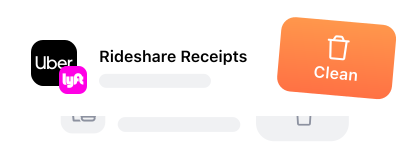
- Before a migration, it helps you find and remove old newsletters, large attachments, and notifications in bulk so you aren't moving gigabytes no one needs.
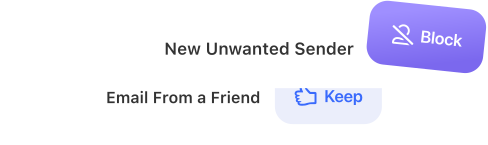
- You can also unsubscribe from unwanted lists at once while sending existing messages from those senders to Trash.
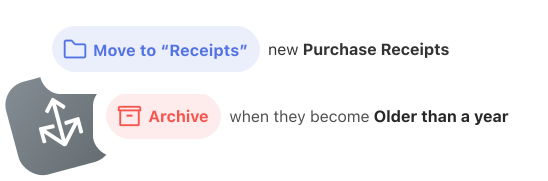
- Then, set Auto Clean rules that quietly keep the inbox lean (deleting old mail, archiving large attachments, handling recurring system emails).
- Finally, act on Cleaning Suggestions that group similar messages for removal, with more to explore.
If you’re migrating more than one mailbox, cleaning first is one of the highest-leverage steps you can take.
Final Thoughts
Zoho Mail migrations aren’t magical, but they are manageable:
➡️ If you want speed and simplicity, use IMAP or built-in admin tools.
➡️ If you want control, logs, and scheduling, use migration software.
➡️ If you want a smoother experience overall, clean the inbox before you move it.