Alias vs New Account: Which One You Need
If you want a new address but expect to keep your existing inbox, contacts, calendar, and subscriptions, an alias is the right tool: it attaches a new address to the account you already have.
💡 Read more on how to create and use an Outlook alias in our guide.
If you need a fully separate inbox with its own storage, contacts, and sign-in credentials, a new Microsoft account is the only option. The rest of this article explains how each path works, what changes, what doesn't, and how to decide which one fits your situation.

What "Changing an Email Address" Actually Means in Outlook
When people say they want to "change their Outlook email address," they usually mean one of the following things:
- Primary email address: Your primary address is the main email tied to your Microsoft account. It's what you use to sign in, and it appears as the default "From" address when you compose a message. It does not change your inbox contents, calendar, or contacts. Users sometimes assume that creating an alias automatically changes the primary, but it doesn't. Instead, you need to explicitly promote the alias to primary status.
- Outlook alias: This is an additional address attached to the same account. It does not create a second inbox or separate your data, it simply gives you another address that funnels into the same mailbox.
- Display name: This human-readable label sits next to your email address (something like "John Smith" rather than john.smith@outlook.com) and is what recipients see when they receive a message from you. Changing it has zero effect on the actual email address itself.
📌 This is the most common point of confusion: users who want a new email address often change their display name instead, then wonder why nothing looks different on the sending side.
- Reply-to address: Outlook lets you set a separate reply-to address, which controls where responses land when someone hits "Reply" to your message. It does not change your "From" address or affect which alias appears as the sender. This is useful during a transition. For example, if you want replies going to your new alias while you're still sending from the old one.
📌 The common mistake here is setting a reply-to address and assuming it changes how your outgoing messages appear. It doesn't: recipients still see your original sending address in the "From" field, and the reply-to only kicks in when they respond.
If your goal is to actually send and receive mail under a different address, the alias route is the one that matters.
Why Outlook Doesn't Allow Renaming the Primary Address
Your Outlook email address is the core identifier for your entire Microsoft account, linked to everything from OneDrive and Xbox to app subscriptions and two-factor authentication. Renaming it would mean rewriting that identity across every connected service simultaneously.
Your email address also serves as the key that verifies who you are when you sign in, reset a password, or confirm a sensitive action. Microsoft takes this so seriously that, as stated on their support page, even their own support agents "are not allowed to send password reset links, or access and change account details."
Besides your own account, email addresses carry a delivery reputation built over time. Mail servers, spam filters, and contact lists all associate trust with a specific address. Keeping the address permanent protects both the sender's credibility and the recipient's security. This is why Microsoft offers aliases as the workaround rather than a rename function, letting you present a new address to the world while the underlying account identity stays intact.
Trade-Offs of the Alias Approach
Before you commit to the alias route, it's worth knowing where it falls short. Aliases work well for most people, but they share everything with the account they're attached to, which means:
- Every alias funnels into the same mailbox, which means your personal messages and professional correspondence will sit side by side. There's no way to separate them into different inboxes.
- Sent messages all land in a single Sent Items folder regardless of which alias you used to compose them, so your outgoing history stays merged as well.
- Because all aliases share one account, they also share the same storage quota. Adding an alias does not give you additional space.
None of these are dealbreakers for most users, but they do matter if you're expecting the kind of separation that only a completely independent mailbox can provide.
When You Actually Need a New Outlook Mailbox
There are situations where an alias simply won't cut it. Generally, if your goal requires a completely separate inbox with no ties to your current account, creating a new Microsoft account is the only path forward. This typically applies when:
- You're going through a full identity change and need a clean break from your existing email history.
- It also applies if you're switching employers or moving to a custom domain, since work and personal accounts operate under entirely different Microsoft ecosystems that can't be merged.
- Legal or privacy concerns can push you in the same direction, especially if your current address has been compromised or involved in a data breach and you'd rather start fresh than continue using it.
- Sometimes the reason is that you just need two inboxes that don't overlap, with separate storage, separate contacts, and separate sent histories.
The trade-offs here are significant, though:
- A new Microsoft account means a new sign-in, a new password, and no automatic connection to anything from your previous account. Your old emails, contacts, calendar entries, and OneDrive files don't carry over. If you want any of that data in your new account, you'll need to migrate it manually, typically by exporting a PST file from the old account and importing it into the new one.
- Subscriptions tied to your old account, including Microsoft 365, can't be transferred either. They'd need to be canceled and repurchased under the new address.
- It's also worth noting that your old address doesn't forward mail to the new one by default. Unless you set up forwarding or keep checking both accounts, messages sent to your previous address will go unanswered.
For these reasons, many users keep their old account active for a while as a safety net, even after making the switch.
What Happens to Existing Emails, Contacts, and Replies
This is what happens to existing emails, contacts, and replies when you change your Outlook email address:
- If you're using an alias, nothing disappears. Your old emails stay exactly where they are, your contacts remain intact, and your calendar doesn't change. Because an alias is just another door into the same mailbox, switching your primary address has no effect on the data inside it. Email threads don't break either, since all aliases share one mailbox and replies continue arriving in the same conversation.
- If you've created a new Microsoft account, the picture is very different. The new account starts with an empty inbox, no contacts, and no history. Anything from your previous account stays behind unless you export and import it yourself. Replies sent to your old address will continue landing in the old mailbox unless you've configured forwarding.
- If you've only changed your display name, your email address, inbox, and message history are completely unaffected. The only thing that changes is the label recipients see next to your address in future messages. This is an important distinction because it's one of the most common sources of confusion: users update their display name expecting it to change their actual email address, but the address itself remains exactly the same. If your goal is to send and receive mail under a different address, changing the display name will not accomplish that, and you need an alias or a new account instead.
This behavior is consistent across all Outlook versions (web, desktop, and mobile). The data stays in the same place regardless of which client you use to access it.
Step-by-Step: How to Change Your Outlook Email Address
Step 1: Pick your path
Microsoft gives you several ways to change your address, and the steps you need are completely different depending on which one you pick:
- Want to add a new address to your existing account but keep your inbox, contacts, and subscriptions? Use an alias—there's nothing to forward or to migrate (Step 5 below).
- Need a fully separate inbox with its own storage and sign-in? Create a new Microsoft account—you'll need to forward mail from the old account, move your data, and update services (Steps 2–6 below).
- Only want to change the name recipients see? That's a display name change. Do it at account.microsoft.com/profile and stop here.
Step 2: Create the new account
Sign up at signup.live.com using the address you want. Add a recovery phone and backup email so you can get back in if something goes wrong.
Step 3: Forward mail from the old account
In your old Outlook inbox, go to Settings → Mail → Forwarding, enter your new address, and tick the option to keep copies in the original inbox. This catches anything sent to the old address while you're updating contacts.
Step 4: Move your data
Outlook doesn't migrate between Microsoft accounts automatically. In Classic Outlook desktop, go to File → Open & Export → Import/Export → Export to a file and save your mail, contacts, and calendar as a .pst file. Sign in with the new account and import the same file.
Subscriptions like Microsoft 365 or Xbox can't be moved — cancel them on the old account and repurchase under the new one if you still need them.
Step 5: Update your linked services
Anywhere your old address is used for sign-in, recovery, or two-factor authentication needs updating: banks, password manager, social accounts, shopping sites. Change one service at a time and send a test reset email after each. Start with anything financial.
This step applies whether you went with an alias or a new account — every service that points at your old address still needs to be told about the new one.
Step 6: Keep the old account open for a while
Leave the old account active and forwarding for at least a few weeks. Once a full billing cycle passes with no surprise mail or login attempts, you can close it.
Common Mistakes to Avoid
Most of the issues around changing an Outlook email address come from a handful of avoidable missteps:
- The biggest one is creating a brand-new Microsoft account when an alias would have done the job. Users who do this walk away from their entire email history, contacts, and calendar without realizing an alias could have given them the new address they wanted while keeping everything intact.
- Just as costly is deleting the old alias too soon after switching. Once you remove a Microsoft-domain alias like @outlook.com or @hotmail.com, it's gone permanently. No one can ever use that address again, including you. The safer approach is to keep it as a secondary alias indefinitely, since it costs nothing and guarantees nothing slips through the cracks.
- Another common mistake is assuming that adding an alias automatically changes your sign-in. It doesn't. You still need to explicitly set the new alias as primary for it to become your default login and sending address.
- Bank accounts, social media logins, two-factor authentication, and email rules may still reference your old address. Removing that alias before updating these services can lock you out of accounts that depend on it for verification or password resets. Make a list of everywhere your old address is registered and work through it before you consider removing anything.
- Finally, don't confuse changing your display name with changing your address. Updating "John Smith" to "Jonathan Smith" on your profile won't alter your actual email address by a single character. It only changes the name label recipients see, nothing more.
You might have noticed that the common thread here is rushing. Take the transition slowly, keep your old alias active, and update external services one by one rather than assuming everything will sort itself out.
How to Prepare Your Inbox Before Changing Addresses
It's a lot easier to switch to a new email address when your inbox isn't already a mess. That's why it's worth spending some time getting your current mailbox in order before you add an alias or create a new account.
- Start by identifying the messages that actually matter. If you have thousands of unread emails piled up, the transition is the perfect excuse to sort through them. Archive or delete old newsletters, expired promotions, and anything you'll never open again.
- Next, make a note of which services and accounts are tied to your current email address. This includes banking, social media, cloud storage, shopping accounts, and anything that uses your email for login or two-factor authentication.
- If you're creating a new Microsoft account rather than using an alias, consider how you'll handle the gap between old and new. Setting up forwarding from your old address to the new one catches messages from contacts who haven't updated their records yet.
- You might also want to set up an auto-reply on the old account letting people know your address has changed, especially if you use it for work or professional correspondence.
The cleaner your inbox is going in, the smoother the transition will be on the other side.
How Clean Email Can Help
Clean Email can speed up the preparation process by connecting directly to your inbox and letting you organize, archive, or remove thousands of messages in bulk instead of sorting through them one by one.
Clean Email works alongside Outlook and supports Gmail, Yahoo, AOL, iCloud, and any other provider using IMAP. It is available on the web and as an app for Mac desktop and mobile.
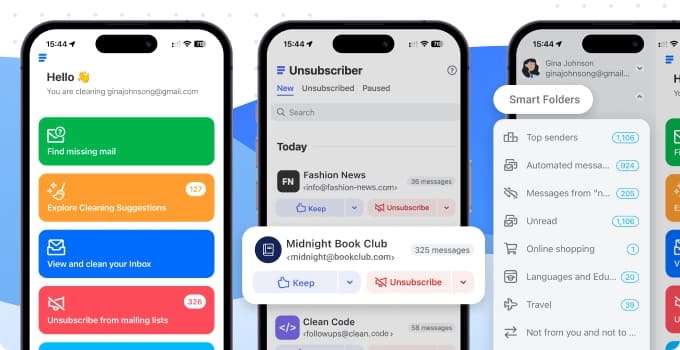

Best of all, it doesn't touch your email address, aliases, or account settings when helping you organize your Outlook inbox so that the conversations you actually care about are easy to find during and after the switch. That means your security and privacy remain protected.