What is Confidential Mode in Gmail?
You may have heard about Confidential Mode in Gmail, but aren’t quite sure of its purpose and how it works. Let’s begin with the basics of using this Gmail feature for sending safer emails.
What Gmail Confidential Mode Actually Does
To get started, we’ll answer common questions like “What does Confidential Mode do in Gmail?” and “Is Gmail Confidential Mode encrypted?”
First, when you use this secure sending feature, your recipient cannot forward, copy, print, or download the email. Additionally, with Gmail Confidential Mode, you can’t download attachments or save files from the email. All of these options are disabled in Gmail’s menu.
Second, emails are not encrypted with Confidential Mode. This feature merely prohibits the recipient from taking the above-mentioned actions. For more on message encryption, look at how to encrypt an email in Gmail.
Finally, you restrict access to the email by setting an expiration date and optionally, texting a passcode to the recipient, both of which we’ll explain next.
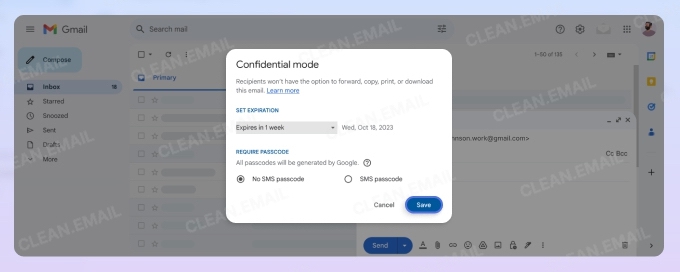
💡 How to mark an email confidential: Turn on the Confidential Mode toggle at the bottom of the email you’re composing.
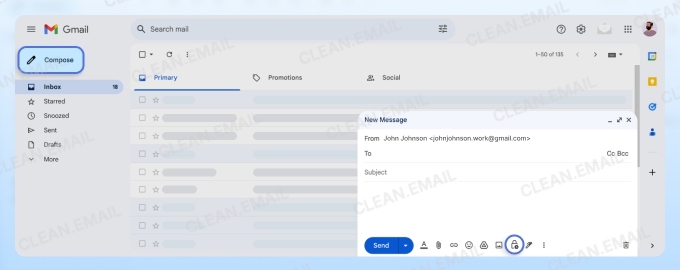
Then, adjust the expire and passcode options.
How Email Expiration Works
When you compose an email using Confidential Mode, you must set an expiration date. This can range from a day or week to three months or five years. Your recipient can only open the email before it expires, and they’ll see this expiration date at the bottom of the message.
If your recipient reopens the email after the expiration date, they’ll see a message that the email has expired, and they must contact the sender if they want it to be resent.
📌 One final note on expiration dates: As the sender, you can revoke access to the confidential email before the initial expiration date arrives by opening the message in Sent emails and choosing Remove access.
How Passcodes and Email Access Function
Passcodes provide an extra layer of protection for the email you send in Confidential Mode. After you set the expiration date, you have the option to also set a passcode.
This then sends a text message to your recipient that they must enter to access the email content. Keep in mind that you’ll need your recipient’s cell phone number to use this feature.
If you don’t set a passcode for the email, your recipient can simply open and view the message content using their Gmail account.
💡 Tip: If you enable this mode and compose your email, but then decide to send the message normally, you can turn off Confidential Mode in Gmail before you hit Send.
Confidential Emails for Gmail Vs Non-Gmail Recipients
You may be wondering if you can toggle Confidential Mode in Gmail if your recipient uses a different email provider such as Outlook or Yahoo Mail. Here’s a rundown of how this mode works for both Gmail and non-Gmail recipients.
For Gmail recipients, viewing emails sent with Confidential Mode is easy. They simply open the message like any other or first enter the passcode they receive via text message if you choose that option.
For non-Gmail recipients, they receive an email that you’ve sent them a confidential message using Gmail. They then click the View the email button in the email which takes them to a website where they request a passcode to open the message. Once they receive the passcode via the same email address, they enter it on the screen to see your message as well as the expiration date.
💡 Tip: Trying to figure out how to send a confidential email in Gmail but don’t see the toggle? While personal Gmail users see the Confidential Mode switch by default, those with work or school accounts may need to contact their Google Workspace administrator to enable the feature.
Important Confidential Mode Limitations
While Confidential Mode does give email senders control over what recipients can do, it does have its limitations.
❌ Confidential Mode does not encrypt emails: As mentioned earlier, messages you send with Gmail Confidential Mode are not encrypted. This feature merely restricts the actions your recipient can take with the email and its attachments.
❌ Screenshots and external captures are still possible: It’s important to understand that Confidential Mode does not prevent your recipient from taking a screenshot or capturing a photo of the email or its attachments.
❌ Emails still exist in the inbox: While an email using Confidential Mode does have an expiration date, this doesn’t mean that the message is deleted when it expires. The recipient simply sees the expired message with the content hidden, but the email remains in their mailbox by default.
❌ Confidential Mode does not reduce inbox volume: With the directly above in mind, remember that Confidential Mode messages do not affect inbox volume and still apply towards the recipient’s available storage space.
❌ It does not stop future emails from the same sender: Whether you’re the sender or the recipient, using Confidential Mode for an email does not impact a sender’s ability to send future messages.
When Gmail Confidential Mode Makes Sense (and When It Doesn’t)
You might now be curious if Gmail Confidential Mode is appropriate for your situation. Let’s look at some real-world example uses along with scenarios where Confidential Mode is irrelevant.
When Confidential Mode is beneficial:
✅ One-time sensitive messages: Recap a private phone call or meeting or relay sensitive information such as health or financial details.
✅ Temporary access sharing: Send login credentials or provide a link to a secure website.
✅ Internal communications: Discuss trade secrets, explain disciplinary actions, or review company documents and images.
When Confidential Mode is insufficient:
❌ Ongoing email clutter: Emails you receive that are sent using Gmail Confidential Mode add to your overall inbox clutter just like any other message.
❌ Subscription overload: Unsolicited emails can remain a problem even if these messages are sent using Confidential Mode.
❌ Long-term inbox growth: Confidential Mode messages consume storage space the same way ordinary emails do, on both the sending and receiving ends.
The Bigger Issue Gmail Doesn’t Solve
Confidential Mode in Gmail gives you a convenient way to send more secure messages. However, this feature is limited to just that — sending safer emails. It, along with other Gmail tools, mostly focus on managing individual messages, not inbox behavior.
Gmail doesn’t effectively help you manage emails that keep arriving when using Confidential Mode. While you can use other features like automated filters, an unsubscribe button, and labels for organization, these again, assist with single message management.
Regardless, your Gmail inbox can unintentionally grow over time, which can cause missed messages, email anxiety, and inbox overload.
How Clean Email Complements Gmail (Not Replaces It)
To solve the above Gmail issue, consider a supplementary tool such as Clean Email. As an inbox management layer, the app provides ways to control email flow, not just single messages on Mac, mobile, and through any web browser.
Automatically clean old or irrelevant messages and keep both sensitive and non-sensitive emails organized over time with Auto Clean. You can create rules to mark, label, or delete incoming and existing messages.
Prevent unwanted emails from returning with Unsubscriber which allows you to unsubscribe from messages in bulk rather than just one at a time.
Reduce inbox overload without daily effort using Cleaning Suggestions which offer recommendations for things like archiving, marking, or removing groups of emails based on your previous actions.
Using Gmail Confidential Mode + Clean Email Together
Where Gmail handles secure message sending, Clean Email handles inbox control.
So, you can easily compose and send emails with Confidential Mode in Gmail to restrict access and control what your recipients do with those messages.
Then, use smart features to organize replies to those emails as well as manage all of your new messages using Clean Email.
Conclusion
Now that you have a clearer picture of how Gmail Confidential Mode works along with what it does and doesn’t do, you can better use the feature to your advantage.