What Are Gmail Search Operators?
You may have heard the term “search operators” in regard to Gmail. And to many, this can sound a little intimidating. But Gmail search operators are actually easy to use and can more minutely and accurately narrow down your search results.
A Gmail search command includes the operator followed by a variable. For example, to search emails in your Gmail Inbox, you’d use in:inbox or to find messages you haven’t read, you’d use is:unread.
There are other operators that allow you to pick the variable. For instance, you can locate emails with a particular Gmail label using label: and entering the label name after the colon. The command label:finance finds all messages with the Finance label.
One more type of operator you can use is a character. Those like hyphens, brackets, and quotation marks can be used as well. For example, to exclude something from your search like messages in your Inbox, you’d use -in:inbox or to find an exact phrase, you’d place it within quotes.
Search operators are ideal when you need to locate specific emails and the built-in search filters don’t provide the criteria you need.

How to Search in Gmail (The Basics)
Before we delve into using search commands, it’s good to know how to search in Gmail using the basics available to you and how these tie into search operators.
The Search Box
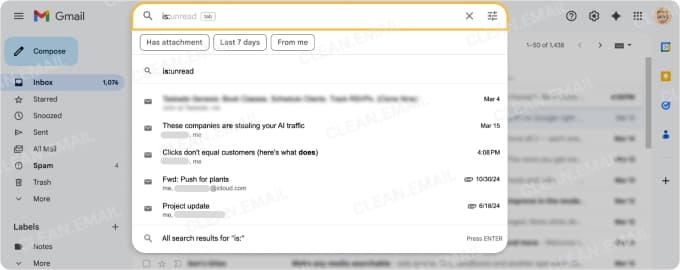
When looking for particular messages, you can enter terms into the Search field at the top. As you click inside the box or start typing, you’ll see suggestions drop-down. This makes it easy to select a recent search or spot the email you need. The Search box is also where you enter search operators.
The Search Options
Instead of entering a term into the Search field, you can open the Search Options window using the button on the far right of the box. You can then enter or select criteria for common searches like From or To a certain sender, specific words in the Subject, and within a timeframe from a particular Date.
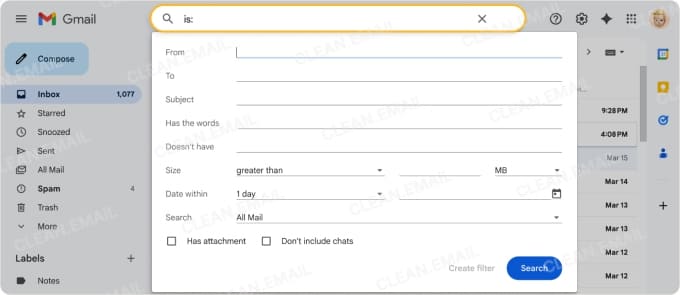
Along with receiving your results after entering the criteria and clicking the Search button, you’ll notice that search operators are automatically populated in the Search box. So, even if you don’t type the search commands yourself, Gmail uses them behind the scenes to find what you enter in the Search Options interface.
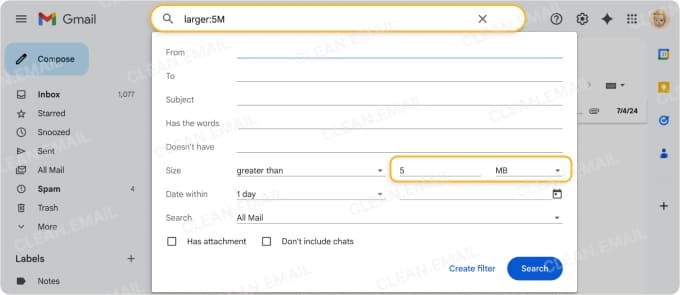
Gmail Search Operators Cheat Sheet (Quick Reference)
If you’re ready to start using search operators in Gmail, you’ll need to know your options. Although Gmail offers over 50 search commands, there’s a smaller subject that you’ll find most useful.
| Operator | What It Does | Example |
|---|---|---|
| "exact phrase" | Find an exact phrase | "project deadline" |
| OR | Match either term (must be uppercase) | from:john OR from:jane |
| - | Exclude a term or operator | -from:noreply@company.com |
| from: | Messages from a specific sender | from:john@example.com |
| label: | Messages with a specific label | label:work |
| category: | Messages in a Gmail category tab | category:promotions |
| is:starred | Starred messages | is:starred |
| is:important | Messages marked as important | is:important |
| in:inbox | Messages in your inbox | in:inbox |
| in:trash | Messages in the trash | in:trash |
| in:sent | Messages in Sent Mail | in:sent |
| in:anywhere | Search all mail including Spam & Trash | in:anywhere |
| has:attachment | Messages with any attachment | has:attachment |
| filename: | Attachment by name or extension | filename:pdf |
| larger: | Messages larger than | larger:10M |
| smaller: | Messages smaller than | smaller:100K |
| after: | Messages after a date | after:2024/01/01 |
| before: | Messages before a date | before:2024/12/31 |
| older_than: | Messages older than a time period | older_than:1y |
| newer_than: | Messages newer than a time period | newer_than:3m |
Gmail Advanced Search: Power Combinations
While you can easily use a single search operator to quickly find what you need, the real power is in combining Gmail search commands. Here are several common examples of Gmail advanced search using combinations.
📌 Note: When you combine two, three, or more search operators, be sure to separate each by a single space.
smaller:10M larger:100K: Search for emails within a size range. This combo finds messages smaller than 10 megabytes and larger than 100 kilobytes.
after:2024/01/01 before:2024/12/31: Search for emails within a date range. This combo finds messages received after January 1, 2024 and before December 31, 2024.
label:work older_than:1y: Search for emails containing a particular label older than a timeframe. This combo finds messages labeled Work that are older than one year.
has:attachment filename:pdf: Search for emails with an attachment of a certain file type. This combo finds messages with PDF files attached.
from:john@example.com is:important is:unread: Search for emails from a particular sender that are specifically marked. This combo finds messages from a sender that are both important and unread.
-in:inbox -in:sent -in:chat -in:drafts: Search for any archived emails. This combo eliminates messages in the Inbox, Sent, Chat, and Drafts displaying only archived emails.
-in:inbox -in:sent -in:chat -in:drafts has:nouserlabels: Search for archived emails without custom labels. This combo is an alternative to finding all archived messages (above).
Gmail Search Not Working? Common Fixes
If you try to use operators to look for emails and find Gmail search not working as expected, there are some possible reasons. Luckily, most are easy to correct.
Search Operator Typos or Wrong Syntax
When typing search operators in Gmail, the syntax you use is extremely important. If you have a typo, missing colon, wrong case (for the OR operator), or no spaces when using a combination, this can return zero results.
💡 Solution: Carefully double-check your search commands and correct any errors.
No Results From Trash or Spam
If you’re searching for emails in either the Trash or Spam folder with no luck, you must use the in:trash or in:spam operator. This is because, by default, Gmail doesn’t look in those folders when searching with operators or filters.
💡 Solution: Use the corresponding search operator for the Trash or Spam, or as an alternative, use in:anywhere to search all mailbox locations.
Gmail Indexing Delays
As you receive emails in Gmail, Google’s systems index those messages. This involves analyzing and organizing content to make it searchable and to support features like Gmail Categories.
While this is a normal process, there are times when an indexing delay can occur. This is often due to synchronization issues, especially for very recent messages, full storage, too many labels, or browser issues.
💡 Solution: Sign out and back in, clear your browser cache, try incognito mode, or reduce your used Gmail storage.
Mobile App Limitations
Although you can use Gmail search operators to find emails in the mobile app, there are some limitations. For instance, there is no Search Options box for simple searches, the wildcard character (*) may not function correctly, and sorting search results defaults to Most Relevant rather than Most Recent.
💡 Solution: Use the most common search operators, avoid complex combinations, and consider using the pre-made search filters at the top after tapping inside the Search box. If problems persist, close and reopen the app.
Bonus: Keep Your Gmail Organized with Clean Email
Gmail’s search operators are convenient for finding the messages you need without manual scanning. But the more cluttered your mailbox, the longer the searches can take and the bigger the risk of still not locating the right emails.
To clear that clutter ahead of time, consider an app like Clean Email. With it, you can clean, organize, and find messages with smart tools and features.
- Advanced sorting allows you order emails by age, size, or number of messages.
- Flexible grouping lets you group emails and search results by sender, domain, date, subject, or label.
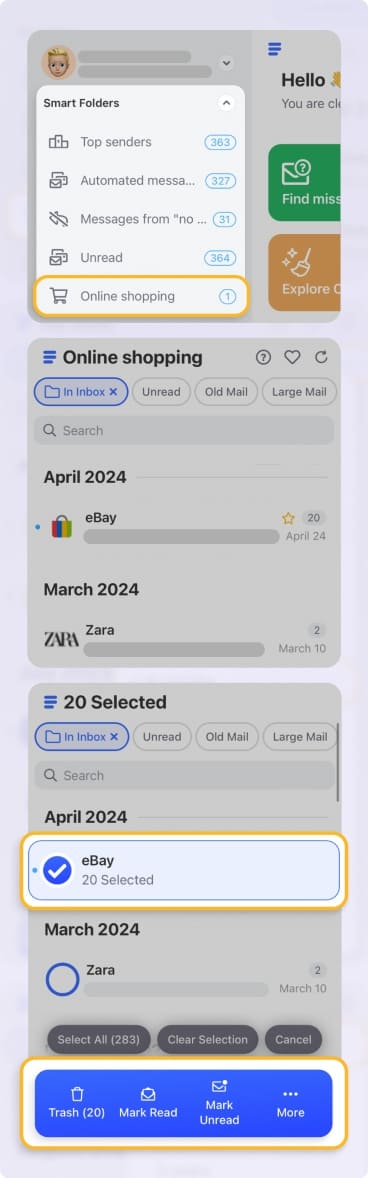
- Smart Folders help you eliminate searching for things like Social Notifications, Online Shopping, Travel, Automated Messages, and more. These premade folders automatically filter emails for you.
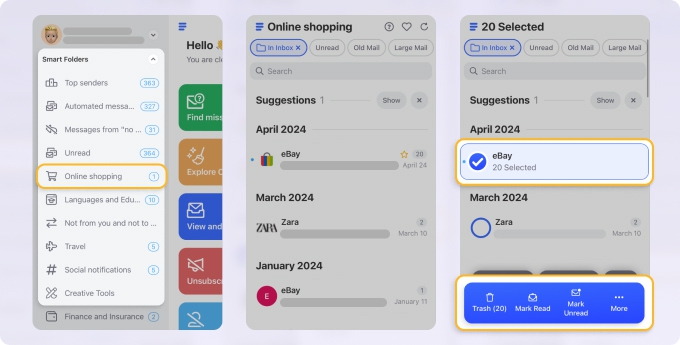
Check out Clean Email as a robust complement to your Gmail workflow. It’s available on desktop and mobile for any IMAP service provider.
Complete Gmail Search Operators Reference (50+ Operators)
To wrap up, see the below reference table for a complete list of Gmail search operators with examples and notes on usage.
| Operator | What It Does | Example | Notes / Limitations |
|---|---|---|---|
| from: | Messages from a specific sender | from:john@example.com | Exact email or name |
| to: | Messages sent to a specific recipient | to:jane@example.com | — |
| cc: | Messages where someone is CC'd | cc:team@company.com | — |
| bcc: | Messages where someone is BCC'd | bcc:boss@company.com | Only works for sent mail |
| subject: | Search only the subject line | subject:meeting agenda | Partial match works |
| "exact phrase" | Find an exact phrase | "project deadline Friday" | Use double quotes |
| OR | Match either term (must be uppercase) | from:john OR from:jane | Default is AND |
| - | Exclude a term or operator | -from:noreply@company.com | Place directly before term |
| ( ) | Group search terms together | (from:john OR from:jane) subject:report | Combine with OR |
| AROUND | Find words near each other | budget AROUND 5 report | Number = max words apart |
| label: | Messages with a specific label | label:work | Use label name exactly |
| has:userlabels | Messages with any user-created label | has:userlabels | Excludes system labels |
| has:nouserlabels | Messages with no user labels | has:nouserlabels | Find unlabeled mail |
| category: | Messages in a Gmail category tab | category:promotions | primary, social, promotions, updates, forums |
| is:starred | Starred messages | is:starred | — |
| has:yellow-star | Messages with a specific star color | has:yellow-star | yellow-star, blue-info, red-bang, etc. |
| has:blue-info | Messages with blue info icon | has:blue-info | Star variant |
| is:important | Messages marked as important | is:important | Gmail priority inbox |
| is:read | Messages you have read | is:read | — |
| is:unread | Messages you haven't read | is:unread from:boss@company.com | Combine for powerful filters |
| in:inbox | Messages in your inbox | in:inbox | — |
| in:trash | Messages in the trash | in:trash | Must search trash explicitly |
| in:spam | Messages in the spam folder | in:spam | Must search spam explicitly |
| in:sent | Messages in Sent Mail | in:sent | Same as from:me for most uses |
| in:drafts | Messages saved as drafts | in:drafts | — |
| in:anywhere | Search all mail including Spam & Trash | in:anywhere invoice | Overrides default scope |
| in:chats | Search Google Chat messages | in:chats | If Chat history is saved |
| in:snoozed | Snoozed messages | in:snoozed | Gmail snooze feature |
| has:attachment | Messages with any attachment | has:attachment | — |
| has:drive | Messages with Google Drive links | has:drive | — |
| has:document | Messages with Google Docs attached | has:document | — |
| has:spreadsheet | Messages with Google Sheets attached | has:spreadsheet | — |
| has:presentation | Messages with Google Slides attached | has:presentation | — |
| has:youtube | Messages with YouTube links | has:youtube | — |
| filename: | Attachment by name or extension | filename:pdf | filename:report.xlsx also works |
| size: | Messages larger than specified bytes | size:5000000 | 5 MB = 5,000,000 bytes |
| larger: | Messages larger than (accepts shorthand) | larger:10M | K, M accepted |
| smaller: | Messages smaller than | smaller:100K | K, M accepted |
| after: | Messages after a date | after:2024/01/01 | Format: YYYY/MM/DD |
| before: | Messages before a date | before:2024/12/31 | Format: YYYY/MM/DD |
| older: | Messages older than a time period | older:7d | d=day, m=month, y=year |
| newer: | Messages newer than a time period | newer:2d | d=day, m=month, y=year |
| older_than: | Alternative syntax for older | older_than:1y | Same as older: |
| newer_than: | Alternative syntax for newer | newer_than:3m | Same as newer: |
| deliveredto: | Messages delivered to a specific address | deliveredto:alias@gmail.com | Useful for aliases |
| list: | Messages from a mailing list | list:team@googlegroups.com | Matches List-ID header |
| replyto: | Messages with a specific Reply-To address | replyto:support@company.com | — |
| rfc822msgid: | Find by Message-ID header | rfc822msgid:abc123@mail.gmail.com | Exact match only |
| is:muted | Muted conversations | is:muted | Won't reappear when new replies arrive |
| from:me | Messages you sent | from:me | Shortcut for your own address |
| to:me | Messages addressed to you | to:me | Direct messages only |
| {} | Group for OR logic (alternative syntax) | {from:john from:jane} | Same as using OR between terms |