Global Gmail User Base
Gmail, used by billions of Google users worldwide, serves as a vital tool for personal and professional communication around the globe.

🧑💻 Total active users
How many Gmail accounts are there? As of 2026, Gmail has approximately 1.8 billion monthly active users worldwide, roughly 22% of the global population.
Beyond its core user base, the Gmail Android app has surpassed 10 billion installs on Google Play, placing it in an elite group of Google apps to reach this milestone.
These statistics showcase Gmail’s steady growth, which is likely fueled by its seamless integration with Google services like Google Drive and Google Workspace. Gmail consistently attracts millions of new users each year, cementing its place as a solid choice for an email client.
It is second only to Apple Mail in terms of market share, which we will dive into later on in the article.
🌎 Demographics
Gmail’s user base is as diverse as it is massive, but millennials (25-34) take the top spot, with younger professionals (18-24) not far behind.
Geographically, North America, Europe, and Asia dominate the usage of Gmail, with the United States as the leading nation for Gmail users.
Largely due to affordable smartphones and better internet access, mobile-first Gmail adoption is booming in emerging markets like India and Brazil, bringing a whole new wave of users into the mix.
Also, Indonesia and India boast the highest Gmail usage rates globally, with 82.6% of Indonesians and 82.4% of Indians actively using the platform. In contrast, the United States sees a lower adoption rate, with 41.9% of its population using Gmail.
Additionally, Gmail’s user base in Africa has expanded significantly due to improved connectivity and access to digital devices. This underscores the platform’s global appeal, considering how many Google accounts there are.
Quick rundown
- There are over 1.8 billion Gmail users globally.
- About 30.9% of the global population uses Gmail.
- The majority of Gmail’s users are aged 25-34.
- Gmail’s most prominent markets are North America, Europe, and Asia.
Gmail’s Market Share
🏅Dominance in the email provider landscape
As of February 2026, Gmail accounts for 23.54% of global email client opens in Litmus’ Email Analytics data, keeping it firmly in second place behind Apple’s combined clients at 45.51%.
Gmail’s growth is thanks to its strong features. Smart Compose, built-in Gemini AI, robust spam filtering, and the platform’s user-friendly design are largely responsible for how many people use Gmail.
These are the most popular email clients in 2026 according to market share:
- Apple Mail - 45.51%
- Gmail - 23.54%
- Outlook - 5.67%
- Yahoo! Mail - 2.06%
- Others make up the remaining share.
📈Historical trends and future projections
Over the past decade, Gmail’s user base has grown by nearly 60%, while competitors like Yahoo Mail and Outlook have struggled to maintain their positions. Other email clients have even experienced significant losses in their user bases.
Gmail is expected to experience continuous growth, particularly in emerging markets, as Google enhances its Workspace tools and integrates advanced AI-powered personalization features.
By 2026, an estimated 424 billion emails are sent every day worldwide, and Gmail is believed to handle on the order of 120+ billion of those messages daily.
Quick rundown
- Gmail currently accounts for about 23.54% of global email client opens, while Apple Mail remains the most popular email provider holding a 45.51% market share.
- Globally, around 424 billion emails per day are expected in 2026.
Google Daily Active Users
👥 Daily email traffic
Gmail processes an astounding 121 billion emails daily. Google daily users often utilize the platform as their main tool for business communications. The average Gmail user sends and receives over 120 emails per day, with business users often handling even higher volumes.
This staggering email traffic highlights Gmail’s pivotal role in global digital correspondence. With how many people use email, automation trends are on the rise. Businesses are increasingly leveraging Gmail for marketing campaigns and client communication.
📊 Engagement metrics
Gmail users spend an average of 28 minutes daily managing their inbox. Gmail’s open rate of 19.2% surpasses the industry average, reflecting its ability to engage users effectively.
Features like Priority Inbox and AI-powered email categorization significantly reduce the time users spend managing routine tasks, enabling businesses to enhance client response times.
Quick rundown
- Open rates from Gmail emails are at 19.2%.
- Gmail users spend 28 minutes every day going through their inboxes.
- Users optimize their email management with Gmail’s Priority Inbox feature.
Gmail’s Role in Google’s Ecosystem
One of Gmail’s most significant strengths lies in its integration with Google’s broader ecosystem. Services like Google Drive for file sharing, Google Calendar for scheduling, and Google Meet for virtual meetings enhance productivity for both personal and professional users. For example, Gmail’s connection to Google Tasks allows users to create and manage to-do lists directly from their email interface.
Google’s AI capabilities further optimize Gmail with tools like Smart Reply, advanced spam filters, and real-time email prioritization. These features work seamlessly to declutter inboxes and provide actionable insights, setting Gmail apart from its competitors.
🧑💼 Business usage of Gmail
Google Workspace boasts over 3 billion active monthly users (as of 2026 data). Gmail has become the preferred email provider for over 60% of small and medium-sized businesses, thanks to its cost-effectiveness and integration with Google Workspace.
Tools like Google Meet and Google Calendar simplify operations, making Gmail a top choice for business accounts and communications.
📊 Benefits for businesses
Businesses can use Gmail’s Smart Labels and Priority Inbox to help them categorize emails efficiently, arranging messages and communications according to urgency.
Since businesses also typically deal with a wealth of data, Gmail’s advanced security measures provide companies with a reliable platform for handling sensitive information.
Additionally, its integration with third-party tools and Google Workspace ensures seamless collaboration among internal and external teams and assists with workflow optimization.
Mobile vs. Desktop Usage
📲 Mobile app downloads
The Gmail app has surpassed 10 billion downloads across Android and iOS platforms, reflecting its global reach. It’s no surprise that mobile users account for nearly 75% of Gmail’s traffic, signaling a clear shift towards mobile-first email management.
💻 User preferences
Mobile users often rely on features like swipe gestures for quick email management and real-time notifications for timely updates. Desktop users, by contrast, take advantage of Gmail’s customization options and advanced email filtering capabilities. Regardless of the platform, Gmail ensures a seamless experience tailored to user preferences.
Gmail’s Security and Spam Filtering
🛑 Spam filtering efficiency
According to Google’s data, Gmail blocks nearly 15 billion spam emails daily—an impressive rate of approximately 10 million per minute—making it one of the most efficient spam filters available.
It also stops over 100 million phishing emails every day, preventing users from experiencing malicious links or files that could compromise their data.
Gmail’s AI-powered tools ensure inboxes stay free from malicious content, which enhances the overall user experience.
🔐 Advanced security features
Gmail has two key security features: two-factor authentication and end-to-end encryption. Both have significantly reduced phishing attacks and data breaches.
Since two-factor authentication (2FA) became mandatory for 150 million Google users in 2021, the use of multi-factor authentication (MFA) has grown steadily. Although exact numbers for Gmail users using 2FA in 2024 remain unavailable, a 2025 report shows that 83% of organizations now require MFA for IT access.
Gmail’s robust security measures position the email provider as a leader in safeguarding user information.
Quick rundown
- Gmail has strong security features, which help it block 15 billion spam emails and stop 100 million phishing emails daily.
- Two-factor authentication became mandatory for 150 million Google users in 2021, and its use has been growing steadily.
Gmail’s Integration with Emerging Technologies
Gmail is an early adopter, integrating cutting-edge technologies like artificial intelligence (AI) and machine learning (ML) to revolutionize email management.
🤖 AI-Powered features
Gmail’s Smart Compose takes predictive text to the next level by suggesting complete sentences as you type. The AI-powered tool saves time while maintaining a natural tone. Similarly, Smart Reply analyzes email content to suggest concise responses, making it easy to reply in seconds.
⚙️ Machine learning in spam filtering
If you’ve ever wondered why your inbox stays relatively free of spam, thank Gmail’s ML algorithms. Gmail’s spam filter boasts an impressive accuracy rate, with only 0.1% of junk emails slipping through into inboxes. By analyzing patterns and learning from user feedback, these algorithms continuously adapt to block phishing attempts and harmful content.
🔮 Future prospects
Gmail is poised to push its technology even further. Imagine personalized email sorting that prioritizes your most important messages or AI that drafts responses tailored to your unique tone of voice. As Google continues to refine its AI capabilities, Gmail users can expect even more intuitive and user-friendly innovations.
The Role of Gmail in Professional and Educational Settings
Gmail’s user-friendly interface and seamless integration with Google Workspace have cemented its position as a go-to solution for businesses, educators, and students alike.
🖇️ Adoption in businesses
Did you know that over 60% of mid-sized companies in the United States rely on Gmail? From startups to established enterprises, businesses favor Gmail for its cost-effective yet powerful features. Tools like Priority Inbox help teams stay organized, while integrations with Google Calendar and Meet optimize workflows and ensure deadlines are met efficiently.
📖 Educational use cases
In schools and universities, educators use Gmail to communicate with students, distribute assignments, and schedule virtual classes through Google Meet. The platform’s simplicity ensures that even tech novices can stay connected, making it a favorite for educational institutions worldwide.
Gmail’s connection to Google Workspace also creates a productivity powerhouse. Features like Google Drive enable easy file sharing, while Google Tasks allows users to create to-do lists directly from their inboxes. For professionals, this means faster project management and optimized communication with clients. For students, it simplifies group projects and keeps coursework organized.
Manage Gmail Better with Clean Email
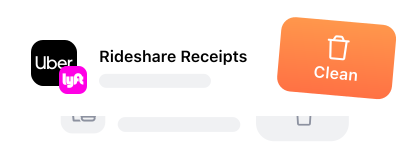
With daily volumes this high, even an average inbox fills up fast. Clean Email is an inbox management tool that helps you take back control of your Gmail, so you can focus on what matters instead of sorting through clutter.
A few features do most of the work:
- Smart Folders automatically sort messages into 30+ predefined categories, so important emails don't get buried under newsletters.
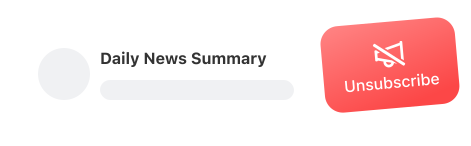
- Unsubscriber removes you from irrelevant mailing lists in one click.
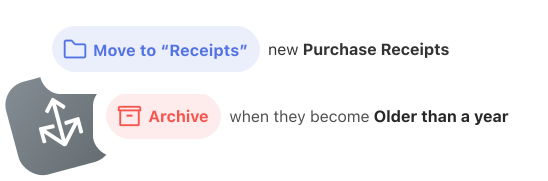
- Auto Clean lets you set rules to archive, delete, move, or mark emails by sender, subject, or keywords, automating the repetitive housekeeping.
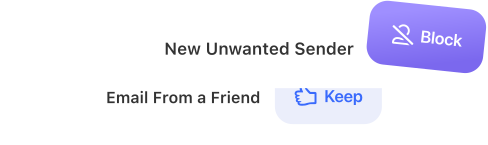
- Screener intercepts messages from new senders so you can allow or block them before they reach your inbox.
The app works on the web, macOS, and mobile, so you can manage your inbox from any device. Gmail's built-in tools are already solid, but pairing them with Clean Email cuts down the manual work of keeping things organized.
Final Thoughts
Gmail continues to lead the email market with its massive user base, innovative features, and strong security measures. These Gmail statistics highlight its indispensable role in global communication. From 1.8 billion monthly active users to 121 billion emails processed daily, the numbers show a platform that stays central to how people and businesses communicate.
For users aiming to improve their Gmail experience, the takeaway is less about the scale of the platform and more about managing your own slice of it. With daily volumes this high, even an average inbox fills up fast, so pairing Gmail's built-in tools like Priority Inbox and Smart Reply with regular cleanup habits is what keeps it manageable day to day.