


When Gmail Stores Your Messages Over Time
A free Google Account includes 15 GB of storage, shared between Gmail, Google Drive, and Google Photos. Scrolling through endless email pages isn't practical, and the default search features can be a hit or a miss. Cleaning up or deleting old emails may not always be the right solution, especially if you've had your Gmail account for years!
Gmail’s search operators, search filters, and the Trash and Spam folders let you find old emails without deleting anything.
💡 You can also use third-party apps like Clean Email. Some users even argue that it can be easier to use than Gmail, especially when accessing it on mobile devices!
For instance, you can go to Old Mail in the Favorites section of the left menu and choose any period you want to find old emails.
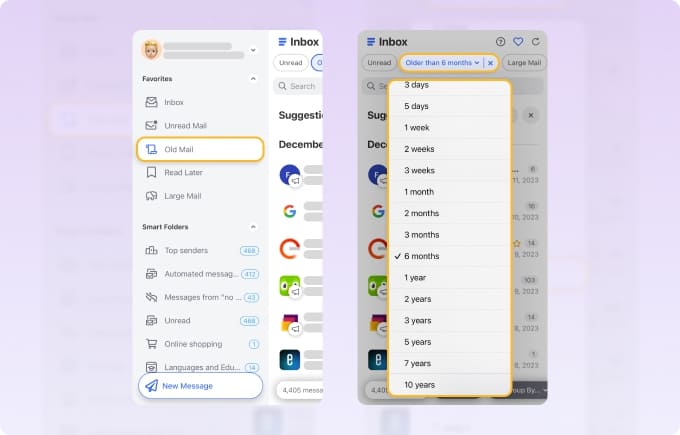
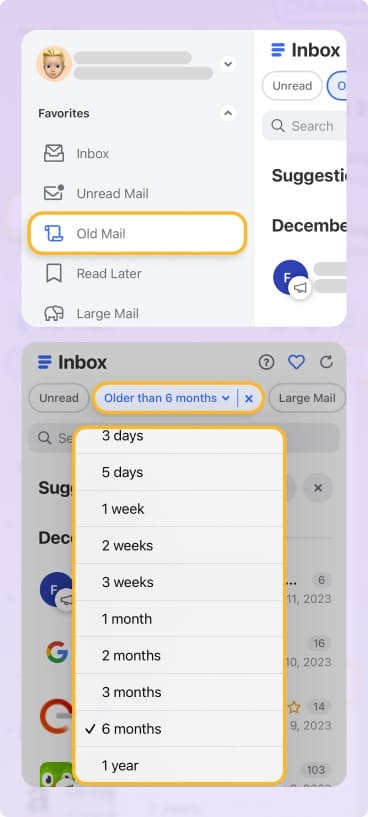
You can also group your emails by date in any folder for better navigation.
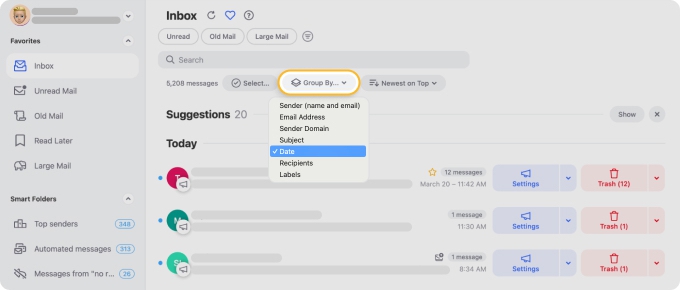
Then, in the Sort drop-down menu (Newest on Top), you can toggle between Newest on Top or Oldest on Top to set your preferred order.

Quick ways to find old emails in Gmail
- Use keywords or sender addresses in the search bar
- Search by date using before:, after:, or older_than:
- Open Advanced Search filters to narrow by size, date, or attachments
- Search All Mail to include archived messages
- Check Trash and Spam using in:trash or in:spam
- Use Clean Email’s Old Mail filters to browse by age instantly
Basic Search Techniques
Gmail's search bar is at the top of your inbox and works like any other search engine. You can type keywords or phrases; Gmail will pull up all relevant emails.
Enter relevant keywords or email addresses into the search bar. For example:
- Keywords: Typing in specific words or phrases related to the email content you're looking for can help narrow down the results. Also, if you know the sender's name or the topic, you will receive a list of matching messages.
- Email addresses: Entering the sender’s or recipient’s email address can quickly bring up all communications associated with that address.
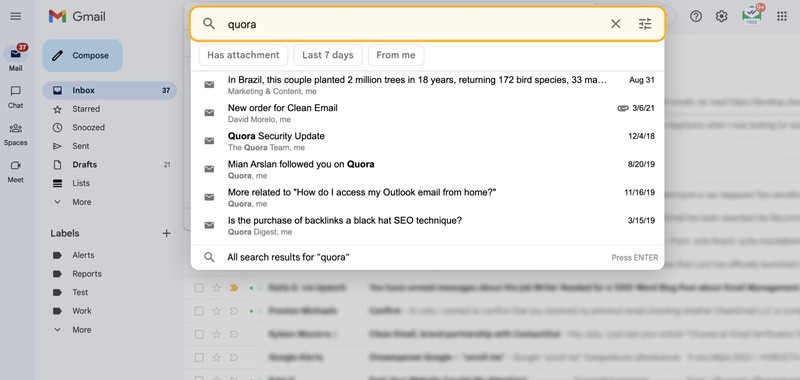
You can use these techniques both on the desktop and on the phone.
To jump straight to your oldest emails on a computer, open All Mail, hover over the message count at the top right (for example, “1–50 of 2,345”), and choose Oldest.
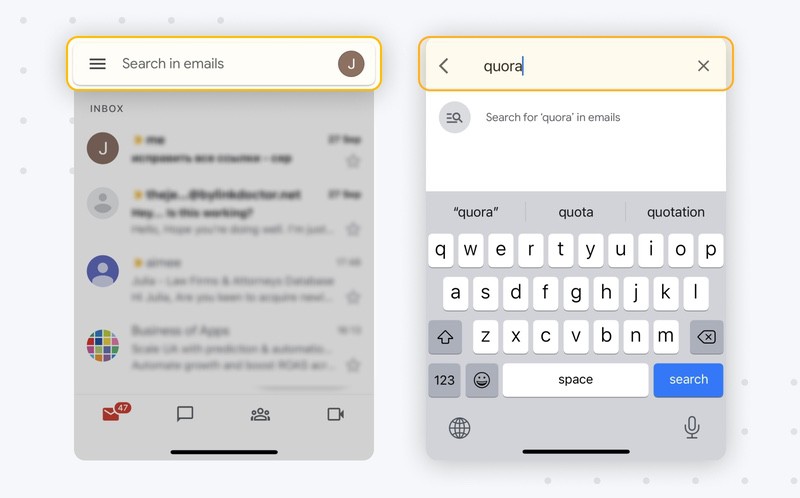
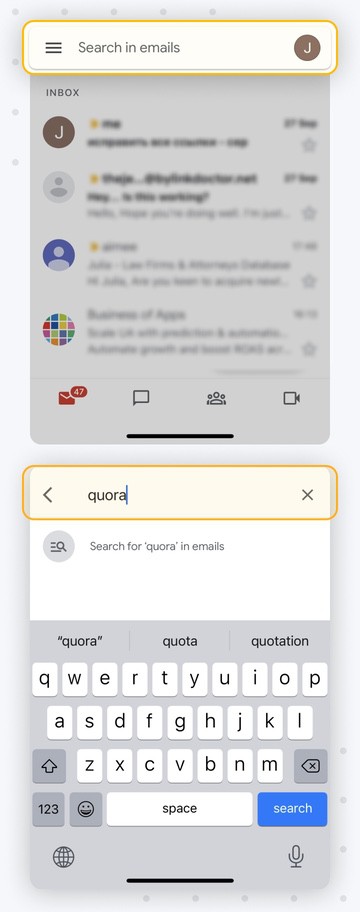
💡 Tip: On the Gmail mobile app, use “search chips” to narrow faster:
- Gmail can show tappable chips (like From, Attachment, Date, or Is unread) under the search bar after you run a search. This lets you narrow down your results without having to type in operators again.
- Gmail’s AI Overview can answer a question or summarize matching emails above your search results, so you don't have to open multiple emails. It works in English on Google AI Plus, Pro, and Ultra plans and eligible Google Workspace plans.
After you enter your query, Gmail will display a list of results. You can sort these results to find what you need more efficiently:
- By relevance: Gmail sorts the results by relevance by default, so the closest matches appear first, not necessarily the newest.
- By date: Switch the results from Most relevant to Most recent to see them newest first. To limit them to a period, click the filter icon (three lines) next to the search bar and set Date within.
How to narrow results when Gmail shows “too many emails”:
- Use quotes for exact phrases: "order confirmation"
- Exclude noisy terms with a minus sign: invoice -reminder -overdue
- Use OR to include alternatives: (receipt OR invoice OR "order confirmation")
- Group logic with parentheses to keep queries readable:
(from:amazon.com OR from:paypal.com) older_than:2y has:attachment
Advanced Search Operators
You can also use operators to refine your query—both on desktop and mobile devices. Here are some useful operators with examples that you can type in the search box to help narrow down your results:
| Operator | What it’s best for | Example |
|---|---|---|
| from: | Emails from a specific sender | from:john.doe@example.com |
| to: | Messages sent to a specific recipient | to:jane.smith@example.com |
| subject: | Messages with specific words in the subject line | subject:meeting |
| before: | Emails sent before a specific date | before:2022/01/01 |
| after: | Messages sent after a specific date | after:2022/01/01 |
| older_than: | Search for emails in Gmail older than a specific time (d, m, y for days, months, years) | older_than:1y (emails older than one year) |
| newer_than: | Messages newer than a specific time | newer_than:7d (emails from the last 7 days) |
| has:attachment | Those with attachments | has:attachment |
| is:important | Messages marked as important | is:important |
| label: | Those with specific labels | label:work |
| " " (quotes) | Exact phrase matches | "wire transfer" |
| - (minus) | Exclude terms | meeting -agenda |
| OR + ( ) | Alternatives + grouping | (from:hr@ OR from:payroll@) OR subject:"W-2" |
| cc: | Emails where someone was CC’d | cc:alex@company.com |
| bcc: | Emails you sent BCC’ing someone (note: doesn’t work for messages you received as BCC) | bcc:vendor@domain.com |
| filename: | Find attachments by name/type | filename:pdf or filename:contract |
| larger: / smaller: | Size-based filtering (bytes) | larger:5000000 has:attachment |
| category: | Narrow to Gmail categories | category:promotions older_than:1y |
| in:anywhere | Search across all folders, including Spam/Trash | in:anywhere subject:"password reset" |
| list: | Mailing list traffic | list:newsletter@domain.com |
| deliveredto: | Messages delivered to a specific address/alias | deliveredto:you+receipts@gmail.com |
Examples of How to Combine Multiple Search Operators for Precise Results
You can also combine search operators to narrow down your criteria. Here are some examples that we've tested ourselves:
- Finding old emails from a specific person with attachments
- Searching for Gmail messages sent to a specific person before a certain date
- Searching for important emails with a specific keyword in the subject line
- Locating emails sent within the last year that contain attachments
- Finding emails from a specific sender within a custom label
- Find old emails that include files (common for receipts, forms, and contracts)
- Old emails with PDFs: "older_than:2y filename:pdf".
- Old emails with spreadsheets: "older_than:2y (filename:xls OR filename:xlsx OR filename:csv)".
- Large old emails clogging storage: "older_than:1y larger:10000000".
- Receipts with attachments from a vendor: "from:store@domain.com older_than:1y has:attachment".
"from:john.doe@example.com has:attachment" — This will show those from John Doe that contain attachments.
"to:jane.smith@example.com before:2022/01/01" — This will display those sent to Jane Smith before January 1, 2022.
"is:important subject:project" — This will bring up all important correspondences with "project" in the subject line.
"newer_than:1y has:attachment" — This will show emails from the past year that have attachments.
"from:boss@example.com label:work" — This will display all messages from your boss that are categorized under the "work" label.
Using Gmail's Advanced Search Filters
The search bar includes a filter icon on the right end of the bar. Clicking this opens up Gmail's search filters, which can help refine your query.
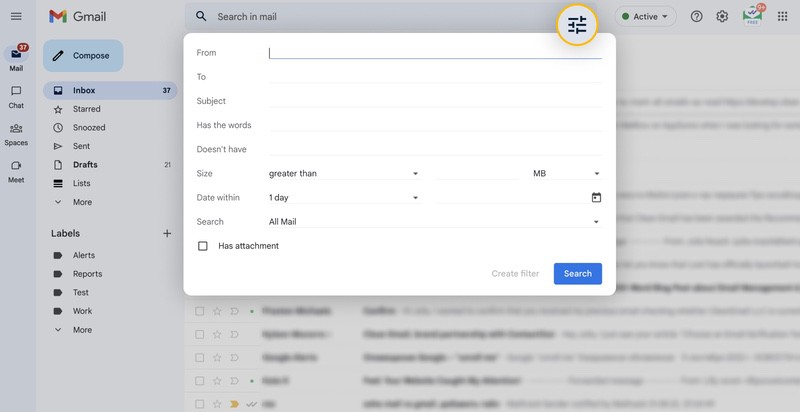
Fill in the following fields to input specific criteria and view narrowed results on Gmail. Here’s how:
| From | Enter the email address or name of the sender whose messages you want to see in Gmail. | From: john.doe@example.com |
| To | Specify the recipient’s email address if you want to get to old emails sent to a particular person. | To: jane.smith@example.com |
| Subject | Type in keywords related to the subject line of the messages you’re seeking. | Subject: project update |
| Has the words | Enter keywords that you expect to find in the body of the emails. | Has the words: annual report |
| Doesn't have | Exclude those containing certain words. | Doesn't have: confidential |
| Size | Search for those larger or smaller than a specified size. | Size: greater than 5 MB |
| Date within | Choose a date range to filter messages sent within a specific time frame. | Date within: 1 year; 2022/01/01 |
| Has attachment | Check this box to include only messages that have attachments. | If ticked, the result will return only those with attachments. |
| Search | Select whether to dig into your entire inbox, starred or unread emails, or other categories. | All Mail / Inbox / Starred, etc. |
Saving Custom Searches for Frequent Use
Gmail doesn’t save searches, but you can turn one into a filter. After filling in the fields, click the Create filter button and choose Apply the label. Check Also apply filter to matching conversations to label existing emails too, so you can open them from that label later instead of searching again.
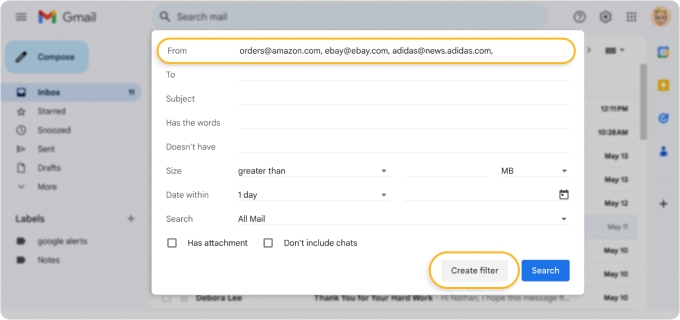
You can use filters in many ways, not just for searching older emails but also organizing your messages.
Recovering Emails From the Trash and Spam Folders
When you auto-delete an email in Gmail, it doesn't vanish instantly. It goes to the Trash folder instead. Messages stay there for 30 days before being deleted for good.
To see if there are any deleted messages in the Trash folder:
- In Gmail, click on Trash on the left side of the screen. If you can't find it, click on More at the bottom of the page to see more labels.
- Look through the messages in the folder to find the ones you want. Use the Search bar to make the search more specific.
Searching Within the Trash and Spam Folders
Gmail allows you to look for older messages specifically within the Trash or Spam folders to locate more efficiently: you can access your old emails from the Search Bar.
- To dig up messages within the Trash folder, include "in:trash" in your search query.
Example: "in:trash meeting notes"
- To look for messages within the Spam folder, include "in:spam" in your search query.
Example: "in:spam invoice"
Find Old Mail Easier With Clean Email
Gmail's built-in search tools are great, but you can make them even better by using third-party tools and extensions to help you organize and manage your emails. These tools often have extra features that make managing email easier and help you get more done.
The Clean Email app has better search features, makes you more productive, lets you customize and personalize it, and has dedicated apps for mobile devices.
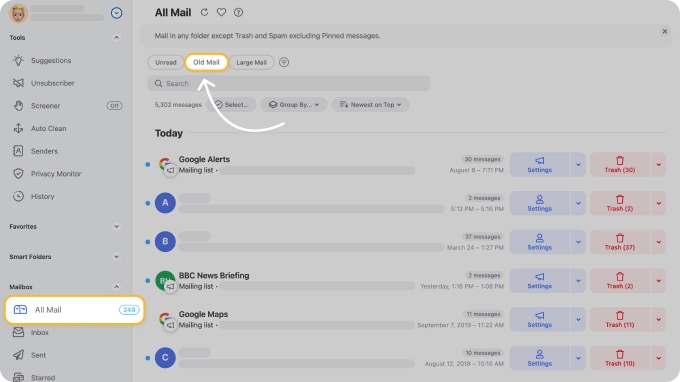
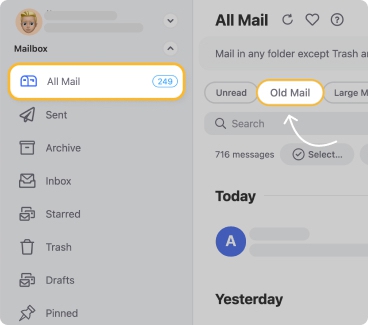
For instance, the Old Mail option is available at the top of every folder (like All Mail) in the Clean Email app for web users and on Android and iOS.
How Clean Email Helps Reduce the Clutter
One of the best ways to stay on top of your inbox is to reduce the number of incoming messages that aren't important. To help manage this issue, you can use Clean Email's powerful inbox filters.
How can Clean Email help you find old emails?
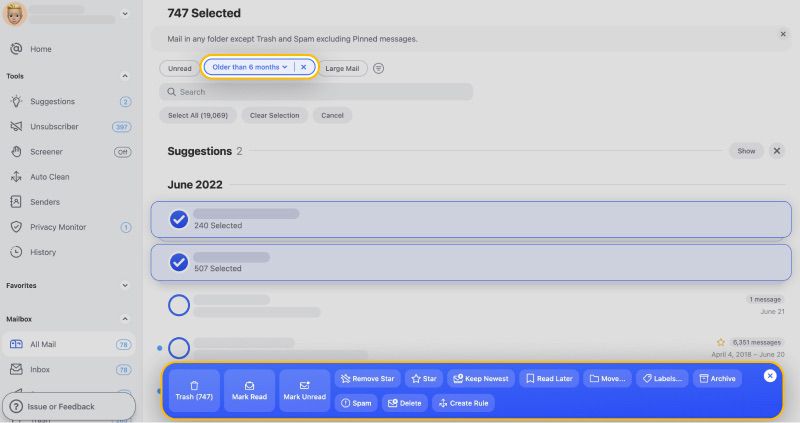
- Choose All Mail from the left-side panel (you may have to scroll down) and click Old Mail, shown above the search field.
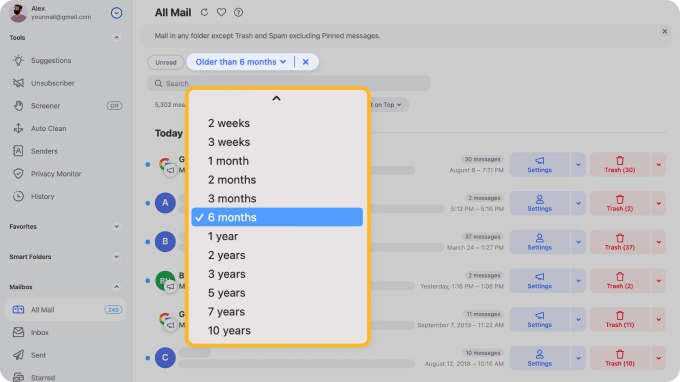
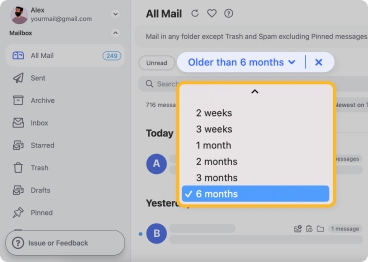
- Select a filter such as ‘Older than 6 months’ to sort your messages.
- Select the messages you need and choose an action such as Delete, mark read, archive, etc. These are great for clearing old, unnecessary messages or tidying up inboxes and folders by removing the unread flag (learn more about how to find unread emails in Gmail).
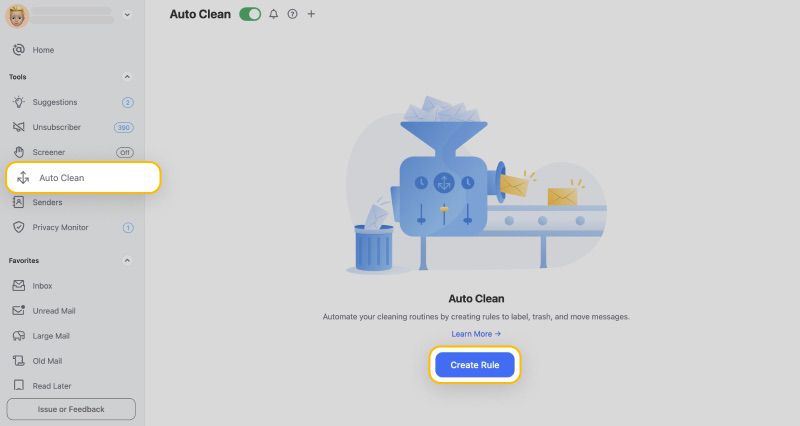
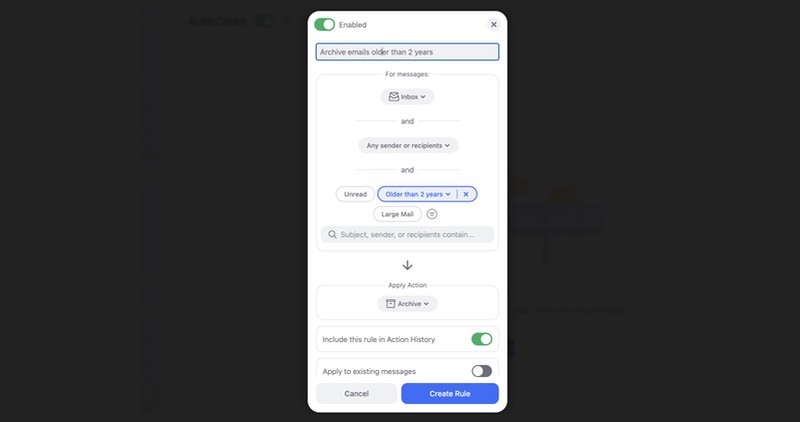
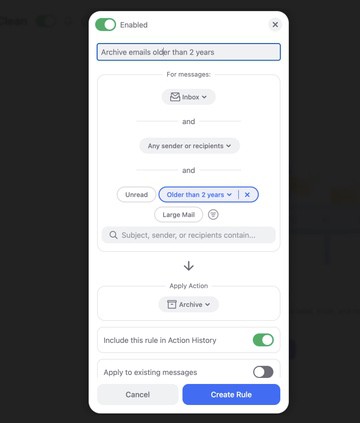
You can also create an automated email rule (Auto Clean feature) to filter certain old messages automatically. For example, if you want old messages (older than…) to be moved to Trash or to the other folder (like Archive) automatically, do the following:
- Click the Auto Clean tab from the left-side panel. Then click Create Rule or the plus button on top.
- Fill in the rule’s criteria. Optionally, toggle the switches to include this rule in Action History and apply it to existing messages.
- Click Create Rule to set up the automation.
📌 Hint: This is especially handy if, for example, your company has a policy of only holding on to data for a specific period and then automatically archiving any email messages over that data range.
Clean Email also has a Smart Folders function, which automatically groups emails based on their context, such as You are CC-ed, Finance and Insurance, or Messages to yourself (we all do it!)
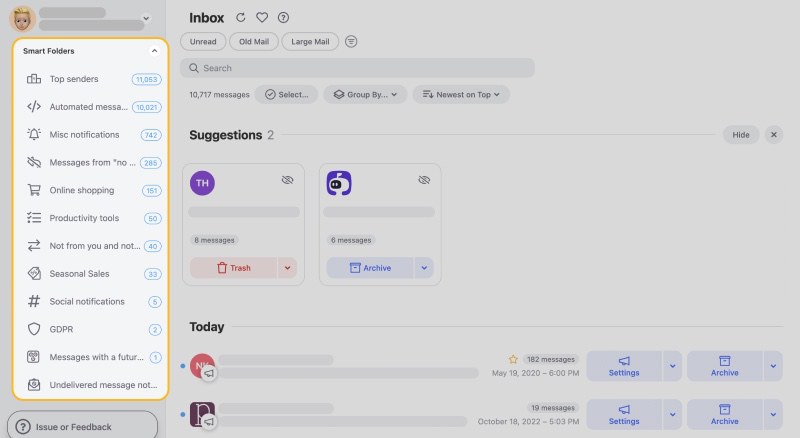
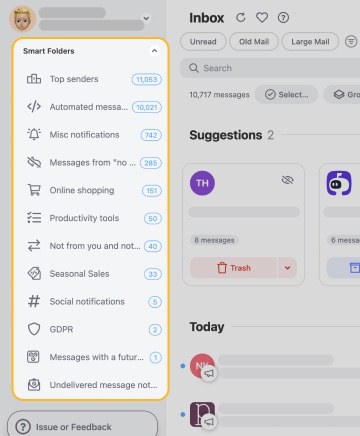
You can also search and get rid of old messages in Clean Email within a specific folder. Just choose the folder from the left-side panel, such as Social notifications or Online shopping, and repeat the above instructions.
How To Find Old Emails On Gmail - FAQs
How far back does Gmail keep emails?
Gmail keeps your emails until you delete them, as long as your account is active and within its storage limit. A free account includes 15 GB shared with Google Drive and Google Photos; once it’s full, you can’t send or receive new emails.
How do I search for emails 10 years ago in Gmail?
Open Gmail and type in ‘older_than:10y’ on the top search bar to look for messages older than 10 years. You can also use the Clean Email app for advanced search options.
Why is my Gmail not showing old emails?
Archived emails leave your Inbox but stay in All Mail, and search includes them. Search skips Spam and Trash, so add in:anywhere to your query. Also check for filters that archive or delete messages automatically.
Why doesn’t bcc: find emails I received?
Gmail search can’t reliably show messages where you were BCC’d as a recipient (because BCC recipients aren’t exposed in headers the same way). The bcc: operator is most useful for locating messages you sent where you BCC’d someone.
Did Gmail delete my old emails?
Gmail doesn’t delete emails on its own, except that Spam and Trash are emptied after 30 days. Google may also delete your content if your account is inactive for 2 years or stays over its storage limit for 2 years, but it sends notices first.
Is Clean Email secure?
Yes, Clean Email is an email management tool, but cannot send or forward any of your communications. We have a clear focus on the privacy and security of our users.


