What Are Categories in Outlook?
Categories in Outlook are color-coded labels you can use to tag emails without moving them from your inbox or a folder. They’re commonly used to mark groups of messages that fall into a particular topic and then easily spot those emails.
Key Takeaways
- Outlook Categories mark an email to describe what it’s about without moving it.
- You can use Categories in all Outlook versions including New Outlook, Outlook on the web, Classic Outlook, Outlook on Mac, and the Outlook mobile app. Features may differ per version.
- You can set up Outlook inbox rules to automatically categorize incoming emails.
- Limiting the number that you use and creating a simple system is the most effective way to use Outlook Categories.

Outlook Categories vs. Folders vs. Flags
There are three practical ways to manage and organize emails in Outlook: categories, folders, and flags. Because it can be difficult to know which one to use and when, check out the table below for explanations and recommended uses.
| Purpose | What happens to the email | Best use case | Main limitations | |
|---|---|---|---|---|
| Categories | Describes what an email is about | Marked and stays in current location | Emails you want to quickly spot that fall into the same topic, e.g. travel arrangements or short-term projects |
|
| Folders | Organizes where emails belong | Moves to the folder | Emails you want to keep for easy access later, e.g. legal or business communications |
|
| Flags | Indicates when action is needed | Marked and stays in current location | Emails that require follow-up, reply, or another action, e.g. replying when you have more time |
|
Outlook Categories by Version
Category features vary in different versions of Outlook. To see what’s available for your version, review the table below.
| Create | Assign | Edit/Rename | Delete | View/Filter | |
|---|---|---|---|---|---|
| New Outlook & Outlook Web | ✅ | ✅ | ✅ | ✅ | ✅ |
| Classic Outlook | ✅ | ✅ | ✅ | ✅ | ✅ |
| Outlook on Mac | ✅ | ✅ | ✅Legacy Outlook ❌New Outlook: Edit color only | ✅ | ✅ |
| Outlook on Mobile | ✅Android ❌iOS | ✅Android ✅iOS | ✅Android: Edit color only ❌iOS | ❌Android ❌iOS | ✅Android ✅iOS |
How to Create and Manage Outlook Categories
If you’re ready to put this feature to work, learn how to create, assign, edit, and delete as well as how to view categories in Outlook.
These instructions cover the most commonly-used versions; New Outlook, Outlook on the web, and Classic Outlook on desktop.
Categories in New Outlook and Outlook on the Web
New Outlook and Outlook on the web have almost identical layouts and features, making Category management easy.
Create a category
- Do one of the following:
- On the Home tab, pick Categorize in the ribbon and choose New category.
- Right-click an email, move to Categorize, and choose New category.
- Go to Settings → Account → Categories → Create new.
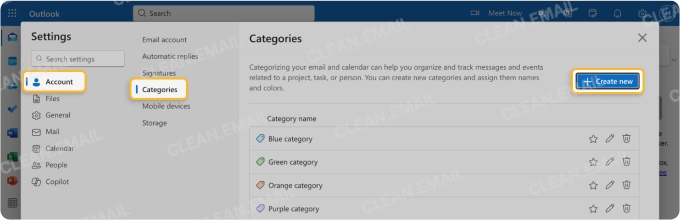
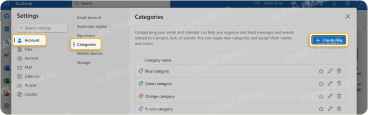
- Enter a category Name and pick a category Color.
- Optionally, pick a Shortcut (desktop only).
- Choose Save.
Assign a category
Do one of the following:
- On the Home tab, select Categorize in the ribbon and choose a Category.
- Right-click an email, move to Categorize, and pick a Category.
Edit or delete a category
Do one of the following:
- On the Home tab, pick Categorize in the ribbon and choose Manage categories.
- Right-click an email, move to Categorize, and choose Manage categories.
- Go to Settings → Account → Categories.
To change the name, color, or shortcut, select Edit (pencil).
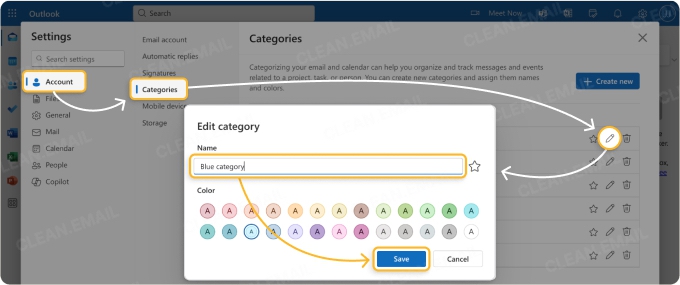
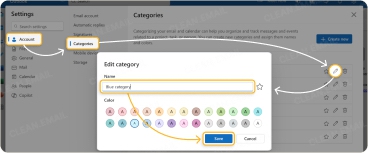
To remove the category, select Delete (trash can).
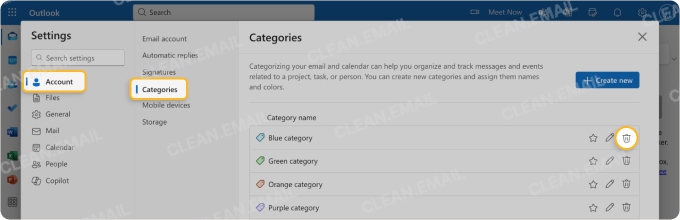
To add a category to Favorites, select the Star.
View or filter by category
To view all emails that have been categorized, select the Sort button on the top right of your message list and choose Category. You’ll see your messages grouped by the category name.
You can then use the Sorted A to Z button or Category column to sort in ascending or descending order if you like.
To find all emails within a specific category, do one of the following:
- Search for category:[name].
- Select a current Category tag on an email.
Categories in Classic Outlook on Desktop
If you’re more comfortable with Classic Outlook on your desktop, managing Categories there is simple.
Create a category
Do one of the following:
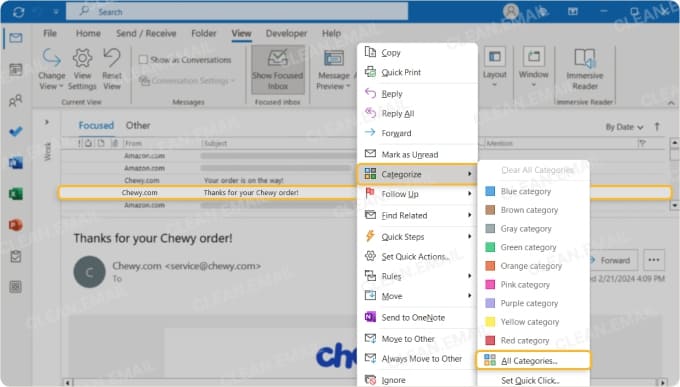
- Go to the Home or Message tab, pick Categorize in the ribbon and choose All Categories.
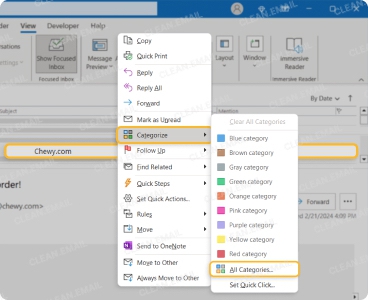
- Right-click an email, move to Categorize, choose All Categories, and click New.
- Select New.
- Enter a category Name and pick a category Color.
- Optionally, pick a Shortcut Key.
- Choose OK and OK again.
Assign a category
Do one of the following:
- On the Home or Message tab, select Categorize in the ribbon and choose a Category.
- Right-click an email, move to Categorize, and choose a Category.
- Right-click within the Category column and choose a Category.
Edit or delete a category
On the Home or Message tab, pick Categorize in the ribbon and choose All Categories.
Select a current category and do one of the following:
- Choose Rename, enter the new name, and press Enter.
- Choose a new Color on the right.
- Choose Delete and choose Yes to confirm.
- Choose a new Shortcut Key on the right.
View or filter by category
To view all emails that have been categorized, select the Sort button on the top right of your message list and choose Categories. You’ll see your messages grouped by the category name.
You can then use the A to Z on Top button or Categories column to sort in ascending or descending order.
To find all emails within a certain category, search for category:[name].
How to Actually Organize Email With Categories
While categories are terrific tools for spotting related emails in your inbox or a folder, they can quickly become ineffective if not used sensibly. For instance, using dozens of categories can cause color duplication — this makes the messages harder to spot and the system more difficult to manage.
To start, here are a few category structures to consider for best usage:
- Action-based: Action / Waiting / Read-Reference
- Area-based: Work / Finance / Home / Health, etc.
- People-based: By name or position; useful for teams or shared mailboxes
Along with using a simple system, there are other considerations for effectively categorizing your emails. Let’s look at these options with some examples.
Multi-Category Tagging
Applying more than one Category to an email is a feature that can be quite useful. You’ll see all category tags attached to the message, can find the email by searching for any of its categories, and can sort or filter in Outlook by Category with the message falling into all applicable groupings.
Example: If you use the area-based structure and receive a medical bill, you can apply both the Finance and Home categories.
To remove a Category from an email, use the Categorize menu to deselect it. For all categories, choose the Clear option in the Categorize menu.
Category Colors
While the Category palette holds many colors, try to use those that correlate to the particular topic. This can make the color and name combination more effective and easier to see at a glance.
Example: For the action-based structure, consider red to signal Action, green for Waiting, and yellow for Reference. Or for the people-based system, consider using each person’s favorite color or a color they wear often.
Favorites
If you use a particular Category often, add it to your Favorites for quick access. You’ll see your Favorites in the Navigation Pane in New Outlook and Outlook on the web and can then choose that Category to view all emails where it applies.
Example: For the action-based structure, add the Action Category to easily see all of those important messages quickly.
Shortcuts
For the desktop versions of Outlook, you can assign a shortcut or short key as described earlier. This can make applying a Category to an email a fast action.
All shortcuts use the Ctrl key plus a Function key such as F2, F3, F4, and so on.
Example: For the area-based structure, you can assign a shortcut like Ctrl + F2 to the Finance category to handle those emails after payday.
Calendar Categories
Another efficient use for categories applies to your Outlook Calendar. Whether you create new categories or use the existing ones, these categories are the same in Outlook Mail as Outlook Calendar. This makes organization a breeze for events, appointments, meetings, and the like that are related to emails.
Example: For the area-based structure, you can apply the Health category to email confirmations of upcoming appointments and to the corresponding appointments on your calendar.
Category Search
Above we provided you with the search operator to find categorized emails. You simply type category:[name] and press Enter to see all messages tagged with that category — for example, category:action or category:work.
But you can also add Category to the advanced search in Outlook:
- New Outlook and Outlook on the web: Select Filters in the Search bar, choose Add filters at the bottom, mark Category, and Save.
- Classic Outlook: Click inside the Search bar, select the arrow, choose Add more options, mark Category, and Apply.
Then, just choose the Category and click Search to see all emails with that certain category.
Can Outlook Automatically Categorize Emails?
Yes, Outlook offers inbox rules that let you automatically categorize emails as they arrive. This gives you an effortless way to apply a Category based on a condition like sender, subject, or keyword.
To set up a rule:
- New Outlook and Outlook on the web: Go to Home, select Rules → Manage rules, and pick Add rule.
- Classic Outlook: Go to Home, select Rules → Manage Rules & Alerts, and pick New Rule.
Then, enter the criteria and action or follow the prompts to complete the setup.
While Outlook rules are more advanced than some other email applications, they still don’t provide broad inbox automation options.
For example, Outlook rules apply to incoming emails and can only run on existing messages with manual intervention. However, other tools, like Clean Email, provide features that make mailbox automation simpler and with less work.
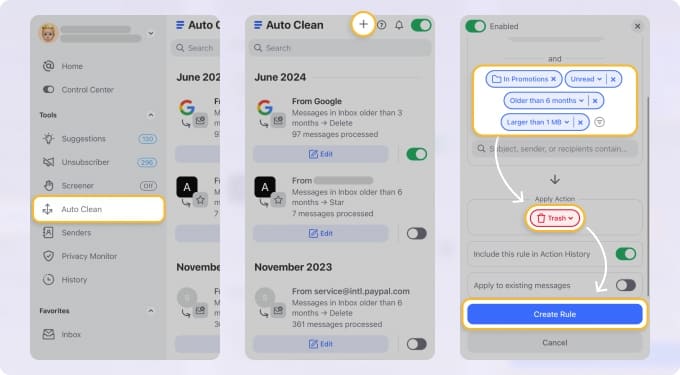
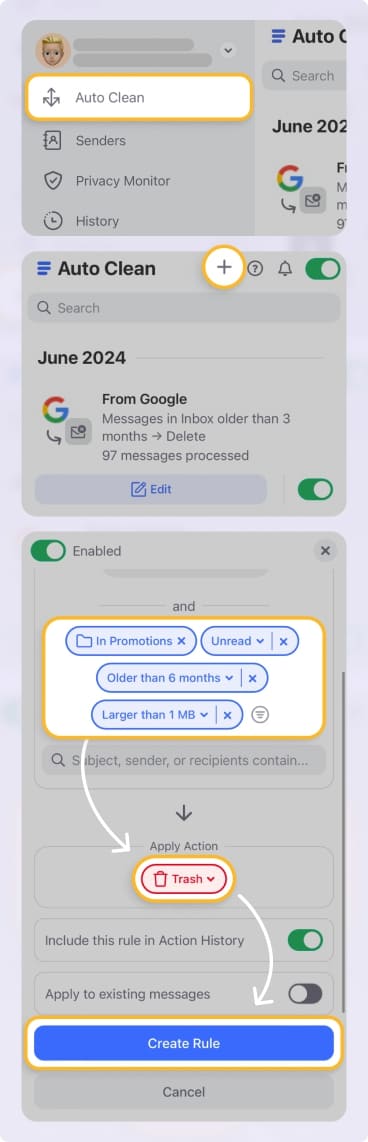
Using Clean Email’s Auto Clean feature, you can create rules that apply to both new and existing messages without extra steps. This lets you set up a repeatable organizational structure for emails and perform a reliable cleanup for your Outlook inbox.
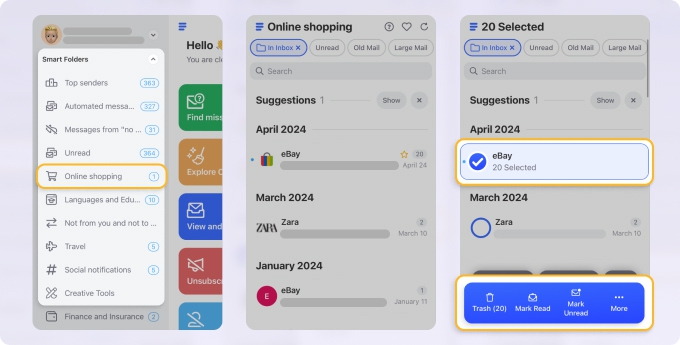
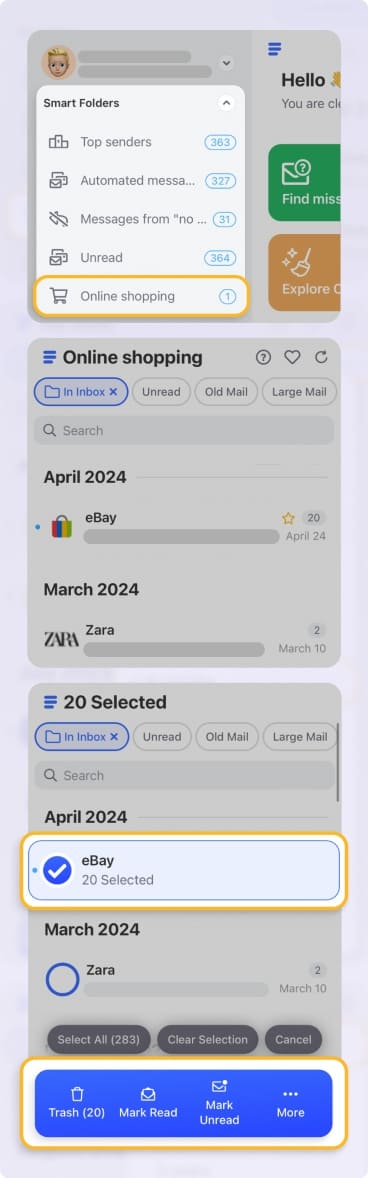
Additionally, Clean Email offers Smart Folders which automatically filter related emails for you which can reduce the need for numerous Outlook categories. For instance, you have pre-made folders for Travel, Online Shopping, Finance, Top Senders, and more with over 30 folders in all.
Clean Email works with multiple providers alongside your preferred email app. Get started with Clean Email on the web or via its full-featured mobile apps to clean, organize, and manage emails from any device.
Troubleshooting Outlook Categories
If you run into problems with your Categories in Outlook, there are a few common issues.
Categorize option missing or greyed out: You haven’t selected an email yet or you’re trying to categorize a message for an unsupported IMAP account.
Categories missing in New Outlook on Windows: You’re using an unsupported IMAP or POP account or a shared mailbox with limited permissions.
Category sync problems: You may experience issues syncing Categories with shared mailboxes in different Outlook versions or on mobile. Try logging into the mailbox in Outlook on the web to refresh the metadata or remove and re-add the mailbox in the Outlook mobile app.
Category colors look different than before: In 2026, the color palette for New Outlook categories changed to a pastel design. You cannot switch the palette back or customize Outlook category colors. If you’re using the application on your desktop, consider reverting to Classic Outlook.
Reset Outlook categories: If you created new categories and renamed existing ones but would like to return to the default list, you can do so.
- In New Outlook or Outlook on the web: Go to Settings → Accounts → Categories to delete any custom categories and rename the default categories.
- In Classic Outlook: Close the application, press Windows key + R, type outlook.exe /cleancategories, and click OK.
Final Thoughts
If you’re not using Outlook Categories, you’re missing out on a key productivity feature. Whether for work or personal emails, categories help you organize your inbox and quickly find related emails.
And remember that tools like Clean Email work alongside Outlook to assist with automated mailbox cleanup and advanced email management — on any device.
Now that you know how to create, assign, and view, along with how to edit categories in Outlook, why not learn more about using folders! You can organize Outlook folders to meet your needs and delete folders in Outlook you no longer use.
FAQs
What happened to categories in the new Outlook?
Categories are still available, but Microsoft changed where some controls appear. You can assign them from the toolbar or right-click menu and manage them under Settings → Accounts → Categories. They may be unavailable for IMAP and POP accounts.
Do Outlook categories sync across devices?
Yes. Categories generally sync when you use the same Outlook.com, Microsoft 365, or Exchange mailbox across supported Outlook apps. However, available category controls vary by app, and shared mailboxes can experience sync delays or inconsistencies.
Can other people see my Outlook categories?
No. Categories applied in your personal mailbox are not visible to email recipients. However, people with sufficient access to a shared mailbox or folder may see and use categories assigned to its items.