Key Zoho Mail Statistics at a Glance (2024–2026)
Between 2024 and late 2025, Zoho Mail strengthened its role as a core business email provider. It now supports hundreds of thousands of companies, serves over 10 million users, and is approaching $100 million USD in annual revenue from Mail alone, with most revenue generated outside India.
- 645,787+ companies using Zoho Mail globally (company-usage datasets)
- 740,982 websites using Zoho Mail as of October 2025
- ~4–8% share of the business email market (depending on dataset)
- 10M+ estimated users
- ~$100M annual Zoho Mail revenue, over 70% from outside India
These figures come from independent tracking platforms and public statements, not Zoho’s internal dashboards—but they consistently point in the same direction.

Adoption by Company Size and Revenue
Zoho Mail’s customer base skews heavily toward small and mid-sized businesses, but it isn’t limited to them.
- Small businesses (<50 employees): ~49%
- Mid-sized companies: ~27%
- Large enterprises (1,000+ employees): ~24%
From a revenue standpoint:
- 57% of Zoho Mail customers generate under $50M annually
- 22% fall into mid-market ranges
- ~11% exceed $1B in revenue
This explains Zoho Mail’s pricing strategy: low entry cost, predictable scaling, and optional upgrades rather than aggressive bundling.
Market Share: Why the Numbers Look “Small” but Still Matter
Email market share is notoriously hard to measure because different sources track different things—providers, clients, inboxes, or websites.
Across 2024–2025:
- Zoho Mail holds ~8.2% share in some B2B “email communications” datasets.
- Website-based trackers show ~0.01% of all sites using Zoho Mail—but that still translates to 740,000+ sites.
- Provider-level comparisons consistently place Zoho Mail around 4% global share, with a business-only focus.
In context, Zoho Mail sits well behind Gmail and Outlook—but comfortably ahead of many niche and regional providers.
Geography and Industry Distribution
Zoho Mail’s reach is global, with notable concentration in a few regions:
- United States: ~18–27% of usage (depending on dataset)
- India: ~8–16%
- Brazil: ~12%
- Remaining usage spread across Europe, Asia, and LATAM
Industries with higher Zoho Mail adoption include:
- News & media publishers
- Developer and software companies
- A wide spread of SMBs across services, ecommerce, and agencies
This aligns with Zoho’s positioning as a privacy-first, cost-efficient business platform.
Revenue and Financial Context
In November 2025, Zoho’s CEO confirmed that Zoho Mail alone is approaching $100M in annual revenue, a meaningful figure for a product that competes primarily on value rather than upsell pressure.
At the company level:
- Zoho revenue (2024): ~$1.4B
- YoY growth: ~27%
- 100M+ users across all Zoho apps
- 700,000+ businesses using Zoho software globally
Zoho Mail is not a side project—it’s a core pillar of the ecosystem.
How Some Zoho Mail Users Handle Inbox Growth
As Zoho Mail adoption is growing, especially among small businesses and fast-moving teams, inbox volume grows with it. Zoho handles delivery, security, and compliance at scale but keeps inbox management conservative to avoid over-automation and accidental data loss.
That's where some users add a layer focused purely on organization. Clean Email is an inbox management tool that connects via IMAP and handles inbox cleanup, the area Zoho keeps manual by design.
For Zoho users, Clean Email can:
- Group emails by sender, category, size, or age across the entire mailbox
- Identify high-volume senders and subscription clutter faster than folder-based tools
- Automate cleanup rules without touching Zoho’s server-side spam or compliance policies
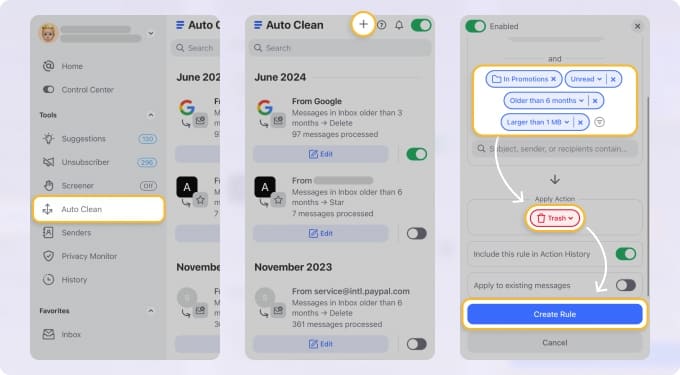

It works consistently across web, macOS, and mobile, which helps users who move between Zoho Mail’s web interface and mobile apps.
In practice, Zoho handles delivery, security, and compliance—while Clean Email helps with visibility and Zoho email cleanup when inbox volume becomes a productivity issue rather than a storage problem.
Do Zoho Mail Users Rely on Third-Party Tools?
There are no public statistics showing what percentage of Zoho Mail users rely on third-party tools versus staying entirely within the Zoho ecosystem. Zoho does not publish integration adoption rates, and independent research firms don’t break usage down at that level.
Still, several signals help frame real-world behavior.
Zoho strongly promotes an all-in-one ecosystem through Zoho One and Workplace. At the same time, late-2025 updates introduced a unified integration layer for Zoho-to-Zoho and Zoho-to-third-party connections—an acknowledgment that many customers do integrate external tools.
The Zoho Marketplace hosts both Zoho-native and third-party apps (Google Workspace, Microsoft 365, Shopify, QuickBooks, Mailchimp, Slack, Zapier). Install counts aren’t public, but Zoho Flow supports 400+ third-party apps, suggesting integration is common enough to warrant serious investment.
From case studies and reviews, a consistent pattern emerges:
- Zoho One / Workplace users rely less on external tools
- Zoho CRM users frequently integrate email, marketing, accounting, or ecommerce platforms
- Mid-market and enterprise teams almost always run mixed stacks
Zoho Mail supports both paths: a closed ecosystem for simplicity, and an open one for integration-heavy environments.
Zoho Mail vs. Google Workspace vs. Microsoft 365 (2025 Snapshot)
| Category | Zoho Mail / Workplace | Google Workspace | Microsoft 365 |
|---|---|---|---|
| Entry pricing | From $1/user/mo | From $7/user/mo | From $6/user/mo |
| Free custom domain | Yes (up to 5 users) | No | No |
| Primary audience | SMBs, startups, Zoho users | Cloud-first teams | Enterprises, Office-centric orgs |
| Ads | None | None (Workspace) | None |
| Ecosystem strength | Zoho-native depth | Docs/Drive/Meet | Office/Teams/SharePoint |
| Market focus | Business email | Broad consumer + business | Enterprise productivity |
Zoho’s advantage remains cost efficiency and ecosystem consistency. Google and Microsoft lead in collaboration scale and enterprise penetration.
Key Zoho Mail Statistics Recap
- 645,000+ companies using Zoho Mail
- 740,000+ websites running on Zoho Mail
- ~10 million users worldwide
- ~4–8% business email market share
- ~$100M USD annual Mail revenue (approaching)
- 88%+ of customers under 100 employees
Those numbers don’t suggest a challenger fading into the background. They describe a platform that’s settled into a long-term role.
Final Take
Zoho Mail’s statistics tell a consistent story: it’s a serious, scaled business email platform with global reach, strong SMB adoption, and growing revenue—without chasing trends or inflating promises.
It doesn’t try to be Gmail or Microsoft 365. And that’s exactly why it works for so many teams.
For organizations that want predictable costs, privacy-first email, and deep business tooling, Zoho Mail’s growth trajectory makes sense.
If you want a breakdown tailored to your company size or a cost comparison using your actual headcount, that’s usually where the numbers get interesting.