Executive Summary
Email usage reached unprecedented scale in 2025, with 4.59 billion global users (56% of world population) exchanging 376.4 billion messages daily—a volume projected to grow to 392.5 billion by 2026 and 408.2 billion by 2027.
This represents consistent 4% annual growth, defying competition from instant messaging and social platforms.
The average user now manages 1.86 email accounts and receives 82-120 emails per day, creating unprecedented inbox pressure.
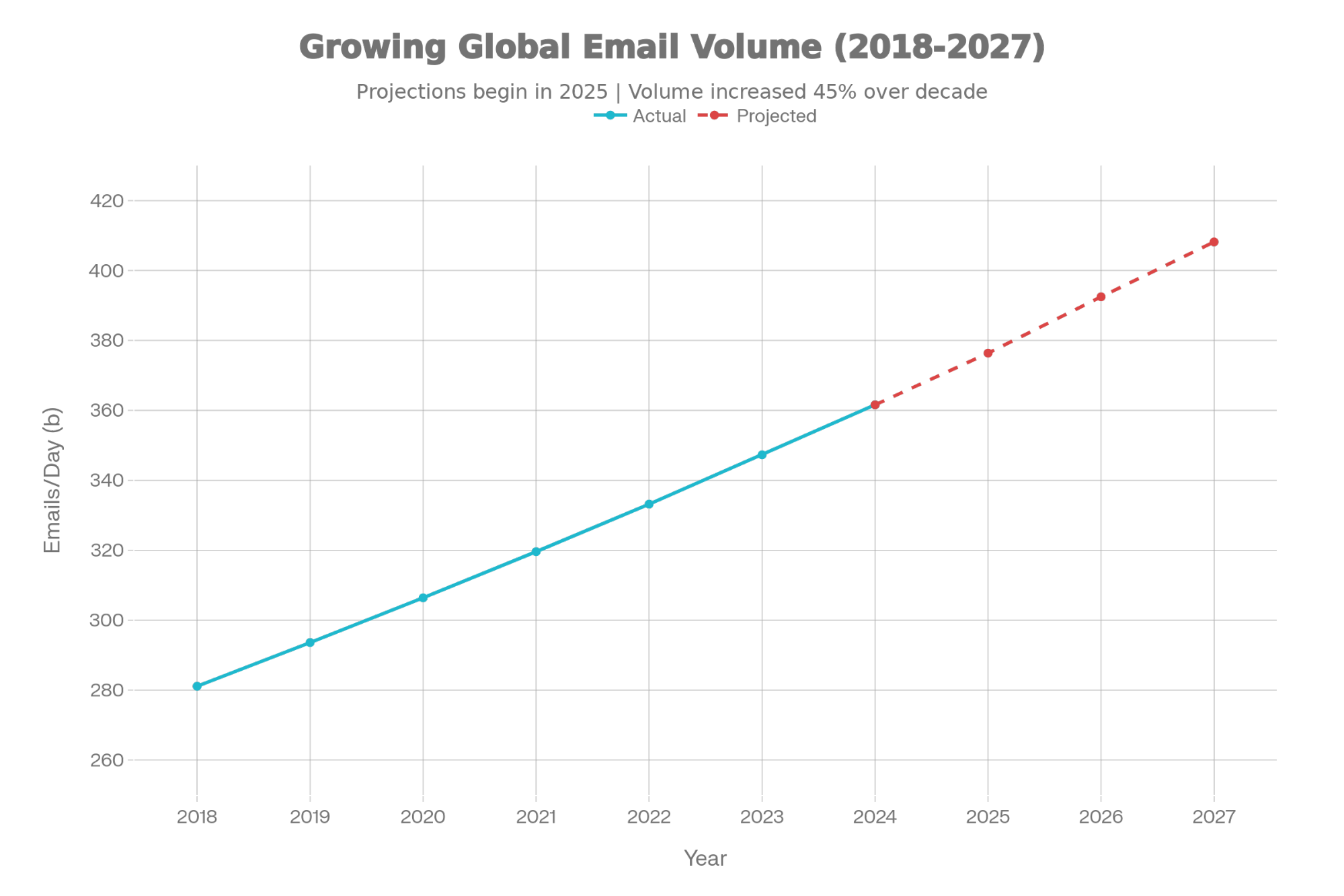
Global email volume has grown consistently at approximately 4% CAGR, with daily volume expected to exceed 400 billion emails by 2027
Three transformative forces are reshaping email in 2026:
- AI-powered intelligence moving from novelty to necessity, with 85% of companies adopting AI email tools for personalization, content generation, and predictive optimization
- Privacy-first architecture demanding authenticated identity (DMARC, BIMI) and zero-party data collection as Apple Mail Privacy Protection and GDPR enforcement reshape metrics and targeting
- Customer rebellion against inbox overload, with legitimate brands—not scammers—now representing the primary threat to inbox sanity.
A groundbreaking Q1 2025 study by Clean Email, analyzing over 500,000 emails and tracking 10,292 active users, revealed a startling reality: established companies like Tinder, LinkedIn, Uber, McDonald's, and Zocdoc dominate spam-flagging and unsubscribe lists far more than malicious spammers.
This represents a fundamental shift in the email threat landscape—users are no longer battling Nigerian princes and phishing schemes but rather aggressive marketing practices from trusted brands employing dark patterns, default-on notifications, and difficult cancellation flows.
The inbox itself is evolving into an intelligent filter where Apple Mail and Gmail algorithms decide message priority, secondary-tab placement, or promotional demotion based on engagement depth rather than sender reputation alone. This shift elevates relevance from marketing advantage to deliverability requirement.
Global Email Usage: Scale and Growth Trajectory
Current State and Projections
Email's growth trajectory remains remarkably stable despite market saturation concerns. The global user base of 4.59 billion in 2025 represents 56% of world population, with projections indicating 4.73 billion users by 2026 and 4.85 billion by 2027—adding approximately 100 million users annually. Daily email volume has climbed from 281.1 billion in 2018 to 376.4 billion in 2025, maintaining a compound annual growth rate (CAGR) of approximately 4%.
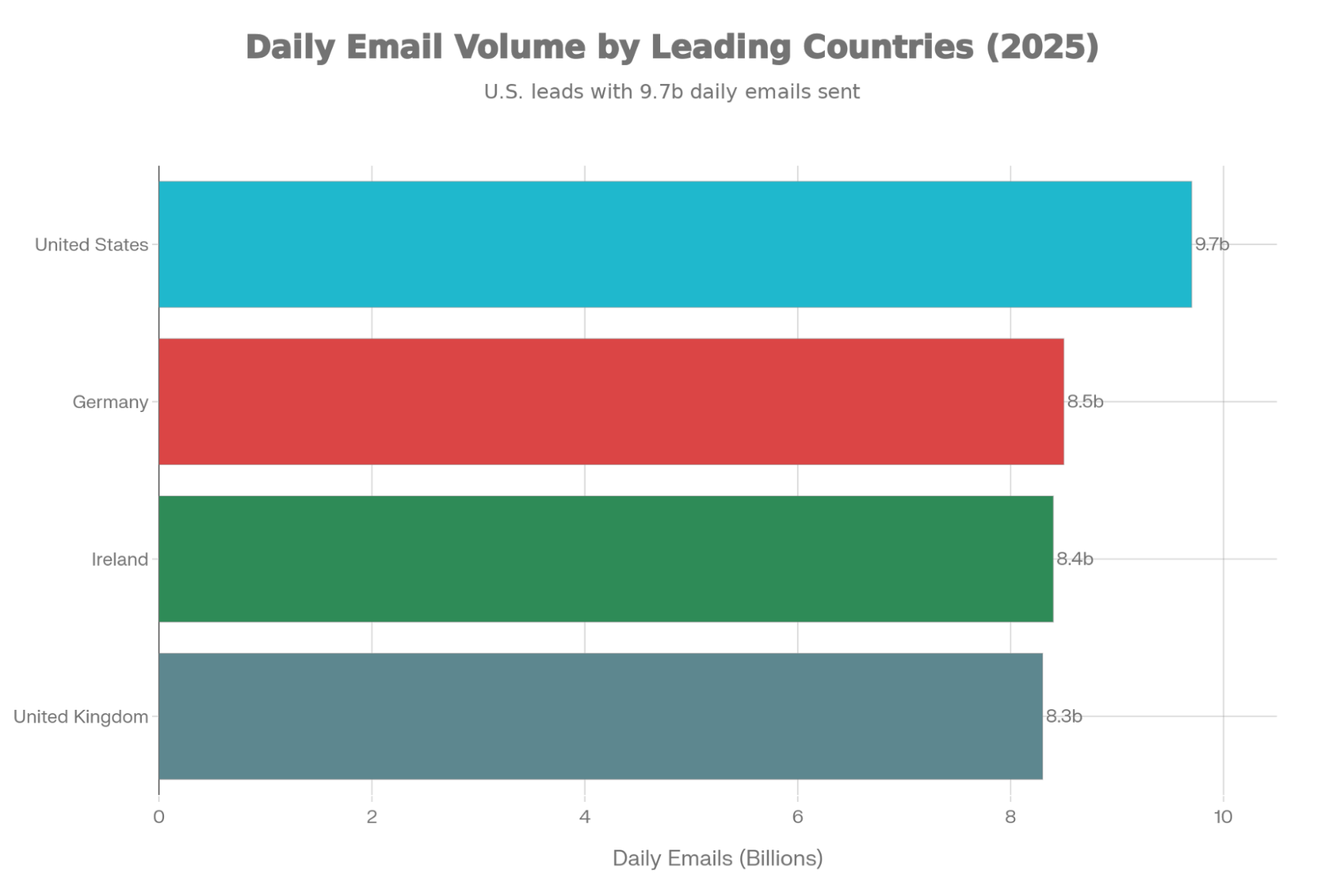
Regional distribution shows concentrated usage in developed markets: the United States leads with 9.7 billion daily emails, followed by Germany (8.5 billion), Ireland (8.4 billion), and the UK (8.3 billion).
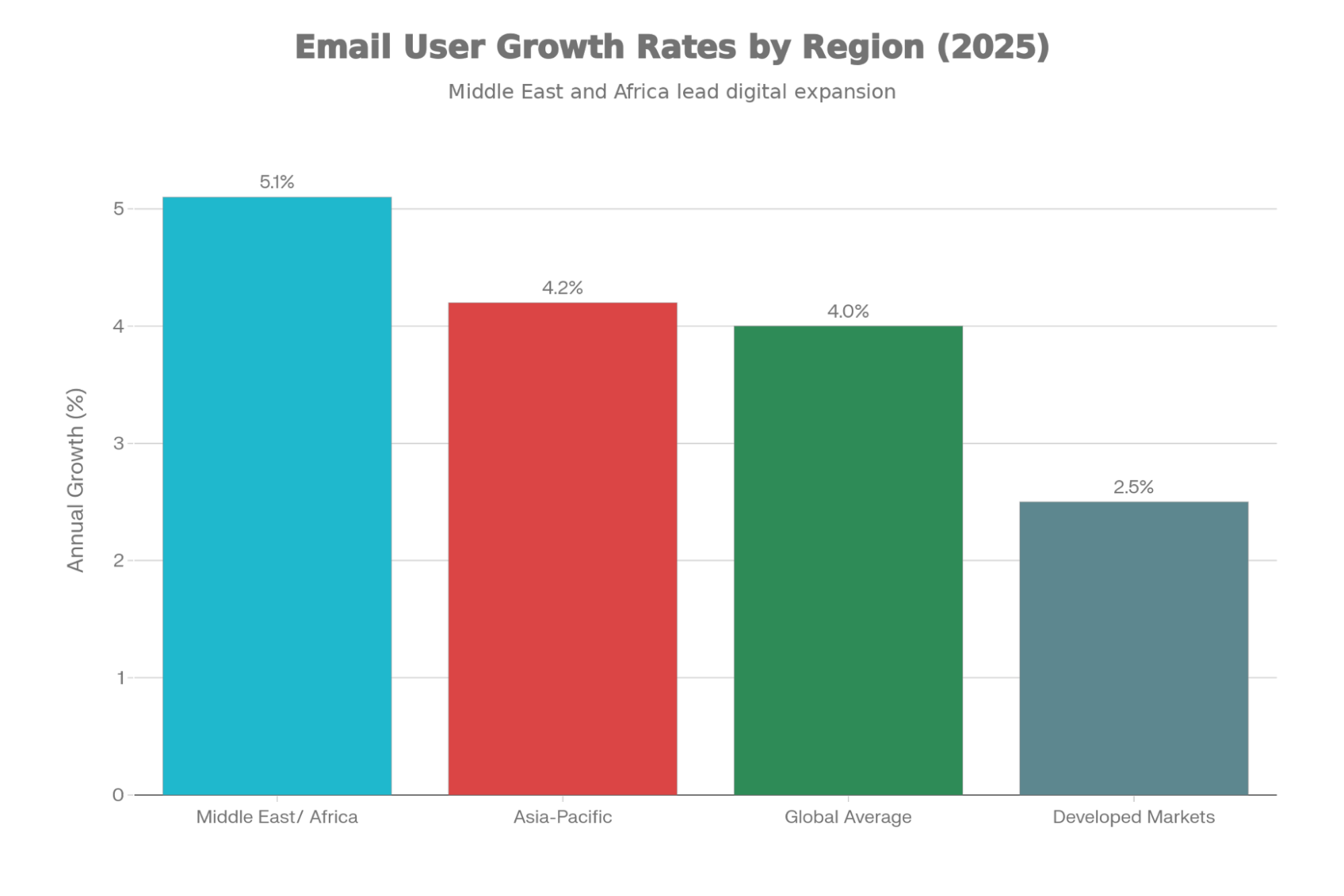
However, the strongest growth rates appear in emerging markets, particularly Asia-Pacific (4.2% annual growth) and Middle East/Africa (5.1%), driven by expanding smartphone penetration and internet access.
Daily Usage Patterns
The average email user receives between 82 and 120 emails per day depending on role and industry, with office workers at the higher end. This translates to approximately 45,990 emails annually per user, or one email every 12 minutes during waking hours.
Engagement remains robust: 93% of users check email daily, with 42% checking 3-5 times daily and 28% checking 10-20 times.
Business users face even higher volumes. The typical office worker receives 121 business emails daily while sending approximately 40, spending between 5 and 15.5 hours weekly on email—a significant productivity tax.
This overload contributes to rising email fatigue, with 70% of professionals citing email as their top workplace stress source and 42% describing their inbox as "out of control."
Mobile Dominance
Mobile has become the primary email access point, with 54-85% of users checking email on smartphones depending on generation.
The mobile open rate reached 78% in 2025, and critically, 75% of users delete emails that aren't optimized for mobile viewing—making mobile-first design a deliverability imperative, not merely a user experience enhancement.
Younger cohorts show even stronger mobile preference: 67% of Gen Z and 59% of millennials prefer smartphones for email, compared to 53% of Gen X and 36% of baby boomers.
Email Provider and Client Landscape
Market Share Dynamics
The email client landscape reflects the mobile-first reality, with Apple Mail's dominance driven by iPhone and iPad prevalence. As of 2025, Apple Mail commands 48-53.67% of email opens globally—more than half the market—due to its default installation on all Apple devices.
This concentration creates significant strategic implications: Apple's privacy decisions (Mail Privacy Protection, image pre-loading) directly impact sender analytics and deliverability for the majority of recipients.
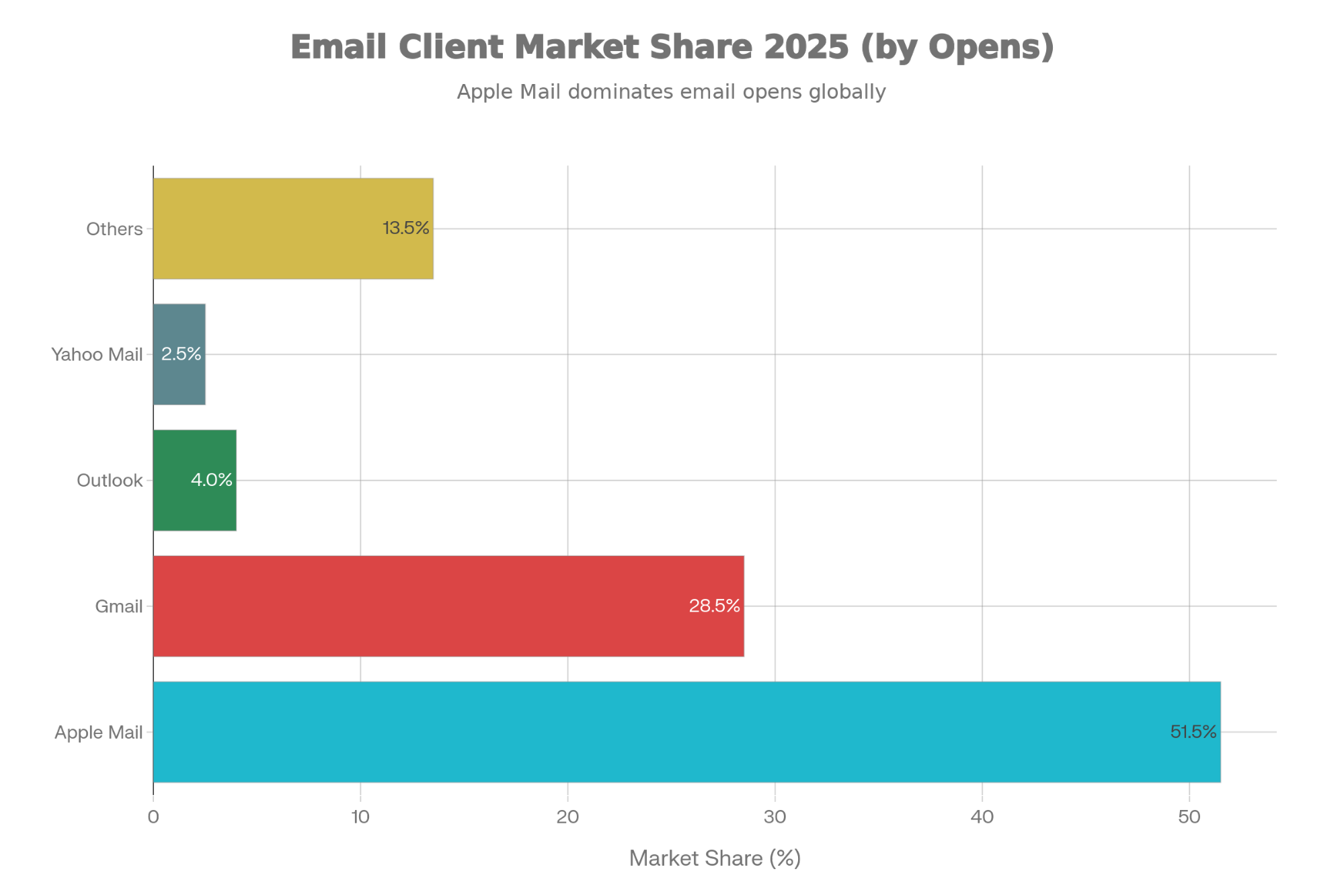
Apple Mail dominates email client market share with over half of all opens, followed by Gmail at 28.5%, reflecting the prevalence of mobile email usage on iOS devices
Gmail holds 27-30.7% of client market share with 1.8 billion active accounts, processing approximately 121 billion emails daily—roughly 30% of global volume.
Gmail's dominance lies in total users rather than device defaults, serving as the largest single provider by account count. Its share is projected to reach 35% by late 2025 if growth trends continue, potentially handling 131 billion daily emails.
Microsoft Outlook represents 3.67-10% of opens (varying by measurement methodology) but maintains strong enterprise presence with 400 million active users. Approximately 60% of Fortune 500 companies use Outlook due to Microsoft 365 integration, giving it outsized influence in B2B communication despite smaller consumer footprint. Yahoo Mail retains 2.16-2.85% share with approximately 225 million monthly active users, while the remaining ~14% is fragmented among providers including Proton Mail, Zoho Mail, AOL, and niche services.
Privacy-Focused Provider Growth
A notable 2025 trend is rising adoption of privacy-centric email providers. Proton Mail reported over 100 million accounts by 2023 and holds approximately 2% market share in privacy-focused segments—small in absolute terms but growing rapidly. Tutanota surpassed 10 million users, while services like FastMail (150,000+ paying customers) and StartMail attract users prioritizing data sovereignty and encryption.
This shift reflects heightened privacy awareness: surveys show 82% of consumers concerned about email data usage, and regulatory pressure (GDPR, CCPA, European AI Act) is driving both individual and enterprise migration toward privacy-first architectures.
The Rise of Email Management Apps
Users increasingly layer productivity and cleanup tools atop primary providers rather than switching accounts. Popular apps include SaneBox (AI-powered filtering), Clean Email (bulk cleanup), Superhuman ($30/month premium client), Spark (collaborative features), and Inbox Zero (Gmail-focused automation). These tools address inbox overload through smart filtering, automated archiving, one-click unsubscribe, AI triage, and snooze functions—capabilities that built-in providers lack or implement poorly.
Clean Email alone processes over 5 billion emails annually, demonstrating the massive scale of third-party inbox management.
The market for email management reflects genuine pain points: users report 90% reduction in unwanted emails with SaneBox and 75% decrease in time spent managing email with Inbox Zero. Power users treat email infrastructure as a stack: Gmail or Outlook for reliability and integration, overlaid with specialized tools for productivity, privacy, or team collaboration.
Email Marketing Performance and ROI
Return on Investment
Email marketing maintains an exceptional ROI profile, consistently outperforming other digital channels. The average return is $36-$42 for every $1 spent, equating to 3,600-4,200% ROI. This performance significantly exceeds alternatives: SEO averages 825% ROI and Google Ads approximately 800%. Retail, ecommerce, and consumer goods sectors report even stronger returns at $45 per $1 spent (4,500% ROI).
Notably, 52% of marketers saw email ROI double between 2022 and 2023, with 5.7% reporting a 4x increase—indicating accelerating effectiveness as personalization and automation mature. The top-performing 10% of email workflows generate $16.96 revenue per recipient versus $1.94 for average campaigns, demonstrating that technical sophistication and strategic segmentation yield disproportionate returns.
Engagement Metrics
Global email performance benchmarks for 2025 show:
- Average open rate: 25.1-43.46% across industries (variance reflects methodology and sector)
- Click-through rate (CTR): 1.5-3.8%
- Click-to-open rate (CTOR): 6.81-12.1%
- Bounce rate: 0.5-0.65%
- Unsubscribe rate: 0.15-0.2%
Industry-specific performance reveals significant variation. Nonprofits lead with 38-46% open rates, while SaaS/tech averages 29-38% and ecommerce/retail 26.5-38.58%. B2B services typically achieve 33.1% opens and 4.3% CTR, outperforming B2C promotional emails.
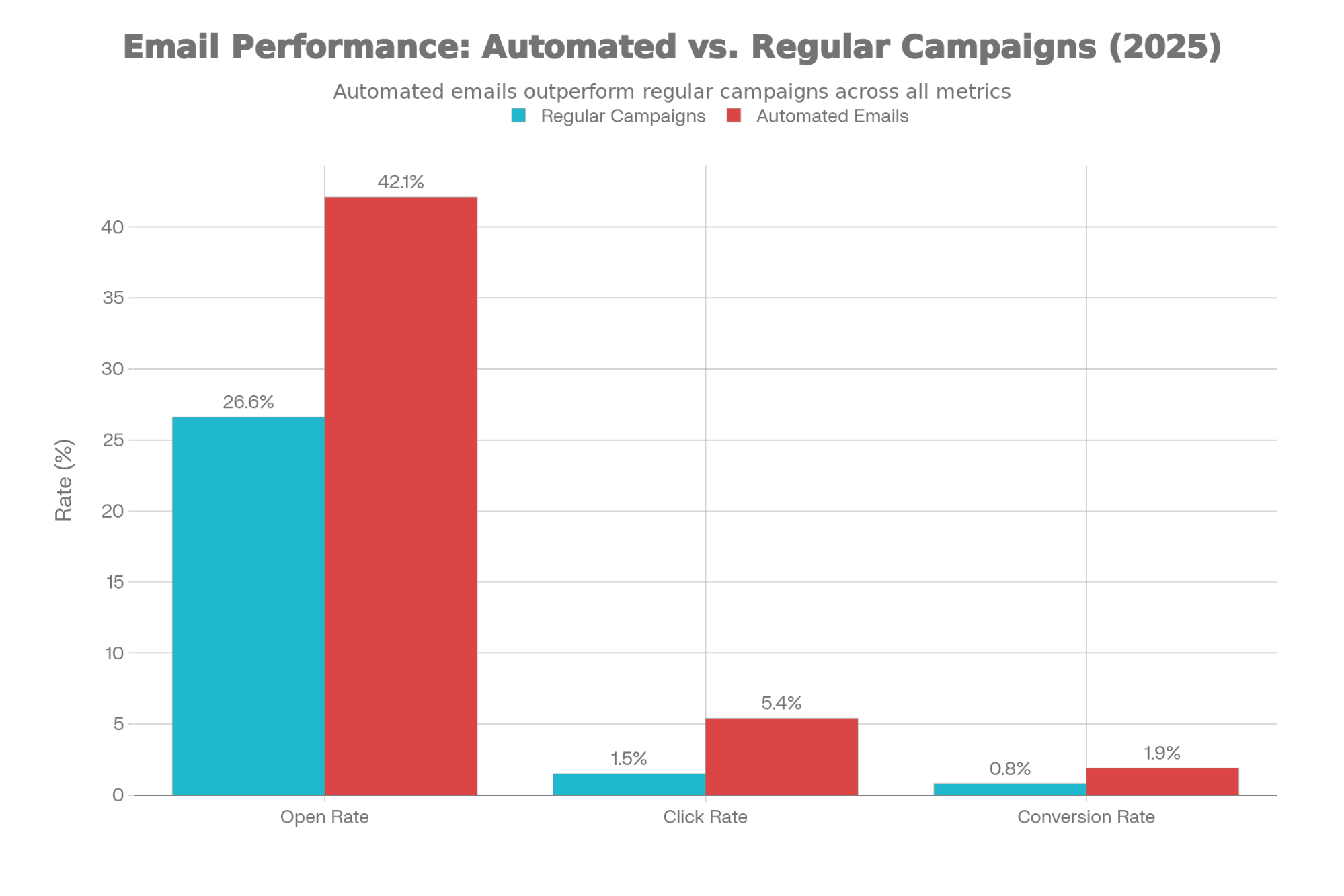
Automated email workflows significantly outperform regular campaigns across all key metrics, with automated emails achieving 52% higher open rates and 332% higher click rates
Automation Performance Advantage
Automated email workflows dramatically outperform one-off campaigns, representing one of the clearest opportunities for performance improvement. In 2025, automated emails achieved 52% higher open rates, 332% higher click rates, and 2,361% better conversion rates compared to standard broadcasts. Specific automation types show exceptional performance:
- Welcome/onboarding emails: 58-70% open rate, 12-22% CTR
- Transactional emails: 85-90% open rate
- Abandoned cart: 42-55% open rate
- Re-engagement campaigns: 28-45% open rate
The top 10% of automated workflows generate 30x higher returns than regular campaigns, and brands sending 5-8 emails per month via automation achieve the highest ROI at $48 per $1 spent. This performance gap explains why creating more automation has consistently ranked as the top email marketing priority for three consecutive years.
The Spam Flag Revolution: When Trusted Brands Become Inbox Enemies
Perhaps the most significant revelation of 2025 comes from real-world user behavior data rather than marketing surveys. Clean Email's Q1 2025 analysis—covering 10,292 randomly selected active users, approximately 200,000 emails for top senders alone, and up to 500,000 total emails—exposes a brutal truth: legitimate brands, not scammers, are the primary threat to inbox sanity.
The Spam-Flagging Hierarchy: Established Brands Lead
Established brands, not malicious spammers, dominate user spam-flagging behavior in Q1 2025, with dating app Tinder leading as the most aggressively blocked sender
The top 10 companies whose emails users most frequently marked as spam reveal a who's-who of established brands:
- Tinder (75 million users globally)
- LinkedIn (1+ billion professionals)
- Uber One (171 million active users)
- McDonald's (69 million app users)
- Zocdoc (6 million patients)
- Gap
- La Poste-Colissimo (France)
- Shutterfly Customer Success
- Nintendo
- Poshmark Shopping
What makes this list remarkable is not just who appears but who doesn't. Internet giants with vastly larger user bases—Google (5 billion users), Amazon (5 billion), Facebook (2.8 billion), and YouTube (2.2 billion)—rank significantly lower despite their scale.
Google appears at position 29, suggesting that sheer volume alone doesn't determine spam-flagging behavior. Instead, aggressive marketing tactics, dark patterns, and disrespectful communication frequency drive user retaliation regardless of company size.
The Unsubscribe Hierarchy: Essential Services Under Pressure
The most-unsubscribed senders reveal a different dynamic, dominated by services users want to maintain but need to control:
- Uber
- Quora
- Spotify
- PayPal
- Amazon
- Adobe
LinkedIn and Uber appearing at the top of both spam and unsubscribe lists signals complete communication breakdown—users initially tried the measured unsubscribe approach before escalating to aggressive spam-flagging when that proved ineffective.
User response patterns reveal strategic decision-making: essential services are unsubscribed from to maintain relationships while reducing volume, while non-essential services are immediately spam-flagged. Companies appearing in both categories initially triggered unsubscribe attempts that escalated to spam-flagging when ineffective
Why Users Choose Spam vs. Unsubscribe: Strategic Decision-Making
User behavior patterns reveal sophisticated decision-making rather than random clicking:
Companies triggering both spam AND unsubscribe: LinkedIn, Uber, Instagram, Quora represent initially essential services whose aggressive tactics pushed users from surgical opt-out attempts to total blocking.
Spam-only targets: Tinder, McDonald's, Reddit, SHEIN are non-essential services where users immediately take aggressive action without worrying about missing important information. A discount coupon for a Quarter Pounder doesn't carry the same urgency as a PayPal security alert.
Unsubscribe-only targets: PayPal, Amazon, Netflix, Apple are services where completely blocking all communications could lead to financial losses, missed deliveries, or account problems. Users prefer the more surgical approach of reducing volume while maintaining critical notifications.
The Dark Pattern Playbook That Backfires
Clean Email's analysis identified specific tactics driving users to aggressive action:
- Default-on marketing machinery: Tinder opts new accounts into every notification category (matches, likes, profile tips, promotions) unless users drill through Profile → Settings → Notifications to manually flip dozens of switches. LinkedIn similarly defaults every newsletter and job alert to active delivery, requiring navigation through more than a dozen separate toggles to achieve silence.
- Buried opt-out mechanisms: Uber's iOS settings hide promotional controls under Account → Settings → Privacy → Offers and Promos, where users must tap the tiny word "here" to reach the unsubscribe screen.Instagram buries email controls several taps deep under Profile → Settings → Notifications → Email Notifications, and users report switches "won't stay off."
- Difficult cancellation flows: The FTC's April 2025 lawsuit against Uber detailed a 12-step, seven-screen (and in some cases 23-screen) gauntlet just to cancel a subscription—obstacles designed to "deter and prevent" cancellation. Users who feel trapped or manipulated retaliate by flagging every incoming message as junk.
- Notification overload: Zocdoc fires an email seven days before appointments, another the day before, a text three hours out, plus any office-specific reminders layered on top. The company's own CEO conceded the industry has created a "potpourri of messages" that causes patients to tune out or spam everything.
- Security-themed noise: Legitimate brands' notification volume creates opportunities for scammers. Tinder users face FBI warnings about "free verification" phishing, McDonald's recipients encounter Snopes-debunked fake reward promotions, and Spotify customers must navigate security alerts that can't be disabled. When users can't distinguish legitimate from fraudulent messages due to sheer volume, the spam button becomes the safest option.
Pre-Digital Brands Struggle With Email Sophistication
An intriguing pattern emerges around companies that existed before the digital age—McDonald's, Gap, Domino's Pizza, La Poste-Colissimo, and Walgreens—all ranking high on spam lists despite having sophisticated digital teams.
These legacy brands lack the digital-native intuition for modern email etiquette: fewer sends, smarter timing, behavioral segmentation, and accessible opt-out options. Their email strategies often reflect broadcast-era thinking (mass messaging, high frequency, promotional focus) rather than permission-based, value-exchange thinking.
Geographic Patterns: US Dominance of Aggressive Sending
The geographic distribution of spam sources reveals striking concentration: 42 out of 50 top spam-flagged companies (84%) are US-based. [Clean Email report]
The unsubscribe list shows similar patterns with 26 out of 33 companies (79%) headquartered in the United States.
This suggests American email marketing practices are globally the most aggressive, with companies prioritizing short-term engagement metrics over long-term subscriber health.
The remaining spots are thinly distributed across France, Japan, China, Germany, Sweden, South Korea, Netherlands, Canada, and Australia—each contributing one to three companies to the lists.
Subscription Fatigue: The Broader Context
Email's challenges mirror a broader subscription economy crisis. The average US consumer now spends $273 per month on 12 paid subscriptions, creating both financial and psychological strain.
By 2025, 50% of respondents had canceled or intended to cancel at least one subscription due to fatigue, with over 60% of streaming consumers specifically reporting subscription exhaustion.
The parallels to email are direct: just as consumers feel overwhelmed managing multiple paid subscriptions with separate billing and login credentials, they feel overwhelmed managing dozens of email subscriptions demanding constant attention.
The subscription economy is projected to reach $1.2 trillion globally by 2030, yet 41% of paid video streamers canceled services due to fatigue as of October 2025—up from 35% just three months earlier.
Email marketers face the same dynamic: growth in volume and frequency meets hardening consumer resistance. The global average email unsubscribe rate of 0.1% may seem low, but acceptable thresholds (below 0.5%) and problem rates (above 1.5%) provide narrow operating margins. North America shows higher-than-global unsubscribe rates at 0.39%, potentially reflecting consumer fatigue in the most email-saturated market.
Email Frequency: Finding the Tolerance Threshold
Research on optimal email frequency reveals narrow safe zones. Studies show 5 emails per week on average represents the tolerance threshold—after that, complaint rates rise substantially. The highest ROI comes from 9-16 emails per month (2-4 per week), generating 46:1 returns versus just 13:1 for one email monthly.
However, these averages mask significant variation by audience, industry, and email type:
- Newsletters: Once weekly shows consistent engagement and reduced unsubscribes
- Marketing emails: 1-3 per week
- Transactional emails: Instant delivery after trigger
- Welcome sequences: 2-3 emails within first week
- Abandoned cart recovery: 2-3 emails within 48 hours
- Re-engagement: 1-2 emails weekly
The trend is toward giving subscribers control through preference centers that let them select frequency and topics, pausing options that prevent full unsubscribe, and behavioral adjustment that reduces sending when engagement drops.
Customer Behavior and Expectations
Email Checking Habits
Email checking behavior is deeply ingrained across demographics. 93% of users check email daily, with 58% checking first thing in the morning ahead of social media, news, or search engines.
The frequency distribution shows 42% check 3-5 times daily, 28% check 10-20 times, and 19% check over 20 times—indicating that for a significant portion of users, email represents near-constant background monitoring rather than periodic checking.
Generational differences are notable but narrowing. While 81% of Gen Z check email daily—lower than older cohorts—they still engage regularly, contradicting narratives that younger users have abandoned email for messaging apps. The reality is multi-channel: younger users prefer SMS and social for personal communication while relying on email for transactions, accounts, and professional contexts.
Inbox Fatigue and Overload
Email fatigue has emerged as a critical 2025 challenge. The average person receives 100-120 emails daily, creating cognitive overload and decision fatigue. 70% of professionals identify email as their primary workplace stress source, with 42% describing their inbox as "out of control."
This manifests in falling engagement: brands report declining open rates despite consistent content quality, rising unsubscribe rates after previously successful campaigns, and increasing spam complaints from fatigued subscribers.
The psychology of inbox overload is compounded by "urgency inflation"—when every message is marked important, nothing feels urgent, leading to paralysis and avoidance. 35% of users spend less than one hour daily on email, suggesting they've implemented coping mechanisms like ruthless filtering or ignoring non-essential messages entirely.
Shift Away from "Inbox Zero"
The aspirational "inbox zero" methodology is giving way to more sustainable approaches. Rather than obsessively clearing every message, users are adopting automated triage systems, smart folders, and AI-powered prioritization that surface important messages while archiving or deleting bulk content. This represents a mental model shift: from treating inbox as todo list requiring manual processing to treating it as filtered stream where automation handles routine work.
Email management apps reflect this philosophy: they emphasize set-and-forget rules, bulk actions, and AI learning that reduces daily decision-making. Users report preferring systems that make the inbox "feel" manageable even if technically not empty, suggesting psychological relief matters more than literal message count.
Privacy Awareness and Expectations
Consumer privacy consciousness has reached mainstream levels in 2025. 82% of smartphone users now enable dark mode (a proxy for privacy-conscious behavior), and 91% of consumers prefer brands that provide relevant offers based on data they voluntarily share rather than inferred tracking. This creates both challenge and opportunity: customers want personalization but demand transparency about data use.
53% of consumers reported receiving a legitimate brand email they initially suspected was fraudulent—a dramatic trust problem that threatens engagement. Users increasingly evaluate sender credibility through visual signals (verified logos via BIMI), domain reputation, and authentication indicators, making technical trust infrastructure a marketing requirement. Privacy-first providers like Proton Mail gain users not from technical enthusiasts but from mainstream consumers seeking alternatives to data-mining business models.
Emerging Technologies and Features
AI-Powered Personalization and Content
Artificial intelligence has transitioned from experimental tool to core email infrastructure in 2025, with 85% of companies expected to adopt AI email tools by year-end—a tipping point indicating mainstream acceptance. AI applications span the entire email workflow:
Content creation: 34% of email marketers use AI for copywriting at least occasionally, making it the most common AI-assisted task. Tools generate subject lines, body copy, product recommendations, and even complete email sequences. Advanced implementations allow AI to write in brand voice by learning from historical messages.
Send-time optimization: Predictive AI analyzes individual user behavior to determine optimal send windows, improving open rates by 10-15% compared to batch sending. Systems learn patterns like "this user checks email during morning commute" or "this user engages with promotions on Friday evenings."
Segmentation and targeting: AI identifies micro-segments based on behavior, lifecycle stage, and propensity models—enabling campaigns for hundreds of distinct audiences rather than three to five broad groups. 63% of B2B marketers now use AI for email writing, and AI-generated hyper-personalized emails increase CTR by 13.44%.
Hyper-personalization at scale represents the frontier: moving beyond [FirstName] merge tags to emails where every element—subject line, hero image, product recommendations, CTA copy—adapts individually based on real-time behavioral signals, purchase history, and predictive intent. This level of individualization was economically impossible before AI; now it's becoming the baseline for competitive performance.
Interactive and AMP Email
Static emails are giving way to interactive experiences that function more like web pages than traditional messages. 97% of marketers used at least one interactive element in 2025, up dramatically from prior years. Interactive components include:
- Polls and surveys: Real-time voting and feedback collection without leaving inbox
- Image carousels: Swipeable product galleries and multi-step guides
- Embedded forms: RSVP, registration, preference updates inline
- Scratch-offs and gamification: Reveal mechanisms for promotions and announcements
- Live content: Real-time inventory updates, countdown timers, social proof
AMP for Email technology enables full landing-page functionality within messages. Early adopters report 60% of users engage with interactive emails, achieving 5x increase in clicks versus static HTML. Business examples show dramatic impact: Razorpay improved survey response rates by 257% with AMP emails and increased product awareness campaign engagement by 45%. Gmail, Yahoo, and Outlook now support AMP, reaching over 80% of email users globally.
B2C brands are particularly aggressive adopters—more than twice as likely as B2B to incorporate CSS-based interactivity—reflecting higher consumer expectations for engaging digital experiences. Interactive elements transform email from passive information delivery to active participation, increasing both engagement and data collection (through polls, quizzes, preference selections).
Email Authentication and Deliverability Infrastructure
Authentication has moved from technical best practice to mandatory requirement in 2025, driven by stricter inbox provider rules from Google, Yahoo, and Microsoft. The authentication trinity—SPF (Sender Policy Framework), DKIM (DomainKeys Identified Mail), and DMARC (Domain-based Message Authentication, Reporting, and Conformance)—now forms the identity layer proving sender legitimacy and message integrity.
Current adoption shows gaps: while 66.2% of senders implement both SPF and DKIM, only 53.8% have DMARC policies, and many remain at non-enforcing "p=none" level rather than "quarantine" or "reject." More concerning, over 25% of senders aren't sure whether they're authenticated at all—a dangerous knowledge gap as inbox algorithms increasingly penalize or block unauthenticated mail.
DMARC enforcement is accelerating as the gateway to BIMI (Brand Indicators for Message Identification), which displays verified brand logos next to messages in the inbox—a powerful visual trust signal. BIMI adoption remains early-stage but growing rapidly among enterprises seeking to combat phishing and strengthen brand recognition in crowded inboxes. The authentication-to-trust pipeline (SPF/DKIM → DMARC enforcement → BIMI logo) represents the future of sender credibility.
Dark Mode and Accessibility
Dark mode email viewing has reached critical mass, with 34-35% of users viewing emails in dark mode as of 2025—up from near-zero in 2020. More significantly, 82% of smartphone users enable dark mode on their devices, creating expectation that emails should render properly in both light and dark themes. Among Apple Mail subscribers specifically, dark mode usage ranges from 40-56% depending on dataset, making it the majority experience for the largest client.
Poorly optimized emails suffer in dark mode: black text disappears against dark backgrounds, branded colors invert incorrectly, and layouts break—causing immediate deletion or spam marking. Email marketers are responding: dark mode optimization rates grew from 0.5% in late 2020 to 9.64% by May 2023, with adoption accelerating. Best practices include:
- Color contrast testing for both themes
- Transparent PNG logos that work on any background
- Inline CSS overrides for dark mode color swaps
- Text-to-image ratio optimization (less reliance on background images)
Accessibility extends beyond dark mode to broader inclusive design. The European Accessibility Act took effect in June 2025, requiring digital content to meet accessibility standards—driving adoption of screen-reader-friendly structures, meaningful alt text, clear heading hierarchy, and keyboard navigation. These practices improve email performance broadly: lighter, well-structured emails load faster, render more reliably across clients, and perform better in low-bandwidth situations.
Voice Assistants and Email
Voice technology is gradually intersecting with email, though adoption remains nascent. 153.5 million Americans will use voice assistants by 2025, with 76% utilizing them for local searches and an increasing number for email tasks like reading messages, dictating replies, and triaging inbox. The global voice assistant market is projected to grow from $6.1 billion in 2024 to $79 billion by 2034, indicating long-term expansion.
For email marketers, voice optimization means simpler content structures that work when read aloud—clear hierarchy, conversational tone, concise sentences, and logical flow. Descriptive subject lines and preview text become even more critical when users listen rather than scan visually. While voice-first email remains a small use case, it's growing among mobile-first users and accessibility-dependent populations.
Privacy, Security, and Compliance Trends
Zero-Party and First-Party Data Collection
The deprecation of third-party cookies and Apple's Mail Privacy Protection have forced a strategic pivot to zero-party data—information customers intentionally and proactively share. This includes preferences, interests, purchase intent, and demographic details voluntarily provided through surveys, preference centers, quizzes, and progressive profiling. Research shows 91% of consumers are more likely to shop with brands that provide relevant offers based on data they voluntarily shared, making zero-party collection both privacy-compliant and commercially effective.
Collection methods are diversifying:
- Preference centers: Allowing subscribers to indicate content interests, frequency preferences, and communication channels
- Quizzes and assessments: Interactive tools that provide value (product recommendations, personalized reports) in exchange for detailed preferences
- Live chat: 79% of customers prefer live chat because it provides instant responses; collecting opt-ins during engaged conversations converts at high rates
- Surveys and polls: Post-purchase feedback, birthday/anniversary data, and satisfaction tracking
Zero-party data offers superior quality over inferred behavior: it's explicitly consented, highly accurate, and enables precise segmentation without privacy violations. The trade-off is volume—brands collect less data but with higher reliability and trust. Successful programs position data sharing as value exchange: "Tell us your preferences so we can send you only what matters."
Email Security and Phishing Landscape
Email remains the primary attack vector for cyber threats, with 90% of security breaches involving phishing via email. The threat landscape has intensified dramatically with AI-generated phishing tools like WormGPT and FraudGPT—jailbroken language models that create highly convincing, context-aware phishing campaigns at scale, lowering attacker costs by 98% while fooling over half of recipients. Deepfake techniques including cloned voices and AI-generated fake websites further blur the line between legitimate and malicious messages.
Enterprise security response is shifting from signature-based detection to AI-native defensesthat analyze intent, context, and anomaly patterns. Key defense metrics include:
- Mean time to detect (MTTD): Best-in-class systems detect novel phishing in real-time (seconds) rather than hours/days
- False positive rate: High accuracy (low false positives) is critical to avoid "alert fatigue"
- Account takeover detection: Monitoring for unusual login locations, failed MFA attempts, privilege escalations
- Pre-campaign detection: Scanning broader digital ecosystem (social, dark web, domain registrations) to identify campaigns before launch
Consumer trust erosion is a strategic concern: 53% of consumers received legitimate brand emails they initially thought were fraudulent—a massive deliverability problem even when technical delivery succeeds. Brands combat this through authenticated identity (DMARC/BIMI), consistent sender names and domains, clear unsubscribe options, and transparency about data usage.
Regulatory Compliance Evolution
Privacy regulations continue tightening globally, with enforcement intensifying in 2025. GDPR in Europe and CCPA in California set baseline standards now being replicated worldwide: explicit consent requirements, right to deletion, data minimization, transparent processing. New regulations include:
- European AI Act: Establishing risk classifications for AI applications and requiring transparency about AI use in email personalization
- Council of Europe AI Treaty: Expanding AI governance beyond EU borders
- State-level US privacy laws: Over a dozen states enacted privacy legislation, creating fragmented compliance landscape
The European Accessibility Act (effective June 2025) mandates accessible digital content, directly impacting email design requirements. Non-compliance carries significant penalties: GDPR fines can reach €20 million or 4% of global revenue, while CCPA allows $2,500-$7,500 per violation.
Forward-looking marketers are privacy-proofing programs for long-term resilience rather than reactive compliance:
- Proactive zero-party data collection through preference centers
- Running re-permission campaigns and double opt-in confirmations
- Removing personally identifiable information (PII) where possible; using subscriber IDs instead
- Transparent AI disclosure in privacy policies
- Offering opt-outs for AI-driven personalization features
Design and Content Trends
Mobile-First and Lightweight Design
Mobile-first design has evolved from best practice to baseline requirement, with 54-85% of opens occurring on mobile devices. Critically, 75% of users delete non-mobile-optimized emails immediately—making mobile rendering a deliverability issue, not merely user experience concern. Best practices in 2025 emphasize:
- Single-column layouts that avoid horizontal scrolling
- Large, thumb-friendly tap targets (minimum 44x44 pixels)
- Optimized image sizes using compression and responsive srcset
- Minimal HTML for fast loading on mobile networks
- Text-to-image ratio favoring text for accessibility and rendering reliability
Lightweight design also addresses sustainability concerns, as bloated emails consume more energy across data centers, networks, and devices. Brands are adopting minimalist aesthetics with streamlined code, balanced text-to-image ratios, and modular design systems that reduce file size while improving cross-client compatibility.
Newsletter and Editorial Content
Newsletters experienced resurgence in 2025, with 58% of marketers including them in strategy—up from 46% in 2024. This growth reflects their power as retention tools rather than promotional vehicles. Newsletters work because they:
- Build relationships through consistent, personality-driven content
- Provide value beyond transactions—education, curation, entertainment
- Stay top-of-mind with the 95% of audience not currently ready to buy
- Drive long-term loyalty that competitors can't easily replicate
The most successful newsletters adopt person-led, editorial voice rather than corporate marketing speak. Readers respond to authentic perspectives, hot takes, and curated insights from recognized experts or brand personalities. This contrasts with promotional emails optimized for immediate conversion; newsletters prioritize relationship depth over transaction velocity.
Growth strategies are evolving beyond organic social sharing (which has declined in effectiveness) toward co-registration partnerships, cross-promotions, and collaborative growth platforms like SparkLoop and Upscribe. 42% of newsletter creators rank direct recommendations from current subscribers as the most effective growth tactic—emphasizing word-of-mouth and quality over paid acquisition.
Omnichannel Integration
Email is increasingly positioned as orchestration hub within broader omnichannel strategy rather than standalone channel. Modern customer journeys blend email with SMS, push notifications, in-app messages, and social retargeting—creating cohesive experiences that follow users across touchpoints. For example:
- Cart abandonment email → SMS reminder → push notification (sequenced based on engagement)
- Email signup → welcome series → SMS preference confirmation → in-app onboarding
- Newsletter click → website visit tracked → retargeting ad → follow-up email with related content
Effective omnichannel requires unified customer data platforms (CDPs) that track behavior, preferences, and engagement across channels, enabling personalized messaging regardless of touchpoint. The shift is from "email-first" to "customer-journey-first" thinking: email becomes one leg of broader lifecycle flows, with transitions between channels feeling fluid and informed rather than disjointed.
Industry-Specific Trends
B2B Email Marketing Evolution
B2B email is transforming from batch-and-blast to sophisticated, multi-stakeholder orchestration. Key 2026 trends include:
Intent-based targeting: Leveraging signals from search behavior, content downloads, and third-party platforms to trigger emails when prospects show buying intent
Account-based marketing (ABM): Designing sequences for entire buying committees with personalized messaging for each stakeholder role (CFO, CTO, operations, etc.)
Leaner sequences with smarter logic: Shorter, more direct emails with AI-optimized touchpoints and drop-off analysis
First-party data focus: Doubling down on owned data as cookies phase out and privacy regulations tighten
Micro-segmentation: Creating campaigns for dozens or hundreds of micro-audiences using dynamic content blocks
B2B performance benchmarks show 39.5% average open rate and 4.3% CTR for B2B services, with educational content and value-driven messaging outperforming promotional approaches. The buying cycle complexity demands sustained nurture—typically 7-13 touches over 3-6 months—making automation and lifecycle workflows essential.
B2C and Ecommerce Strategies
B2C email emphasizes emotional triggers, high frequency, and behavioral automation distinct from B2B's rational, measured approach. Successful B2C tactics include:
Behavioral automation: Abandoned cart reminders, browse abandonment, post-purchase sequences, birthday/anniversary rewards—all triggered by real-time actions
Personalization at scale: Product recommendations based on browsing history, purchase patterns, and collaborative filtering
Visual appeal and urgency: Eye-catching design, countdown timers, limited-inventory messaging, and flash-sale dynamics
Transactional excellence: Order confirmations, shipping updates, and delivery notifications that achieve 85-90% open rates and drive repeat purchases
B2C brands typically send 3-5x more frequently than B2B, with promotional cadence ramping during key retail periods (Black Friday, holidays, seasonal campaigns). The higher volume demands rigorous segmentation and preference management to avoid fatigue.
Retail and ecommerce sectors achieve the strongest email ROI at $45 per $1 spent (4,500%), driven by immediate conversion potential and high customer lifetime value. Post-purchase emails generate 90% more revenue per recipient than regular campaigns, with open rates 217% higher and CTR over 500% higher.
Predictions and Strategic Recommendations for 2026
Volume and Scale Projections
Email will continue robust growth through 2026 and beyond:
- Daily volume: 392.5 billion emails in 2026, 408.2 billion by 2027 (4% CAGR)
- User base: 4.73 billion in 2026, 4.85 billion by 2027
- Gmail market share: Projected to reach 35%, processing ~131 billion daily emails
- Mobile dominance: Expected to exceed 80% of opens as smartphone penetration grows in emerging markets
This growth is concentrated in Asia-Pacific, Middle East, and Africa, while mature markets (US, Western Europe) show plateauing user counts but increasing per-user volume.
The Customer Rebellion Will Intensify
Clean Email's Q1 2025 data provides the most important predictive signal for 2026: user tolerance for aggressive email practices has reached breaking point. When established brands with sophisticated marketing teams—LinkedIn (1+ billion users), Uber (171 million users), McDonald's (69 million app users)—dominate spam-flagging lists, it signals systemic market failure rather than isolated bad actors.
Prediction 1: Spam-flagging of legitimate brands will accelerate in 2026. If users are already marking messages from brands they voluntarily signed up for as spam, this behavior will worsen in 2026 as inbox fatigue compounds. The average 100-120 emails per day is already unsustainable; as volume continues growing at 4% annually, users will become more ruthless.
Prediction 2: "Subscription fatigue" converges with email fatigue. The broader subscription economy shows 50% of consumers canceling services due to fatigue and 41% of streaming subscribers cutting services in Q3 2025 alone. Email follows the same trajectory: users cutting quantity aggressively, tolerating only the most valuable subscriptions. The global unsubscribe rate of 0.1% appears stable but masks growing volatility underneath.
Prediction 3: Essential vs. non-essential triage accelerates. Users are developing sophisticated mental models: PayPal, Amazon, and financial services get surgical volume reduction (unsubscribe), while Tinder, McDonald's, and promotional senders get instant blocking (spam). By 2026, this categorization will be even more binary—brands will either be in the "must-keep" category or face aggressive filtering.
Prediction 4: Third-party management tool adoption explodes. Clean Email already processes 5 billion emails annually; as built-in provider solutions (Gmail filters, Outlook rules) remain inadequate, more users will adopt specialized cleanup and management tools. Expect management app adoption to grow 30-50% in 2026 as inbox overload worsens.
Dark Patterns Will Face Regulatory and User Backlash
Clean Email's analysis exposed specific tactics driving user retaliation:
Prediction 5: Default-on strategies become liability. LinkedIn and Tinder's approach of opting users into all notifications by default will face both user rebellion and regulatory scrutiny. By 2026, expect more jurisdictions to require explicit opt-in for promotional communications rather than allowing opt-out-only models.
Prediction 6: Difficult cancellation triggers enforcement. The FTC's 2025 lawsuit against Uber for its 23-screen cancellation gauntlet represents just the beginning. More regulatory actions targeting dark patterns will emerge in 2026, forcing easier unsubscribe and cancellation flows.
Prediction 7: Pre-digital brands fall further behind. Companies that existed before the digital era—McDonald's, Gap, Domino's, La Poste—show persistent inability to master modern email etiquette. By 2026, the performance gap between digital-native brands (who understand permission, segmentation, value exchange) and legacy brands (who treat email like broadcast TV) will widen dramatically. Legacy brands face rising spam complaints, falling engagement, and damaged sender reputation.
Prediction 8: Geographic divergence. With 84% of top spam-flagged companies US-based, American email marketing practices are globally the most aggressive. By 2026, expect European and Asian markets to impose stricter standards (building on GDPR, European Accessibility Act) while US practices remain aggressive until regulation forces change. This creates regional fragmentation in email best practices.
Technology Adoption Forecast
Prediction 9: Near-universal AI adoption with quality divergence. 85% of companies will use AI email tools by the end of 2025, likely exceeding 95% by late 2026. However, the quality gap between AI-augmented (human oversight, brand voice training, strategic deployment) and AI-replaced (template-driven, generic content) will become obvious. Inbox algorithms may begin identifying and deprioritizing generic AI-generated content.
Prediction 10: Interactive email becomes baseline. AMP and CSS interactivity will transition from innovative to expected, with most ESPs offering drag-and-drop interactive elements by mid-2026. Brands not incorporating polls, carousels, or inline forms will appear outdated.
Prediction 11: DMARC enforcement becomes mandatory. Inbox providers will require authenticated sending for bulk email, making DMARC implementation non-negotiable for deliverability by late 2026. Brands without proper authentication will face severe deliverability penalties or complete blocking.
Prediction 12: Zero-party data becomes primary targeting method. Third-party inference will be obsolete and potentially illegal; preference centers, quizzes, and voluntary data sharing will be the only compliant and effective targeting approaches.
Prediction 13: Omnichannel orchestration standard. Email will function as hub within unified CDPs, seamlessly triggering SMS, push, and in-app messages based on behavior. Standalone email campaigns will be replaced by cross-channel journeys.
Inbox Algorithm Evolution
Prediction 14: Engagement depth trumps sender reputation. Apple Mail and Gmail are implementing increasingly sophisticated filters that prioritize messages based on predicted engagement, user intent, and historical interaction patterns. By 2026, even authenticated, well-designed emails from established brands will be demoted if algorithms predict low engagement. This makes relevance a deliverability requirement—brands must earn their place in primary inbox through consistent value delivery.
Prediction 15: AI saturation leads to content filtering. As more senders adopt AI writing tools, inboxes risk saturation with similar-sounding, template-driven content. By late 2026, inbox algorithms may identify and deprioritize generic AI-generated patterns, creating advantage for brands that use AI as augmentation (maintaining human voice, strategic oversight) rather than replacement.
Strategic Imperatives for 2026 Success
Organizations should prioritize five strategic initiatives:
1. Earn permission continuously, not just at signup. The Clean Email data proves initial opt-in is insufficient—users revoke permission through spam flags and unsubscribes when brands abuse trust. By 2026, successful brands will:
- Implement robust preference centers allowing frequency and topic control
- Conduct annual re-permission campaigns confirming subscriber intent
- Monitor engagement depth (not just opens/clicks) to identify disengagement early
- Offer "pause" options that prevent full unsubscribe while reducing volume
2. Eliminate dark patterns proactively. Don't wait for regulation or user rebellion:
Convert all default-on notifications to explicit opt-in
- Surface unsubscribe options prominently (header and footer)
- Implement one-click unsubscribe without login requirements
- Make preference management accessible within 2 clicks from any email
- Test your cancellation flow—if it takes more than 3 steps, simplify it
3. Shift from volume to value. The Clean Email data shows even high-value brands (LinkedIn, Uber, PayPal) trigger unsubscribes when volume overwhelms value:
Reduce overall send frequency by 20-40% while increasing personalization
- Implement strict frequency capping (no more than X emails per user per week)
- Use behavioral triggers rather than calendar-based batch sends
- Measure success by engagement depth and revenue per send, not total volume
4. Invest in authentication and trust signals. Complete SPF/DKIM/DMARC setup with enforcing policy, then pursue BIMI for verified logo display. This directly impacts deliverability as inbox algorithms increasingly penalize unauthenticated mail. Budget for annual authentication audits and monitoring.
5. Build zero-party data infrastructure. Deploy preference centers, interactive quizzes, and progressive profiling to collect explicit consent and preferences. This data is both privacy-compliant and commercially superior to inferred tracking. Make data sharing a value exchange: offer early access, exclusive content, or personalized recommendations in return for preferences.
Emerging Challenges for 2026
Challenge 1: The trust crisis. When 53% of consumers suspect legitimate brand emails are fraudulent, basic deliverability is insufficient—brands must prove identity and earn trust with every send. By 2026, trust infrastructure (DMARC/BIMI, consistent sender identity, transparent data practices) becomes as important as technical deliverability.
Challenge 2: Privacy vs. personalization paradox. Users simultaneously demand privacy and personalized relevance—a paradox requiring transparent value exchange and consent-based collection. Brands that navigate this balance will earn trust and engagement; those that over-collect or under-disclose will face backlash. By 2026, expect more users to demand visibility into what data brands hold and how it's used.
Challenge 3: The subscription economy shakeout. With subscription fatigue driving 41-50% to cancel services and $273/month average spend, every subscription (including email) faces ruthless evaluation. By 2026, users will apply the same "does this provide enough value for the attention it demands?" test to email subscriptions. Brands that fail this test will be aggressively pruned.
Challenge 4: Competitive content saturation. As 97% of marketers use interactive elements and 85% adopt AI tools, differentiation becomes harder. By 2026, technical sophistication (AMP, AI, personalization) will be table stakes—what differentiates will be authentic voice, genuine value, and respectful communication practices that Clean Email data shows are currently rare.
Conclusion
Email's resilience through decades of disruption stems from its unique position as open protocol, universal identifier, and permission-based channel. Unlike walled-garden social platforms or ephemeral messaging apps, email provides direct, portable access to audiences—making it the most valuable digital asset brands can own.
Yet the 2026 landscape demands a fundamental recalibration. Clean Email's Q1 2025 analysis—the most comprehensive real-world user behavior study available—reveals that established brands employing aggressive marketing tactics now pose a greater threat to inbox sanity than malicious spammers. When companies with sophisticated marketing teams and massive user bases (LinkedIn, Uber, McDonald's, Zocdoc) dominate spam-flagging lists, it signals that current industry practices are unsustainable.
The data points to three converging forces that will reshape email in 2026:
User rebellion against volume and manipulation. With 100-120 emails daily, 70% citing email as top stress source, and 42% describing inboxes as "out of control," users are implementing aggressive coping mechanisms. The distinction between "legitimate" and "spam" is eroding—users increasingly define spam as "anything I don't want right now" regardless of whether they technically opted in. Dark patterns (default-on notifications, buried opt-outs, difficult cancellations) that once boosted short-term metrics now trigger immediate spam-flagging and permanent sender reputation damage.
Technology that empowers both sides. AI enables unprecedented personalization and automation for senders, but also powers sophisticated filtering and cleanup tools for recipients. Clean Email processes 5 billion emails annually; management tools will only grow as built-in solutions remain inadequate. By 2026, the arms race between sender optimization and recipient filtering will intensify, with inbox algorithms becoming arbiters of value rather than mere spam detectors.
Subscription fatigue extending to email. The broader pattern of 50% canceling subscriptions due to fatigue, $273/month average spend, and 41% of streamers cutting services in Q3 2025 alone directly parallels email behavior. Users are applying the same ruthless evaluation: does this provide enough value for the attention it demands? Brands that fail this test face aggressive pruning
The path forward requires abandoning volume-based, manipulation-driven tactics in favor of permission-first, value-exchange models:
- Earn permission continuously through preference centers, annual re-confirmation, and engagement monitoring
- Eliminate dark patterns proactively—default opt-in, prominent unsubscribe, simple cancellation
- Shift from frequency to relevance using behavioral triggers, strict capping, and AI-powered personalization
- Build authentication and trust infrastructure (DMARC/BIMI, verified identity, transparent practices)
- Collect zero-party data through voluntary sharing, making data exchange explicit value trade
The companies that thrive in 2026 will be those that recognize email as privileged access to customer attention rather than unlimited promotional inventory. They will measure success by engagement depth and long-term relationship value rather than short-term open rates and click volume. They will use technology not to send more but to send smarter—fewer messages, higher relevance, greater value.
The inbox of 2026 will be more crowded, more filtered, and more demanding than ever. It will also be more profitable for those who earn their place in it through respect, relevance, and genuine value delivery. The age of "batch and pray" is over. The age of "earn and engage" has begun.
Sources:
- https://www.emailtooltester.com/en/blog/email-usage-statistics/
- https://www.emailtooltester.com/en/blog/how-many-emails-are-sent-per-day/
- https://www.theglobalstatistics.com/email-statistics/
- https://99firms.com/research/how-many-email-users-are-there/
- https://techjury.net/industry-analysis/how-many-emails-are-sent-per-day/
- https://superagi.com/top-10-ai-email-marketing-automation-platforms-of-2025-a-comprehensive-guide/
- https://www.mailjet.com/blog/email-best-practices/email-marketing-trends-2026/
- https://exclaimer.com/blog/celebrating-data-privacy-day-why-data-privacy-matters-in-email-communication-in-2025/
- https://blog.hubspot.com/marketing/zero-party-data-email-engagement
- https://sqmagazine.co.uk/email-statistics/
- https://cropink.com/email-marketing-statistics
- https://venngage.com/blog/email-stats/
- https://www.omnisend.com/blog/email-marketing-statistics/
- https://www.zerobounce.net/email-statistics-report/
- https://blog.cloudhq.net/workplace-email-statistics/
- https://prosperitymedia.com.au/how-many-emails-are-sent-per-day-in-2025/
- https://www.smtp2go.com/blog/email-usage-key-trends-for-2025-and-beyond/
- https://99firms.com/research/mobile-email-statistics/
- https://sqmagazine.co.uk/gmail-statistics/
- https://www.aboutchromebooks.com/gmail-statistics/
- https://www.litmus.com/email-client-market-share/
- https://www.sci-tech-today.com/stats/gmail-statistics-updated/
- https://electroiq.com/stats/outlook-statistics/
- https://www.startmail.com/private-email-essential-2025
- https://work-management.org/productivity-tools/clean-email-review/
- https://blog.superhuman.com/app-to-clean-up-email/
- https://inboxdone.com/ai-email-tools-for-inbox-zero/
- https://todaytesting.com/clean-email-review/
- https://www.baytechconsulting.com/blog/shortwave-vs-superhuman-the-2025-executives-guide-to-ai-email-clients
- https://setapp.com/app-reviews/gmail-vs-spark-mail
- https://sparkmailapp.com/blog/spark-vs-gmail
- https://blog.aweber.com/learn/does-email-marketing-still-work.htm
- https://designmodo.com/email-marketing-roi-statistics/
- https://www.emailtooltester.com/en/blog/email-marketing-roi/
- https://www.emailmonday.com/email-marketing-roi-statistics/
- https://www.shopify.com/blog/email-marketing-statistics
- https://www.amraandelma.com/crm-email-automation-statistics/
- https://www.mailerlite.com/blog/compare-your-email-performance-metrics-industry-benchmarks
- https://inboxparrot.com/email-marketing-benchmarks-2025/
- https://blog.hubspot.com/sales/average-email-open-rate-benchmark
- https://www.wix.com/blog/email-marketing-statistics
- https://www.litmus.com/blog/trends-in-email-marketing
- https://almog.io/blog/is-saas-oversaturated-navigating-subscription-fatigue-in-2025/
- https://dealhub.io/glossary/subscription-fatigue/
- https://www.emarketer.com/content/subscription-economy-hit--1-2-trillion-by-2030--fatigue-setting-in
- https://civicscience.com/feelings-of-video-subscription-fatigue-take-hold-driving-streamers-to-switch-churn-and-cancel/
- https://www.amraandelma.com/email-unsubscribe-rate-statistics/
- https://www.omnisend.com/blog/unsubscribe-rate/
- https://nowspeed.com/blog/your-2025-email-marketing-guide-improve-timing-frequency-metrics/
- https://www.retainful.com/blog/email-frequency-best-practices
- https://www.benchmarkemail.com/blog/inbox-fatigue/
- https://salesso.com/blog/dark-mode-email-statistics/
- https://www.singlegrain.com/email-marketing/zero-party-data-email-personalization/
- https://emailtree.ai
- https://createandgrow.com/best-ai-email-assistants-for-teams/
- https://encharge.io/ai-email-tools/
- https://www.imarkinfotech.com/email-automation-in-2025-what-you-need-to-know/
- https://acceligize.com/featured-blogs/b2b-email-marketing-trends-to-watch-in-2025/
- https://www.trulyinbox.com/blog/email-deliverability-statistics/
- https://verticalresponse.com/blog/email-marketing-in-2026-trends-tactics-and-what-to-do-now/
- https://www.roboticmarketer.com/how-email-marketing-2026-demands-intelligent-automation-and-personalization/
- https://www.dailystory.com/blog/email-marketing-trends-to-watch-in-2026/
- https://mailfloss.com/email-marketing-trends-2026/
- https://kasplo.com/marketing-strategies/amp-emails-in-2025/
- https://audiencepoint.com/amp-emails/
- https://www.libraesva.com/blog/email-security-predictions-for-2025
- https://masterful-marketing.com/master-dark-mode-friendly-email-campaigns/
- https://cmercury.com/blog/dark-mode-email-design-impact-on-marketing-performance/
- https://www.emarketer.com/content/voice-assistant-user-forecast-2025
- https://superagi.com/mastering-ai-powered-voice-assistants-in-2025-a-beginners-guide-to-device-continuity-and-situational-awareness/
- https://skywork.ai/skypage/en/The-Evolution-of-AI-Voice-Assistants:-Usage-Patterns-and-Adoption-Trends-in-North-America/1950063575851700224
- https://11.agency/blog/zero-party-data-ecommerce-email-marketing-in-2025/
- https://hyperise.com/blog/an-email-marketers-guide-to-zero-party-data
- https://www.strongestlayer.com/blog/enterprise-email-security-benchmarks-2025
- https://11.agency/blog/updates-in-2025-email-compliance-and-data-privacy/
- https://blog.hubspot.com/marketing/state-of-newsletters
- https://knak.com/blog/2026-email-marketing-trends/
- https://www.progress.com/blogs/design-marketing-trends-see-more-email
- https://www.reddit.com/r/Newsletters/comments/1i186ax/what_are_your_newsletter_predictions_for_2025/
- https://www.siteground.com/academy/email-marketing-trends/
- https://www.yellowdogllc.com/2025/03/04/b2b-email-marketing-trends/
- https://emotsy.com/b2b-vs-b2c-email-in-2025-tactics-that-differ/
- https://audiencepoint.com/email-deliverability-trends-2025/
- https://market.us/statistics/internet/email-users/
- https://www.mailreach.co/blog/email-deliverability-statistics
- https://www.hellobar.com/blog/email-unsubscribe-guide/
- https://adapty.io/blog/9-subscription-trends-dominating-2025/
- https://www.mailreach.co/blog/email-frequency-best-practices
- https://getwpfunnels.com/email-marketing-trends/
- https://martech-pulse.com/industry-insights/subscription-fatigue-the-great-subscription-commerce-shakeout-of-2025/
- https://fluentcrm.com/email-frequency-best-practices/
- https://masterbase.com/en/7-email-marketing-trends-you-wont-want-to-miss-in-2025/masterbase/
- https://www.twilio.com/en-us/resource-center/email-marketing-best-practices-tips
- https://www.accedo.tv/insights-and-news/the-breaking-point-of-subscription-fatigue
- https://analytify.io/email-marketing-best-practices/
- https://socialgeeks.com.au/2025/08/fixing-high-unsubscribe-rates-in-email-campaigns/