Device-Specific Methods: How to Check Your Email Inbox
These days, you can check messages from your phone, tablet, smartwatch, car screen, or even by using voice commands. Let's explore multiple device-specific methods, starting with the most common.
How to check my email on desktop or laptop
The easiest way to check my email online from a computer is through your provider's web interface.
- Open your web browser and navigate to your email provider's website, such as gmail.com, mail.yahoo.com, outlook.com, or icloud.com/mail.
- Enter your email address and password, then complete any two-factor authentication request.
- Go through your inbox and review all messages received.
💡 Troubleshooting tip: If you can't remember which email provider you use, check old emails on your phone or ask someone you've emailed to tell you the domain after the "@" symbol in your email address (like @gmail.com or @yahoo.com).
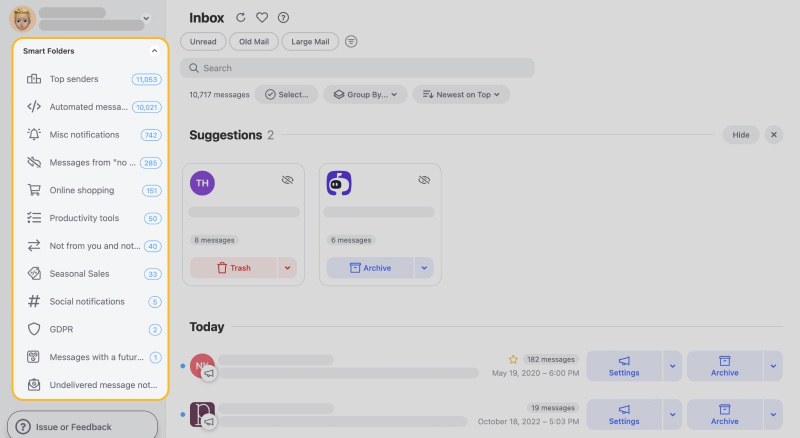
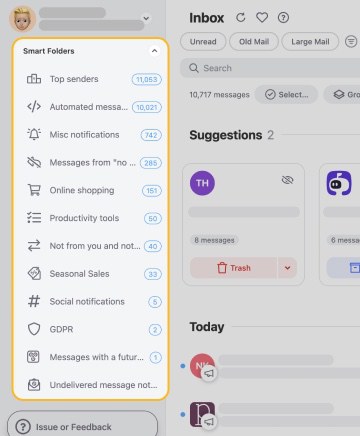
📌 For desktop users managing multiple accounts or dealing with inbox overload, Clean Email offers Smart Folders that automatically organize messages by category, which makes it faster to find what you need across all your accounts.
How do I check my inbox on phone
Most phones include a mail app, such as Gmail on Android or Apple Mail on iPhone. You can also install your provider’s app.
- Open your mail app or install it from the App Store or Google Play.
- Sign in and complete any additional verification.
- Your inbox should open with the newest messages at the top.
💡 Troubleshooting tip: You may need to configure IMAP/POP settings in order to add your email account to iPhone or Android device. If you don't know what they are, search "IMAP settings for [your email provider]" online. Either your provider's help page or some online article will have the exact details you need.
Check inbox on tablet
Tablets use the same mail apps as phones, so the process is similar:
- Open Apple Mail on iPad or Gmail on Android tablets, or install your preferred provider's app.
- Sign in. Your Apple or Google account may add the email address automatically.
- Your inbox should open automatically and show all new and existing messages in chronological order.
💡 Tip: Tablets have larger screens, so you can also open your provider’s website in a browser.
How to check messages on my email using smartwatch
Supported smartwatch apps can display email notifications and may let you read or reply to messages (note that you can't compose new emails or view attachments on most smartwatches).
If messages do not appear, confirm that the watch is paired with your phone and email notifications are enabled.
Email access through car screens (CarPlay & Android Auto)
While you can't directly access your full inbox through CarPlay or Android Auto for safety reasons, your car's display can read emails aloud and show notifications.
- Connect your phone to your car via CarPlay (iPhone) or Android Auto (Android) using a USB cable or wireless connection.
- Enable email notifications in your phone's CarPlay or Android Auto settings before driving.
- When a new email arrives, your car screen will display a notification that you can tap to have the message read aloud through your car's speakers.
💡 Tip: If you need to check multiple email accounts while on the road, consider setting up automatic email forwarding to consolidate important messages into one inbox.
How can I check my email online using voice assistants
Voice assistants like Alexa, Google Assistant, and Siri can read your emails aloud hands-free, which is useful for accessibility reasons or multitasking.
- Make sure your voice assistant has access to your mail account. This means being signed in to your account on the same device and giving the voice assistant the necessary permissions.
- Say a voice command like "Alexa, read my emails," "Hey Google, check my inbox," or "Hey Siri, do I have any new emails?"
- The assistant will read email subjects and senders aloud. Depending on which assistant you use, you may be able to ask it to read full messages or even send replies on your behalf.
💡 Troubleshooting tip: Voice assistants typically only work with major providers like Gmail and Outlook. Lesser-known providers and security-first services like Proton Mail are typically not supported.
Open my inbox with home screen widgets
Email widgets display unread message counts and recent emails directly on your phone's home screen without opening any apps.
- Long-press on an empty area of your home screen and tap "Widgets" (iOS) or the "+" icon (Android).
- Scroll through the widget list to find your email app (Gmail, Yahoo Mail, Outlook, etc.) and select the inbox widget style you prefer.
- Drag the widget to your desired location on the home screen. Different widgets show different things, such as the unread count, the subject lines of recent messages, or even small previews.
Check email using AI agents & AI-enabled browsers
AI agents like Microsoft Copilot in Windows and AI-enabled web browsers like ChatGPT Atlas can check, summarize, and even reply to your messages.
- Enable or install your AI agent of choice. Microsoft Copilot, for example, is included in the latest version of Windows, and ChatGPT Atlas can be downloaded for free from OpenAI's website.
- Make sure the AI agent is authorized to access your inbox.
- Instruct the agent to check your inbox using natural language comments like "summarize my unread emails."
💡 Troubleshooting tip: Be careful if you're managing multiple Gmail accounts and want the AI agent to help across all of them. Always double-check which account is active before asking the AI to send or reply to messages.
How to Check Email on the Most Popular Providers
Your provider determines where and how you sign in. Use the official links below; detailed instructions follow for the four most popular services: Gmail, Yahoo, Outlook, and iCloud.
Official email login pages
| Email account | Official sign-in page | Common addresses or account type |
|---|---|---|
| Gmail | mail.google.com | @gmail.com and many Google Workspace accounts |
| Yahoo Mail | mail.yahoo.com | @yahoo.com and regional Yahoo addresses |
| Outlook.com | outlook.live.com/mail | @outlook.com, @hotmail.com, and @live.com |
| Microsoft 365 | outlook.office.com/mail | Work and school Microsoft accounts |
| iCloud Mail | icloud.com/mail | @icloud.com, @me.com, and @mac.com |
| AOL Mail | mail.aol.com | @aol.com |
| Proton Mail | mail.proton.me | @proton.me and @protonmail.com |
| Zoho Mail | mail.zoho.com | Zoho addresses and custom-domain business accounts |
Enter your email address and password, then complete any two-factor authentication request. If you use a custom work, school, or business address, the domain after the “@” may not reveal which company hosts the mailbox. Use the sign-in page supplied by your organization or email administrator.
Gmail inbox check
To perform a Gmail inbox check, visit mail.google.com in any web browser.
- Enter your Gmail address (ending in @gmail.com) on the login screen.
- Type your password and complete any two-factor authentication steps if enabled.
- Your inbox will load automatically, with unread messages shown in bold.
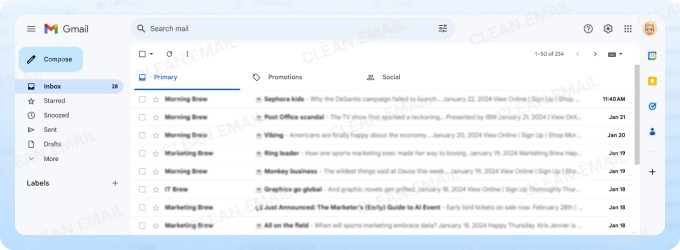
💡 Troubleshooting tip: You can work with multiple Gmail addresses at once by adding another mail address to Gmail. Then, you can switch between accounts without logging out.
Where is my email inbox in Yahoo Mail
- Go to mail.yahoo.com to open Yahoo Mail.
- Enter your Yahoo email address or username on the sign-in page.
- Type your password and click "Sign in" (you may need to verify with a code sent to your phone).
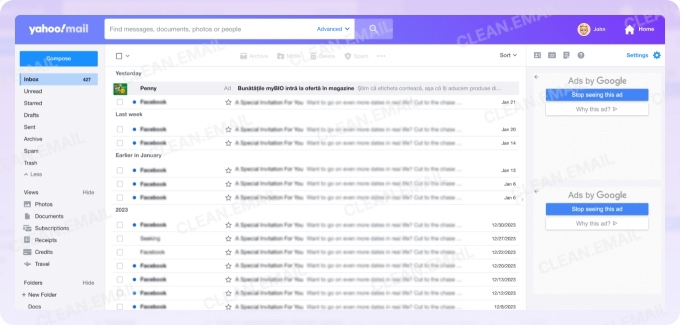
- Yahoo Mail will show all messages received with the newest ones at the top.
How to check my email inbox in Outlook
To check your Outlook inbox, go to outlook.com or outlook.office.com/mail for Microsoft 365 accounts.
- Sign in with your Microsoft account email address (which ends in @outlook.com, @hotmail.com, @live.com, or region-specific variants like @hotmail.cz).
- Enter your password and complete any security verification if prompted.
- Your inbox should load immediately, and you should see your messages.
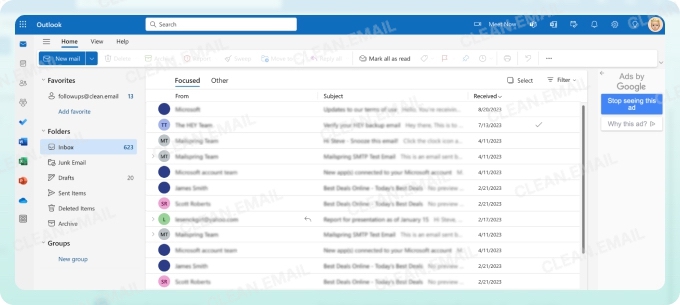
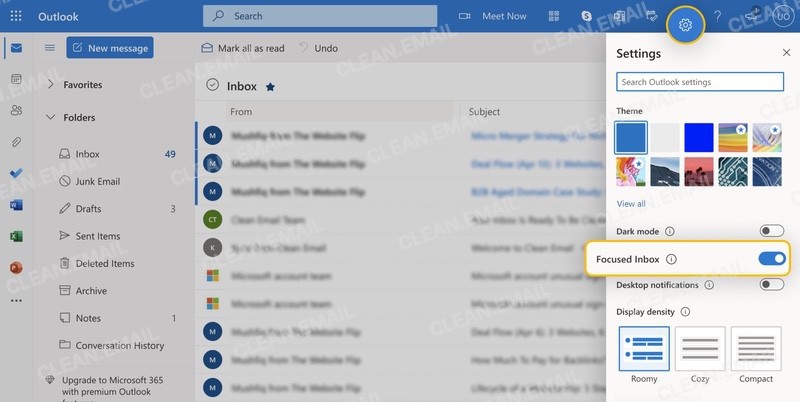
💡 Troubleshooting tip: Depending on your Outlook inbox configuration, your inbox may be organized into "Focused" (important messages) and "Other" (less priority) tabs, so don't let this confuse you if some messages seem to be missing.
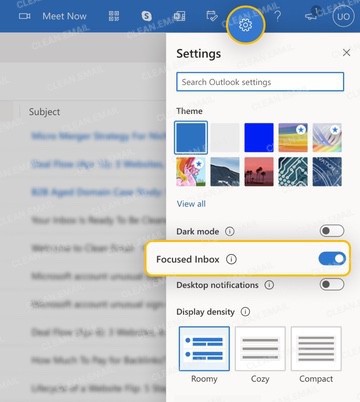
Email access for iCloud Mail
For iCloud Mail email access, navigate to icloud.com/mail using any web browser.
- Sign in with your Apple ID and password (the same credentials you use on your iPhone, iPad, or Mac).
- Complete two-factor authentication by entering the code sent to your trusted device.
- Click the Mail icon to open your inbox and view all messages.
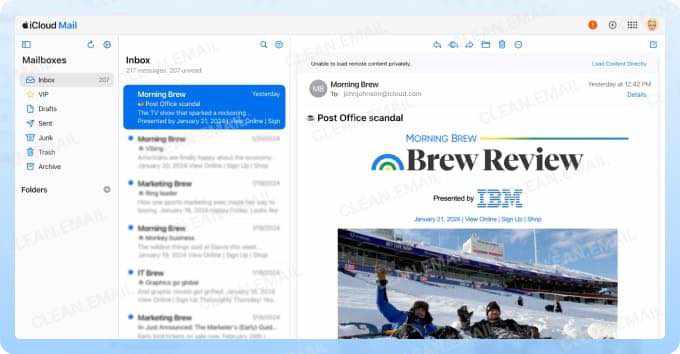
💡 Tip: On Mac, you can add iCloud and other accounts to Apple Mail.
How to check work, school, or custom-domain email
A custom address such as name@company.com does not reveal who hosts the mailbox. It may use Google Workspace, Microsoft 365, Zoho Mail, or another service.
- Check the login instructions provided by your employer, school, domain host, or IT administrator.
- If the account uses Google Workspace or Microsoft 365, sign in through Gmail or Outlook using your complete work address.
- In your mail app, choose the correct provider. If it is not listed, select Other and enter the supplied IMAP and SMTP settings.
Do not guess the server settings. Some accounts also require organizational sign-in, two-factor authentication, or an app-specific password before they can be added to a third-party email app.
Email Not Showing? Check Webmail First
If messages are missing from your app, check official webmail first. This shows whether the problem affects delivery or app synchronization.
| What you find | Likely problem | What to check |
|---|---|---|
| The message appears in webmail but not in the app | App or synchronization problem | Refresh the app, confirm that mail sync is enabled, check the selected folder, and sign in again if authorization has expired. |
| The message is missing from webmail and the app | Delivery or account problem | Search Spam, Trash, and All Mail; check forwarding rules, filters, blocked senders, available storage, and the provider’s service status. |
| Only recent or older messages are missing from the app | Synchronization period or account setup | Check how many days of mail the app is configured to sync and confirm that the account uses the correct IMAP settings. |
| The unread count changes but the message seems missing | Automatic inbox organization | Check categories, tabs, Focused and Other inboxes, archive folders, and active filters. |
If the sender received a delivery failure notice, ask them to share the error because it may identify the exact problem.
Ways to Keep Track of Emails Received
Knowing HOW to access your inbox is one thing. However, it's equally important to know WHEN new messages arrive, so you don't waste time constantly checking without reason.
Fortunately, you have three main options to track new emails automatically without manual checking:
- Email notifications: Push alerts on your phone/tablet, smartwatch, or desktop notify you instantly when new messages arrive. Most email apps let you configure notification settings in their preferences menu. For example, you can choose to receive alerts for all emails, only messages from specific senders, or emails marked as important.
- Inbox widgets: Home screen widgets display unread counts and recent message previews without opening your mail app. Widgets update automatically in the background, so you can see new message counts and subject lines at a glance without unlocking your phone or launching any apps.
- Automatic mail forwarding: You can forward messages from multiple accounts to one central inbox and make it easier to monitor everything from a single location. If you use Gmail as your main account, you can follow our guide on managing multiple Gmail accounts, which has a section dedicated to forwarding. Of course, you still need either notifications or a widget to actually know when new messages arrive in your central inbox.
Most people find that combining methods works best. For instance, using notifications for urgent emails while relying on widgets for a quick visual check of less important accounts. We recommend you experiment with different ways to keep track of emails received until you find the best setup.
Manage Multiple Accounts Fast with Clean Email
Opening one inbox is simple. The work adds up when you manage several accounts and repeatedly search, sort, and clean each mailbox. Clean Email lets you organize connected accounts in one app and automate recurring tasks.
Main features that save time if you use multiple mail accounts:
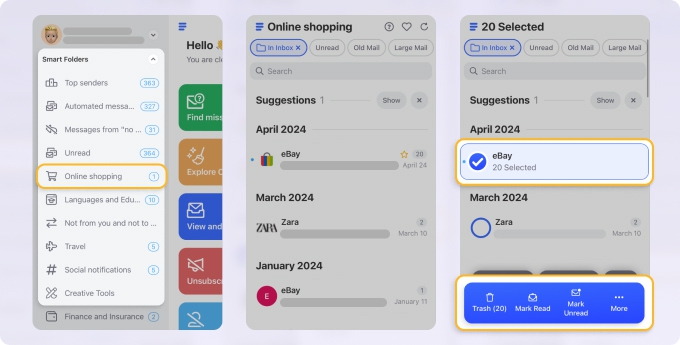
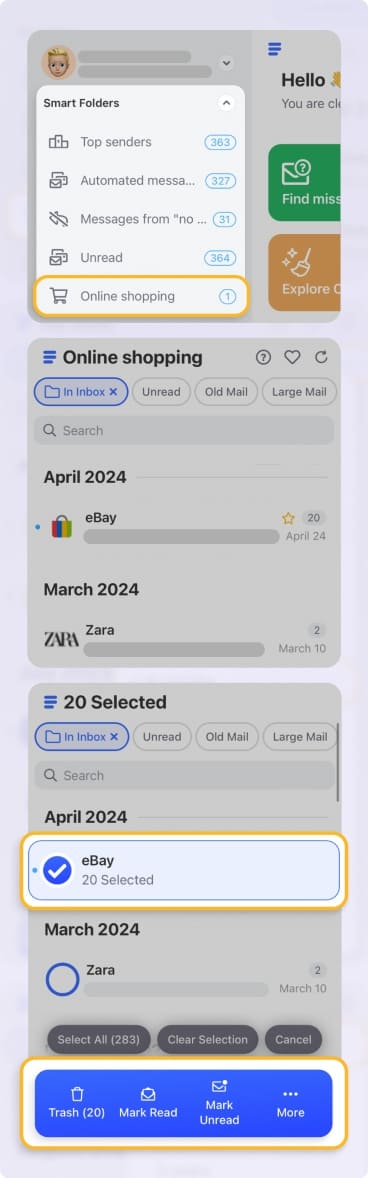
- Smart Folders: Automatically categorize messages into groups like Online Shopping, Social Notifications, Newspapers and Magazines, and Travel to make it easy to find and manage similar emails in bulk, regardless of which account they arrived in.
- Auto Clean: Create custom rules that automatically organize, archive, or delete messages as they arrive.
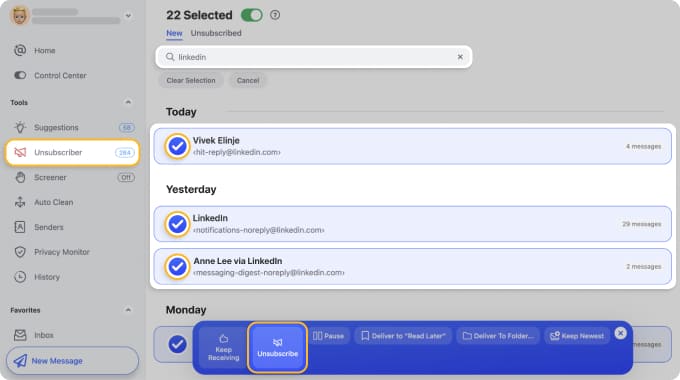
- Unsubscriber: View all your newsletter subscriptions in one list, then unsubscribe from unwanted mailing lists with a single click instead of hunting through multiple inboxes.
- Screener: Block messages from unknown senders before they reach your inbox. You can then review them at your convenience to decide what gets approved and what remains blocked.
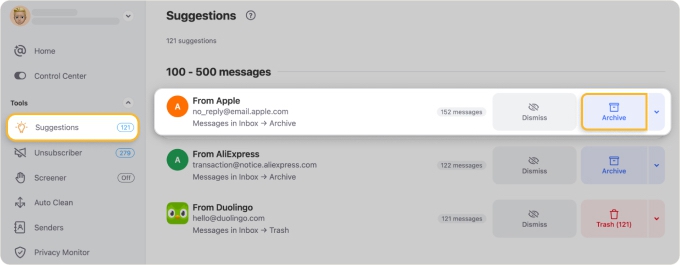
- Cleaning Suggestions: Get intelligent recommendations for managing repetitive emails based on your past behavior and common patterns.
Clean Email works with Gmail, Yahoo, Outlook, iCloud, and any IMAP-enabled email provider. It’s available on macOS, mobile, and the web, so you can manage and organize your inbox from any device.
📌 If you're concerned about security, read our expert analysis on whether Clean Email is safe to understand how your data is protected.
Conclusion
You now have everything you need to access your email inbox on any device and through any major provider. We hope this guide saves you time and frustration. For the best email experience across multiple accounts, remember that combining different methods for accessing your inbox with smart organization tools like Clean Email makes all the difference.
FAQs
How to check email when messages aren’t arriving?
Check spam/filters and forwarding rules, confirm the sender isn’t blocked, and verify sync settings; if still missing, sign in to webmail and look for server-side rules or delivery errors.
How to check my email if my account is locked or blocked?
Follow the provider’s account recovery/support instructions (verify identity, remove suspicious devices, clear security alerts), and check any account-owner notification messages for next steps.
Should I enable two-step verification for my email?
Yes, 2FA adds a strong extra layer of security and is one of the most effective ways to prevent unauthorized access.
Can voice assistants read my sensitive emails aloud?
Yes, if you link your account, they can read emails aloud; only enable this on trusted devices and avoid enabling it on shared smart speakers.
How to check if an email is phishing?
Verify the sender address, hover over links to preview URLs, avoid unexpected attachments or urgent payment requests, and when in doubt, contact the sender via a known channel.
How to check which devices are signed into my email account?
Open your account’s security or device activity page (for example, Google Account → Security → Your devices) to see active sessions and sign out any unfamiliar devices.
How to safely check email on public Wi-Fi?
Use a trusted VPN, prefer official apps or HTTPS webmail, avoid sending passwords or sensitive info, and enable two-step verification so credentials alone aren’t enough to break in.
How to check email permissions and revoke third-party access?
Go to your provider’s Security or Apps/Connected Sites page, review granted apps and permissions, and revoke any third-party access you don’t recognize or no longer use.