Find the Right Gmail Cleanup Tool
This guide compares Gmail cleanup options by the actual problem they solve, not by generic rankings.
The main decision factors are:
- Bulk cleanup options and speed
- Unsubscribe options
- AI automation
- Privacy & safety
- Mobile support
- Chrome extensions
- Storage cleanup
Gmail already supports the cleanup basics, such as bulk selection, sorting using labels and categories, and more. Gmail also offers subscription management and storage management tools for deleting large emails and freeing shared Gmail/Drive/Photos storage.
The problem is scale. Gmail is effective when you know exactly what to search for and can handle the cleanup manually.
Cleanup apps become necessary when the same actions keep repeating. That includes recurring rules, bulk unsubscribe workflows, sender-level cleanup, and guided organization in larger inboxes.
This article evaluates how the leading tools handle common inbox problems, including deleting 50,000 emails, cleaning the Gmail Promotions tab, finding large emails, organizing newsletters, and working toward Inbox Zero.

What Are You Trying to Do?
Start with the task. The right Gmail cleanup tool is usually obvious once the problem is specific.
| Your problem | Best option | Why it fits |
|---|---|---|
| Delete thousands of old emails | Clean Email or Mailstrom | Both are built around grouped bulk actions. Gmail can do this with search operators, but it becomes slow when you need to review many senders, categories, and dates. |
| Unsubscribe from newsletters | Gmail Manage subscriptions view for light cleanup; Clean Email or Trimbox for bulk cleanup | Gmail is enough for a few senders. A cleanup app is better when you also want to delete old newsletter history or handle many subscriptions at once. |
| Organize inbox automatically | SaneBox, Shortwave, Clean Email, or Clean Inbox for Gmail | Choose SaneBox for priority filtering, Shortwave for AI email workflows, Clean Email for recurring cleanup rules, and Clean Inbox for Gmail for Gmail-filter-based organization. |
| Use a Chrome extension only | Trimbox | Trimbox is designed for Gmail users who want to one-click unsubscribe and delete actions inside the browser rather than a full cleanup dashboard. |
| Clean Gmail on iPhone | Gmail’s native app or Clean Email for iOS | Gmail’s app is enough for basic search, deletion, and unsubscribe actions. Clean Email offers mobile apps and deeper cleanup workflows. |
| Avoid giving full inbox access | Native Gmail, Clean Inbox for Gmail, Trimbox, or SaneBox | Native Gmail avoids third-party access entirely. Clean Inbox for Gmail focuses on filters and labels without reading email bodies. Trimbox emphasizes local browser processing. SaneBox uses headers by default. |
| Clean the Promotions tab | Gmail search for small jobs; Clean Email or Trimbox for large jobs | Gmail can search category:promotions, but apps make it easier to bulk review, unsubscribe, delete, or automate future cleanup. |
| Use AI to organize email | Shortwave | Shortwave is a good fit if you want an AI-first Gmail client. |
Best Gmail Cleanup Apps Compared
Instead of treating every product as a general “email cleaner,” we looked at them through the most common Gmail cleanup jobs: bulk deletion, newsletter cleanup, storage recovery, daily triage, and privacy exposure.
For each tool, we checked whether it solves the job directly or simply repackages Gmail’s existing search, labels, and filters.
1. Clean Email
Best for: Users who need to delete large amounts of email, unsubscribe in bulk, automate recurring cleanup, and free up storage fast.
Clean Email does not leave users to decide where to start. Cleaning Suggestions highlight likely clutter, so you can tackle the most obvious mess first. It works on the web, Mac, Android and as a Gmail cleaner app for iPhone.
Three things make this app stand out from manual Gmail cleanup:
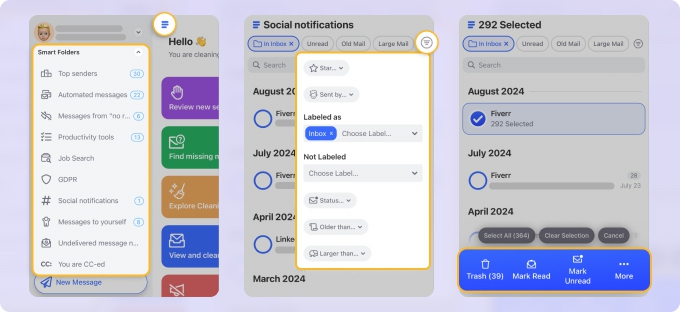
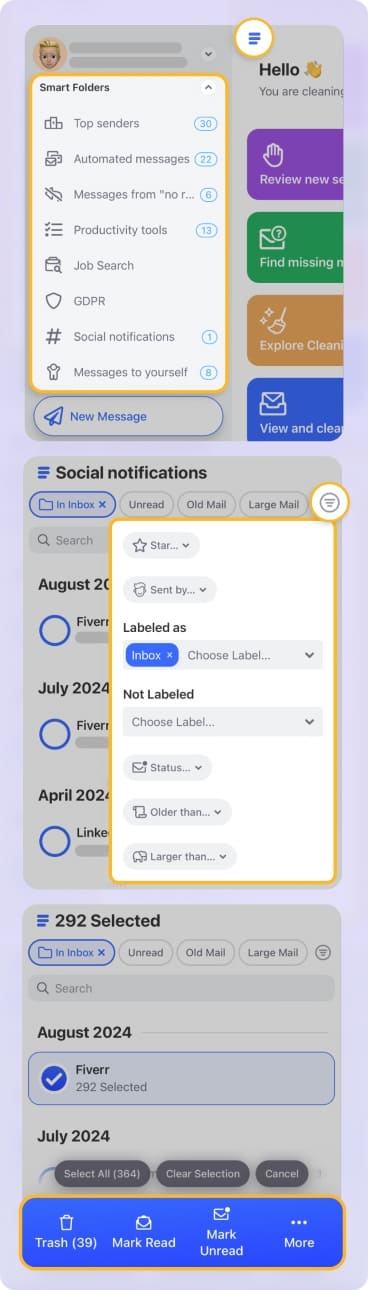
- No repeated search queries. Predefined Smart Folders replace manual searches for older_than:1y, category:promotions, or larger:10M.
- Grouped review. Cleanup is built around sender groups and patterns, not individual messages.
- Privacy-first design. Does not sell user data and processes cleanup using email headers instead of full message bodies.
Useful features
- Bulk delete. Removes large email groups after review.
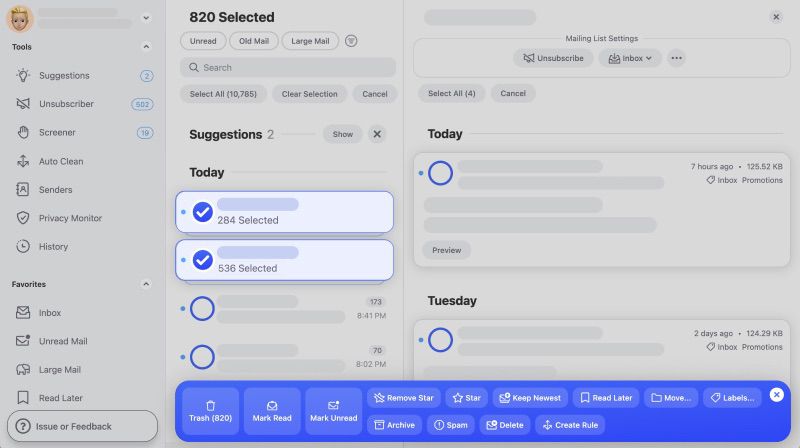
- Sender-based cleanup. Acts on repeat clutter from one company, newsletter, store, or automated service.
- Auto Clean rules. Handles recurring clutter after the first cleanup. Easier to set up than Gmail filters because actions are tied to grouped inbox patterns.
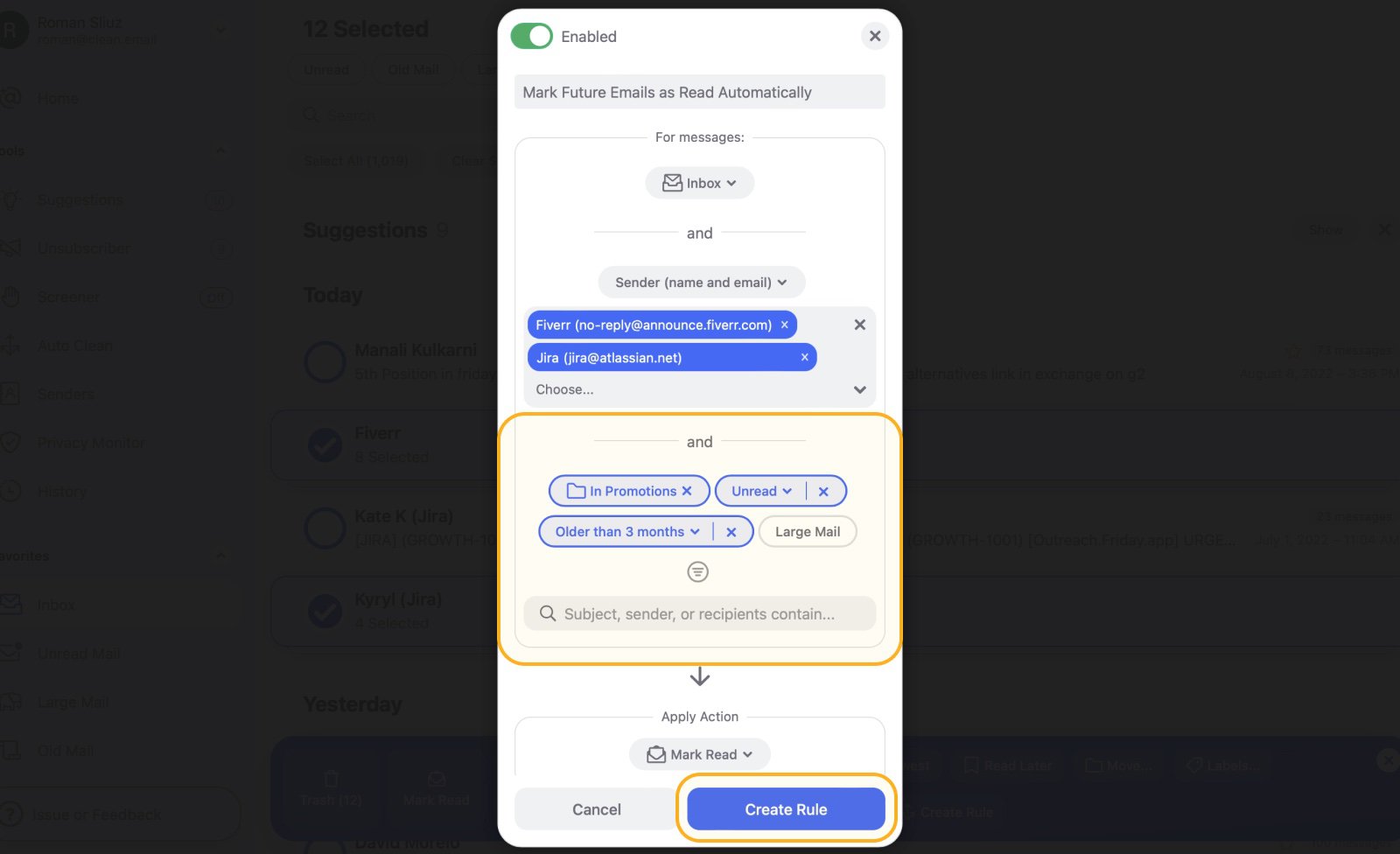
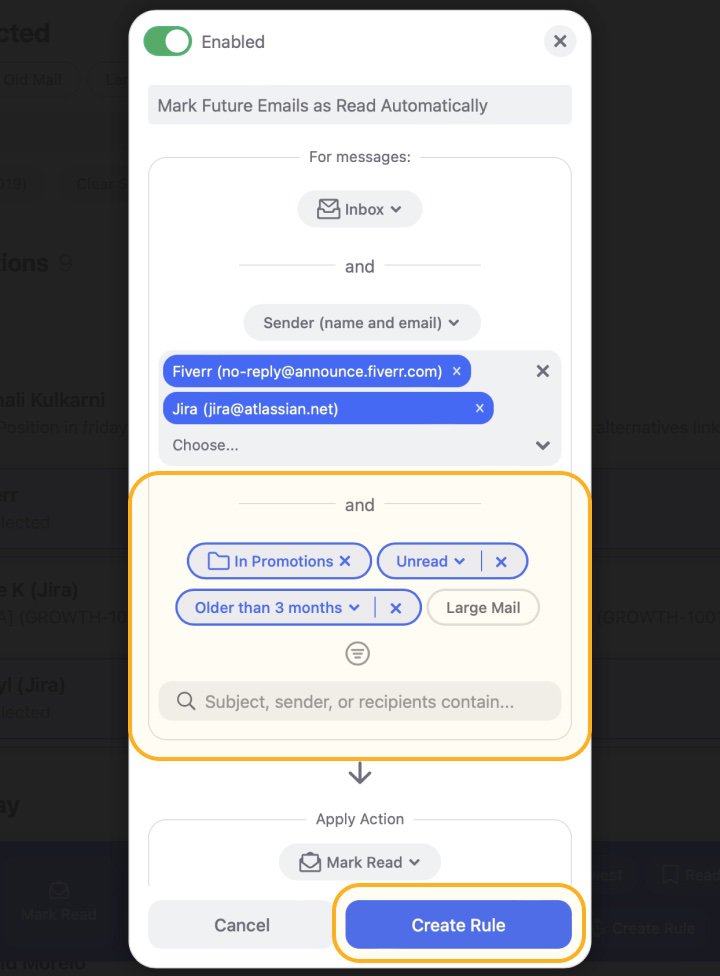
- Unsubscribe management. Stops future marketing emails and cleans old newsletters in one go.
- Screener. Quarantines unknown senders for your review before they become ongoing clutter in your Inbox.
Limitations
Clean Email is more than most casual Gmail users need. If you only need to delete a few old messages or unsubscribe from a couple of newsletters, Gmail’s native tools are enough.
Some users may also find the initial setup complicated.
Best use case
Broad inbox problems: too many old emails, too many newsletters, a messy Promotions tab, storage pressure, and no realistic way to clean everything manually in Gmail. The most practical option when you want both a cleanup reset and rules to keep the inbox cleaner afterward.
Learn more about how to quickly clean out Gmail inbox with Clean Email.
2. Clean Inbox for Gmail
Best for: Users who want to block or label unwanted email without using a separate cleanup dashboard.
Clean Inbox for Gmail improves Gmail filters instead of replacing Gmail with a GPT-powered cleanup dashboard. Its value is in stopping future clutter from reaching the main inbox, not deleting years of old mail.
This approach is different from a typical cleanup app:
- No access to email contents. The tool cannot read what is inside messages.
- Labels, never deletes. Filtered emails are tagged so you can review before removing.
- Focused on incoming mail. Better for reducing future spam than for historical purges.
Useful features
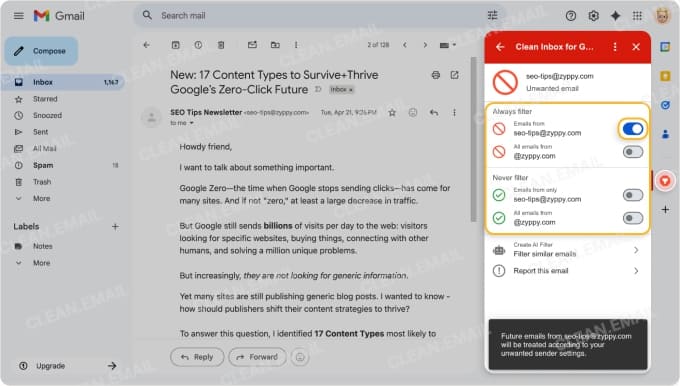
- Public filter categories. One-click labels for common unwanted email types when Gmail’s default tabs are too broad.
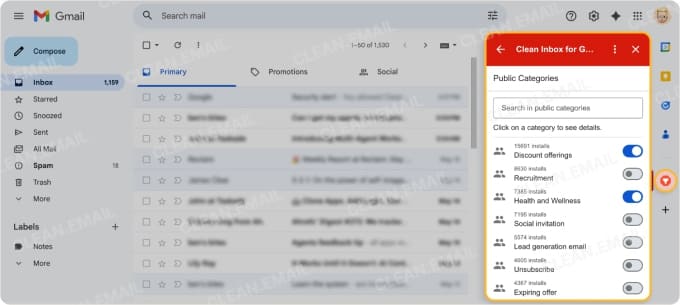
- AI-powered custom categories. Suggests filters for similar future emails when you give access to the opened email’s title, no manual Gmail rules required.
- Domain and sender filtering. Filters everything from a domain or specific user. Often more reliable than waiting for unsubscribe links to work.
Limitations
Not a heavy-duty backlog cleaner. If your goal is to delete 50,000 old emails, cut Google storage usage, or run a full sender-by-sender purge, this is not the most efficient option.
It also relies on Gmail’s filter and label system. Safer than automated deletion, but it means you may still need to review labeled mail or build extra rules manually.
Best use case
Low-access, Gmail-native organization. Especially relevant if you want AI-assisted filters but do not want a full cleanup app reading or processing your mailbox.
3. Shortwave
Best for: Users who want to change how they work with Gmail, not just clean old email.
Shortwave is not a traditional Gmail cleanup tool. It works more like an AI Gmail email client with features for triage, summaries, search, scheduling, organization, and more.
Its strongest advantage over native Gmail is flexible automation. Gmail filters follow fixed rules, while Shortwave AI filters take plain-language instructions to label, archive, star, or route emails.
Labels, filters, stars, and signatures sync from Gmail, so you do not rebuild your inbox structure from scratch.
Useful features
- AI filters. Natural-language rules to label, archive low-priority mail, mark important threads, or remove junk.
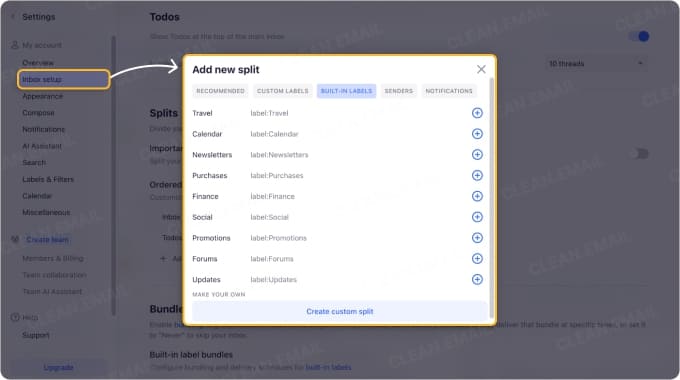
- Splits. Focused inbox views by importance, sender, label, or search query. They are more flexible than Gmail’s Primary, Promotions, and Social tabs.
- Bundles group related emails (newsletters, promotions, notifications) so you can snooze, delete, or mark a whole batch done.
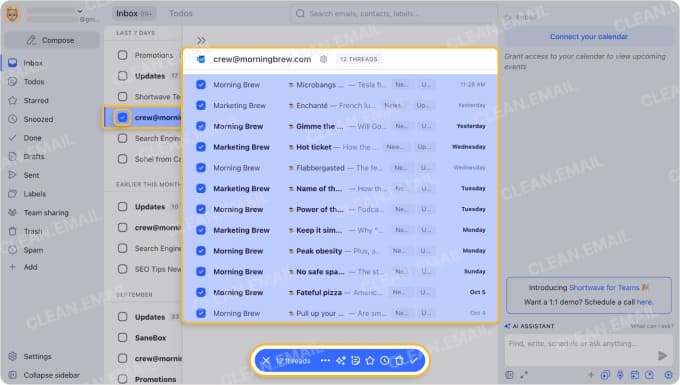
- The AI Assistant summarizes threads, searches old emails, drafts replies, and surfaces important messages.
Limitations
- Shortwave is a new email client experience. If you like Gmail’s interface and only want to clear old clutter, this is more change than necessary.
- Privacy also works differently from metadata-focused cleanup tools. Shortwave’s privacy policy says it processes email contents and metadata as part of providing the service, while stating it does not sell personal data.
Best use case
Ongoing organization, summarization, and prioritization, not a one-time cleanup. Makes the most sense for users who want an AI email client layered on Gmail.
4. Mailstrom
Best for: Users who want to identify which senders, subjects, mailing lists, or date ranges are creating the most clutter.
Mailstrom is great when the inbox problem is volume. Gmail search can find messages by sender, date, size, or keyword, but Mailstrom makes cleanup easier by grouping related emails for batch review.
Unlike an AI cleanup tool, it does not try to decide what matters for you. It shows inbox patterns and lets you choose what to remove, keep, move, or block. Actions are not permanent and can be reversed from the task list, though you should still recover mistakes before Trash is emptied.
Useful features
- Sender and mailing-list grouping. Review the biggest sources of clutter in one view instead of running separate Gmail searches for every brand or newsletter.
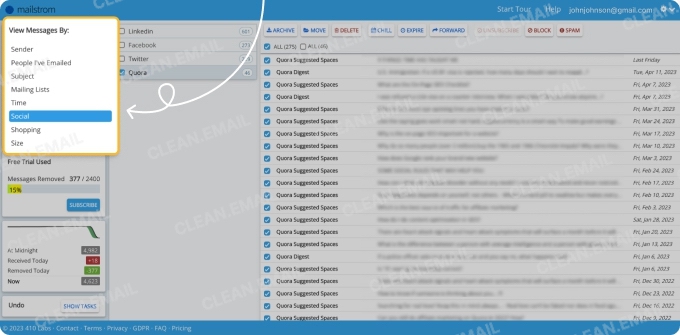
- Bulk delete, archive, and move. For Gmail, moving works like adding a label and removing the Inbox label.
- Unsubscribe. Available from the Mailing Lists tab. Sends a request to the list owner or opens the web unsubscribe page when needed.
- Block and recurring Move rules. Based on sender, list, or subject, applied to promotions and automated messages.
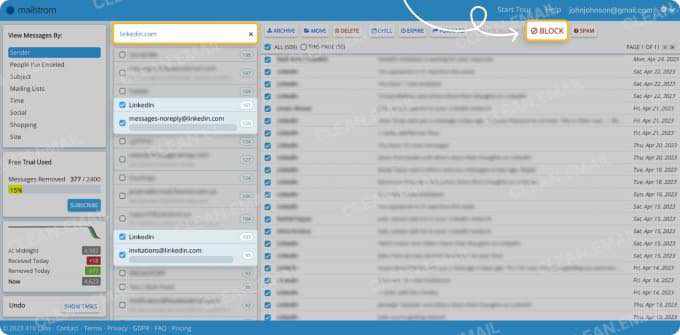
- Chill and Expire add cleanup control beyond Gmail’s basic actions. Chill returns selected emails later, while Expire removes stale messages after a chosen time period.
Limitations
Less compelling if your priority is AI organization, mobile-first cleanup, or privacy-focused filtering.
It is also a better backlog tool than a modern AI productivity layer. For summaries, drafting, or conversational inbox management, look at Shortwave or Gemini-assisted Gmail instead.
Best use case
A cleanup console for old mail. Delete by sender, list, topic, size, or date without building dozens of Gmail searches manually.
5. SaneBox
Best for: Users whose main problem is not old clutter, but daily inbox noise. It routes less important mail away from the inbox while leaving important messages visible.
SaneBox works in the background. You keep using Gmail (or another provider) as usual while it handles prioritization, moving lower-priority emails into folders like @SaneLater and keeping important ones in view.
What sets it apart from manual Gmail filtering:
- Adaptive, not rule-based. Gmail filters follow rules you build manually. SaneBox learns from how you move emails between the inbox and Sane folders.
- Works across providers. Not Gmail-only, which matters if you juggle multiple accounts.
- Header-based privacy model. SaneBox says it does not access email bodies or attachments by default. Core features like SaneLater, SaneNews, and SaneBlackHole rely on headers.
Useful features
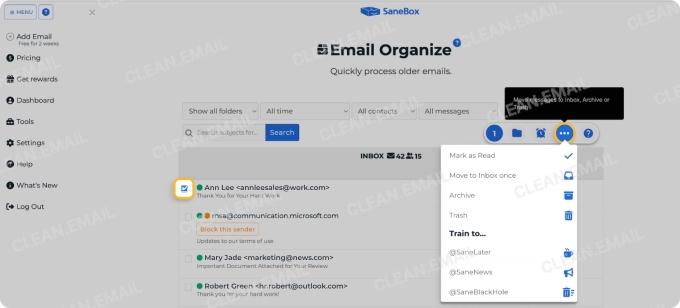
- SaneLater. Moves less important emails out of the inbox while keeping them accessible inside the account. In Gmail, it shows up as a label/folder.
- SaneNews and SaneCC. SaneNews pulls newsletters and mailing lists out of priority mail. SaneCC does the same for copied messages.
- SaneBlackHole. Sends mail from unwanted senders straight to Trash, with a seven-day review period for new messages.
- Email Deep Clean. For old-mail and storage cleanup. Pick a date range, review the senders SaneBox finds, and choose what gets trashed.
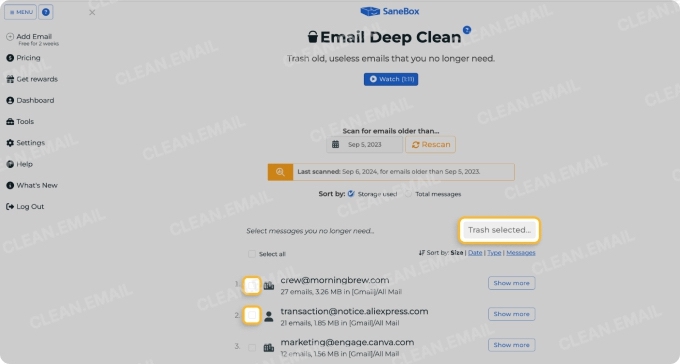
- Auto-archive or delete. Items in SaneLater can be cleared after a set period.
Training is the part most users underestimate. If SaneBox misfiles something, move it back to the inbox or into another Sane folder, and that one action teaches it how to handle similar messages going forward.
Limitations
Not the right first choice if your immediate task is deleting tens of thousands of old emails or hunting down storage-heavy attachments. SaneBox is built to prevent the next mess, not clean up the current one.
Best use case
A steady stream of mixed-priority email where important messages keep getting buried under low-priority noise. SaneBox makes Gmail feel calmer every day rather than fixing it once.
6. Trimbox
Best for: Users who want to unsubscribe from email lists and delete old messages from the same senders without leaving Gmail.
What stood out
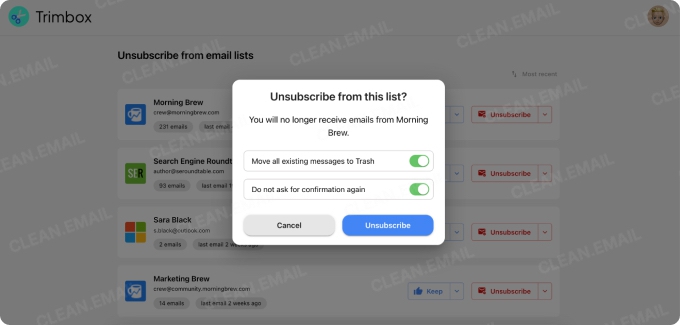
Trimbox solves a narrow Gmail problem: newsletters, promotional senders, and mailing lists that need quick unsubscribe or cleanup. It is not pretending to be a full cleanup dashboard.
Gmail’s Manage subscriptions helps you unsubscribe, but Trimbox adds the second step that matters: deleting past emails from the same sender in one action. That is the difference when clutter is already sitting in your inbox.
Useful features
Mailing list detection finds the senders causing repeat clutter, which works better than Gmail’s broad default tabs.
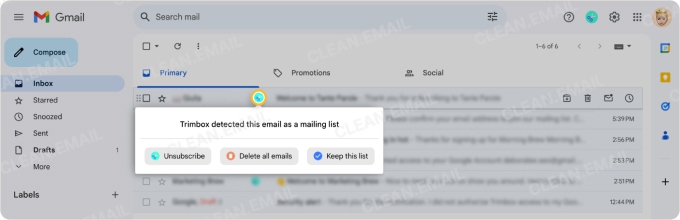
Bulk sender cleanup. Delete previous emails from a sender in one action after unsubscribing, faster than searching and selecting results in Gmail manually.
The Chrome extension is the strongest fit for Gmail users. A browser version and mobile app are also available.
Limitations
Trimbox is narrower than Clean Email or Mailstrom. It is not a full inbox operating system, AI assistant, or multi-category cleanup platform. It is also Gmail-specific, so not ideal if you manage other providers too.
The free tier is limited. Users with a very large number of subscriptions may need to pay or combine Trimbox with Gmail’s native tools.
Best use case
Newsletters and recurring senders as the core problem. A practical choice if you want a browser-based cleanup layer with a privacy-conscious design.
Gmail Native Tools vs Third-Party Cleanup Apps
Many users ask: “Why not just use Gmail filters?”
For basic cleanup, that is a reasonable approach. Gmail search, labels, filters, categories, unsubscribe controls, and storage tools can handle many common tasks.
The limitation is process efficiency.
Here’s how native Gmail cleanup features compare to dedicated cleanup apps:
| Native Gmail | Cleanup Apps |
|---|---|
| Search operators for finding emails by sender, date, size, category, or attachment | Smart grouping that automatically organizes similar emails for review |
| Labels for manual organization | Automated labels, folders, or rules based on sender, category, behavior, or AI classification |
| Filters for future incoming emails | Bulk workflows that can clean both old and future messages |
| Manual deletion and archiving | One-click or grouped deletion across thousands of messages |
| Basic unsubscribe links and Gmail subscription management | Advanced bulk unsubscribe options |
| Categories such as Promotions and Social | More granular sender, newsletter, shopping, finance, travel, notification groupings, and more |
| No third-party access required | More convenience, but requires permission review and trust in the vendor |
Gmail alone is enough when the problem is small and specific. For example, if you need to delete emails larger than 15 MB, remove one sender, or create a simple filter, Gmail is usually sufficient.
A third-party cleanup app becomes more practical when the task is repetitive, high-volume, or ambiguous. Examples include cleaning years of old emails, unsubscribing from dozens of newsletters, setting recurring rules, or keeping future inbox clutter under control.
Are Gmail Cleanup Apps Safe?
Safety depends on the tool, the permissions granted, and the user’s tolerance for cloud processing. Google allows users to review and revoke third-party app access, and Google’s policies require apps using Google API data to be transparent and request only relevant permissions.
Users should still review each app’s access request, privacy policy, and deletion behavior before connecting Gmail.
What users worry about
The main concerns are valid:
- Apps reading email content.
- Apps collecting or monetizing inbox data.
- Accidental deletion.
- Losing important emails.
- Giving broad Gmail permissions for a small cleanup task.
The safest choice is always Gmail’s native tools because no third-party connection is required. After that, the best option depends on how much access the tool needs to solve the problem.
What to check before using any Gmail cleanup app
- OAuth permissions: Prefer apps that use Google OAuth, not your Gmail password. Review the specific permissions — a filter tool should not need full email client access.
- Data policies: Check whether the app reads email bodies, stores metadata, or sells derived data. "Free" does not mean privacy-neutral.
- Undo options: Look for recovery paths, non-destructive actions, or warnings before permanent deletion. Gmail's Trash adds a recovery buffer.
- Security transparency: Public privacy policies, encryption details, compliance info, and Google verification references.
Third-Party Tools Privacy Comparison
| Tool | Reads email body | Cloud processing | Sells data |
|---|---|---|---|
| Clean Email | No | Yes | States it does not sell or analyze user data beyond providing features |
| Clean Inbox for Gmail | No | Limited Gmail add-on and filter processing | States it does not share data with third parties for unrelated purposes |
| Shortwave | Yes; as an AI email client, it processes email contents and metadata | Yes | States it does not sell personal data |
| Mailstrom | Yes; has access to email contents when displaying messages; stores subject lines and metadata only | Yes | States it does not sell data |
| SaneBox | No | Yes | States it does not sell data and that email bodies are not downloaded by default |
| Trimbox | Yes; processes email content and metadata locally in the browser | Primarily local/browser-based by its stated design | States it does not sell email address, personal information, or aggregated information |
AI Gmail Cleanup: Can AI Actually Clean a Gmail Inbox?
Google’s Gemini features in Gmail can summarize threads, draft replies, suggest responses, help find information from previous emails, and connect with Drive and Calendar, depending on plan and availability.
But Gemini is still more of an AI assistant than a true inbox cleanup tool. It does not replace a cleanup workflow for bulk deleting, unsubscribe management, storage cleanup, or recurring cleanup rules.
For example, Gemini may help you find old newsletters. It is not yet the right tool for a command like: “Delete all promotional emails older than two years except receipts, travel confirmations, warranties, and tax-related purchases.”
| Feature | Gemini | Cleanup Tools |
|---|---|---|
| Email summaries | 🔵 Excellent | 🟡 Limited |
| Drafting replies | 🔵 Excellent | 🔴 Weak |
| Bulk cleanup | 🔴 Weak | 🟢 Strong |
| Unsubscribe automation | 🔴 Weak | 🟢 Strong |
| Storage cleanup | 🔴 Weak | 🟢 Strong |
| Inbox automation | 🟡 Limited | 🟢 Strong |
Popular AI Gmail Cleanup Tools
✅ Shortwave is the strongest fit for users who want an AI-first Gmail client, with AI filters, summaries, and workflow automation.
✅ Clean Inbox for Gmail is useful for users who want GPT-assisted Gmail filters while keeping cleanup actions label-based and easy to review.
Current AI Limitations
AI still struggles with contextual importance. A newsletter may contain a receipt. A promotional email may contain a travel confirmation. An automated message may become important months later.
For that reason, fully autonomous inbox cleanup is still risky. AI can help classify and prioritize email, but deletion and unsubscribe decisions should remain reviewable.
Final Verdict
After testing every tool in this guide, one thing became clear: the question "what is the best Gmail cleanup app" is the wrong question. The right one is "what does your inbox actually need?"
The pattern that emerged across testing is simple. Start with Gmail's native tools. Search operators, Manage subscriptions, and storage management handle small, specific jobs without third-party access. If the cleanup is one-off and the scale is manageable, no extra app is needed.
Add Clean Email when the work becomes repetitive. Bulk deletion, sender-level cleanup, unsubscribe management, recurring rules, and storage cleanup stop being separate tasks and start working as one system. It is the strongest all-around option when your inbox problem is broad rather than narrow.
The rest of the tools solve narrower problems well:
- Mailstrom for manual sender and list-level cleanup with full visual control.
- SaneBox for ongoing priority filtering instead of historical cleanup.
- Shortwave for users who want an AI Gmail client, not a cleanup utility.
- Trimbox for Gmail-only newsletter cleanup inside the browser.
- Clean Inbox for Gmail for low-access, filter-based email organization.
The honest takeaway: pick the tool that matches the problem you actually have, not the one with the most features. A Gmail cleanup app you do not need is just another permission grant.
FAQs
Is it safe to connect Gmail to cleanup apps?
Usually yes, if the app uses official Google OAuth, has a transparent privacy policy, requests appropriate permissions, and provides safe cleanup controls. Always review permissions before connecting Gmail and revoke access when you no longer use the tool.
What is the most secure Gmail cleanup app?
Native Gmail is the most secure choice because no external app connects to your mailbox. For the best third-party apps to clean Gmail inbox, consider Clean Inbox for Gmail, Clean Email, or Mailstrom if you want lower content exposure.
Is there a free AI cleaner for Gmail?
There is no fully reliable free AI tool that can clean your Gmail. Gemini can help with summaries, drafting, and search, but it can’t help with bulk cleanup or unsubscribing. Shortwave has a free starting plan with AI features, and Clean Inbox for Gmail offers GPT-assisted filter creation with free and paid features, but deeper cleanup and automation usually require a paid tool.