What Are Roundcube Filter Rules?
Roundcube filter rules are sets of instructions for the Roundcube email client to automatically perform when certain conditions are met.
Each filter combines at least one rule (for example, “Subject contains invoice” or “Size over 5 MB”) with at least one action, such as moving the message to a folder, redirecting it to another address, flagging it, or deleting it. Filters can save you time on routine inbox management tasks and make Inbox Zero, a state when there are no unprocessed messages in the inbox, much easier to maintain.
Roundcube stores your filters as a Sieve script on the mail server, and the mail server applies them as new messages arrive, so they work even when you’re not logged in. Keep in mind that filters only process incoming mail: they don’t sort messages that are already in your mailbox. The Filters section is provided by Roundcube’s Managesieve plugin, so it’s only available if your email provider has enabled it.

Create Filter Rules in Roundcube Webmail
Here’s how to create a filter that moves matching messages to a specific folder:
- Log in to Roundcube.
- Click the Settings icon on the left.
- Select Filters.
- Click the Create button.
- Enter a Filter name and make sure Filter enabled is turned on.
- Choose the Scope: matching all of the following rules, matching any of the following rules, or all messages.
- Under Rules, choose what to check (for example, Subject or From), select an operator such as contains, and enter the value to match.
- Under Actions, choose Move message to and select the destination folder.
- Click Save.
The filter applies to new messages from now on. Give each filter a descriptive name so you can easily find it later to disable, delete, or modify it. Filters run in the order they’re listed; add the Stop evaluating rules action when you don’t want later filters to process a message.
Disable Rules in Roundcube
Any rule that no longer serves its purpose can be disabled with a simple click:
- Log in to Roundcube.
- Click the Settings icon on the left.
- Select Filters.
- Select the rule you want to disable.
- Turn off Filter enabled.
- Click Save.
The option to disable a filter comes in handy when you want to temporarily stop filtering certain messages. To resume their filtering, all you need to do is put the Filter enabled toggle to the ON position, which beats having to create the same filter again from scratch.
Delete Roundcube Email Rules
To delete an unnecessary rule in the Roundcube email client:
- Log in to Roundcube.
- Press the Settings icon on the left.
- Select Filters.
- Select the rule you want to delete.
- Click the Delete button in the toolbar.
- Confirm the deletion.
Deletion is permanent, so if you might need a filter again, disable it instead.
Create Rules to Filter Emails with Clean Email
Roundcube’s mail filtering capabilities are useful, but they’re not exactly convenient, and they’re also lacking in terms of flexibility. Fortunately, the mail client is based on the IMAP protocol, so it’s possible to create rules with a third-party inbox organizer — Clean Email.
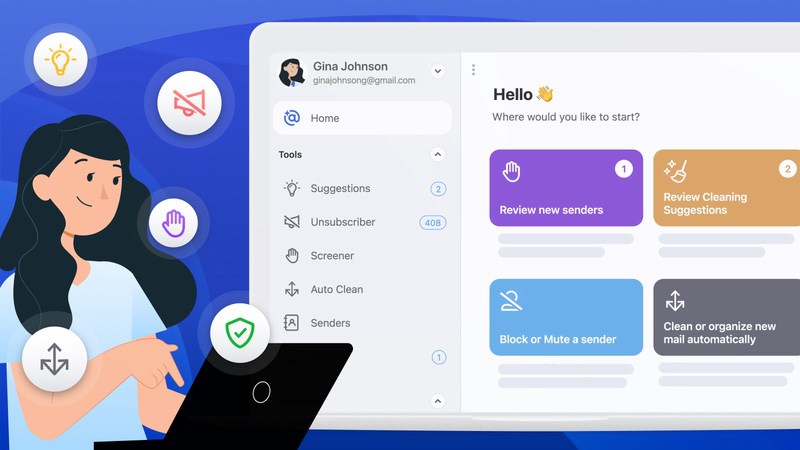

Clean Email brings to the table several important advantages:
- Ease of use: With its Auto Clean feature, Clean Email allows users to turn any inbox management action into a rule with just a few clicks. Even complete novices can create complex rules without reading lengthy tutorials.
- Cleaning Suggestions: Clean Email intelligently organizes similar messages into so-called Cleaning Suggestions. For example, it creates Smart Folders for social notifications, subscriptions, finance messages, and so on. This feature works hand-in-hand with Auto Clean, making it easy to create powerful filters.
- Flexibility: The filtering conditions supported by Roundcube are quite limited. Clean Email, on the other hand, lets you create sophisticated filters that take into account conditions like email age or size.
But enough talking about Clean Email’s merits. It’s time to demonstrate them in practice on an example. Here’s how easy the inbox organizer makes it to move all messages that are older than 1 year to a dedicated folder:
- Go to: https://app.clean.email/.
- Enter your email address and click Continue.
- Enter your account password and your IMAP hostname.
- Once you’re logged in, select the “Emails older than 1 year” Smart Folder.
- Click Select all.
- Click Move and choose the New Folder option.
- Create a new folder for the matching emails.
- Choose to apply the action to all selected and future similar emails.
- Click Move and Create Rule to confirm.
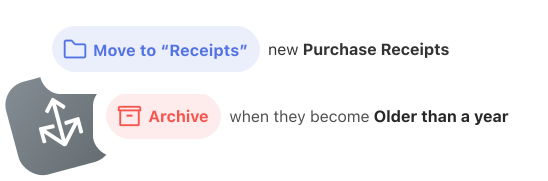
From now on, the inbox organizer will automatically move all messages to the selected folder when they become older than 1 year.
These features make Clean Email a great choice for all Roundcube users, and there’s even more. The Unsubscriber feature can easily unsubscribe you from any unwanted emails that may be cluttering your inbox, while the Keep Newest feature is perfect for managing messages that are only relevant until the next one comes in.
Clean Email is a freemium tool, so you can try it for free to see what makes it so useful.
Conclusion
Roundcube is a mature web-based mail client that provides out-of-the-box support for mail filters. Because the client uses the IMAP protocol, it works with third-party inbox organizers like Clean Email, which provides a streamlined filter creation workflow and offers a number of advanced features that Roundcube doesn’t have.
FAQ
Why is the Filters category not visible?
The Filters section comes from Roundcube’s Managesieve plugin, and it only appears when your email provider has enabled that plugin and the mail server supports ManageSieve. Some hosting providers disable it because they offer mail rules through their own control panel instead, so check your host’s control panel or contact its support.
Is Clean Email safe?
Yes, Clean Email is designed with its users’ privacy and security in mind. The inbox organizer never downloads full emails—it only analyzes the metadata contained in email headers.
Can Roundcube filters delete large messages?
Yes, they can, but only if you create them using a third-party tool — Clean Email.