The Quickest Method for Each Platform
Below you'll find the quickest method for each service, plus how to block entire domains and how Clean Email can help you manage unwanted emails in all your accounts.
| Provider | Blocked mail goes to | Address limit | Domain blocking | Full guide |
|---|---|---|---|---|
| Gmail | Spam folder | No limit | Yes — via filters | Block on Gmail |
| Outlook/Hotmail | Junk folder | 1,024 addresses | Yes — via Junk settings | Block on Outlook |
| Yahoo | Spam folder | 500 addresses | Not natively available | Block on Yahoo |
| Apple Mail (Mac) | Trash or marked | No limit | Via iCloud.com rules | Block on Mac |
| Apple Mail (iPhone) | Junk folder | No limit | Via iCloud.com rules | Block on iPhone |
| iCloud.com | Trash (server-side) | No limit | Not natively available | Block on iCloud |
| AOL | Spam folder | 1,000 filters | Supported | Block on AOL |
| Android (Gmail app) | Spam folder | No limit | Via Gmail filters | Block on Android |
Blocking Emails on Gmail
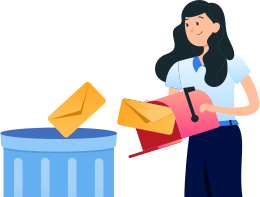
Gmail does a good job of sorting your incoming mail and moving spam to the Spam folder, but some unwanted emails still get through.
To block someone on Gmail, open a message from the sender, click More (the three vertical dots next to the Reply button), and select Block [sender's name]. Gmail will ask you to confirm — click Block, and all future messages from that address go straight to your Spam folder.
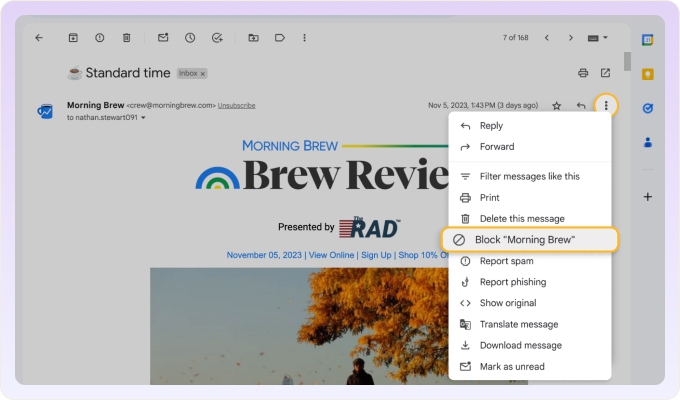
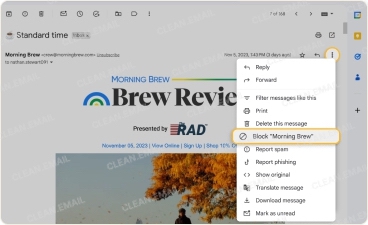
The steps are the same in the Gmail mobile app on both Android and iPhone — open the email, tap the three-dot menu, and tap Block. Note that on Android, if you use the Samsung Email app rather than Gmail, the steps are different — see the full Android guide in the table above for details.
Should you ever want to unblock the sender on Gmail, open any message from that contact, click More, and select Unblock [sender's name]. You can also go to Settings → Filters and Blocked Addresses to manage your full blocked list.
The problem with spammers is that they often keep generating new addresses, forcing you to block each one individually. Gmail lets you block an entire domain using filters — we cover that in the domain blocking section below.
Blocking an Email Address in Outlook
Outlook provides a straightforward way to stop unwanted emails. To block emails on Outlook using the web service: go to your Inbox, choose an email from the sender you want to block, click More options (three dots) on the top toolbar, click Block, then press OK to confirm.
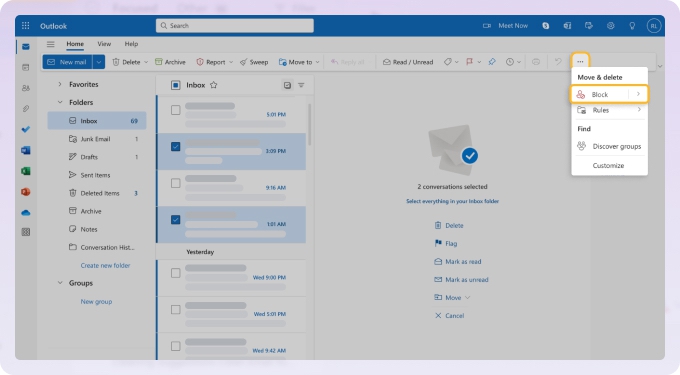
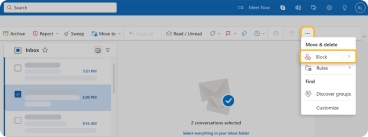
To manage your blocked senders list or to unblock someone in Outlook, click the Settings gear icon, choose Mail, and go to Junk email to add or remove senders and domains.
Outlook has a limit of 1,024 blocked addresses — if you're hitting that cap, use Outlook Rules for more reliable filtering or a tool like Clean Email that handles blocking without limits.
The Outlook mobile app also lets you block senders individually.
For Hotmail users: Hotmail is now Outlook.com, so these same steps apply.
Blocking Emails on Yahoo
Yahoo lets you block up to 500 addresses. When you block an address, all messages from it automatically move to the Spam folder.
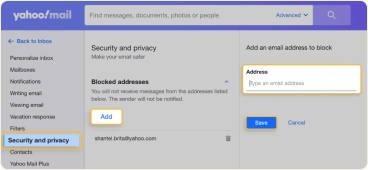
To block emails on Yahoo: hover over the Settings icon, choose More Settings, go to Security and privacy, click Add next to Blocked addresses, type the address, and click Save.
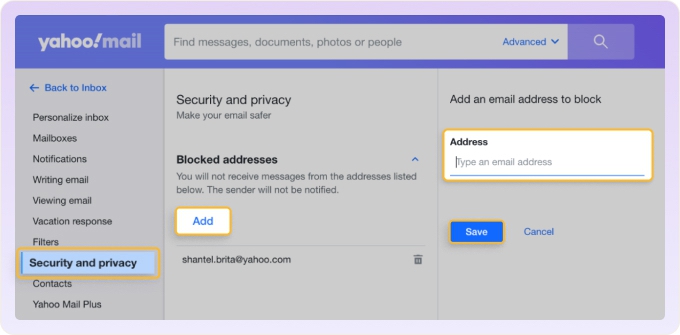
To unblock an email address on Yahoo, go back to the Blocked Addresses section and remove the sender.
💡 Note: The Yahoo mobile app doesn't have a direct block option. Instead, select the unwanted message, tap More, and choose Mark as spam. For full blocking on mobile, use the desktop site or Yahoo Mail in a browser on your phone.
Blocking an Email Address in Apple Mail
If Apple Mail is your preferred email client, you can block senders on both Mac and iPhone. The block behavior varies by method — it's worth knowing which one fits your situation.
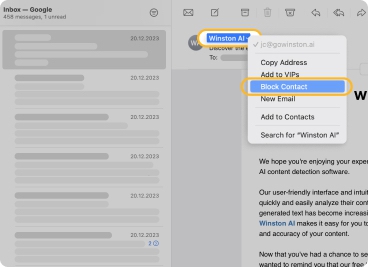
On Mac: Open the Mail app, select a message from the sender you want to block, place the mouse pointer over the sender's name in the message header, and select Block Contact. A blocked icon will appear next to that sender's name.
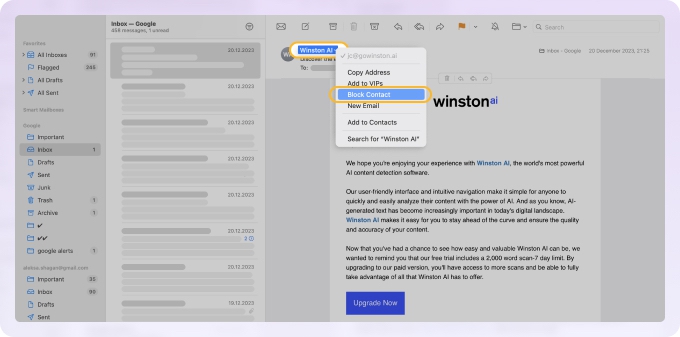
For the right-click shortcut and settings-based method, use the Block on Mac link in the table above.
On iPhone & iPad: Open the email, tap the sender's name at the top, tap it again to see their details, then choose Block this Contact. You can also long-press an email in your inbox and select Block Sender to block without opening the message.
To unblock, go to Settings → Mail → Blocked.
On iCloud.com: The web version doesn't have a one-click block button. Instead, go to Settings → Rules → Add New Rule, set "is from" to the sender's address, choose Move to Trash, and click Add. This creates a server-side rule that applies across all your Apple devices automatically.
Block Emails In All Accounts with Clean Email
If you manage more than one email account — or if standard provider blocking featutre isn't stopping everything — the Clean Email app offers capabilities that no individual email service has.
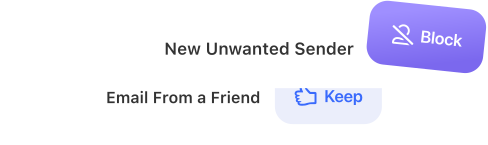
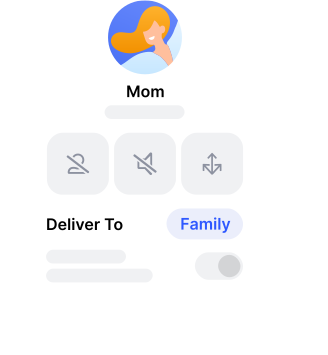
Screener: Before an email from an unknown sender reaches your inbox, Screener holds it in a separate review queue. You see who's trying to reach you, approve the contacts you want, and block the rest — future messages from blocked senders go straight to Trash.
Unlike reactive blocking (where you respond after an email arrives), Screener stops unknown senders from ever touching your inbox in the first place.
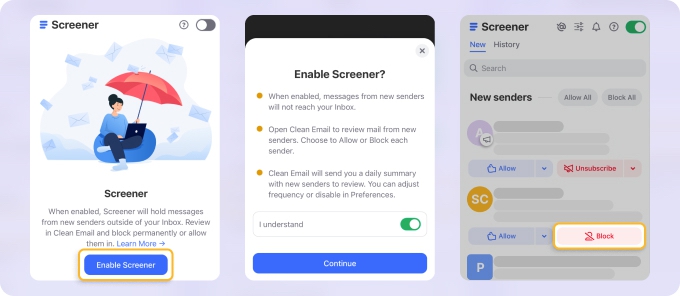
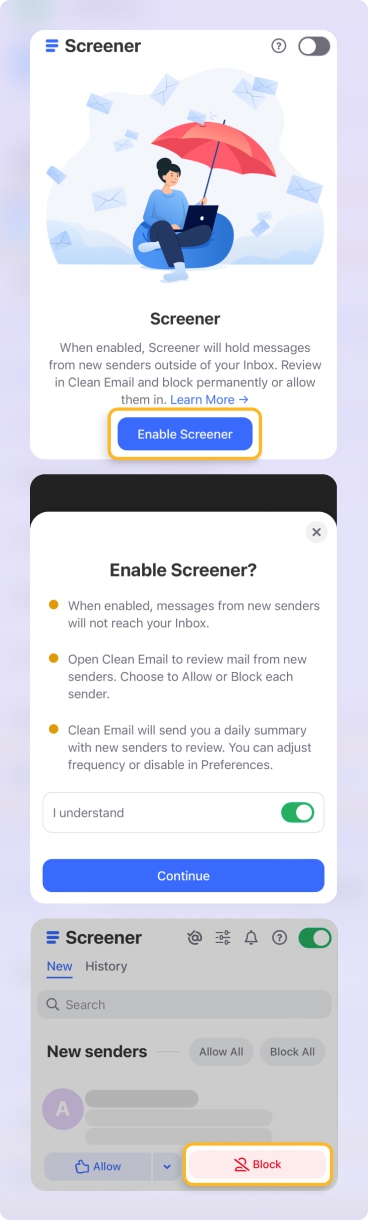
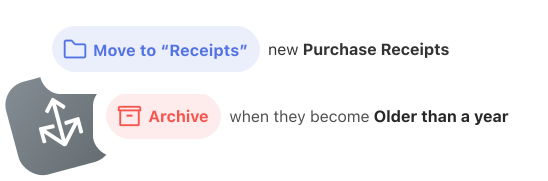
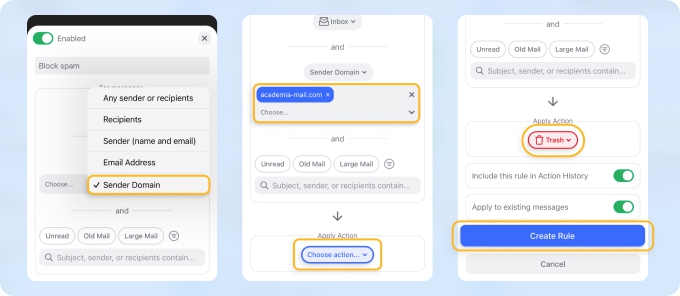
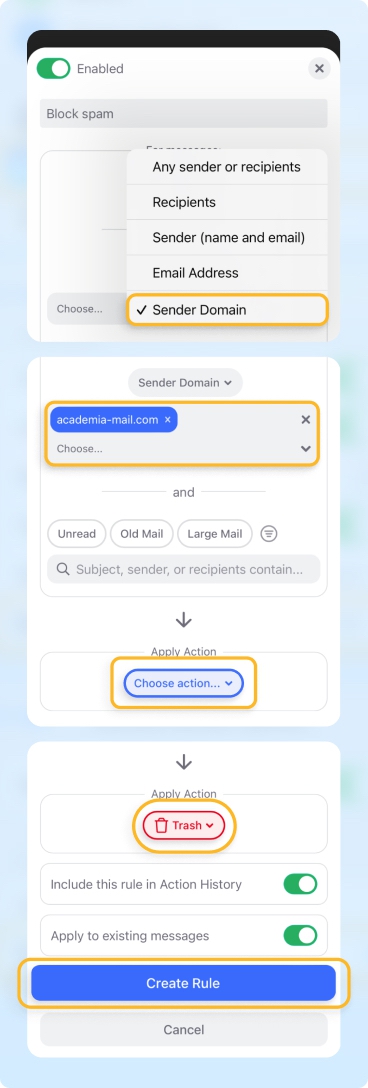
Domain blocking: Clean Email blocks the spam sender (or their entire domain) so future emails go straight to Trash. You can also add custom filters to your email rule and apply them to existing emails to clean up your inbox.
Bulk blocking via Senders: Instead of opening individual emails to block senders one at a time, the Senders view groups every sender in a single list. You can review, block, pause, unsubscribe, and more based on who emails you most often. Then, in separate tabs, you can check your blocked, unsubscribed, paused, and muted senders and manage them from there.
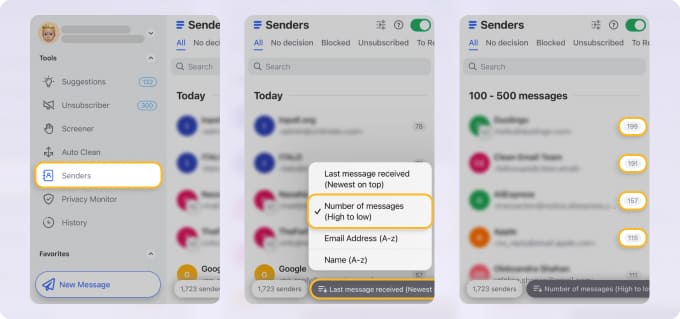
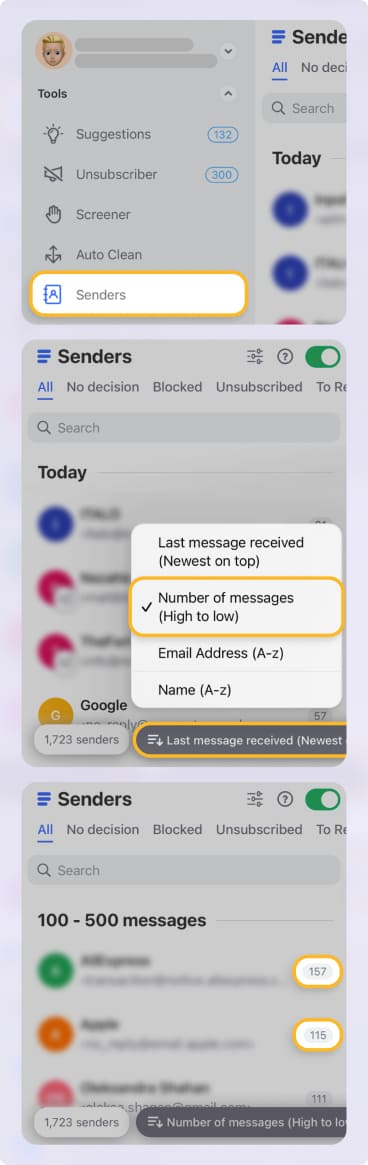
Clean Email also has no address limit — unlike Outlook (1,024 cap), Yahoo (500), or AOL (1,000 filters), there's no ceiling on what you can block.
Your information is secure with Clean Email. The app only examines email header information — subject line, sender, recipient, size, and date. The body and attachments of messages are never downloaded or accessed. Your data is encrypted and never shared.
Clean Email is available as a web app and also offers apps for iPhone, Android, and Mac.
How to Block Emails on Other Providers
In AOL
AOL automatically scans and filters incoming messages, but some spam still gets through. To block emails on AOL in a web browser: click the Settings gear icon, choose More Settings, go to Security and privacy, click Add next to Blocked addresses, type the address, and press Save.
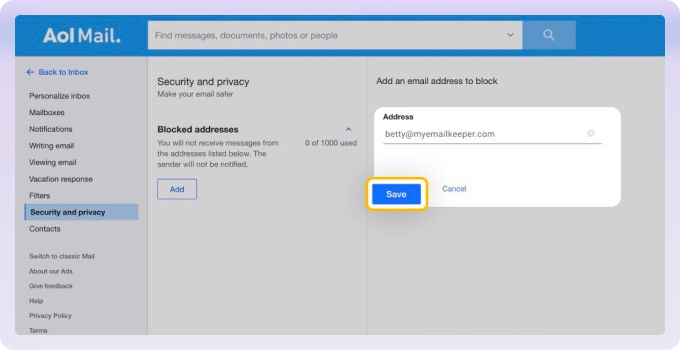
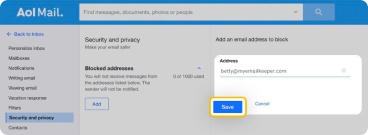
AOL lets you create up to 1,000 filters. The AOL mobile app doesn't have a built-in block feature — you can mark messages as spam instead.
In Proton Mail
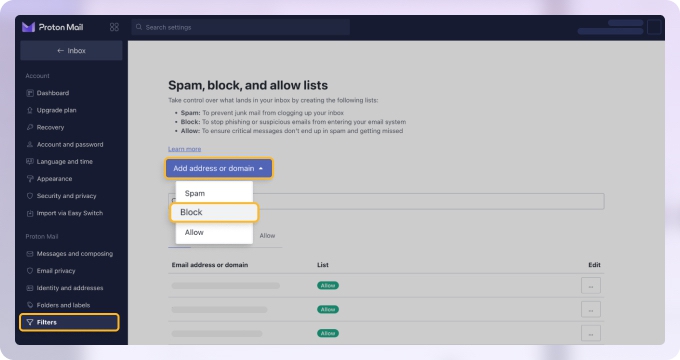
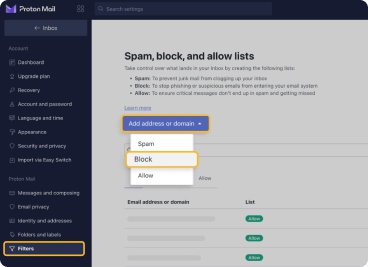
Proton Mail uses a smart spam detection system, but junk emails sometimes get through anyway. To block a sender: click the Settings gear icon → All settings → Filters → scroll to Spam, block, and allow lists → click Add address or domain → choose Block. Enter the sender's address or domain and click Add address.
In Zoho Mail
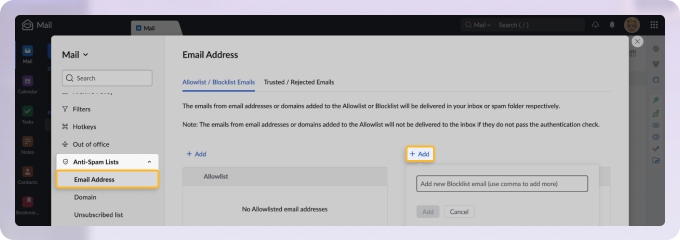
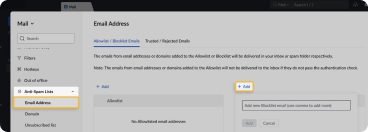
You can use Zoho Mail's anti-spam lists to block specific addresses or entire domains. Click the Settings gear icon → Anti-Spam Lists → choose Email Address or Domain → click Add above the Blocklist field, enter the address or domain, and click Add.
In GMX and Mail.com
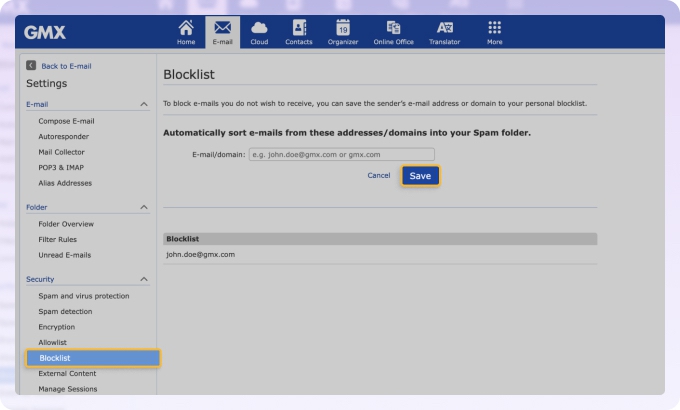
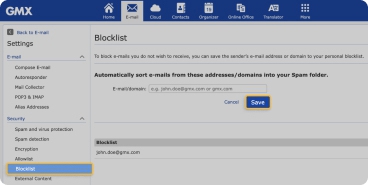
Both GMX and Mail.com use the same interface. Go to E-mail Settings → Blocklist, enter the email address or domain name, and click Save. Both support address-level and domain-level blocking.
For Thunderbird users, see: Blocking a Sender in Thunderbird guide.
How to Block an Entire Domain
Blocking a single address works for known senders, but spammers often keep randomly generating new addresses. To stop all emails from an entire domain (like @spammydomain.com), you need domain-level blocking.
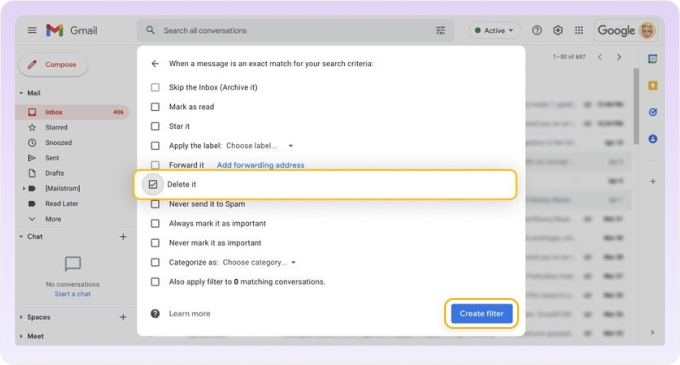
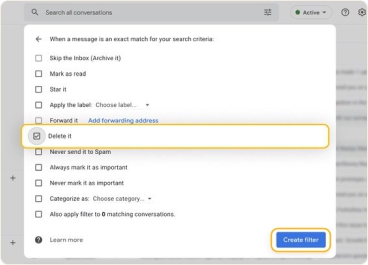
In Gmail: Click Show search options in the search bar, type the domain under From, click Create filter, select Delete it, and click Create filter. All emails from that domain will be auto-deleted.
In Outlook: Go to Settings → Mail → Junk email → Blocked senders and domains and add the domain. You can also create a Rule to auto-delete emails from that domain.
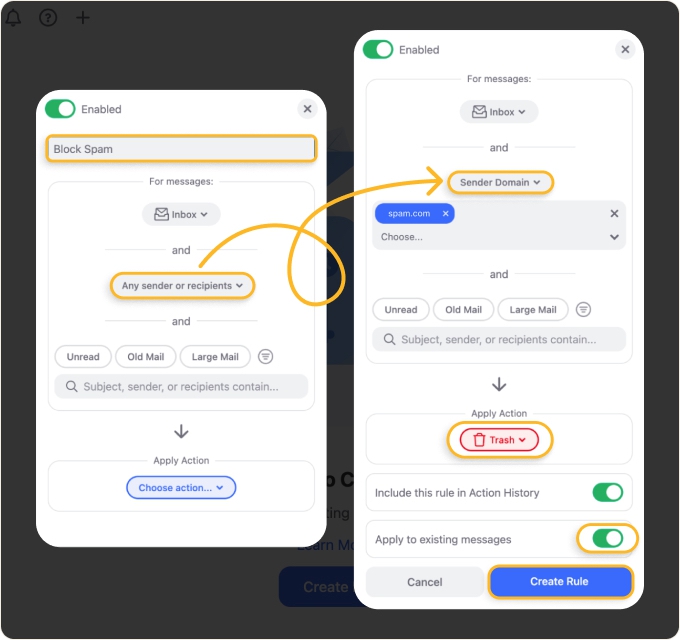
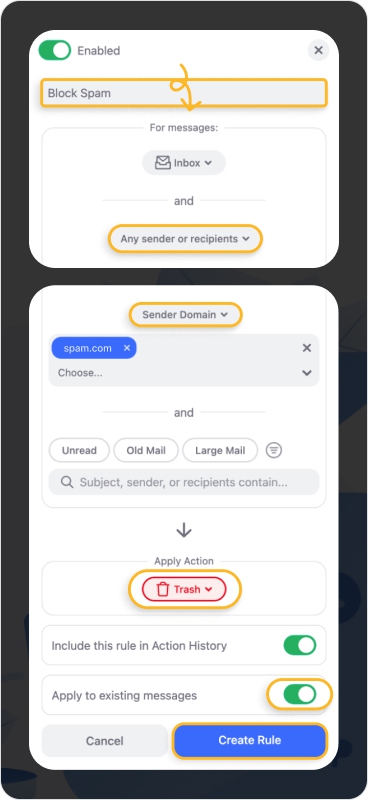
With Clean Email: Create an Auto Clean rule: choose the sender domain, set the action to Trash, and turn on Apply to existing messages. The rule runs automatically on all future emails.
If you receive emails with no visible sender address — a tactic used by some spam and automated senders — standard domain blocking won't apply. See how to block no-sender emails for options specific to that situation.
Unsubscribing vs. Blocking
Blocking and unsubscribing serve different purposes. Blocking sends future emails from a sender to your Spam or Trash folder, but it doesn't remove your address from their mailing list — the sender keeps sending, you just don't see the messages.
Unsubscribing actually removes you from the list, which makes it the better option for newsletters, marketing emails, and other subscriptions you signed up for.
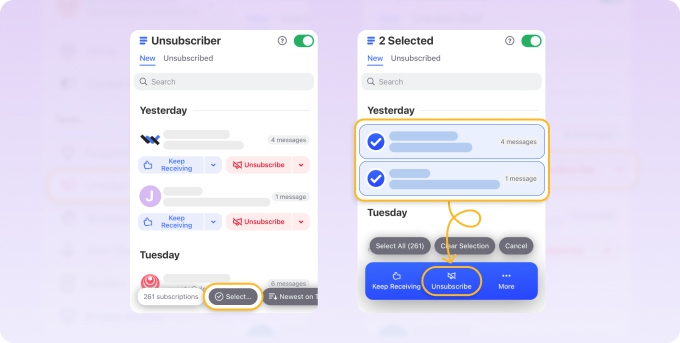
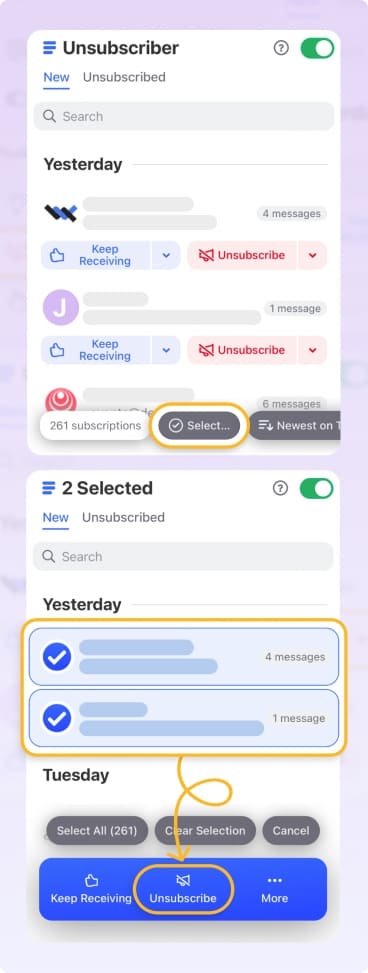
Clean Email provides an Unsubscriber feature that identifies subscription-based emails and lets you unsubscribe from emails from multiple senders in one place. Hit the Unsubscribe button, and the app follows the unsubscribe links and completes the necessary forms on your behalf.
Frequently Asked Questions
What happens when you block an email?
When you block an email address, future messages from that sender are automatically redirected to your Spam or Trash folder depending on your provider — see the table at the top of this page for a breakdown by provider. You won't receive notifications for these emails, and the sender is not notified that they've been blocked.
Where do blocked emails go?
It depends on the provider. Gmail and Yahoo route blocked mail to Spam. Outlook routes it to Junk. iCloud.com rules route blocked mail to Trash (server-side). Apple Mail's "Block Contact" on Mac marks the message and may move it to Trash depending on your settings. Most providers auto-delete Spam/Junk messages after 30 days.
Why do I still get emails from a blocked sender?
Two common causes. First, the sender may have switched to a new address — your block only applies to the exact address you targeted, not the person. Blocking their domain is the fix. Second, if you blocked the sender inside an email app (Apple Mail, Outlook desktop) rather than at the account level, the block runs on your device after the email has already been delivered by the server — so it can be bypassed if the app isn't running. For the most reliable blocking, use your provider's web interface or account-level rules (iCloud.com Rules, Gmail filters, Outlook Junk settings).
Does the person know if I blocked their email?
No. Adding a sender to your blocked list does not send them any notification. Their emails simply stop appearing in your inbox. If you want to notify them, you'd need to send them a message directly before blocking.
How do I unblock emails if I change my mind?
Go to the settings of your email provider, find your blocked senders list, and remove the address. In Gmail: Settings → Filters and Blocked Addresses. In Outlook: Settings → Mail → Junk email. In Yahoo: Settings → More Settings → Security and Privacy → Blocked addresses. In Apple Mail on iPhone: Settings → Mail → Blocked. In iCloud.com: Mail → gear icon → Settings → Rules.