Key Takeaways
- Version matters: Classic Outlook uses Home → Junk → Block Sender; Outlook.com and New Outlook use ⋯ More options → Block (or Settings → Mail → Junk email)
- Blocked messages go to Junk — the sender is not notified; each list (Blocked Senders, Safe Senders, Safe Recipients) has its at least 1,024 entries per list; some Microsoft 365 tenants appear to allow up to 10,000 entries based on recent reports
- Domain blocking is available natively in Outlook.com and New Outlook: Settings → Mail → Junk email → Blocked domains
- Block option may not appear in the Junk folder — if it doesn't show, move the email to your Inbox first, then block
- If blocking fails: check whether you've hit the 1,024-entry cap on any list, try the Settings path instead of the inbox method, or check if you're already in the Junk folder

Which Version of Outlook Do You Have?
| What you see | Your version | Jump to |
|---|---|---|
| Junk button in the Home toolbar | Classic Outlook (2013–2024 / Microsoft 365 desktop) | Classic Outlook |
| ⋯ menu with "Block" option; no Junk toolbar button | New Outlook for Windows | New Outlook |
| mail.outlook.com in your browser | Outlook.com (web) | Outlook.com |
| Outlook app on iPhone or Android | Outlook mobile | Mobile |
| Outlook app on Mac | Outlook for Mac | Mac |
| You have a @hotmail.com address | Outlook.com — Hotmail is now Outlook.com | Outlook.com |
How to Block an Email in Outlook.com
Option 1: Block Directly from the Inbox
This is the faster method and works without opening the email.
- Log in to mail.outlook.com.
- Select the message(s) from the sender you want to block.
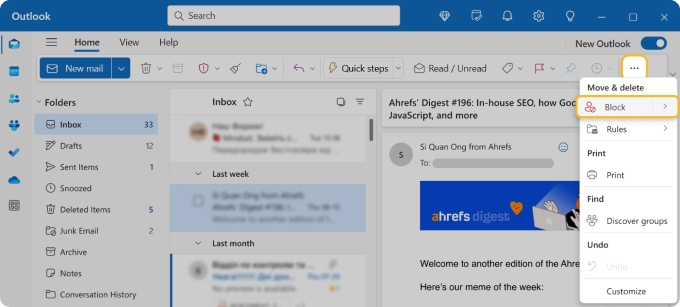
- Click ⋯ More options in the top toolbar.
- Select Block under Move & delete.
- Click OK in the confirmation popup.
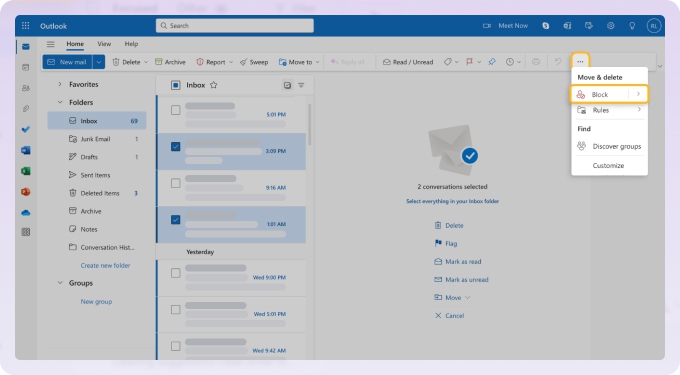
The message is deleted and all future mail from that sender goes to Junk. The sender is not notified.
Option 2: Add to Blocked Senders via Settings
Use this to add addresses manually or manage your full blocked list.
- Click the Settings gear icon at the top right.
- Go to Mail → Junk email.
- Under Blocked senders and domains, click + Add.
- Type the address or domain you want to block and press Enter to save.
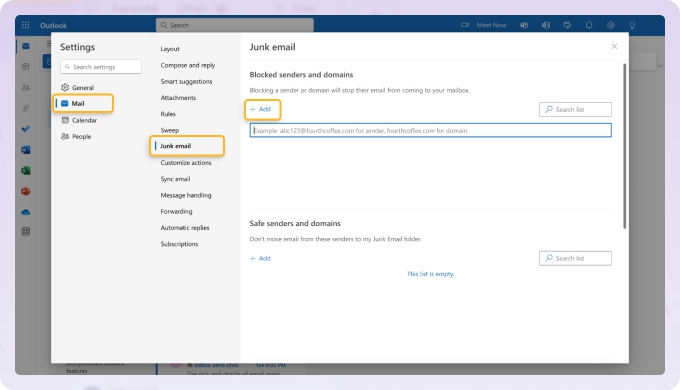
💡 Note: These instructions also apply to Hotmail accounts — Hotmail is now Outlook.com and uses the same interface.
How to Block a Sender in Classic Outlook for Windows
These steps apply to Classic Outlook across all versions: 2013, 2016, 2019, 2021, 2024, and Microsoft 365 desktop.
- Open the Outlook desktop app and select a message from the sender you want to block.
- In the Home tab toolbar, click Junk → Block Sender.
- Click OK to confirm. The message moves to your Junk folder and the address is added to your Blocked Senders list.
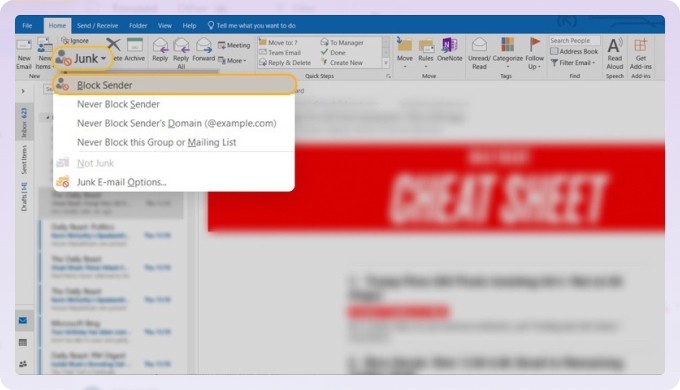
💡 Note: Classic Outlook's Junk filter must be enabled to route blocked mail correctly. Go to Junk → Junk E-mail Options and make sure the filter level is not set to No Automatic Filtering.
How to Block a Sender in New Outlook for Windows
New Outlook uses a nearly identical interface to Outlook.com. You have two options:
From a message:
- Open the email from the sender you want to block.
- Click ⋯ More actions in the top right of the email.
- Select Block Sender and click OK to confirm.
Via Settings (to add addresses manually or block a domain):
- Go to Settings → Mail → Junk email.
- Under Blocked senders and domains, click Add, enter the address or domain, and click Save.
How to Block Emails on Outlook for Mac
- Open the Outlook app on your Mac.
- Select the email from the sender.
- Click the three dots icon (See more items) in the toolbar.
- Click Block from the dropdown menu.
- Confirm by clicking OK.
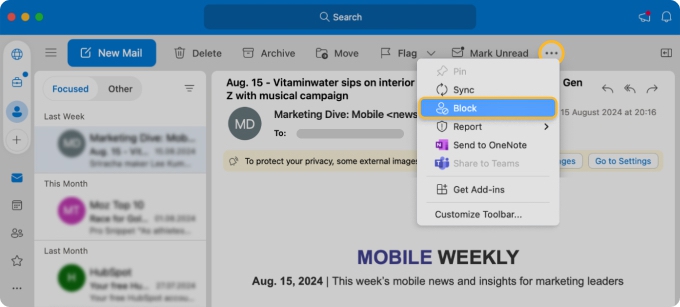
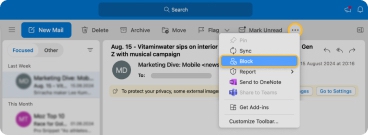
Blocked messages go to your Junk folder. For more Outlook blocking and filtering options on Mac, see how to block emails on Mac.
💡 Note: Block/Unblock in Outlook for Mac only works for Exchange-based accounts such as Outlook.com or work accounts; for other accounts, use junk preferences or server-side rules instead.
How to Block Someone on Outlook Mobile
- Open the Outlook mobile app and open a message from the sender you want to block.
- Tap the ⋯ three dots in the top right corner.
- Tap Report junk (or Report message on some versions) — a choice screen appears.
- Choose Block sender and confirm by tapping Block sender again.
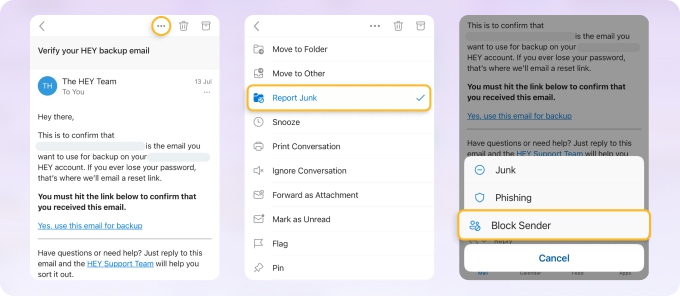
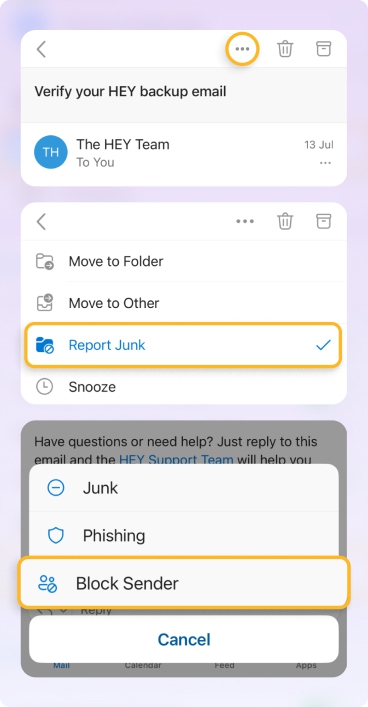
To unblock later, find the message in your Junk folder — the option to unblock is available there.
⚠️ Note: If you suspect the message is spam, avoid opening it before blocking — opening a spam email can signal to the sender that your address is active.
How to Block an Entire Domain in Outlook
Blocking by domain stops all emails from any address at that domain (e.g., every message from @example.com), which is more effective than blocking individual addresses when spammers rotate senders.
In Outlook.com and New Outlook for Windows:
- Go to Settings → Mail → Junk email.
- Under Blocked senders and domains, click + Add.
- Enter the domain name (e.g., example.com) and press Enter to save.
In Classic Outlook: There is no dedicated one-click domain-block button in the toolbar, but you can block entire domains via Junk → Junk E-mail Options → Blocked Senders tab — enter the domain name (e.g., example.com) there.
Each list (Blocked Senders, Safe Senders, Safe Recipients) has its own 1,024-entry cap — some Microsoft 365 tenants allow up to 10,000. If you need to block more than Outlook allows, see the Clean Email section below.
Block Entire Domains Without the 1,024 Limit
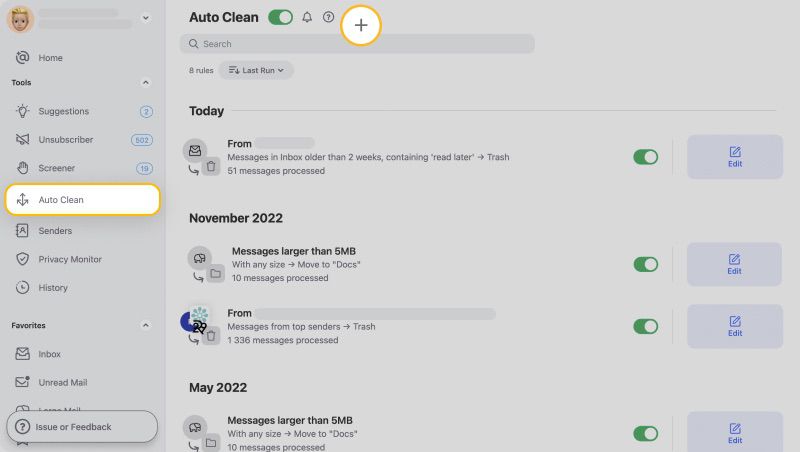
When spammers keep reaching you from new addresses under the same domain, or when you've hit the 1,024 cap, Clean Email's Auto Clean lets you block an entire domain with a single rule — with no address cap and no limit on the number of domains.
- Go to app.clean.email and sign in with your Outlook account.
- Select Auto Clean from the left panel, then click the ✚ icon.
- Name your rule, choose Any sender or recipients → Sender Domain, type the domain, and select it.
- Set the action to Move to Trash, toggle on Apply to existing messages if needed, and click Create Rule.
All future emails from that domain go to Trash automatically. Clean Email is available for iOS, Android, Mac, and web.
💡 Note: Outlook offers both an email service (using an @outlook.com address) and an email client that can link with providers like Gmail, Yahoo, AOL, and others. Actions taken in Clean Email apply only to the Outlook service provider, and not to any other email accounts linked with the Outlook email client. You should add each email account you have to Clean Email separately.
Troubleshooting: Why Isn't My Block Working?
"Couldn't block sender — try again later" error. This is a known intermittent Outlook bug. The workaround is to use the Settings path (Settings → Mail → Junk email → +Add) instead of the inbox method.
The Block option isn't appearing. Check which Outlook version you're using. If you see a Junk button in the Home toolbar, you're in Classic Outlook — the ⋯ menu won't have a Block option there. If neither appears, you may be viewing the email from inside the Junk folder — move it to your Inbox first.
You're viewing the email from the Junk folder. The block option may not appear for messages already in Junk. Move the message to your Inbox, then block the sender.
The 1,024-entry cap on a list is reached. New blocks silently fail once a list is full. Go to Settings → Mail → Junk email (Outlook.com / New Outlook) or Junk E-mail Options (Classic Outlook) and remove stale entries from the Blocked Senders list.
Blocked sender is still getting through. The sender likely switched to a new address. Blocking targets the exact address — if they're rotating, use domain blocking instead (or use the Clean Email rule below for domain blocking).
Classic Outlook junk filter is set to "No Automatic Filtering". Blocked senders won't be caught if the filter is disabled. Go to Junk → Junk E-mail Options and set it to at least Low.
Conclusion
For most senders, Outlook's built-in block handles the job in a few clicks — just pick the right method for your version. When spammers rotate addresses or you've hit the 1,024 cap, domain-level blocking is the more durable fix. To unblock a sender you've previously blocked, see the full guide on how to unblock senders in Outlook.
Frequently Asked Questions
Does blocking work the same in Classic Outlook and New Outlook?
No — the two versions use different interfaces. Classic Outlook (2013–2024 and Microsoft 365 desktop) has a Junk button in the Home toolbar; select an email and click Junk → Block Sender. New Outlook for Windows (and Outlook.com) removed this button — instead use ⋯ More actions → Block Sender, or add the address via Settings → Mail → Junk email. If you're following steps from another guide and the button isn't where they say, you're likely on a different version.
Why isn't my Outlook block working?
The most common causes: you're trying to block from inside the Junk folder (move the email to Inbox first), you've hit the 1,024-entry cap on the Blocked Senders list (check Settings → Junk email and delete old entries), or you're hitting the intermittent "Couldn't block sender" bug (use the Settings path instead of the inbox method). If blocked emails keep arriving, the sender has probably switched to a new address — switch to domain blocking.
How many email addresses can I block in Outlook?
Outlook applies a 1,024-entry cap per list — Blocked Senders, Safe Senders, and Safe Recipients each have their own separate limit. Some Microsoft 365 tenants may allow up to 10,000 entries. When you hit the cap on any list, new additions to that list fail silently. To free up space, remove old entries from Settings → Mail → Junk email (Outlook.com / New Outlook) or from Junk → Junk E-mail Options → Blocked Senders (Classic Outlook).
How do I find my blocked senders list in Outlook?
In Outlook.com and New Outlook: Settings → Mail → Junk email → Blocked senders and domains. In Classic Outlook: Junk → Junk E-mail Options → Blocked Senders tab. In the mobile app, there's no built-in view — use the web interface.
How do I block emails on Outlook Mobile?
Open the email, tap ⋯ in the top right, tap Report junk (or Report message) — a choice screen appears — then choose Block sender and confirm. If you want to block by domain or manage your blocked list on mobile, open Outlook.com in your phone's browser and use the Settings path.