Key Takeaways
- Two main tools: Xfinity's built-in spam filter (catches obvious spam automatically) and Filter Rules (lets you block specific senders or domains)
- Critical limitation: your custom filter rules only apply to mail delivered to your Inbox — if Xfinity's spam filter catches a message first and sends it to the Spam folder, your rules never fire
- Domain blocking is possible via filter rules: set the condition to "From contains @domain.com" to catch any address from that domain
- Mobile app: the Xfinity mobile app does not support filter rules — use a browser on your phone and log in to connect.xfinity.com instead
- Yahoo migration: if Xfinity has moved your account to Yahoo Mail, these steps no longer apply — use Yahoo's block and filter tools instead

How to Enable Xfinity's Built-In Spam Filter
This is the first thing to check. If spam filtering isn't enabled, all mail goes straight to your Inbox regardless of how suspicious it looks.
- Log in to connect.xfinity.com in a browser.
- Click the gear icon in the top-right corner and select Email Settings.
- In the left menu, click Mail, then Advanced Settings.
- Select Automatically move spam and potentially harmful messages to the Spam folder.
- Optionally, check Save a copy of emails marked as spam if you want to review caught messages before they're deleted.
Spam caught by this filter is automatically deleted after seven days. To check for false positives, open your Spam folder periodically and click Not Spam on any legitimate messages.
💡 Note: Enabling spam filtering means Xfinity's server-side filters run first. Any message they classify as spam goes directly to the Spam folder and is not processed by your custom filter rules. See Why Your Filters Might Not Be Working below for how to handle this.
How to Block a Specific Sender with Filter Rules
Filter rules let you target individual senders and decide exactly what happens to their mail: move it to Spam, discard it silently, or redirect it elsewhere.
- Log in to connect.xfinity.com.
- Click the gear icon → Email Settings.
- From the left menu, select Mail → Filter Rules.
- Click Add new rule and give the rule a name.
- Click Add condition, choose From, then Contains, and type the sender's email address.
- Click Add action and choose what to do with matching mail — Discard (silently delete) or Move to folder → Spam.
- Click Save.
To block multiple senders, create a separate rule for each address. You can also stack multiple conditions inside a single rule — any message matching any of the conditions will trigger the action.
⚠️ Note: Filter rules only process mail delivered to your Inbox. If Xfinity's spam filter catches a message first (which is likely for obvious spam), the message goes to the Spam folder and your filter rule never fires. If you want your rules to catch everything, see the workaround in the troubleshooting section below.
⚠️ Reported issue: Some users say their filter rules occasionally disappear from their account without warning. Because this has been reported over time, it's smart to screenshot or note your rules so you can recreate them if needed.
How to Block an Entire Domain
When a spammer keeps switching to new addresses at the same domain, blocking individual senders one by one won't help. Use a domain-level filter rule instead.
- Follow the same steps as above to create a new filter rule.
- For the condition, choose From → Contains, and type just the domain with the @ symbol — for example, @spammydomain.com.
- Set the action to Discard or Move to Spam.
- Save the rule.
Any message from any address at that domain will now match the rule. You can create separate rules for as many domains as needed — for example, a rule for @hotmail.com and another for @outlook.com if you're getting a lot of spoofed mail from those domains.
How to Use the Safe List (Allow-Only Mode)
The Safe List is the most aggressive option: only email addresses you explicitly approve can reach your Inbox. Everything else is blocked entirely.
- Click the gear icon → Email Settings → Mail → Advanced Settings.
- Click Use Email Safe List.
- Add every address or domain you want to allow.
⚠️ This setting is extremely strict. Anyone not on your Safe List will be blocked completely — their messages won't even reach your Spam folder, so you won't know you missed something. Only use this if you're being overwhelmed by spam and are confident you can maintain the list. It's easy to accidentally block someone important.
Safer Alternative: Use Screener Instead of a Strict Safe List
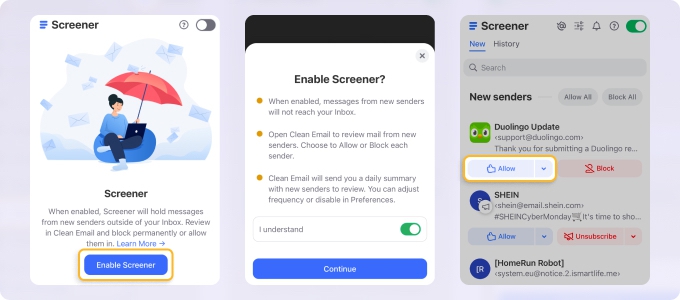
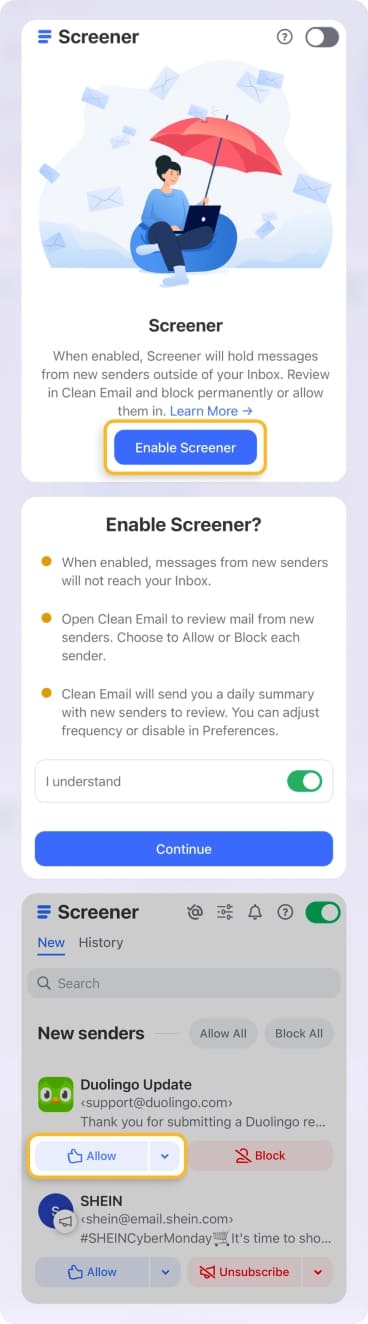
If you like the idea of approving senders but don’t want to risk missing important emails, Clean Email’s Screener is a safer alternative. Instead of blocking every unknown sender completely, Screener holds messages from new senders for your review. You can then choose to allow trusted senders or block unwanted ones before they continue reaching your inbox.
This works better for most users than Xfinity’s Safe List because new emails are not silently rejected. You still get control over who reaches your inbox, but with a chance to review unknown senders first.
How to Report Spam to Improve Xfinity's Filters
Every time you mark a message as spam, you're contributing to Xfinity's spam detection system. Over time this helps Xfinity catch similar messages automatically — for you and other customers.
To report spam in the webmail interface: select the message and click the Spam button in the toolbar.
To report spam that slipped through the filter: forward the message as an attachment to missed-spam@comcast.net. This goes directly to Xfinity's security team and is more effective than just marking as Spam.
To report spam originating from within the Comcast network: copy the full message headers, paste them along with the message into a new email, and send to abuse@comcast.net.
💡 Note: Reporting spam doesn't instantly stop that sender — it trains the system. If the same address is spamming you repeatedly, also set up a filter rule to discard or block it directly.
Why Your Xfinity Filters Might Not Be Working
This is the most common complaint among Xfinity email users. Here's what's actually happening and what to do about it.
Your custom rules don't apply to Spam folder messages.
Xfinity runs its own spam detection before your rules. Messages it classifies as spam go straight to the Spam folder, bypassing your filter rules entirely. Your rules only apply to messages that land in your Inbox. This is why a rule that says "discard mail from spammer@example.com" seems to do nothing — the message is already in Spam before your rule has a chance to act.
Forcing all mail through your rules.
If you want your custom rules to process all incoming mail, you can force everything to arrive in your Inbox first:
- Go to Settings → Email Settings → Mail → Advanced Settings.
- Review the spam and security options and, if available in your account, choose the setting that bypasses or relaxes automatic spam filtering so more mail reaches your Inbox, where your filter rules can apply.
The trade-off: you're now responsible for catching all spam yourself through your own rules. This works well for users who have comprehensive rules set up, but it's not recommended as a first step — you'll likely see more spam in your Inbox initially.
Spam filter stopped working suddenly.
If you've had a sudden increase in spam reaching your Inbox after previously good filtering, try toggling the spam filter off and back on: go to Advanced Settings, temporarily turn off automatic spam filtering if that option is available, save, then turn "Automatically move spam and potentially harmful messages to the Spam folder" back on and save again. Some users report this resets the filter behavior.
Your filter rules disappeared.
This is a reported Xfinity issue — some users say rules sometimes vanish from their accounts. Check your Filter Rules list regularly and recreate any missing ones.
Marking as Spam isn't stopping the sender.
Marking spam trains the filter but doesn't guarantee the same sender is immediately blocked. Create a manual filter rule to discard or move their mail while the system learns.
Yes - this is the best placement. I’d extend Blocking on Mobile and make Clean Email the first option because it directly solves the mobile limitation.
Use this version:
Blocking on Mobile
The Xfinity mobile app does not support creating or managing filter rules. This means you can read emails in the app, but you can’t easily create sender blocks, domain rules, or advanced spam filters from there.
Option 1: Use Clean Email on Mobile
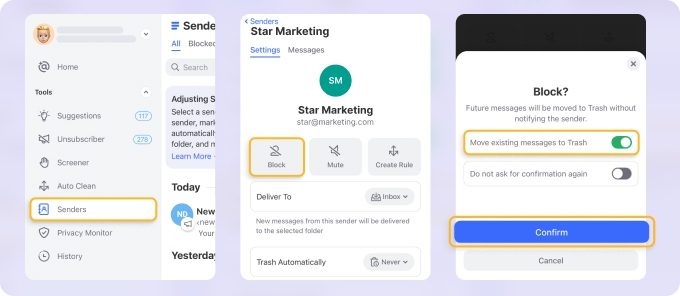
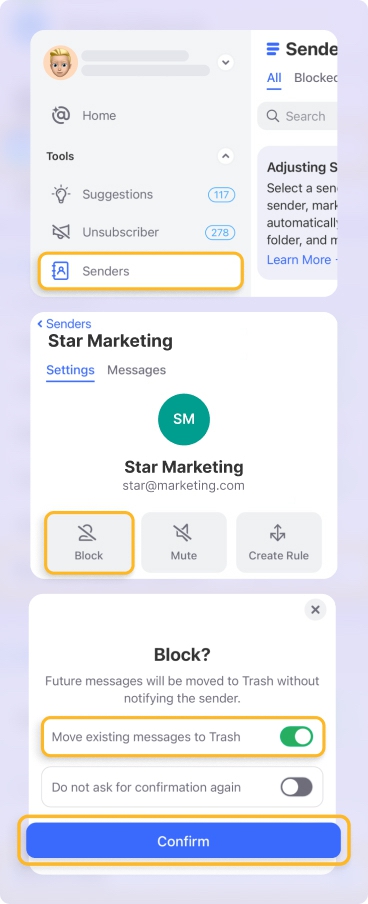
If you want to manage unwanted Xfinity emails directly from your phone, Clean Email is the easier option. Its iOS and Android apps let you block unwanted senders, clean up existing messages, and create Auto Clean rules without opening Xfinity’s desktop-style webmail settings in a browser.
Option 2: Use Xfinity Webmail in a Mobile Browser
For any spam filter or blocking task inside Xfinity itself, use a browser on your phone or tablet:
- Open Safari (iPhone) or Chrome (Android).
- Go to connect.xfinity.com and sign in.
- Go to Settings → Email Settings → Mail → Filter Rules or Spam settings.
- Create or update your blocking rule.
All the Xfinity steps in this guide work in the mobile browser the same way they do on desktop, but the process is less convenient than using a dedicated mobile app.
After Migrating to Yahoo Mail
If Xfinity has moved your comcast.net account to Yahoo Mail, none of the steps in this guide apply anymore — your inbox is now fully managed through Yahoo's interface and filters.
Here's what changes:
- Your Xfinity filter rules don't transfer. Any rules you set up in Xfinity Connect are not carried over to Yahoo Mail. You'll need to recreate blocking rules from scratch in Yahoo.
- Spam settings reset. Yahoo's spam filter starts fresh — it won't have learned from your previous Xfinity spam reports, so you may see a temporary increase in junk mail while Yahoo's system catches up.
- Blocking a sender works differently. In Yahoo Mail, open the email, click the three-dot menu (⋯) in the top-right corner of the message, and select Block senders. Confirm to add the address to your blocked list. You can also block via Settings → Security and Privacy → Blocked addresses.
- Domain blocking in Yahoo is done the same way — block one address from a domain, or add a filter rule in Yahoo's filter settings that matches "From contains @domain.com."
Conclusion
For most users, enabling Xfinity's built-in spam filter and creating a few targeted filter rules covers the majority of unwanted mail. When spammers rotate addresses, switch to domain-level rules. If you hit the limits of Xfinity's system — disappearing rules, server-side filtering conflicts, or persistent spam — forwarding missed messages to missed-spam@comcast.net and using browser-based webmail on mobile will get you further than the app alone.
If you've recently received an invitation to move your inbox to Yahoo Mail, review your filter setup after migration — Yahoo's spam tools work differently and your existing Xfinity rules won't transfer.
Frequently Asked Questions
How do I block a sender in Xfinity email?
Go to connect.xfinity.com, click the gear icon → Email Settings → Mail → Filter Rules → Add new rule. Set the condition to "From contains [sender's address]" and the action to "Move to Spam" or "Discard." Save the rule. The sender's future messages will be filtered before they reach your Inbox.
Why are my Xfinity spam filters not working?
The most common reason: Xfinity's own spam detection sends messages to your Spam folder before your custom filter rules run — rules only apply to messages arriving in your Inbox. To force all mail through your rules, go to Advanced Settings and look for an option to relax or bypass automatic spam filtering. Also check that your filter rules haven't disappeared (a reported Xfinity issue — some users say rules sometimes vanish from their accounts) by visiting Mail → Filter Rules.
Can I block an entire domain in Xfinity email?
Yes. Create a filter rule with the condition "From contains @domain.com" (for example, @spammydomain.com) and set the action to Discard or Move to Spam. This catches any address from that domain. Create a separate rule for each domain you want to block.
Why do my Xfinity filter rules keep disappearing?
This is a reported, unresolved issue in Xfinity email — some users say rules periodically vanish from their accounts. The only workaround is to check your rules periodically and recreate any that are missing. Screenshot or write down your rules so you can restore them quickly.
Can I block emails from the Xfinity mobile app?
The Xfinity mobile app doesn't support filter rules or advanced spam settings. To manage blocking on a phone, open your mobile browser (Safari or Chrome), go to connect.xfinity.com, and use the full webmail interface — all the filter and spam settings are available there.
What is the Xfinity Safe List and should I use it?
The Safe List is an allow-only mode: only addresses you add to the list can reach your Inbox — everyone else is blocked completely. It's very effective against spam but also blocks legitimate mail from anyone not on your list. Use it only if you're being overwhelmed and are willing to actively maintain the list.
Xfinity is moving my email to Yahoo — what happens to my spam settings?
Your current filter rules and spam settings will not transfer to Yahoo Mail. After migration, you'll need to set up blocking and spam rules from scratch in Yahoo. Yahoo has its own block sender flow and spam filter settings. See our guide on how to block emails on Yahoo.
How do I report spam to Comcast?
In the webmail interface, select the message and click Spam in the toolbar. For spam that slipped through the filter, forward the message as an attachment to missed-spam@comcast.net. For spam sent from within the Comcast network, forward it to abuse@comcast.net.
Is it better to use "Discard" or "Move to Spam" in a filter rule?
Discard silently deletes the message without any trace. Move to Spam sends it to your Spam folder where you can review it. If you're confident about a sender being spam, Discard is cleaner. If you want to double-check that the rule is working correctly before committing, Move to Spam lets you verify before switching to Discard.