How to Block a Specific Sender in Thunderbird
The quickest way is to create a message filter directly from a message in your inbox:
- Open Mozilla Thunderbird.
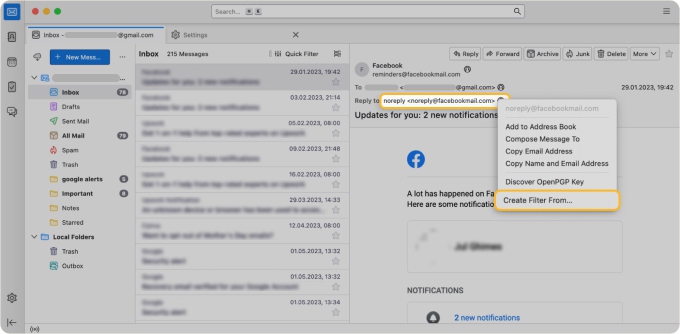
- In your inbox, open a message from the sender you want to block.
- Right-click the sender’s email address and select Create Filter From… in the menu that appears.
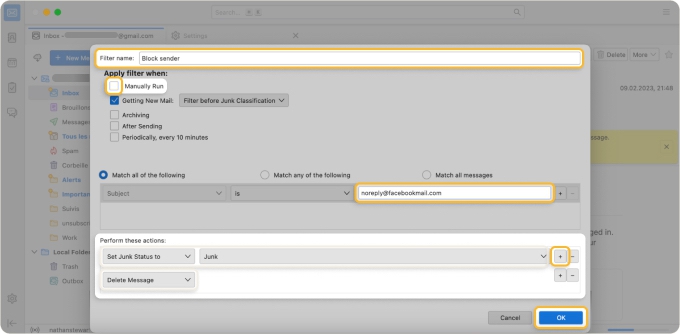
- In the Filter Rules window, the sender’s address is already filled in. Give your filter a name.
- Under Perform these actions, click the dropdown and choose one of the following:
- Set Junk Status to → Junk — moves the message to your Junk/Spam folder. You can still review it there.
- Delete Message — sends the message straight to Trash. More aggressive, and can’t be undone unless you check Trash.
- You can click the ✚ button to add both actions to the same filter.
- Make sure Getting New Mail is enabled under Apply filter when so the filter runs on new messages; you can leave Manually run enabled if you also want to run it on existing mail.
- Click OK to save.
💡 Tip: You don’t need a separate filter for every sender you want to block. Edit an existing filter via Tools → Message Filters → Edit, then add more From conditions connected with OR logic. This keeps your filter list manageable.
⚠️ Important: Message filters in Thunderbird are per-account. If you have multiple email accounts in Thunderbird, you’ll need to create the filter separately for each account where you want it to apply.

How to Block an Entire Email Domain in Thunderbird
If a spammer keeps changing their sending address but always emails from the same domain — for example, anything @spammydomain.com — blocking the whole domain is far more effective than targeting individual addresses.
- Go to Tools → Message Filters.
- Click New to create a new filter.
- Give the filter a name (e.g., “Block spammydomain”).
- Set the filter condition:
- First dropdown: From
- Second dropdown: ends with
- Text field: @spammydomain.com (include the @ symbol)
- Under Perform these actions, select Delete Message (or Set Junk Status to Junk).
- Click OK to save.
Every message from any sender at that domain will now be filtered automatically.
Blocking multiple domains in one filter: Click the ✚ button next to the first condition to add a second domain, then set the top-level match dropdown to Match any of the following. This keeps things tidy rather than creating a separate filter per domain.
Blocking a TLD extension: You can set the condition to “From ends with .ru” (or any TLD) to block all senders from that extension. Use with caution — this is a broad setting that will also catch legitimate senders from that TLD.
How to Use Thunderbird’s Junk and Spam Controls
Alongside manual message filters, Thunderbird has a built-in adaptive spam filter that uses a Bayesian algorithm to learn what’s legitimate and what isn’t — based on your own behavior. This is a separate system from message filters and worth setting up in tandem.
📌 Note for Thunderbird v145 and later: Thunderbird renamed “Junk” to “Spam” starting in version 145. If you’re on an older version, you’ll see “Junk” throughout; in v145+, it appears as “Spam.” The underlying feature is identical.
Check out our detailed Thunderbird email client review.
Training the Adaptive Filter
The filter only works well once trained. Here’s how:
- When a spam email arrives, select it and press J (or click the Junk/Spam button in the toolbar). This marks it and teaches the filter.
- When a legitimate email lands in your Junk/Spam folder, open it and click Not Junk / Not Spam. This is equally important — training on what’s legitimate prevents false positives.
Training both sides (spam and not-spam) is what makes the filter effective. Training only one side significantly limits its accuracy.
Configuring Junk Settings
- Go to Menu (≡) → Account Settings → [your email account] → Junk Settings.
- Check Enable adaptive junk mail controls for this account (on by default).
- Under Do not automatically mark mail as junk if the sender is in, select Personal Address Book. This whitelists your contacts so they’re never flagged as spam.
- Optionally, enable Move new junk messages to to automatically route detected spam to a specific folder.
Blocking all unknown senders (advanced): You can create a message filter that deletes any email where the sender is not in your address book. Go to Tools → Message Filters → New, set the condition to Sender is not in Address Book → Personal Address Book, and the action to Delete Message. This is aggressive — use it only if you receive email almost exclusively from known contacts.
Managing and Editing Your Block Filters
To review, edit, reorder, or remove your existing filters:
- Go to Tools → Message Filters.
- Use the Filters for dropdown to select the account whose filters you want to manage.
- Select any filter and use Edit, Delete, Move Up, or Move Down.
Thunderbird executes filters top to bottom. If an earlier filter has a Stop action, all filters below it are skipped. If your blocks aren’t behaving as expected, check the order and look for any Stop actions in other filters.
For a full walkthrough of Thunderbird’s filter system — including running filters on existing messages, copying rules, and advanced conditions — see: How to Set Up Rules in Mozilla Thunderbird.
Why Blocking in Thunderbird Has Limits
Before relying on Thunderbird’s filters alone, it’s worth understanding what they can and can’t do.
Filters only run when Thunderbird is open. Message filters are client-side — they process mail inside the application. If Thunderbird is closed when an email arrives, the filter doesn’t execute until you next open the app and it syncs. Emails sit in your inbox in the meantime.
Filters are per account. Each email account has its own separate filter list. A filter created for one account won’t apply to any other account in the same Thunderbird window.
Blocking doesn’t prevent delivery. Thunderbird filters are not server-side rules. The email is delivered by your mail server and then sorted or deleted by Thunderbird after arrival. The sender receives no bounce or rejection notice.
Spammers rotate addresses. A per-address filter only blocks the exact address you targeted. Many spammers rotate addresses slightly (e.g., info1@spam.com, info2@spam.com), bypassing your filter immediately. Domain-level blocking is more durable for this reason.
What to do when filtering isn’t enough:
- Use your email provider’s server-side spam controls via webmail — these filter before delivery, which Thunderbird can’t do.
- Report persistent spam to your provider so their filters improve for everyone.
- For multi-account management without keeping Thunderbird open, see the Clean Email section below.
Troubleshooting: Filters Not Working
If your block filters aren’t catching messages they should, diagnose with these steps:
- Check the Filter Log. Go to Tools → Message Filters → Filter Log. This shows which filters ran, when, and what they matched. Look for errors or unexpected behavior.
- Check the account assignment. Use the Filters for dropdown to confirm the filter is set up under the correct account — not a different one.
- Check the filter order. An earlier filter with a Stop Execution action prevents all filters below it from running. Reorder if needed.
- Test with Run Now. In Tools → Message Filters, select the filter and click Run Now to apply it manually to existing inbox messages. If it works manually but not automatically, check whether Manually run is accidentally checked in filter settings.
- Make sure Thunderbird is running. Filters don’t execute if the client is closed. For always-on filtering, use server-side rules via your provider’s webmail.
Block Unwanted Emails in Thunderbird with Clean Email
Thunderbird filters can help block unwanted emails, but they often take time to set up - especially when spam comes from multiple addresses or entire domains. Clean Email gives Thunderbird users a faster way to block senders, stop new spam, and keep the inbox organized across desktop and mobile.
With Clean Email, Thunderbird users can:
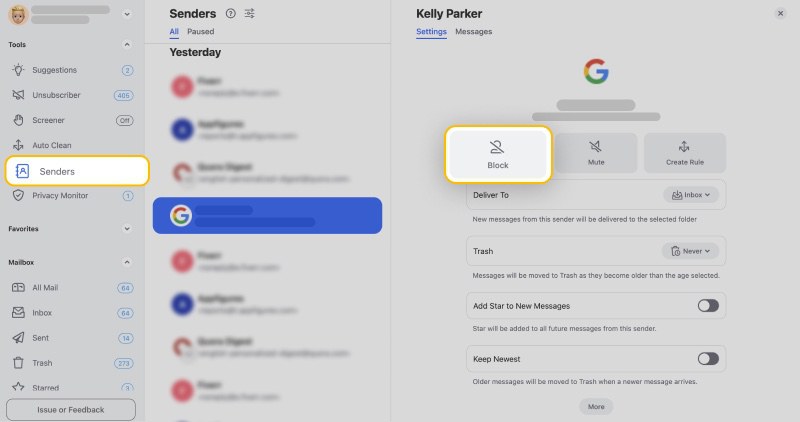
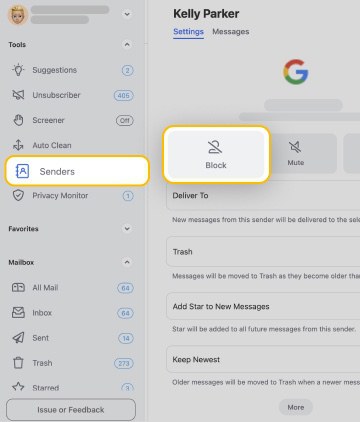
- Block unwanted senders quickly from the Senders page, so future messages go straight to Trash.
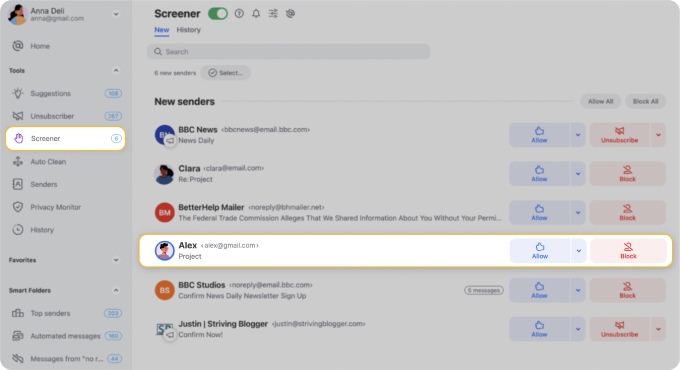
- Stop emails from unknown senders with Screener, which holds messages from new contacts until you approve or block them.
- Block entire domains with Auto Clean rules - useful when spam comes from many addresses under the same domain.
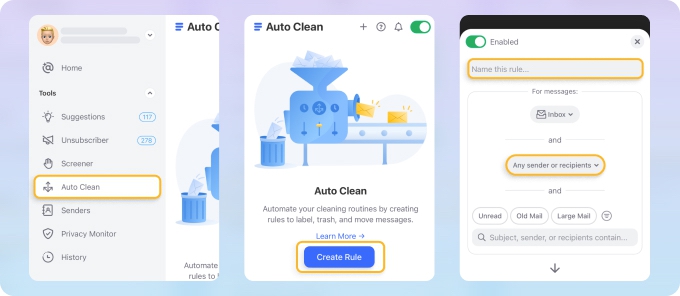
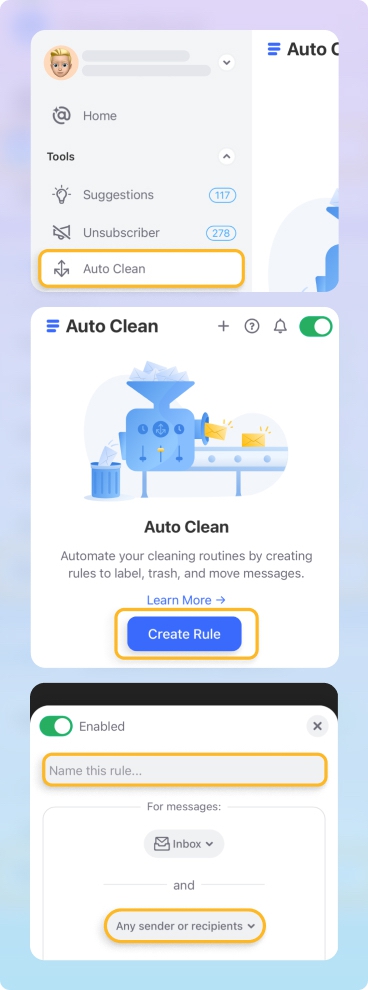
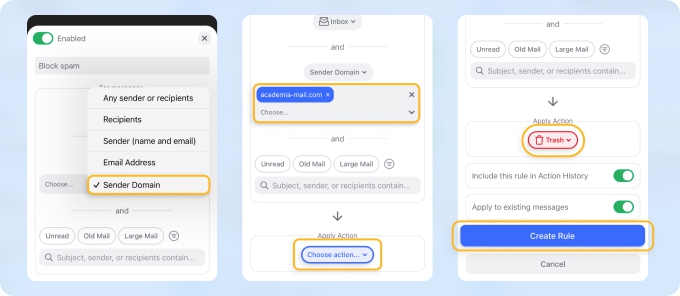
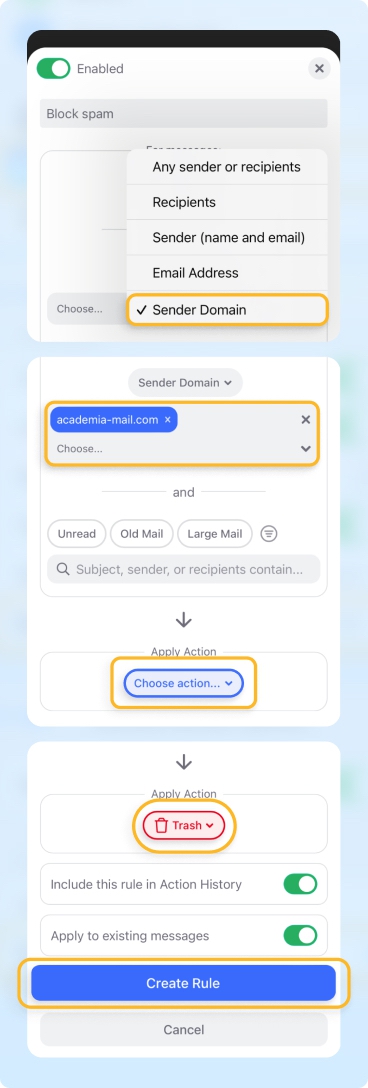
- Clean up existing emails at the same time by applying rules to messages already in the mailbox.
- Get smart cleanup suggestions based on the types of emails you usually delete or archive.
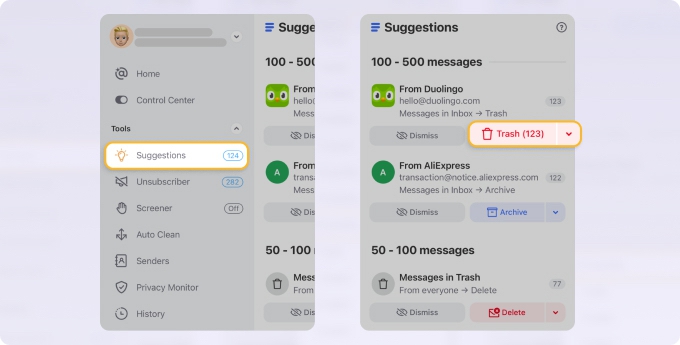
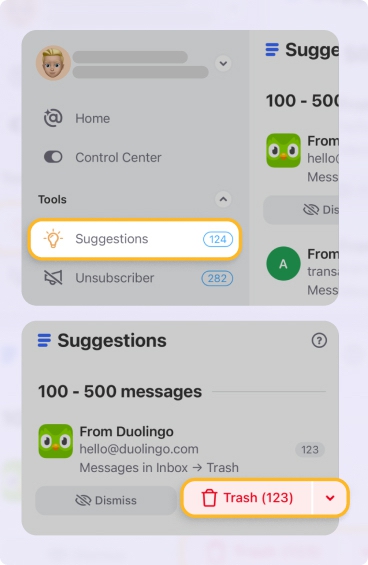
- Manage Thunderbird inbox clutter from any device, including Android, iOS, web and desktop (Mac).
Clean Email is especially useful for Thunderbird users who want stronger spam control without manually building and maintaining complicated message filters.
FAQ
Can you block senders in Thunderbird?
Not with a dedicated block button — Thunderbird doesn’t have one. But the same result is achievable through message filters: set a filter that matches a sender’s address (or domain) and deletes or junks the message automatically. The end result is identical to a block.
How do I permanently block an email address in Thunderbird?
Right-click a message from the sender → Create Filter From… → set the action to Delete Message → click OK. The filter applies to all future messages from that address. Note: it’s only as permanent as the sender’s address — if they switch addresses, you’ll need to update the filter. Domain-level blocking is more resilient for persistent spammers.
How do I block emails from a complete domain in Thunderbird?
Go to Tools → Message Filters → New. Set the condition to From ends with @domain.com and the action to Delete Message. This catches every message from that domain, regardless of the specific sender address used. You can add multiple domain conditions to one filter using OR logic.
Why are blocked emails still arriving in Thunderbird?
Usually one of two reasons: (1) Thunderbird was closed when the email arrived — filters only run while the app is open, so the message sat in your inbox until the next sync. (2) The sender changed their address, bypassing your per-address filter. Switch to domain-level blocking for the second problem, and use your provider’s webmail spam controls for the first.
Do Thunderbird filters work when the app is closed?
No. Thunderbird’s message filters are client-side and only execute while the application is open and syncing. If you close the app, emails are delivered to your server normally and pile up in your inbox unfiltered. For always-on filtering, use server-side rules through your provider’s webmail, or a tool like Clean Email that operates at the server level.
What’s the difference between Set Junk Status and Delete Message in a filter?
Set Junk Status moves the message to your Junk/Spam folder, where it stays until you review or delete it — useful when you want a safety net and aren’t 100% sure about the sender. Delete Message moves it to Trash immediately. You can apply both actions in one filter by clicking the + button to add a second action.