


Quick Steps to Delete Archived Messages in Gmail
If you want the fastest way to locate and delete all archived emails in Gmail, follow these three steps:
- In Gmail, type the search query -in:inbox -in:sent -in:chat -in:drafts has:nouserlabels
- Select the checkbox at the top of the results. If the results span more than one page, click Select all conversations that match this search.
- Click Delete to remove all matching emails.
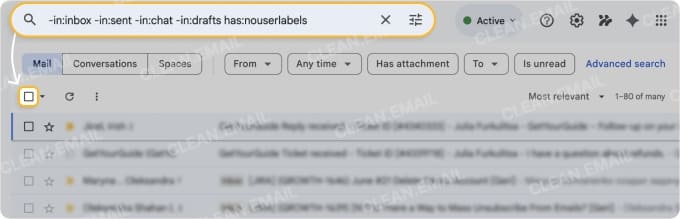
💡 Note: In a Gmail search operator, the minus sign (-) means the label should be excluded from the results. For example, -in:inbox hides emails that are currently in your Inbox. The has:nouserlabels operator finds messages that don’t have any custom labels applied, so this query skips archived emails you’ve labeled. To include those too, use in:archive below.

Alternative Way to Find and Remove Stored Emails
⚠️ Note: Gmail doesn’t have a true Archive folder. Archiving simply removes the Inbox label from a message, and archived emails keep any other labels you’ve applied.
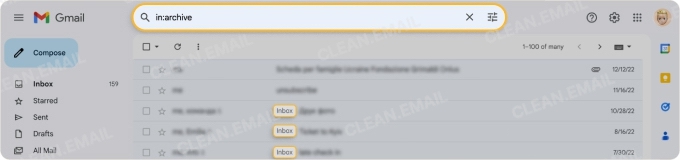
To delete stored Gmail messages, you can use the in:archive search operator, which Google lists as the operator for finding archived messages.
On the web:
- Enter in:archive in the Search field followed by Enter or Return.
- Mark the Select checkbox on the top left.
- If the results span more than one page, click Select all conversations that match this search.
- Click Delete in the toolbar.
To delete stored emails in the Gmail mobile app:
- Tap inside the Search in mail field at the top and enter in:archive.
- Long-press any email in the results.
- At the top left, tap the box next to Select all. Gmail selects up to 50 emails.
- Tap the Delete icon in the toolbar.
- To delete the next 50, scroll to the top, tap Select all again, and repeat.
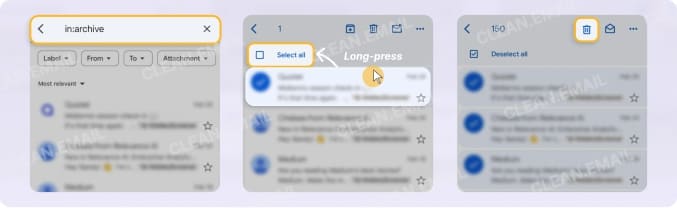
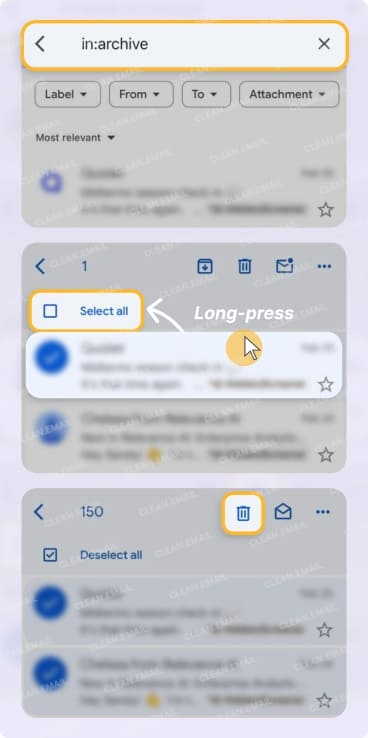
📌 Tip: You can add more search operators to the combination if you’d like to see more specific stored messages. For instance, you can delete old emails in Gmail that have been archived.
Table 1: Ways to Delete Archived Emails in Gmail
| Method | Pros | Limitations |
|---|---|---|
| Gmail search (in:archive) | Simple to use and works on web and mobile | May not show all stored emails and requires deleting messages page by page |
| Advanced Gmail search operators | Can find more archived emails and allows bulk deletion | Search queries can be confusing and may still miss messages that have labels |
| Clean Email | Shows archived messages as a separate mailbox and allows fast bulk actions | There are no limitations on working with archived emails |
Delete Archived Emails Quickly in Bulk With Clean Email
With Clean Email, you can quickly select and remove only stored messages—all in just a few steps:
- Go to app.clean.email or download the mobile app for your phone. Sign in with your email account.
- Under the Mailbox section in the left-hand menu, choose Archive. Here, you’ll see all archived Gmail emails.
- Click the Select button in the top toolbar (at the bottom on mobile) and then choose the Select All option.
- You can now delete all selected messages by clicking the Trash button.
- Confirm your decision to proceed with the action.
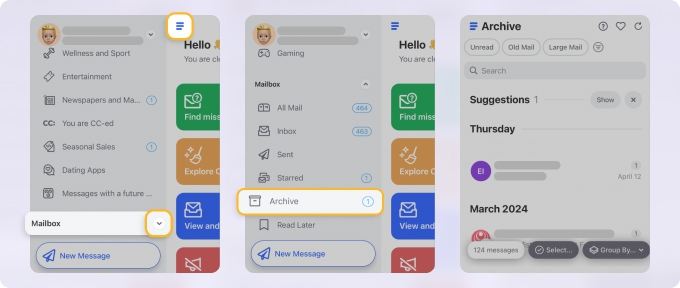
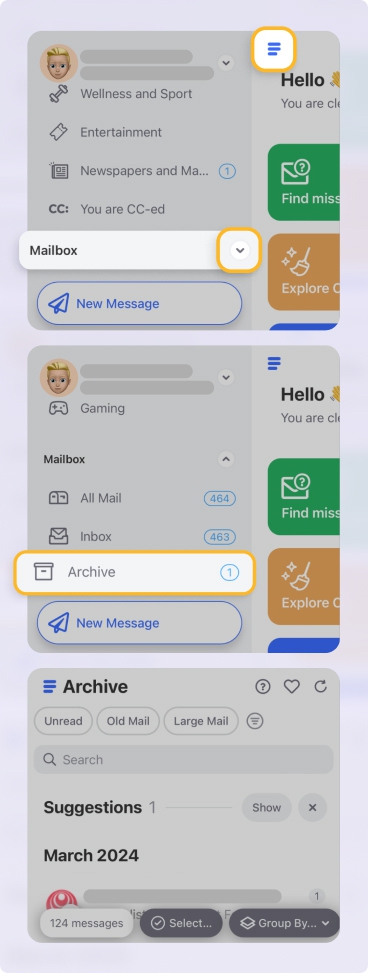
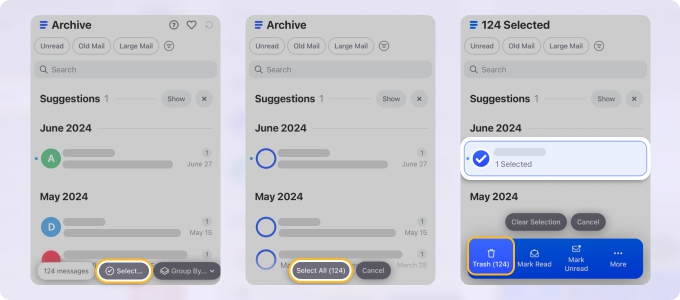
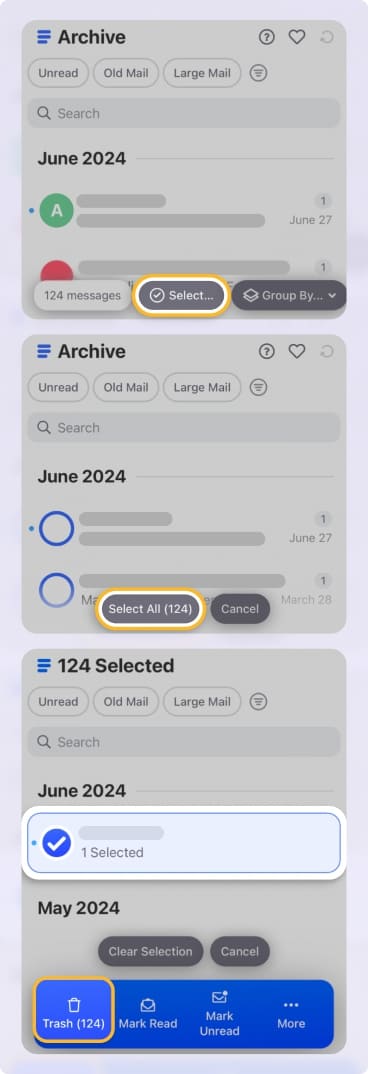
Now that your archived messages are deleted, you can't unarchive them anymore, but you can retrieve them from the Trash folder if you need to (learn more about the difference between Gmail archive vs. delete).
Why it's easier to manage Archive outside of Gmail
Gmail doesn't see "archive" as a separate mailbox; it sees it as the absence of an Inbox. Clean Email shows archived messages as a separate mailbox state, which lets:
- Only choose archived emails on purpose;
- Bulk actions such as emptying the Archived folder that don't use search logic;
- Consistent behavior on the web, desktop, and mobile.
What to Know About Archive in Gmail
As you’re performing the searches above to find archived emails in Gmail, there are a few key things to keep in mind.
- Gmail does not have an archive folder. Archive in Gmail is an action, not a mailbox location or label.
- Archived emails do count toward your Google storage limit.
- If you apply a label to a message before or after archiving it, that label will remain on the email.
- Archiving an email removes the Inbox label, so you’ll no longer see the message in your Inbox, but will see it in All Mail.
- If you decide to look for stored emails in All Mail, you can identify them two ways: there is no Inbox label, and the toolbar shows Move to Inbox instead of Archive.
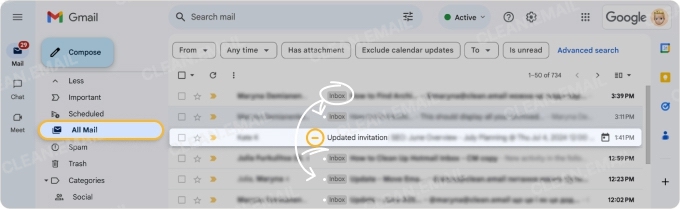
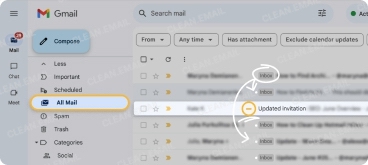
📌 Tip: Learn more about the differences between the Inbox and All Mail in Gmail.
Troubleshooting Archived Email Deletion in Gmail
Because Gmail has no Archive folder, a few issues come up often when deleting archived emails.
Archived emails returning to your Gmail Inbox?
When you receive a reply to an email you’ve archived, the conversation returns to your Inbox. To stop a conversation from coming back, mute it instead of archiving it.
Additionally, if you use a third-party email application, you may run into sync issues or delays with mailbox actions such as mass deleting messages.
See archived emails with the Inbox label?
If you see stored emails with the Inbox label in Gmail, this means that the conversation returned to your inbox after you received one or more replies.
To remedy this, turn off Conversation View by going to Settings >See all settings, selecting Conversation view off, and clicking Save Changes. Then, when you search for your archived messages, you should no longer see those replies containing the Inbox label.
Want to permanently delete archived emails?
When you delete emails in Gmail, these go to the Trash where they remain for 30 days before they’re automatically and permanently removed. To delete an email before the 30 days, open the Trash, select the message, and click Delete Forever at the top. Alternatively, you can delete all emails from the Trash by choosing Empty Trash now.
Remember that if you delete emails from the Trash or empty it, you can no longer restore those messages!
Conclusion
To delete archived emails in Gmail, you can search for archived messages using Gmail search operators and delete them in bulk. Because Gmail doesn't have a true archive folder, stored emails are simply messages without the Inbox label. Using search queries or filters can help you locate and remove these messages quickly.


