The Core Idea: Select → Group → Delete
All email service providers follow the same pattern:
- Select multiple messages.
- Apply an action (delete, archive, or move).
- Confirm or repeat if needed.
The difference between services is where the buttons are, not how the system behaves.
If you need precise, step-by-step instructions for a specific platform, check our guides on how to delete emails in bulk for your provider:
Method 1: Select emails using checkboxes
Most email interfaces let you select messages individually:
- Click or tap the checkbox next to each email.
- Select several messages.
- Apply the delete action.
📌 The method works best for small cleanups (10–50 emails).
Method 2: Use Shift to select a range
This is one of the fastest universal tricks:
- Select the first email.
- Hold Shift.
- Select another email further down.
- Everything in between gets selected.
📌 This works best for:
- Cleaning sections of your inbox.
- Deleting emails from a specific time range.
Method 3: Select all emails on a page
Most inboxes load messages in batches (e.g., 50–100 at a time):
- Use "Select all."
- Delete the selected group.
- Repeat for the next batch.
📌 This is how people delete hundreds or thousands of emails manually.
Method 4: Use search to group emails
Instead of selecting randomly, group email messages first. You can search for:
- Sender
- Keyword
- Date range
Then:
- Select all results
- Delete them together
📌 This is the closest thing to “bulk delete” without advanced tools.
A Faster Way: Use an Inbox Cleaning Tool
If you’re dealing with hundreds or thousands of emails, deleting them manually quickly becomes a tedious task. This is where tools like the Clean Email app can help.
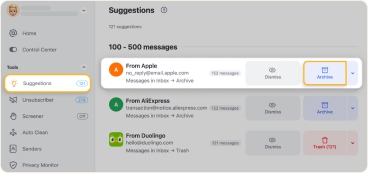
Instead of selecting messages one by one, Clean Email automatically groups emails into categories (like promotional messages, social network notifications, or shopping emails). You can then:
- Review grouped emails
- Select entire categories
- Delete many emails at once in a few clicks
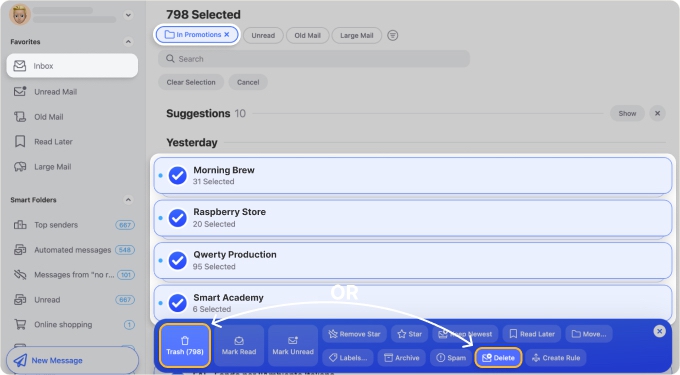
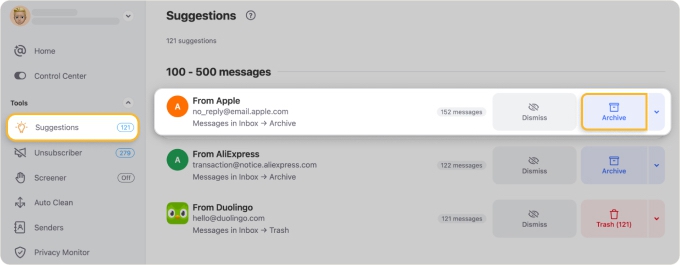
It also suggests what to clean based on your inbox habits. Those recommendations can greatly speed up the process compared to selecting messages one by one by hand.
Why Deleting Large Numbers of Emails Takes Time
Most email services don’t allow deleting everything instantly because:
- Messages are loaded in batches
- Actions are limited per page
- Large operations are restricted to prevent mistakes
That’s why deletion usually happens in cycles, not one click.
How to delete hundreds or thousands of emails
The practical approach:
- Filter emails (by sender/date/type).
- Select all visible messages.
- Delete.
- Repeat until done.
It’s repetitive, but it works in almost every email system.
Common Mistakes
- Deleting emails one by one
- Not using Shift selection
- Ignoring search filters
- Forgetting to empty trash (messages may still exist and take space)
📌 Important Note: The exact steps and buttons can look different depending on your email service.
Conclusion
Deleting multiple emails always follows the same logic:
- Select messages
- Group them efficiently
- Delete in batches
For small cleanups, manual methods work fine. But for bigger inboxes, tools like Clean Email can help you remove bulk groups of emails much faster with less effort.
FAQs
Can deleting multiple emails slow down my email account?
Yes, especially if you keep deleting large groups of messages. When email services process a lot of requests at once, they may slow down actions or updates for a short time. This is normal, so do not worry if changes do not happen right away when you’re trying to delete multiple emails at once.
Why do deleted emails still show up in my storage usage?
Most systems move deleted messages to a trash or recycle folder first, where they still count toward storage until they are permanently deleted. To really free up space, you usually have to manually empty the trash or wait for the computer to clean up automatically.
How can I stop myself from accidentally deleting important emails?
Before deleting a lot of emails, it is a good idea to look at the first and last items in your selection and not delete groups of messages that are mixed together. Bulk actions are quick, but they also make it more likely that you will lose something by accident.
What happens if I delete emails while new ones are arriving?
Most of the time, new emails will not be included in what you have already chosen. That said, if you use filters or grouped views, the list can change as new messages come in. When you work in smaller groups, things tend to stay the same.
Is there a limit to how many emails I can delete at once?
There are limits that make sense, but they are not always strict. Most email services limit how many messages can load and how many actions can be done at once. That is why big cleanups, like trying to delete multiple emails, usually happen in stages instead of all at once.