Quick Answer
The fastest way to delete old emails is to search for messages older than a specific timeframe and remove them in bulk. Many users also use email cleanup tools to automatically delete old messages without repeating manual searches.
Why Deleting Old Emails Is Harder Than It Looks
Most email providers offer search tools and filters that allow you to find messages by date or age. However, once users start cleaning large inboxes, they often run into several limitations.
Email providers limit bulk actions
Many email services only allow selecting a limited number of conversations at once. For example, Gmail typically displays 50–100 conversations per page, meaning large cleanups may require multiple deletion cycles.
Filters don’t re-check email age automatically
Another common misconception is that email filters can automatically delete old emails as they age.
In reality, most providers—including Gmail—only apply filters when new emails arrive. They do not continuously re-evaluate existing emails as they become older.
Important emails can get mixed with old ones
Older emails are not always unimportant. In many inboxes, older messages may include account confirmations, receipts and invoices, work conversations, and other important messages.
Without careful filtering, bulk deletion may accidentally remove emails that should be kept.

The Main Ways to Delete Old Emails
There are several different approaches to deleting old messages, and the best one depends on your email provider and the number of emails you want to remove.
Here are the most common methods.
| Method | Best for | Works in |
|---|---|---|
| Search operators | Finding emails older than a timeframe | Gmail, Outlook |
| Date filters | Deleting emails within a custom range | Most providers |
| Sorting by oldest | Removing the earliest messages manually | Most providers |
| Email rules and filters | Partial automation | Gmail, Outlook |
| Email cleanup tools | Fully automated cleanup | All providers |
Some methods work well for deleting a few hundred emails, while others are designed for large inbox cleanups involving thousands of messages.
Below we’ll look at each method in detail.
Method 1: Search and Delete Emails Older Than a Specific Timeframe
Many email services allow you to search for messages older than a certain age. This is usually the fastest way to locate outdated emails.
For example, Gmail supports powerful search operators such as:
- older_than:1y
- older_than:6m
- older_than:90d
After running the search, you can:
- Select the checkbox above the results
- Click Select all conversations that match this search
- Press Delete
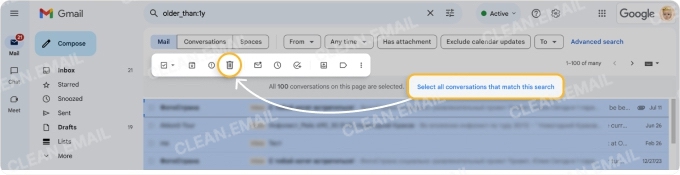
This approach works well if your goal is to remove all emails older than a specific age, such as one year or two years.
However, this method has some limitations:
- results may include archived messages
- important emails can accidentally be included
- Gmail only selects visible results unless you expand the selection
Because of these limitations, it's important to review your search results before deleting them.
For a detailed walkthrough, see our full guide on How to Delete Old Emails in Gmail.
Method 2: Erase Old Emails Within a Specific Date Range
Another common way to remove outdated emails is to search within a custom date range.
Most email providers allow you to filter messages using two parameters:
- before: a specific date
- after: a specific date
For example:
after:2022/01/01 before:2023/01/01
This query returns emails sent during that timeframe.
Date range searches are useful when you want to remove messages from a specific period, such as:
- old work emails from a previous job
- messages from a discontinued subscription
- notifications from a service you no longer use
After running the search, you can select and delete all matching emails in bulk.
The main drawback is that manual searches must be repeated every time, because email providers typically don't re-check messages as they age.
Method 3: Sort Emails by Oldest First
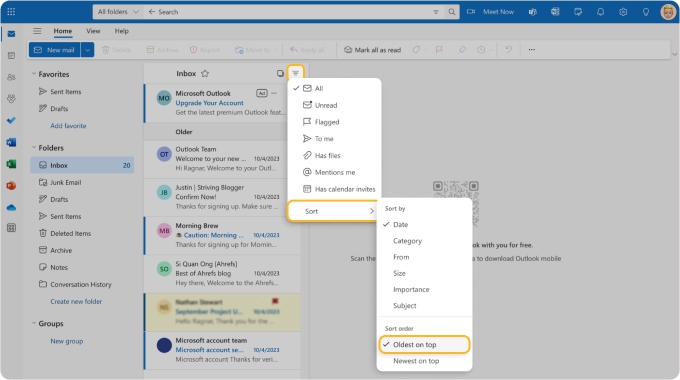
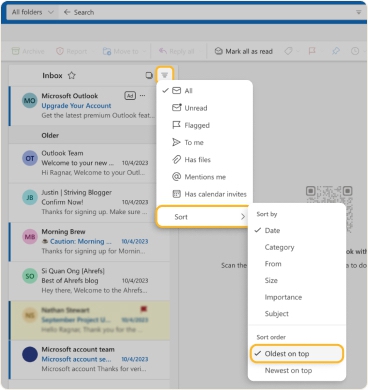
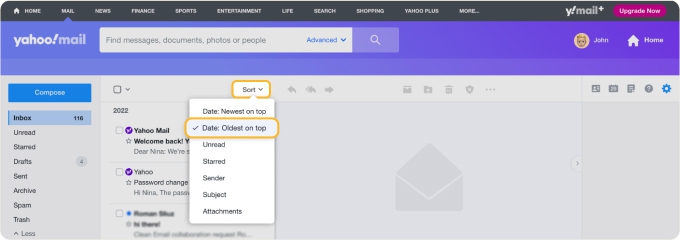
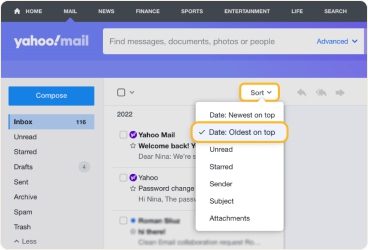
Some email services allow you to sort messages so the oldest emails appear first. This makes it easier to manually review and remove outdated messages.
This method is commonly available in:
- Outlook
- Yahoo Mail
- Apple Mail
To remove old emails using sorting options:
- Open your inbox
- Select the Sort or Filter menu
- Choose Oldest first
- Scroll through your inbox and remove older messages in batches
While this approach provides more control, it’s often impractical for large inboxes because:
- many providers limit selections to one page at a time
- selecting thousands of emails manually is slow
- older emails may be scattered across multiple folders
For large cleanups, automated filtering usually works better.
Method 4: Automatically Delete Old Emails Using Filters
Some email providers allow you to create rules that automatically handle incoming messages.
For example, Gmail allows users to create filters that perform actions such as:
- automatically deleting messages
- archiving emails
- labeling certain senders
- skipping the inbox
A filter for deleting older messages can be created using the Has the words field in Gmail’s filter settings.
Example: older_than:1y
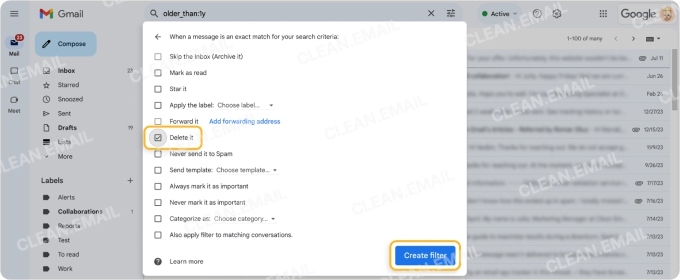
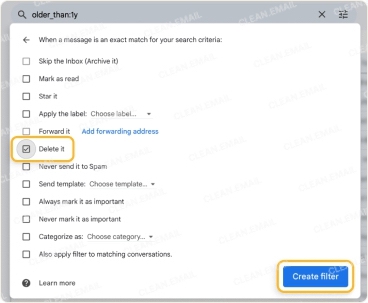
Once the filter is created, Gmail can apply it to matching conversations.
However, there is an important limitation.
Filters typically work only when emails arrive, meaning Gmail does not automatically revisit messages to check if they have become older than a certain age. Read more in our guide on How to Auto-Delete Emails in Gmail.
Because of this, filters are helpful for one-time cleanup actions, but they are not a reliable long-term solution for automatic deletion.
Method 5: Use an Email Cleanup Tool
If your inbox contains thousands of messages or multiple years of accumulated emails, manually deleting them can become difficult.
Dedicated email cleanup tools are designed to simplify this process by offering features that most providers don’t include.
These tools typically allow users to:
- find emails older than a chosen timeframe
- group messages by sender
- delete thousands of emails at once
- automatically remove messages as they age
This approach can save significant time compared with manually running search filters.
The Easiest Way to Delete Old Emails Automatically
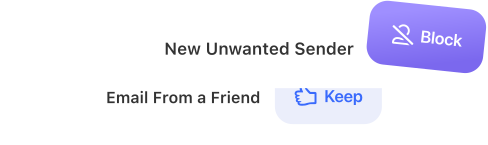
If you want a faster way to remove old emails without repeating manual searches, tools like Clean Email provide automation that most providers lack.
Clean Email works with major email services including:
- Gmail
- Outlook
- Yahoo Mail
- iCloud
- AOL
- other IMAP accounts
Instead of manually searching your inbox, the app automatically identifies older messages and groups them for easy cleanup.
Erase thousands of old emails in one click
With Clean Email, you can quickly locate outdated messages using the Old Mail filter, which automatically finds emails older than a selected timeframe.
From there, you can:
- Open the app and sign in with your email account
- Click the Old Mail filter in the left-hand menu
- Adjust the age threshold (for example older than 6 months or 1 year)
- Select messages individually, by sender, or all at once
- Delete them permanently or move them to Trash
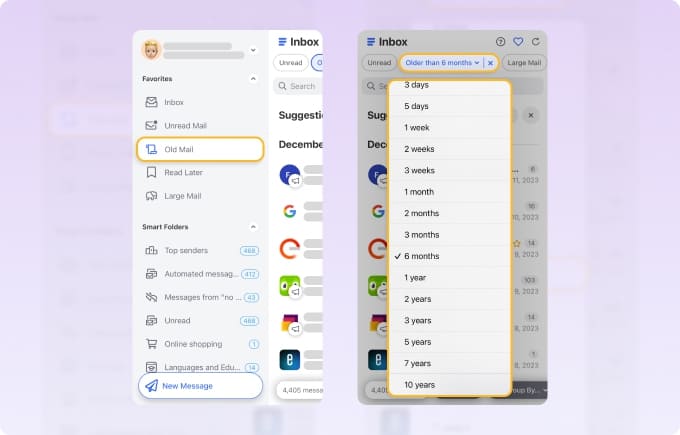
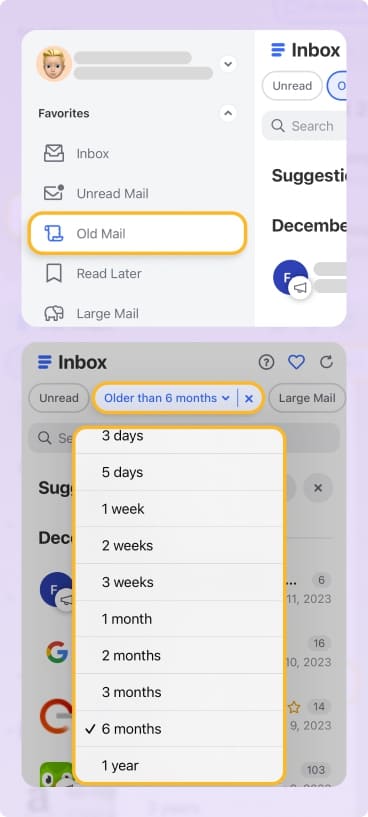
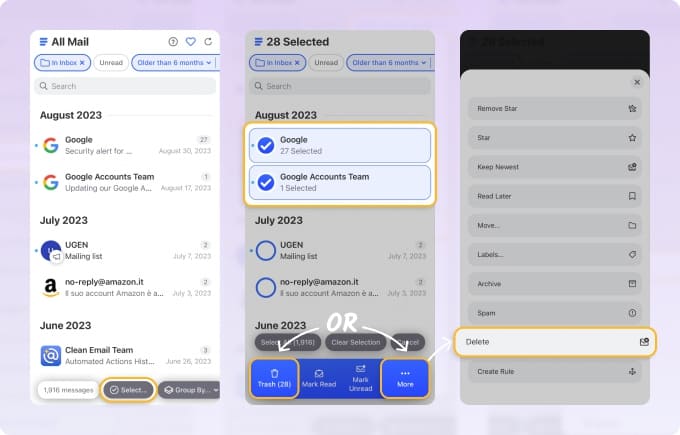
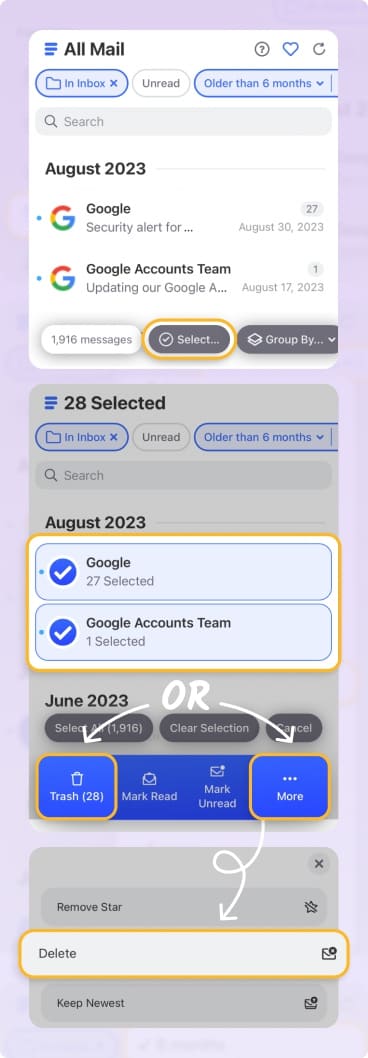
This allows you to remove thousands of outdated messages in seconds.
Automatically remove old emails
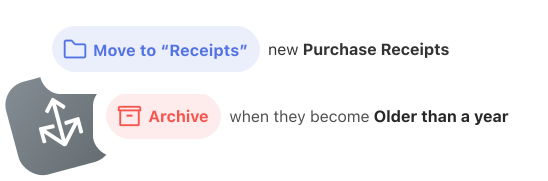
Clean Email also allows you to create automation rules using the Auto Clean feature.
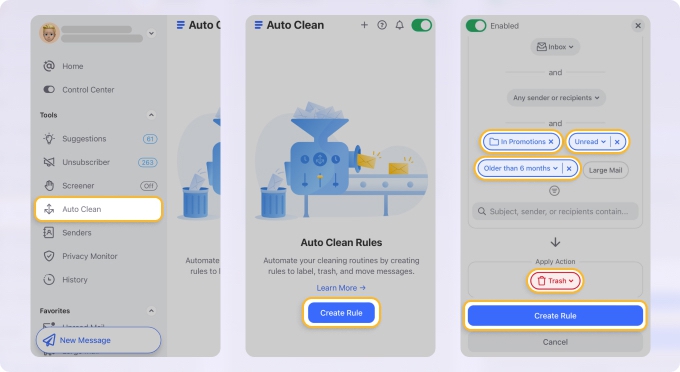
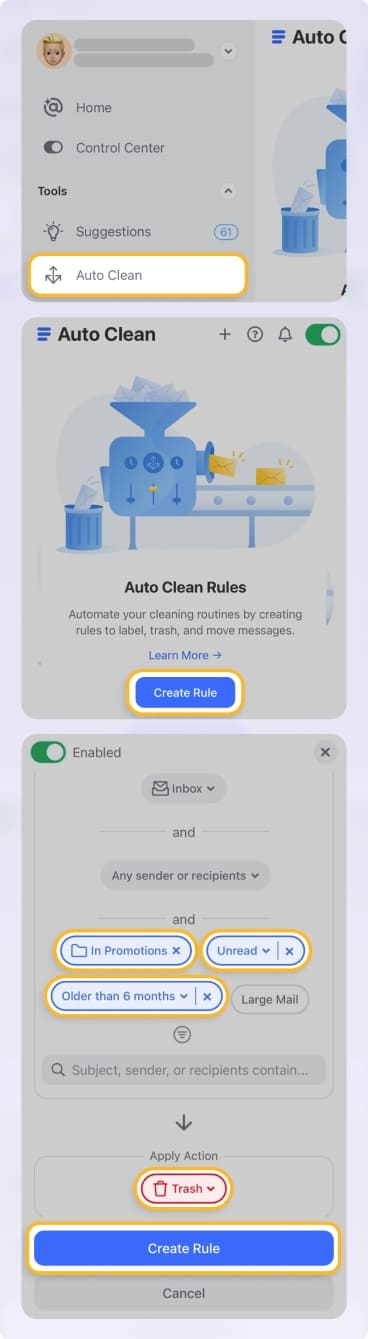
For example, you can create rules that:
- get rid of emails older than 1 year
- remove newsletters after 90 days
- keep only the newest message from a sender
Once configured, these rules run automatically in the background, keeping your inbox clean without requiring manual maintenance.
Gmail vs Outlook vs Yahoo: How They Handle Old Emails
Different email providers offer different levels of control when managing older messages.
| Provider | Search by age | Bulk delete | Auto deletion rules |
|---|---|---|---|
| Gmail | Yes | Yes | Limited |
| Outlook | Partial | Yes | Limited |
| Yahoo Mail | Partial | Yes | Limited |
| Apple Mail client | No built-in age filter | Manual | No |
Gmail currently provides the most advanced search operators, allowing users to filter messages by age using queries such as:
older_than:1y before:2021/01/01
Outlook and Yahoo rely more heavily on date-based searches and sorting.
For step-by-step guides to remove old emails, check out our guides: Does Yahoo Delete Old Emails? and How to Erase Old Emails in Outlook.
However, none of these providers offer reliable built-in automation for deleting emails as they age, which is why many users eventually look for dedicated email cleanup tools.
Final Thoughts
While most email providers offer basic tools for finding messages by date or age, these tools often have limitations when dealing with large inboxes.
Using search filters and manual deletion can work for small cleanups. However, if your inbox contains thousands of outdated messages, using a dedicated cleanup tool like Clean Email can significantly simplify the process.
By regularly removing old emails, you can keep your inbox manageable, reduce clutter, and ensure that important messages remain easy to find.
FAQs
Should I get rid of old emails?
Yes, it will free space for new important messages, attachments, and files. Deleting old messages will also help keep your inbox clean and organized.
Why are old emails appearing in my inbox?
Old emails may still appear because they were archived instead of deleted or because your inbox includes messages from multiple folders such as All Mail. They can also remain if filters or rules previously moved them back to the inbox.
Is there an easy way to delete old emails?
Yes, the easiest way is to search for emails by age or date and delete them in bulk using built in filters. You can also use an email cleanup tool like Clean Email to automatically find and remove old messages.
How can I delete all my old emails at once?
You can search for emails older than a certain timeframe, select all matching conversations, and delete them in bulk. Some cleanup tools also allow you to delete thousands of old emails at once or create rules to remove them automatically.
Why don’t deleted old emails free up storage immediately?
When you erase emails, most providers move them to the Trash or Deleted Items folder instead of removing them permanently. These emails usually stay there for about 30 days and still count toward your storage until the Trash folder is emptied.