Quick Answer: Delete Old Outlook Emails Fast
The same method works across Classic Outlook, the new Outlook, Outlook.com, and the mobile app, with a few small differences between them.
To delete old emails in Outlook quickly:
- Open the folder you want to clean (Inbox, Sent Items, or any subfolder).
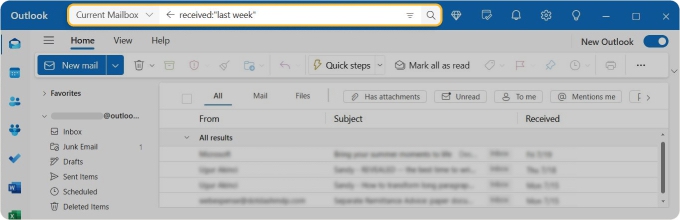
- Click into the search bar and type a date filter like received:last week or received:<01/01/2026 to pull up everything received before that date.
- Press Enter to run the search.
- Press Ctrl+A to select all results.
- Press Delete to send them to the Deleted Items folder, or, on desktop or web, use Shift+Delete to skip that step and remove them permanently.
- Empty the Deleted Items folder to free up actual storage.
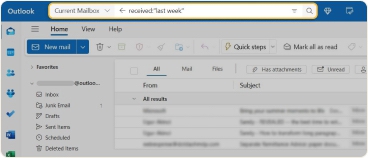

How to Find Old Emails by Date in Outlook
Outlook's search bar handles every date-based query you'll need. You just need to learn how to structure your queries. The good news is that the same syntax works in Classic Outlook, the new Outlook, and Outlook.com.
⚠️ Important: Operators are typed in lowercase, and dates follow your system's regional format. For a broader look at search syntax, see our guide on how to search emails in Outlook.
Emails Before a Specific Date
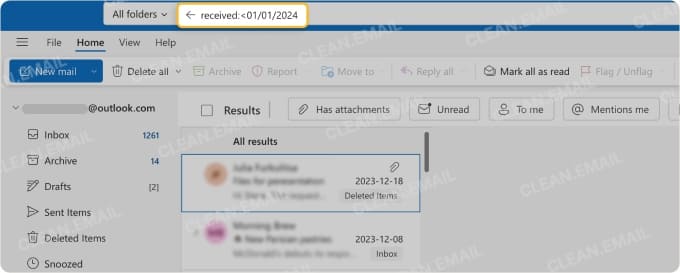
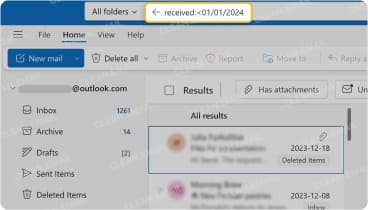
Type received:< followed by your cutoff date. For example, received:<01/01/2024 pulls up every message received before January 1, 2024. Swap the date for whatever you need.
💡 Tip: For the Sent Items folder, use sent:< instead. Sent emails (especially ones with large attachments) take up just as much storage as incoming ones, and they're a common reason an Outlook mailbox runs out of space.
Emails Older Than 6 Months or 2 Years
Outlook doesn't have a built-in "older than 6 months" operator, but you can calculate the cutoff date and use received:< with it.
If today is May 22, 2026:
- To find emails older than 6 months, type received:<11/22/2025.
- To find emails older than 2 years, type received:<05/22/2024.
Alternatively, you can also sort by the Received column to bring the oldest emails to the top and grab a range visually, which our guide on how to sort emails in Outlook walks through in detail.
Emails Within a Date Range
Use two dots between two dates:
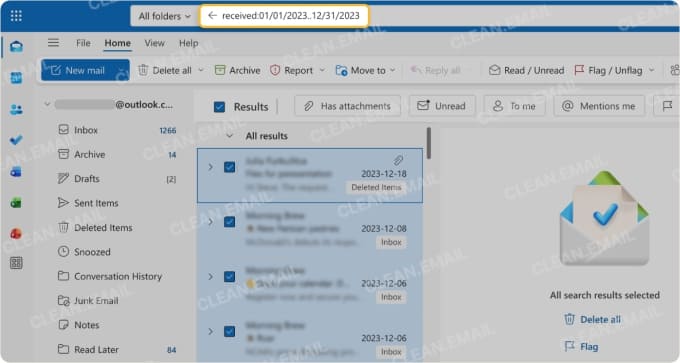
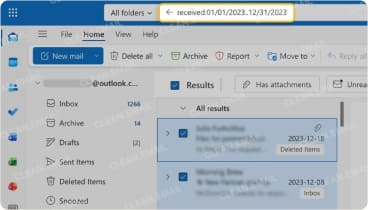
received:01/01/2023..12/31/2023
The query returns every message received during 2023, which is useful when you want to delete old emails in Outlook by date range without touching anything outside that window. Know that the same .. syntax works with the sent: operator.
Once the search returns the messages you want, press Ctrl+A to select them and Delete to clear the batch in one action. Like always, don't forget to empty the Deleted Items folder after.
Common Cleanup Scenarios
Most cleanup tasks fall into a few recurring scenarios. The operators below (some of which we've already described) cover all of them, and you can combine any of them with spaces (for example, from:amazon@ received:<01/01/2025).
| Operator | What it does | Example |
|---|---|---|
| received:<DATE | Messages received before a date | received:<01/01/2024 |
| received:DATE1..DATE2 | Messages within a date range | received:01/01/2023..12/31/2023 |
| sent:<DATE | Sent messages before a date | sent:<01/01/2024 |
| from: | Messages from a specific sender | from:newsletter@example.com |
| subject: | Messages with a keyword in the subject | subject:invoice |
Delete Emails Older Than 6 Months
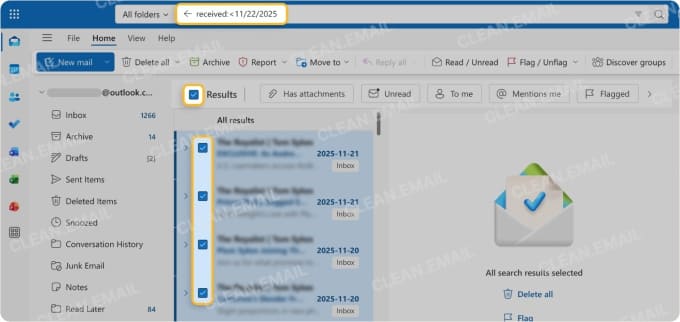
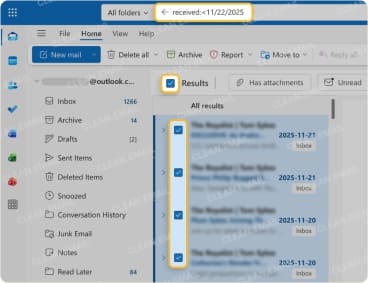
To delete emails older than 6 months in Outlook, calculate today's date minus 6 months and use it as the cutoff. If today is May 22, 2026, you'd type received:<11/22/2025, press Enter, then Ctrl+A and Delete.
Delete Emails Older Than 2 Years
The age of deleted emails doesn't change the steps you need to perform in Outlook. To delete emails older than 2 years in Outlook, just subtract 2 years from today, type received:<DATE in the search bar, select all results, and delete.
⚠️ Important: think about what's actually in that window first. Invoices, tax records, and contracts often need to be kept for several years (accountants typically want 3 to 7 years of records on file, longer for businesses).
Delete Old Emails From One Sender
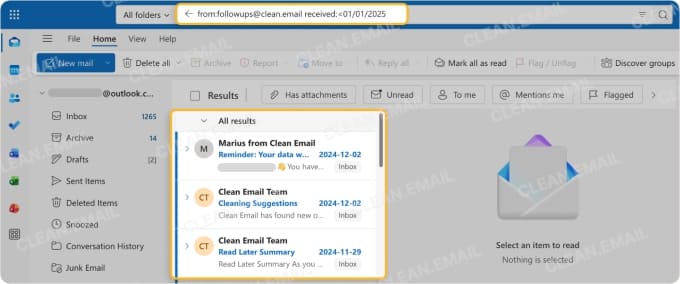
If a single sender (an old job-board newsletter, a former colleague, an automated notification address) is responsible for hundreds of stale messages, combine from: with a date filter.
For example, from:notifications@example.com received:<01/01/2025 returns every old message from that sender, ready for bulk deletion in Outlook.
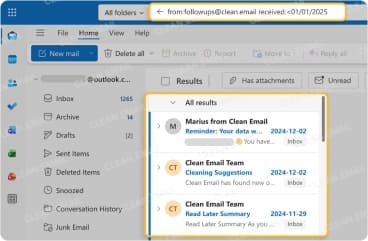
Clean Up Old Newsletters or Notifications
The fastest sweep combines a sender or subject keyword with a date cutoff:
- from:newsletter@ received:<06/01/2024 for everything from a specific newsletter address older than that date.
- subject:digest received:<01/01/2025 for digest emails older than 2025.
- from:noreply@ received:<01/01/2025 for automated notification addresses across the board.
If the same senders keep showing up in every cleanup, it's worth unsubscribing or filtering them in Outlook so they stop arriving in the first place.
How to Delete All Filtered Emails at Once
Once your search has narrowed the folder down to old messages, you can clear them all by pressing Ctrl+A to select everything visible, and then clicking the Delete button.
In the new Outlook, Outlook on the web, and Outlook.com load search results in batches. If your search returns thousands of hits, the first Ctrl+A only grabs the loaded portion. Click the "Select all messages in this folder" banner that appears at the top of the message list to extend the selection across the full search.
What's Different Across Outlook Versions
The same date-based workflow runs across all four Outlook versions, but each has its own quirks:
- Classic Outlook makes everything easy because it supports every search operator, full Select All, and even has built-in tools like Mailbox Cleanup under File → Tools.
- The new Outlook for Windows uses the same search syntax but loads results in batches like the web version, so the "Select all messages in this folder" banner becomes essential for large sweeps.
- Outlook on the web and Outlook.com share that batched-loading behavior. They also include a handy Storage page (Settings → Accounts → Storage) that can wipe messages older than 3, 6, or 12 months without any manual selection.
- The Outlook mobile app is best for small cleanups. Filtering is limited and "Select all" only covers what's currently loaded, so you'll spend more time scrolling than filtering.
An Easier Way to Delete Old Emails with Clean Email
If you want to delete old Outlook emails in the easiest way possible, then you should try a third-party inbox cleaner called Clean Email.
Clean Email is a dedicated inbox organizer that connects to your Outlook account (Outlook.com, Microsoft 365, or any IMAP setup) and groups messages in ways the native search can't easily replicate. Instead of typing date operators, you sort and filter visually across the whole mailbox at once.
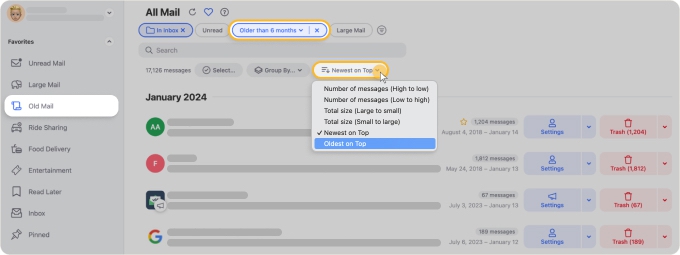
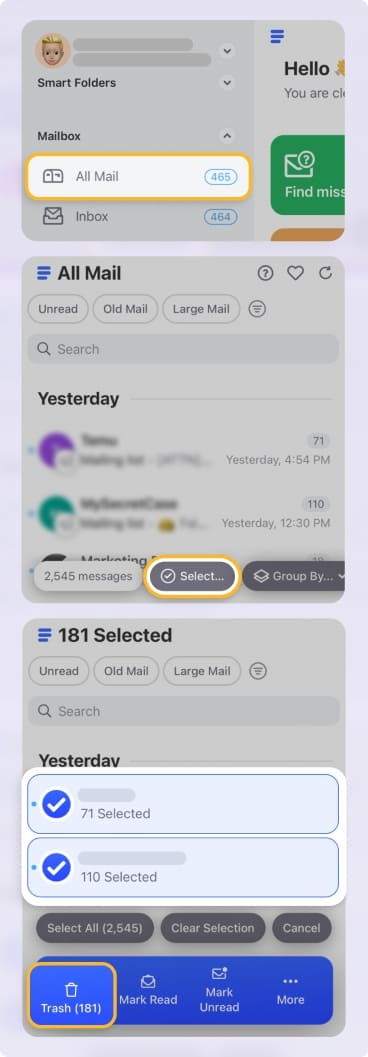
Sort by Received date or message size across every folder simultaneously instead of just the one you happen to be in. Old attachments hiding in Sent or buried in a subfolder show up alongside everything else, so you can hit them in a single sweep without juggling separate searches.
Bulk deletion is where the difference is most obvious. Select thousands of messages from a single view and clear them in one action.
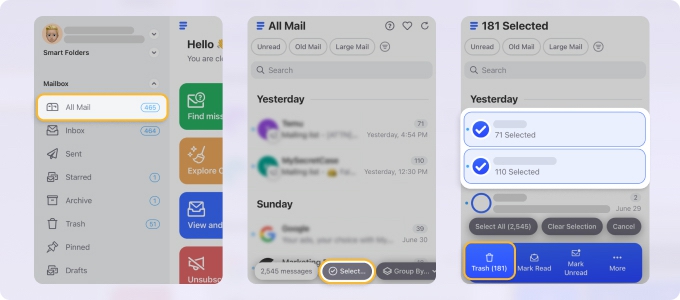
The Keep Newest feature is built for senders who send the same thing on repeat. It keeps only the most recent message from a sender (or by subject) and clears everything older automatically.
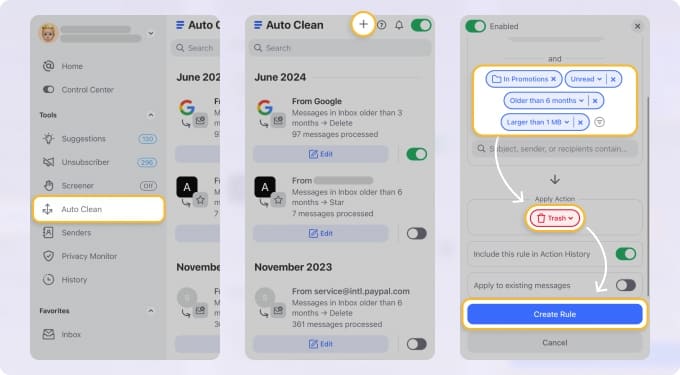
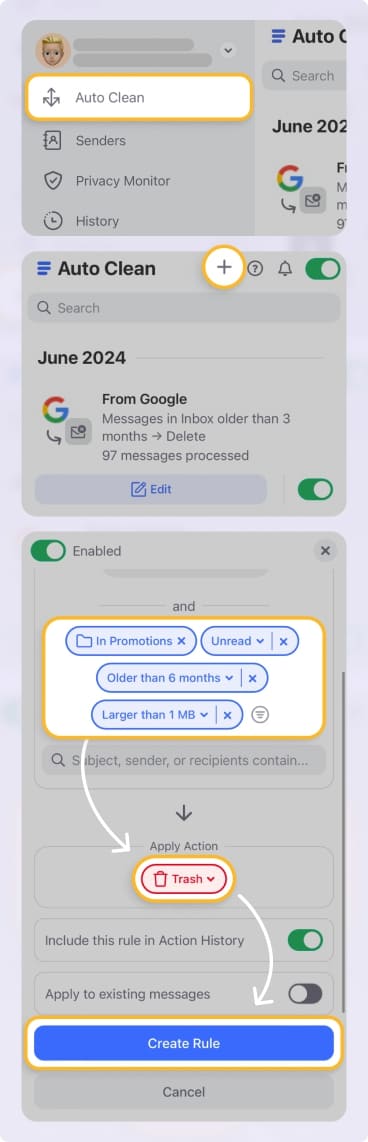
For ongoing maintenance, Auto Clean lets you set a one-time rule, like "trash unread promotional emails older than 6 months," and Clean Email keeps applying it as new mail arrives. No need to re-run the same date search every month.
Advanced Options
If a date-based purge is something you'll repeat regularly, two Outlook features can automate it (mostly in Classic Outlook). The first is AutoArchive, which moves or deletes messages older than a defined age on a schedule. Note that it only exists in Classic Outlook; the new Outlook and Outlook on the web don't include it.
The second is rule-based deletion. You can build a rule that auto-deletes incoming messages matching specific senders or conditions, then run it retroactively against existing mail too. Our guide on how to automatically delete emails in Outlook covers both Classic and new Outlook setups.
Troubleshooting Issues
Why Can't I Select All Old Emails in Outlook?
Two common causes:
- On Outlook on the web and the new Outlook, results load in batches. The first Ctrl+A only grabs the loaded set. Click the "Select all messages in this folder" banner at the top of the message list to extend the selection across the full search.
- In Classic Outlook, search has a default 250-result cap. Go to File → Options → Search and uncheck "Improve search speed by limiting the number of results shown" to load more.
For mailboxes with tens of thousands of matching messages, you may still need to delete in waves regardless of version.
Why Is Outlook Only Showing Some Old Emails?
Usually one of three reasons:
- Cached Exchange Mode is limiting offline mail. By default, Classic Outlook only downloads the last 12 months. Go to File → Account Settings → Account Settings → change and drag the "Mail to keep offline" slider all the way to All.
- The search index is incomplete or corrupted. Rebuild it under File → Options → Search → Indexing Options → Advanced → Rebuild.
- The search scope is set to Current Folder when the messages live elsewhere. Switch it to Current Mailbox or All Mailboxes (All folders or Subfolders on the web).
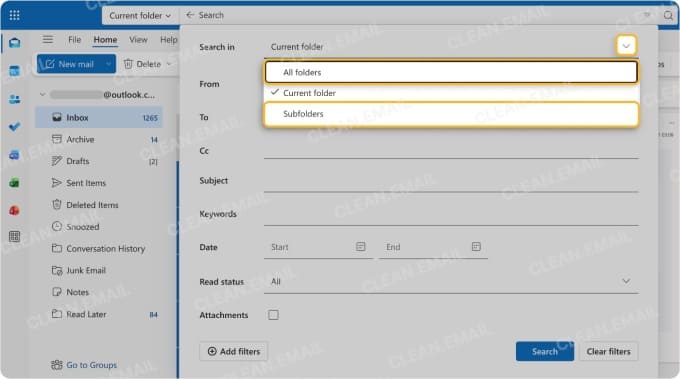
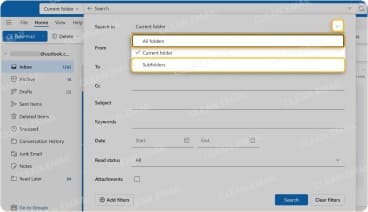
The first cause is Classic-only; the new Outlook and the web don't use Cached Exchange Mode.
Conclusion
The fastest way to delete old emails in Outlook is to filter by date, select the results, and delete the batch. The same received:<DATE workflow runs across Classic Outlook, the new Outlook, and Outlook.com, while the mobile app is best for small cleanups. For repeated maintenance or very large mailboxes, AutoArchive, rules, or Clean Email's age-based filtering make manual work virtually unnecessary.