Quick Answer: How to Create Email Filters
To create an email filter:
- Select a repeating message type (e.g., newsletters, receipts, or community updates).
- Choose the condition(s) (e.g., sender, subject, or keyword).
- Pick the action(s) (e.g., move, archive, or mark as read).
The best email filters are centered around recurring email types and patterns, not one-off instances.
Start With an Inbox Audit: What Patterns Should You Catch?
To know which types of emails warrant automated filters, take a bit of time to review your inbox and look for patterns. You may just realize that you receive more repeating message types than you thought.
Here are several common email patterns that are ideal filter candidates:
- Newsletters, promotions, and marketing emails
- Receipts, purchases, and shipping confirmations
- Finance and banking messages
- Security and account alerts
- Work and client emails
- Reports and recurring updates
- Forum and community notifications
- Low-priority notifications
- Junk from known senders
Keep in mind that not everyone treats the same email type the same way. For instance, if you’re active in online forums and communities, you may want to label or move these messages to a folder. But if you’re not, you might prefer to automatically delete these types of emails.
Use this checklist to find patterns and decide which actions to take:
- Which emails arrive repeatedly?
- Which ones should stay visible?
- Which ones can skip the inbox?
- Which ones should never go to spam?
- Which ones should be deleted, archived, or sent to Read Later?
- Which ones should be unsubscribed from instead rather than filtered?
Useful Email Filter Examples
After you decide which patterns deserve an email filter, you’ll choose the conditions and actions for matching messages. To help you get started, here are several automated rule examples for various email types.
| Use case | What to look for | Example condition | Best action | When to avoid this filter |
|---|---|---|---|---|
| Newsletters | Recurring emails with unsubscribe links, brand updates, content digests | Has the word: unsubscribe | Label “Newsletters,” skip inbox, or send to Read Later | Avoid sweeping everything with unsubscribe if important senders also use unsubscribe links. Add exceptions. |
| Promotions | Sale alerts, coupons, product launches, marketing blasts | From contains promo domains like @news.brand.com or subject contains sale, offer, deal | Label “Promotions” or skip inbox | If you never read them, unsubscribe instead of filtering. |
| Purchases and receipts | Receipts, invoices, orders, shipping updates, delivery notices | Subject contains receipt, invoice, order, shipped, delivery | Label “Purchases,” keep searchable, never send to spam | Avoid auto-archiving if you need to track active deliveries. |
| Finance and banking | Bank alerts, payment confirmations, card statements, tax documents | From bank/payment domains or subject contains statement, payment, transaction | Label “Finance,” star, never send to spam | Do not skip inbox for urgent fraud, payment failure, or account alerts. |
| Security alerts | Password resets, verification codes, new sign-ins, suspicious activity | Subject contains password reset, security alert, new sign-in, verification code | Label “Security,” star, keep in inbox | Avoid archiving these automatically. They should stay visible. |
| Client or project work | Client domains, project names, recurring work threads | From contains @clientdomain.com or subject contains project/client name | Label by client or project, keep visible | Avoid creating too many client rules if search already works well. |
| Reports and recurring updates | Weekly reports, analytics summaries, system updates, status emails | Subject contains weekly report, analytics, status update, summary | Label “Reports,” skip inbox if low priority | Do not skip inbox for reports that require action. |
| Alerts and notifications | Monitoring alerts, app notifications, tool updates | Subject contains [Alert], notification, failed, completed | Label “Alerts,” keep unread or route to a dedicated folder | Avoid bundling critical alerts with low-value notifications. |
| Forums and communities | Reply notifications, private messages, subscribed threads | Subject contains reply to thread, private message, topic reply, forum notification | Label “Forums,” skip inbox | Avoid filtering community emails you actively participate in daily. |
| Social media updates | Likes, follows, mentions, digest emails | From social platforms or subject contains mentioned you, new follower, weekly digest | Label “Social,” skip inbox or mark as read | If they add no value, turn off notifications at the source. |
| Job alerts | Saved search results, recruiter emails, application updates | Subject contains job alert, new jobs, application update, interview | Label “Jobs,” keep in inbox or star | Do not skip inbox while actively job hunting. |
| Travel emails | Booking confirmations, boarding passes, hotel reservations, car rentals | Subject contains booking, reservation, itinerary, boarding pass, check-in | Label “Travel,” star if upcoming | Avoid archiving active trip emails before the trip ends. |
| Known unwanted sender | Persistent unwanted sender or domain | From contains specific sender/domain | Move to junk, archive, or delete | If it is a real subscription, unsubscribe first. |
| Internal company emails | HR updates, payroll, benefits, office announcements | From company domain or subject contains payroll, benefits, HR, policy | Label “Company,” keep searchable | Avoid skipping inbox for policy, payroll, or deadline-based messages. |
| Read-later content | Articles, newsletters, educational emails, long-form digests | Has unsubscribe plus trusted sender/domain | Send to Read Later, label, skip inbox | Avoid mixing urgent account emails into Read Later. |
Provider Comparison: What Each Email App Is Best For
Depending on the email service provider you use, you may have decent flexibility for setting up and managing rules or you might find that the limitations are too restrictive for your needs.
This first summary shows each popular provider with what it’s best for and its main limitation when it comes to email filter rules.
| Provider | Best for | Main limitation |
|---|---|---|
| Gmail | Powerful keyword/search-based filters, labels, newsletters, receipts, project routing | Filters are best created on desktop; large rule systems become hard to maintain |
| Outlook | Work inboxes, folders, categories, Microsoft 365 workflows | Rules vary by Outlook version and may be server-side or client-only |
| Yahoo Mail | Simple sender/topic-based folder sorting | Less flexible for complex filtering systems |
| Apple Mail on Mac | Mac-based app rules and local automation | Rules may depend on the Mail app and can confuse users if provider filters also exist |
| iCloud Mail / iPhone | Simple iCloud Mail rules across Apple devices | Not a universal filter system for Gmail, Yahoo, or Outlook accounts inside iPhone Mail |
This next summary shows mobile support, whether or not new filters can apply to existing emails, if it accommodates complex rules, and the provider’s main risk for rules.
| Provider | Mobile rule creation | Apply to old emails | Good for complex rules? | Main risk |
|---|---|---|---|---|
| Gmail | Limited | Yes | Yes | Too many labels/rules |
| Outlook | Varies | Varies | Yes | Version and server/client confusion |
| Yahoo Mail | Limited | Limited | Basic only | Rule priority and simple logic |
| Apple Mail | Mac-first | Yes on Mac | Medium | App-side rules vs provider rules |
| iCloud Mail | Yes for iCloud rules | Yes | Basic | Not universal for all iPhone accounts, iCloud Mail only |
Basic Rule Creation Flow
Once you determine which messages to filter and the rules to create for them, you can use a simple workflow for setting up filters in any email client.
💡 Note: If you plan to use labels or folders for your email rule, be sure that their names are clear and make sense.
- Select a repeating pattern.
- Choose the condition(s) for matching messages.
- Pick the action(s) you want to apply.
- Decide whether or not to apply the filter to existing emails (if available).
- Test the filter with a recent email or via the Search feature.
Remember, repeat this only for those email patterns that deserve a dedicated rule.
For a specific email provider, here are guides for inbox rule creation with details and steps:
When Native Filters Are Not Enough
Short of changing email service providers, you may feel stuck with your provider’s options and limitations for creating email filter rules.
Most times, native filters are just fine for a small set of predictable patterns. However, these filters can become harder to manage when you have multiple accounts, many subscriptions, tons of old clutter, several email apps, and too many rules.
When you need a more robust filtering solution, consider incorporating Clean Email into your flow.
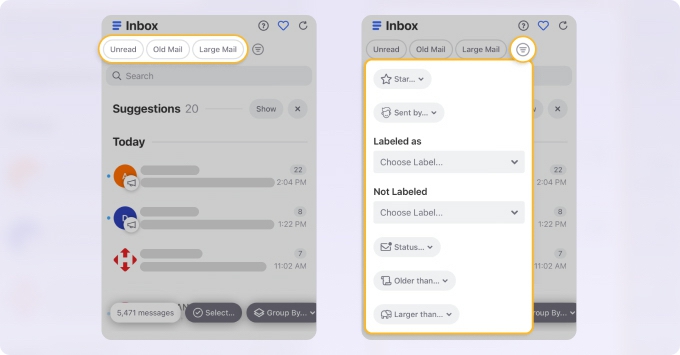
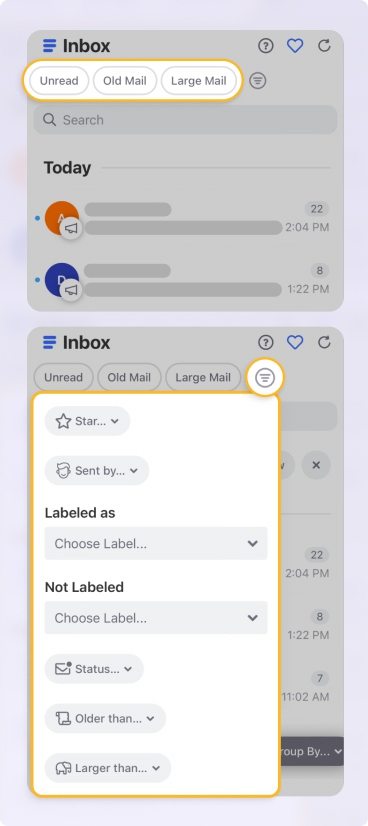
Clean Email’s offerings don’t have to replace your existing rules, but it does give you an easy and customizable cleanup, recurring automations, and cross-provider inbox maintenance.
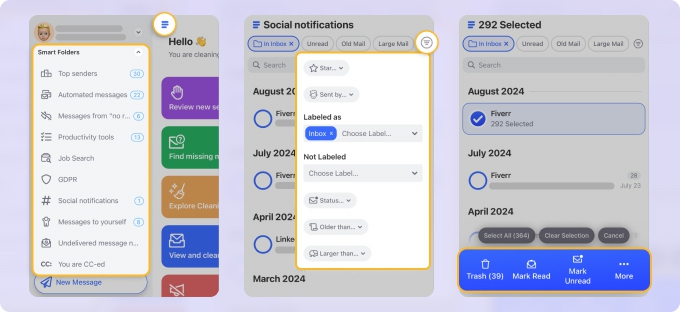
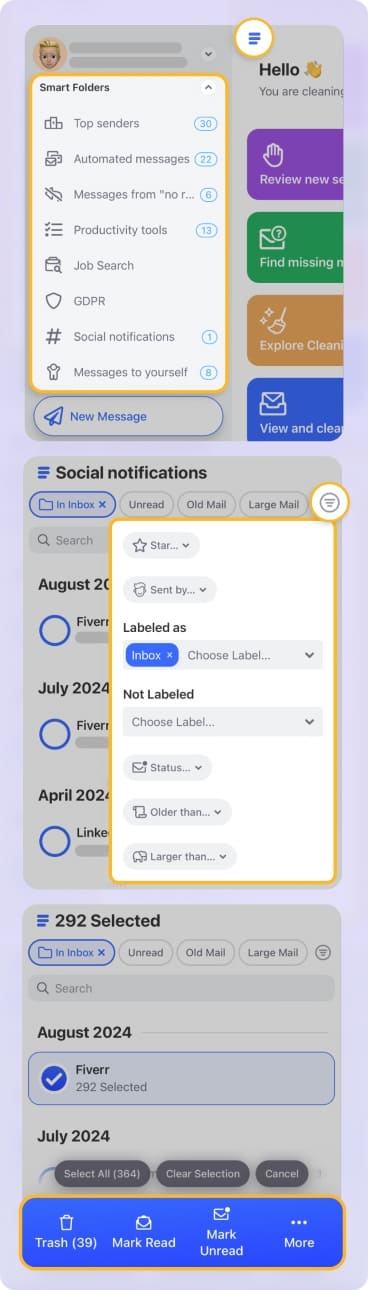
For example, you can use the pre-made Smart Folders to manage related emails rather than set up mailbox rules. You have folders for travel, online shopping, social notifications, finance, and more, that work like built-in filters.
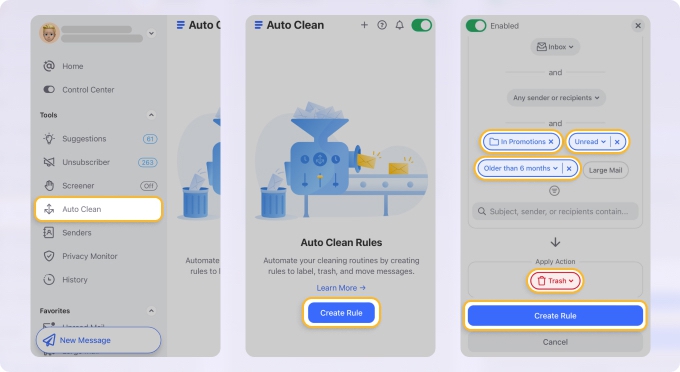
You can also create repeating rules with Auto Clean. This automated feature provides and domain-based filtering, and is available in both the web and mobile apps.
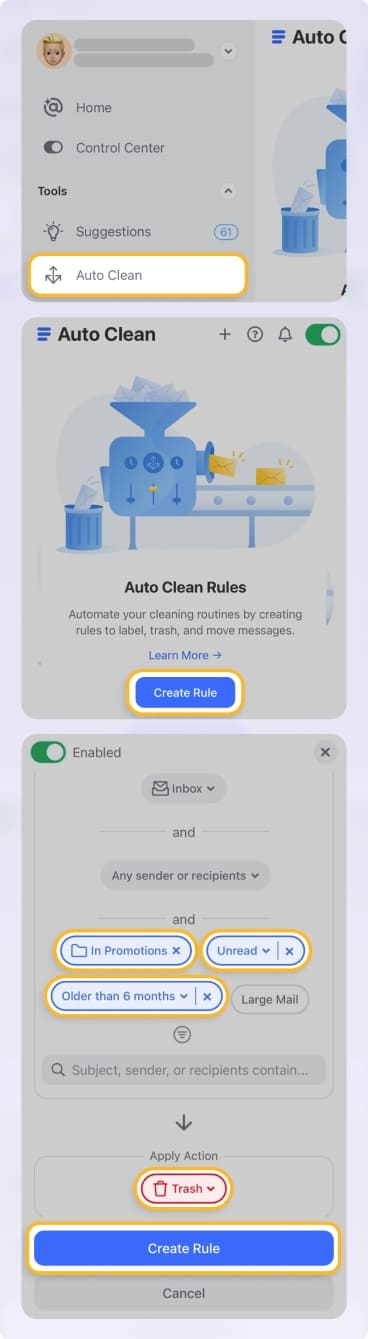
Clean Email is safe to use, doesn’t sell or share user data, and only accesses email headers and metadata, not message content. It’s available for all IMAP providers on the web and mobile devices.
Why Email Filter Rules Stop Working
Taking the time to review your email patterns and set up inbox rules hardly feels worth it when your filters stop working. But there’s typically a sensible reason.
Here are several common causes of non-working filters and how to correct them.
1. Senders change addresses or domains
When you use the sender’s email address or domain to filter emails, the rule can appear to stop working when a sender changes it. In reality, the filter still works but doesn’t automatically update to a different address or domain.
- Edit the rule to include the new email address or domain.
2. Marketing emails come from different subdomains
If you set up a narrow rule using a subdomain, it won’t apply to additional subdomains from that sender. For example, if the filter applies to emails from sales.company.com, messages you receive from deals.company.com won’t be included.
- Use the main domain and/or a wildcard character (*) when creating the rule.
3. Rule order is crucial
Email filters run in the order they appear in your list, from top to bottom. This means that the first rule whose conditions match the message is applied before the system checks against rules lower on the list.
- Place specific rules at the top of your list with more generic ones at the bottom.
4. Rules overlap
If you have multiple rules that can apply to the same message, it can cause confusion and lead you to wonder what exactly happened to the email.
- Apply the “stop processing more rules” setting to prevent the system from applying additional lower-level filters.
5. Too many narrow rules
Having too many email filters can easily become unmanageable over time as well as result in overlapping rules.
- Consolidate email filters where it makes sense and remove those that you no longer need.
6. Rules created in too many places
If you use more than one email client to filter your emails, you may have trouble determining which system applied its rule and thus, what happened to the message.
- Review your list of rules and remove duplicate or contradictory filters. Alternatively, focus on a single client for rule creation.
7. Bad rule naming
Giving a rule a generic name doesn’t tell you exactly what it does when reviewing your filter list. This can lead to duplicate or overlapping rules along with confusion.
- Use a meaningful filter name that lets you know the purpose at a glance.
If you find that emails are missing, it’s likely that they were moved, archived, labeled, deleted, or marked as read by one of your rules. So, it’s important to know where your rules live to avoid duplicates and for reviews and changes.
Consider this checklist for troubleshooting your email filter rules:
- Which provider receives the email first?
- Where are the main rules created?
- Are the rules server-side or app-side?
- Do duplicate rules exist in more than one app?
- Are filter names clear enough to understand later?
- Was the email deleted, or just moved, archived, labeled, or hidden?
- Can it still be found with search?
FAQ
Do email filters work before or after spam filtering?
System spam filtering typically occurs before email filters are applied. Service providers scan incoming messages for junk and spam before they reach your inbox where automated filters are then implemented.
What is the difference between an email filter, a rule, and a label?
An email filter and a rule are the same thing. You choose the conditions for matching messages and the actions to automatically apply. A label, on the other hand, is a customizable tag to categorize and organize emails. These are most commonly found in Gmail.
Should I create separate filters for every sender?
In most cases, no, you shouldn’t create separate filters per sender. This can create an unmanageable set of inbox rules. Instead, consolidate the senders into a single rule if the resulting action is the same.
Is it better to filter by sender, subject, or keyword?
While it depends on your goal, filtering by sender is the usually most reliable method because it’s distinctive. Using the subject or a keyword is better for broader topics; however, combining one of these with the sender creates a more powerful system.
Can email filters accidentally delete important emails?
Yes, filters for deleting messages may mistakenly remove emails if the rule is too generic, has a typo, or is misconfigured.
Should I use folders or labels for filtered emails?
Because folders and labels work differently, this depends on your intent and your service provider. For example, Outlook uses folders and an email can only reside in a single folder whereas Gmail uses labels and an email can have several labels applied to it.
Do email filters work if my computer or phone is turned off?
This varies by where you have the filter set up. For instance, rules created with providers like Gmail and iCloud Mail run on the server side and work regardless. But for desktop clients like Outlook on Windows or Apple Mail on Mac, the rules run locally on the device, requiring it to be powered on and awake.
Why do filters behave differently on desktop and mobile?
One reason that filters can behave differently is due to server-side versus client-side rules. For example, server-side rules run regardless of which device you use whereas client-side rules only run on the device where you set them up.
Additionally, many email providers and clients offer a more limited feature set for filters on mobile than they do in their desktop or web-based applications.
Should I filter promotional emails or unsubscribe from them?
This really depends on whether or not you want the email. For instance, if you subscribed to a newsletter that you no longer want to receive, you should unsubscribe to remove yourself from the mailing list and stop future emails. But if you want to continue receiving the newsletter, consider an automated filter to move, label, or send the messages to Read Later.
How often should I review my email filters?
It’s a good idea to review your filters every few months to make sure they’re still applicable, especially if you make changes to your folders or labels. If you notice that emails are missing or not being acted upon as expected, you should perform a review sooner.
What should I do before deleting an old filter?
Before deleting an automated filter, review it to confirm that you no longer need it or whether it can simply be edited rather than removed. If available, temporarily disable the filter to see how it changes your email workflow and then decide how to manage those messages without the filter moving forward.
Can too many email filters slow down or complicate my inbox?
Yes, these automations can cause a lag when running your email client as well as a delay in messages appearing in your mailbox. Additionally, too many rules can make them unmanageable and leaves you open to overlapping filters and confusion.