How I Tested Email Sorter Apps
The purpose of email sorter software is to intelligently sort your emails according to various criteria, such as their importance, topic, sender, or age. That way you read what deserves your attention first and spend less time digging through the rest.
When sorting through the dozens of email management tools available, I focused on finding the most effective ones. My goal was to pick the best apps that truly organize inboxes while offering great value for money and being comfortable to use.
Specifically, my choices are based on these five key factors:
- Sorting Efficiency – How well does the app categorize emails into relevant groups?
- Automation Features – Can it automatically sort, archive, or prioritize emails based on set rules?
- Ease of Use – Is the interface intuitive, and does it require a learning curve?
- Privacy and Security – Does the tool respect user data without selling or exposing private information?
- Compatibility – Does it work seamlessly across different major email providers?
After hands-on testing, I’ve selected the best email sorting apps available today, each excelling in different areas:
- Clean Email: Best for Bulk Inbox Sorting and Automated Cleanup
- SaneBox: AI-Powered Solution That Learns From Your Inbox
- ActiveInbox: Great for Turning Emails into Actionable Tasks
- Sortd: Ideal for Organizing Emails with a Kanban-Style Layout
- Reply: Best for Managing Email Outreach and Follow-Ups
- Shortwave: Smart Gmail Tool with Enhanced Sorting and Productivity
- Superhuman: Perfect for Professionals Who Prioritize Speed
- Hey Imbox: Best for Sender Screening and a Different Inbox Model

Top 8 Email Sorter Apps Compared
Let’s take a look at eight email sorting tools that can instantly reveal which unread emails in your inbox can be deleted without opening and which should become your top priority.
Some of the email sorters I’ve selected and tested go far beyond email sorting, featuring everything from a bulk unsubscribe option to advanced filters. Based on my review and recommendations, you can choose the best mail sorting software for you.
Quick comparison table
| Tool | Main benefit | Main limitation | Automation level | Privacy/data-access note | Free option |
|---|---|---|---|---|---|
| Clean Email | Preset Smart Folders plus bulk actions on existing mail | Can’t add custom Smart Folders | High (rules + Auto Clean) | Reads headers and metadata only, not message body | Free up to 1,000 emails |
| SaneBox | Learns to filter incoming mail | No custom rules; new mail only | High (automatic) | Headers/metadata to filter; states it does not read bodies | 14-day trial |
| ActiveInbox | Due dates and tasks inside Gmail | Gmail only; manual sorting | Low (manual) | Full Gmail access via Google sign-in | 14-day trial only |
| Sortd | Trello-style boards in Gmail | Gmail only; no auto-categorization | Medium (some automations) | Full Gmail access via extension | 7-day trial only |
| Reply | Auto-labels sales replies by intent | Campaign replies only, not personal | High (within campaigns) | Processes campaign email content | 14-day trial only |
| Shortwave | AI Bundles in a full client | Setup and learning curve | Medium (rules + bundles) | Full client; reads message content | Free plan |
| Superhuman | Fast keyboard-first triage | No free tier; manual split setup | Medium (AI-assisted) | Full client; reads message content | None |
| Hey Imbox | Screens senders before the inbox | Best on @hey.com; extra for own domain | Medium (sender-based) | Full email service; hosts and reads mail | 14-day trial |
1. Clean Email
Price: Subscription (plans). Free for managing up to 1,000 emails and unsubscribing from 25 subscriptions. A 14-day trial for Premium features is also available.
Rather than treating email as a stream of individual messages, Clean Email sorting app focuses on patterns across your inbox. It helps you identify recurring senders, subscriptions, notifications, and other groups of emails that are often easier to manage in bulk than one message at a time.
How it sorts emails
Clean Email has a variety of advanced filtering and sorting options.
The Smart Folders feature sorts emails by traits the messages share, grouping them into categories such as Social Notifications, Online Shopping, Finance and Insurance, and Job Search, with 30+ predefined filters ready as soon as you sign in.
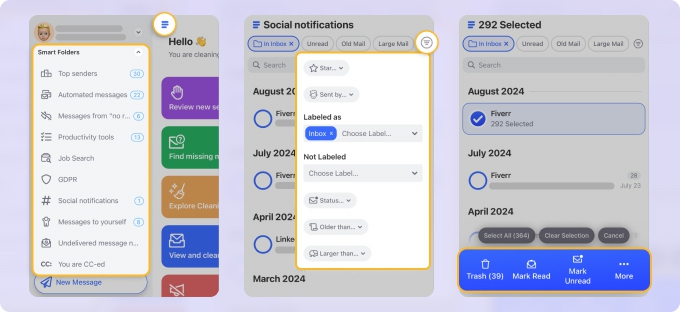
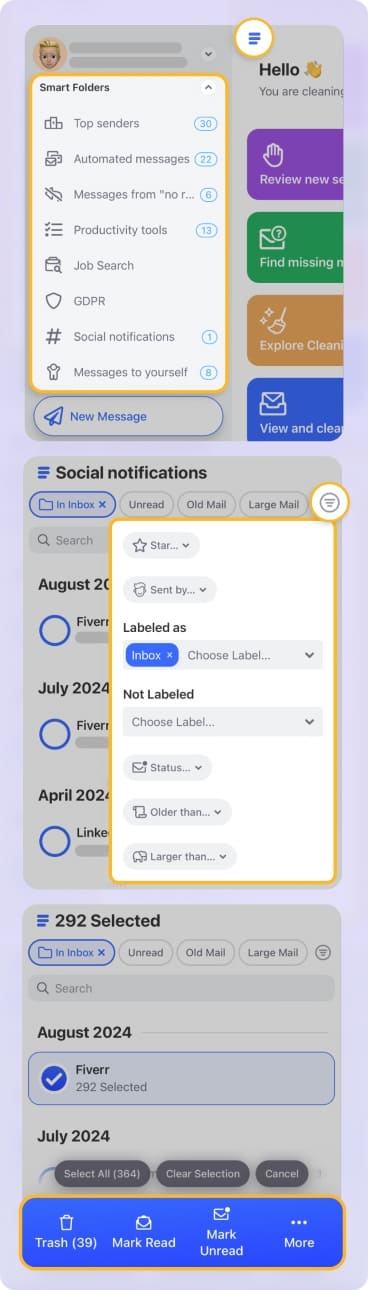
Additionally, you can break down how each folder sorts the messages, whether based on the newest or oldest messages, the number of messages (per sender), or the total size of the messages.
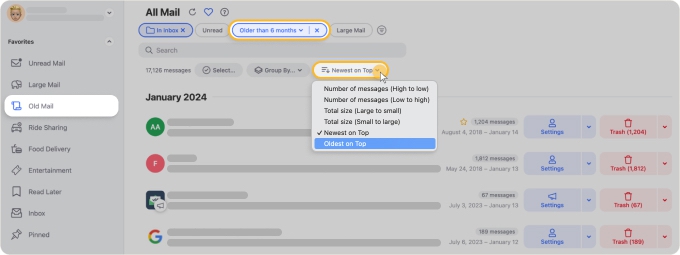
You can also sort and filter senders by criteria like Newest on Top or Email Address for finer control over what you act on.
Finally, the Preview Pane (which lets you preview individual messages and see all emails from the selected sender) lets you sort the pane's contents separately from the sort sequence applied to the main Smart Folder contents.
Privacy and security
Connects through IMAP using OAuth and reads only email headers and metadata, never the body of your messages or attachments. It does not sell your data and includes a Privacy Monitor feature that alerts you to data breaches involving your address.
Who should use it
- People with a large existing backlog who want to sort and clear it quickly
- Anyone who wants rule-based, automated cleanup that keeps running
- Users with several accounts across different providers who want one email management tool
How to sort email messages with Clean Email:
- Go to: https://app.clean.email/
- Sign in with your email account.
- Choose the Smart Folder in the left menu.
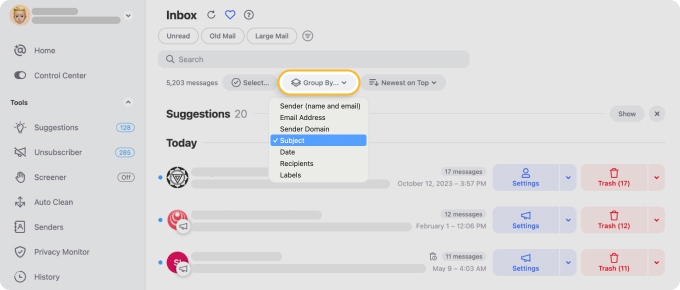
- To change the sorting order, click Newest on Top and select a parameter such as the number of messages sent by that sender, total email size, newest or oldest on top.
- Click Group by… and select a parameter such as sender name, email domain, subject, date, and more to group your emails.
- Finally, manage emails as you wish: select senders and apply bulk actions or set up Auto Clean rules to sort messages automatically.
Auto Clean keeps the sorting going on its own. You can set rules to label mail from specific people, archive receipts, or trash old promotional emails automatically, so you do not repeat those actions by hand.
- Easy-to-use predefined Smart Folders
- Automated email filtering with Auto Clean
- Advanced email management features
- Available on multiple platforms, including dedicated apps for iOS and Android
- Doesn’t allow creating custom Smart Folders, only providers-alike custom filters and labels
2. SaneBox
Price: Subscription. From $7 per month.
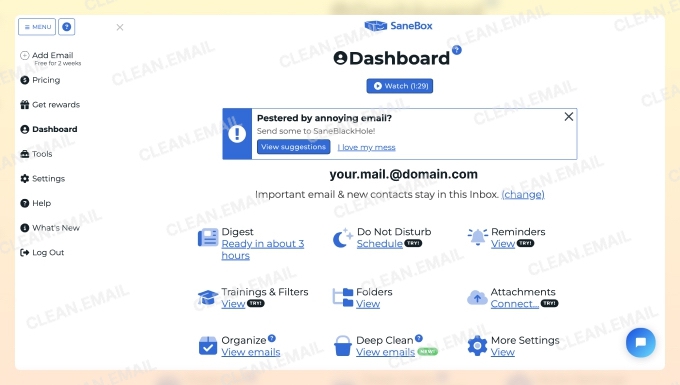
SaneBox is a simple yet powerful email sorter that has been around since 2010. I found it useful for managing incoming emails by automatically filtering out less important messages. The more I reviewed my inbox, the more the app learned from my actions and gradually improved its filtering.
How it sorts emails
SaneBox categorizes your incoming messages into different folders or labels, prioritizing messages based on their importance. The app offers several folders by default: SaneLater, SaneNews, SaneBlackHole, and SaneTomorrow, and more.
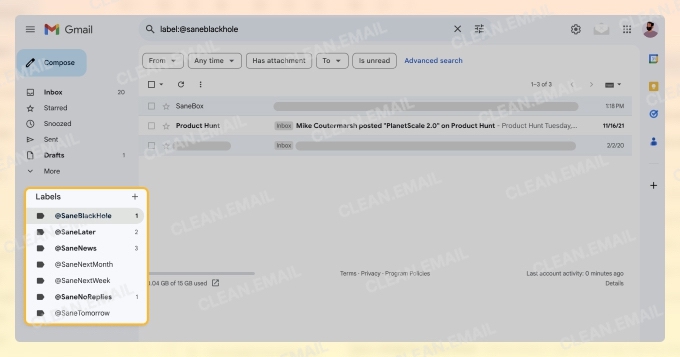
As I moved messages between these folders or took certain actions, the app adapted and refined its sorting to better align with my workflow. I also had the option to create custom folders and train SaneBox to use them for organizing my emails.
However, unlike Clean Email, SaneBox focuses on filtering new incoming emails rather than tackling existing clutter. As a result, its impact becomes noticeable over time rather than instantly, which may not be ideal for those looking for a quick way to clean up an overloaded inbox.
💡 Find out more in the Clean Email vs. SaneBox comparison.
The tool also offers features like the ability to see which emails haven’t received a response (SaneNoReplies), offloading attachments onto a cloud storage drive (SaneAttachments), and the ability to gather and mass delete old messages (Email Deep Clean).
SaneBox organizes new mail well, but it lacks deep-cleaning tools and ways to manage specific email groups. If your inbox is already overflowing, it clears slowly, which is its main drawback.
Privacy and security
Analyzes only your email headers and metadata; the bodies of your emails are never downloaded to its servers. It is SOC 2 Type II compliant and states that it does not sell user data, though a few optional features (such as SaneAttachments and SaneReminders) can require limited extra access.
Who should use it
- People whose inbox is roughly under control who want new mail triaged automatically
- Users who prefer a set-and-forget filter over manual organizing
- Not the right pick if you need to clear a large backlog fast
How to sort email messages with SaneBox:
- Go to: https://www.sanebox.com/
- Sign in with any email address.
- Wait for SaneBox to analyze your inbox and create Sane folders (labels in your inbox).
- Train the SaneBox filter by moving existing emails to your preferred folders. Note that the number of available folders depends on your pricing tier.
- New incoming messages will automatically be sorted into the assigned folders as soon as they arrive.
- If needed, you can always update your training via your dashboard or Digest.
- Hassle-free email sorting
- Trusted by many large brands
- Can’t create your own email rules
- Lacks advanced email management features
3. ActiveInbox
Price: from $5.37 per month.
Most of the mail you send and receive is tied to a task, so why sort it by date instead of by what you need to do? That is the idea behind ActiveInbox.
How it sorts emails
This Gmail extension turns your inbox into an email manager. Instead of copying details into a separate to-do app, you sort messages and build to-do lists straight from Gmail.
Namely, ActiveInbox gives you due date options to assign to each message in your Gmail account, thereby sorting them based on when you need to finish the task, respond to the message, or perform another action based on the message.
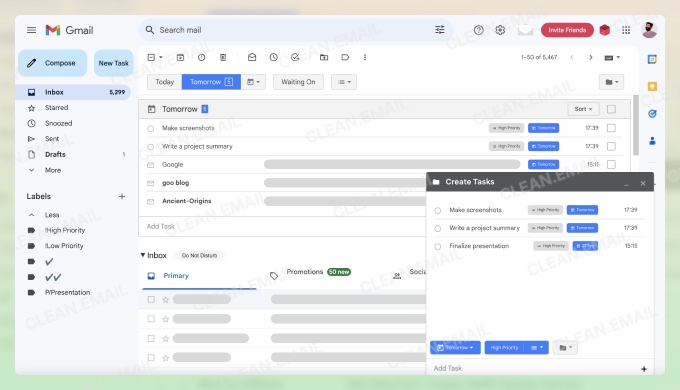
However, this prioritization system isn’t the only way to organize emails within ActiveInbox. The toolbar also gives you the option to create your own sorting folders. Similarly, you can use the Lists feature to assign labels to emails based on your created high-priority, low-priority, or custom lists.
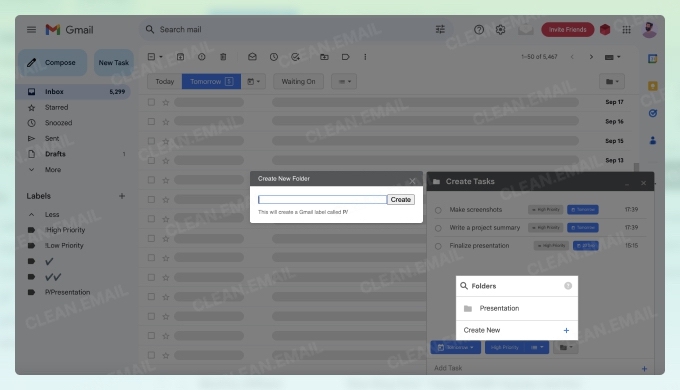
Finally, ActiveInbox has plenty of extra productivity-oriented features, including due date reminders, a dedicated follow-up (aka Waiting On) area, and more. You can even create checklists of subtasks for each message, jot notes down as you read the email, or click Related to view all other messages related to the one you have open.
Unfortunately, ActiveInbox doesn’t sort emails automatically like Clean Email. You must do everything manually, which can be time-consuming, especially in the beginning.
Privacy and security
Runs as a Chrome extension that connects to your Gmail account, so it has access to your full mailbox content rather than headers alone. Review Google's permission scope at install and ActiveInbox's privacy terms, since it works inside Gmail itself.
Who should use it
- Gmail users who think in tasks and deadlines rather than folders
- People who want their to-do list to live inside the inbox
- Not for anyone needing multi-provider support or automatic sorting
How to sort email messages with ActiveInbox:
- Go to: https://www.activeinboxhq.com/
- Download the Gmail extension into Chrome.
- Refresh (or open) Gmail.
- Create to-dos from your messages.
- Blends task management with email management
- Easy to get used to
- Works only with Gmail
- Available strictly as Chrome Extension with no mobile version
4. Sortd
Price: Free 7-day trial; premium plans start at $10/month.
Sortd is one of the best tools I’ve used to turn Gmail into a task management system. Like ActiveInbox, it integrates seamlessly into Gmail, allowing me to plan, prioritize, and sort Gmail emails alongside tasks—all within my inbox.
How it sorts emails
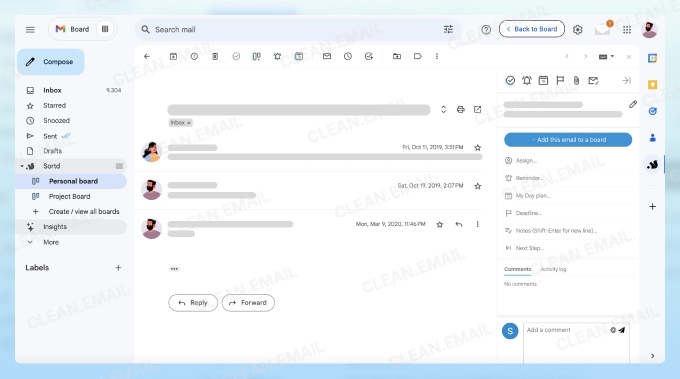
Instead of relying on folders and labels, Sortd transforms emails into a visual, Trello-style workspace. When I come across a message I need to act on later, I can simply drag it into a customizable column on the right. I set mine up for Ideas, Planned, In Progress, and Done, but Sortd lets you organize them however you like.
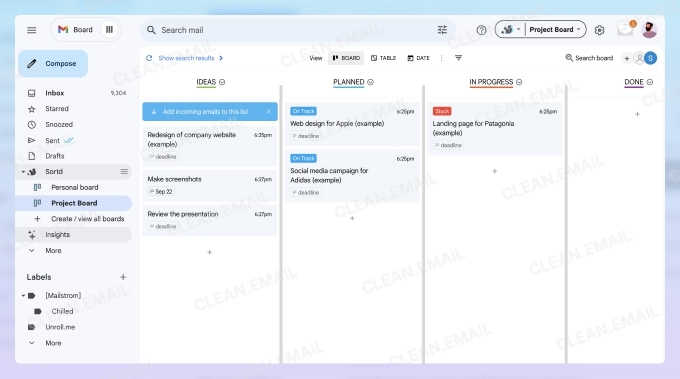
One feature I absolutely loved is Sortd’s Automation tools. Unlike some online email sorters that require completely manual organization, Sortd lets you automate repetitive tasks. I set up automations to sort incoming emails into specific lists, assign emails to teammates, and even apply actions like reminders and follow-ups.
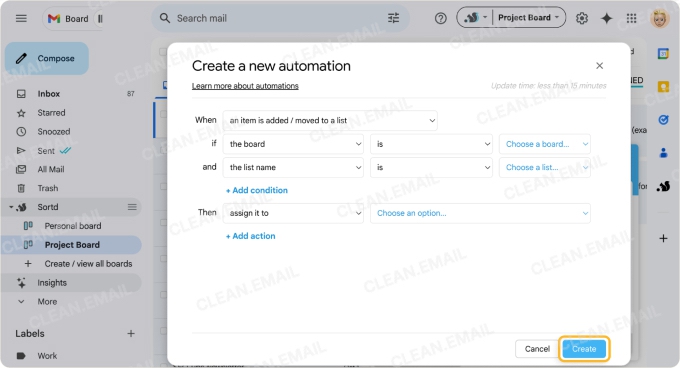
Sortd is strong for team collaboration. The premium version lets you share boards, assign tasks, and track emails together, which suits sales and customer service teams that need a shared inbox.
However, Sortd doesn’t automatically categorize emails based on type or importance, which I found to be its biggest limitation. It also only works with Gmail, so if you manage multiple email accounts, this might not be the best fit. For a deeper look into its features, check out the detailed Sortd app review.
Privacy and security
Installs as a Chrome extension and asks for permission to access your Gmail, giving it full content-level access to your inbox. As with any extension-based tool, check the requested permissions and its data-handling terms before connecting.
Who should use it
- Gmail users who prefer a visual, drag-and-drop board over folders
- Small sales or support teams who want a shared inbox view
- Not for multi-account users or anyone wanting automatic categorization
How to sort email messages with Sortd:
- Go to: https://www.sortd.com/
- Click the Add Sortd to Gmail and install the Chrome extension.
- Go to Gmail and configure Sortd to fit your workflow by setting up as many boards as you need.
- Move emails to relevant boards.
- Set up Automations to automatically sort incoming emails into lists, assign them to people, or apply other actions.
- Automation tools make sorting emails faster and easier
- Great for Trello users who prefer a visual approach
- Affordable compared to many other productivity tools
- No built-in smart email categorization
- Works only with Gmail
5. Reply
Price: Free 14-day trial; premium features starting at $89/month if billed annually.
Reply is an AI email sorter with 90% data accuracy for correct categorization. Like Sortd, Reply is designed for business use in mind. However, unlike virtually any other best email sorter on this list, Reply is not focused on everyday messages—it’s explicitly designed for sales-based email campaigns.
How it sorts emails
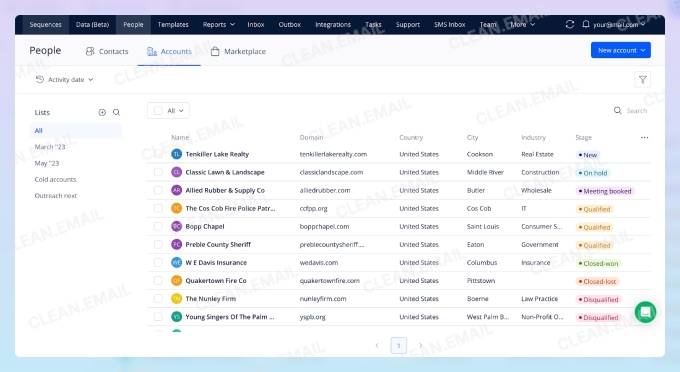
When you set up a new email campaign and add the data to Reply, the algorithm scans all replies you receive and labels them based on the reader’s interest. This method of sorting email helps you quickly find contacts interested in your offer and reply to them via the Inbox tab.
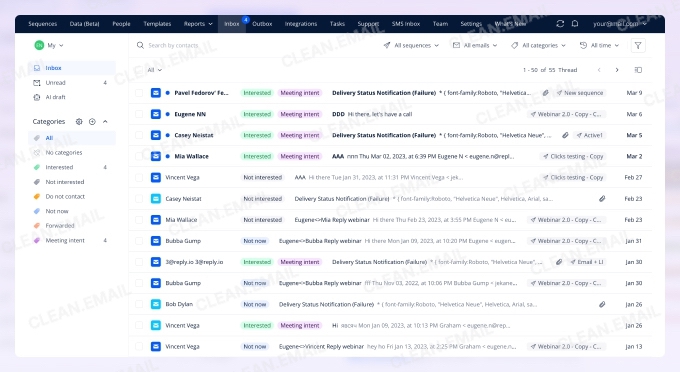
Reply sorts messages into six folders by default: Interested, Not Interested, Not Now, Do Not Contact, Forwarded & Meeting intent. However, you can add custom folder options for your messages if you desire. Also, you can transform messages in each folder into tasks so you can reply to messages, call interested clients, and more.
Reply is not built to sort a personal inbox and offers few tools for everyday accounts. But if your goal is to improve sales campaign results and speed up how you handle replies, it is a strong fit for that job.
Privacy and security
Connects to your sending mailbox and processes the content of your campaign emails to classify replies by intent. Because it reads message content for outreach automation, review its data-processing and retention terms, especially for prospect data.
Who should use it
- Sales and outreach teams who need campaign replies sorted by intent
- Anyone wanting to speed up how they handle campaign responses
- Not for personal inbox cleanup or general sorting
How to sort email messages with Reply:
- Go to: https://reply.io/
- Create an account to start your trial.
- Use the Sequences tab to set up a new campaign.
- Once replies come in, review them based on category in the Inbox tab.
- Powerful AI-backed algorithm sorts messages automatically
- Ability to set up custom sorting folders
- Not designed for personal use
- Only sorts replies to email campaigns
6. Superhuman
Price: Starts at $30/month when billed monthly, doesn't offer a free trial.
Superhuman is a premium email client built for speed and efficiency, making it a solid choice for professionals handling high email volumes.
How it sorts emails
Instead of traditional folders, it uses Split Inboxes to sort emails into categories like VIP, Team, and Calendar, helping users focus on what matters most.
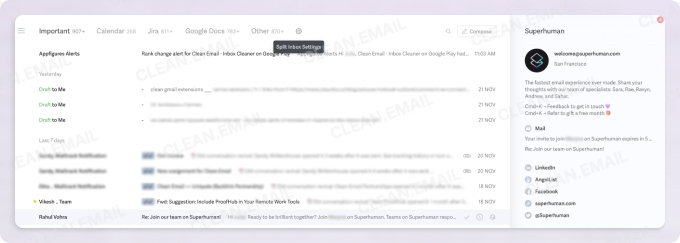
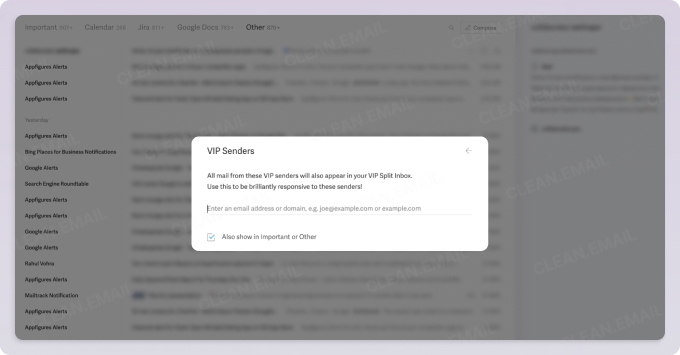
In my experience, the Split Inbox feature works well, but setting it up takes some effort since email addresses must be added to each split manually.
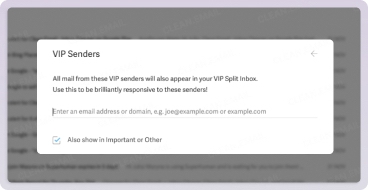
After trying it out, I found Superhuman’s AI-powered features useful for prioritizing important emails and drafting replies faster. It also supports keyboard shortcuts for nearly every action, allowing you to navigate and process emails without touching a mouse.
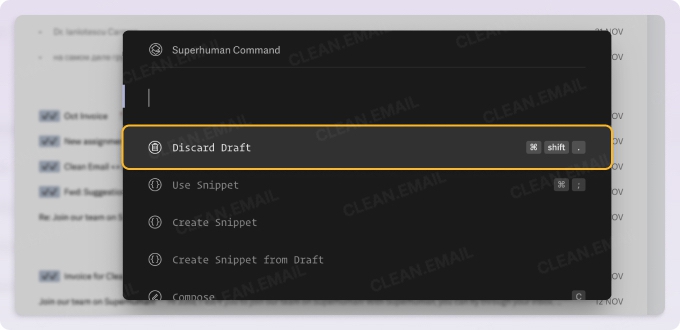
Superhuman does not fully automate sorting, but its AI learns your habits and improves triage over time. It does not match the automated sorting of Shortwave, which leans on AI-driven Bundles and rules.
For managing clutter, Superhuman includes unsubscribe and blocking tools, but these require manual confirmation. It doesn’t offer bulk unsubscribe or automatic filtering for newsletters, making it less effective for large-scale inbox cleanup.
Privacy and security
Operates as a full client for Gmail and Outlook, reading your message content to power triage and AI features, and it uses third-party language models (OpenAI) to process content. It supports only Gmail and Outlook and caches data locally for speed.
Who should use it
- Professionals who live in email and want maximum triage speed
- Keyboard-first users who value shortcuts over a mouse
- Not for people who mainly need bulk cleanup of an overloaded inbox
How to sort email messages with Superhuman:
- Sign up at https://superhuman.com/ and complete the onboarding process.
- Set up Split Inboxes to categorize emails based on your priorities.
- Use keyboard shortcuts to quickly archive, snooze, or apply other actions to emails.
- Enable AI-powered features for smart email prioritization.
- Ultra-fast email triage with keyboard shortcuts
- AI-powered email prioritization and reply assistance
- Sleek, distraction-free interface
- High subscription cost compared to other email sorters
- Limited to Gmail and Outlook accounts
7. Shortwave
Price: Free plan. Premium plans start from 9$/month.
Shortwave is designed specifically to help users reach and maintain inbox zero. Unlike traditional email clients, it follows a Getting Things Done methodology, combining manual actions with workflow automation to keep inboxes organized.
How it sorts emails
From my hands-on experience, I found that Bundles were one of Shortwave’s most useful features. This tool groups related email threads into a single row, reducing inbox clutter and making it easier to manage similar messages. Bundles can be created manually or automatically based on senders, though they require some initial setup.
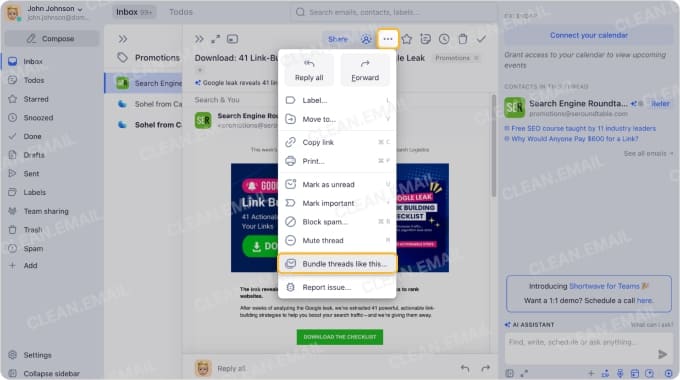
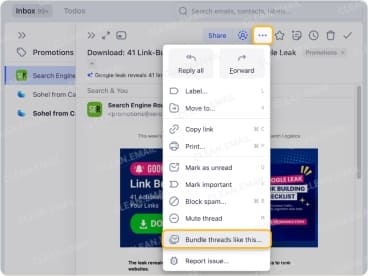
Shortwave also offers Smart Labels to automatically sort messages into categories. However, unlike Clean Email, these filters must be manually configured and only apply based on the sender. While useful, I found this setup less intuitive compared to Clean Email’s predefined Smart Folders, which require no manual rules.
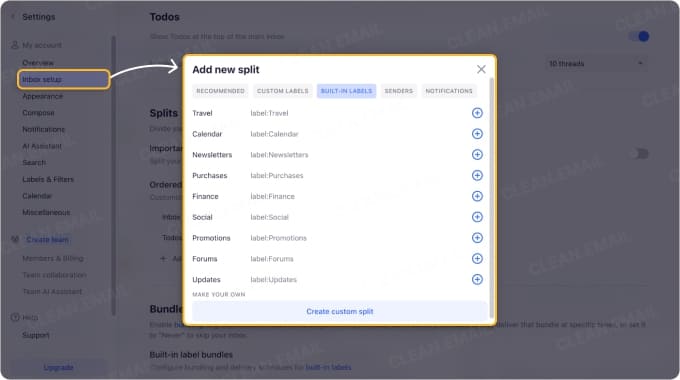
Shortwave is not just an email organizer; it is a full email client with built-in composition and sending, which makes it a cheaper alternative to Superhuman.
Privacy and security
Works as a full email client for Gmail and reads and indexes your entire email history so its AI can search, bundle, and summarize. That is broad content access by design, so weigh it against the convenience of the AI features.
Who should use it
- Gmail users who want AI-assisted bundling inside a real client
- People chasing inbox zero who do not mind some setup
- Anyone wanting a lower-cost alternative to Superhuman
How to sort email messages with Shortwave:
- Download the Shortwave app or visit https://www.shortwave.com/
- Go to Settings and choose Splits under Inbox setup, use them to automatically sort your incoming mail.
- Use Bundle threads like this… button to automatically group similar emails together.
- Perform triage by categorizing messages as Pin, Snooze, Done, or Delete.
- Provides a variety of sorting and labeling options
- Makes it easy to prioritize messages
- Lets users send messages from the app
- Requires a lot of manual work to set up
- The learning curve can feel steep for beginners
8. Hey Imbox
Price: Starting at $99/year. Free trial for 14 days.
Unlike most email sorting apps, Hey Imbox does not sort messages after they land in your inbox. It sorts before they arrive, holding new senders in The Screener until you approve them.
How it sorts emails
In addition to The Screener, Hey Imbox sorts all messages into one of three buckets: The Imbox, The Feed, and The Paper Trail. You tell the app where you want messages to go, and it handles the rest going forward. Your Imbox is for important emails you want to read immediately, while non-urgent emails like newsletters that you read occasionally go to The Feed. For things like receipts you rarely need to read, The Paper Trail is the place to go.
Depending on how you handle messages that require a response, you can also use the Reply Later label to sort messages that need a thoughtful response. This label separates the emails from the rest, so you can easily sit down and reply to multiple messages at once.
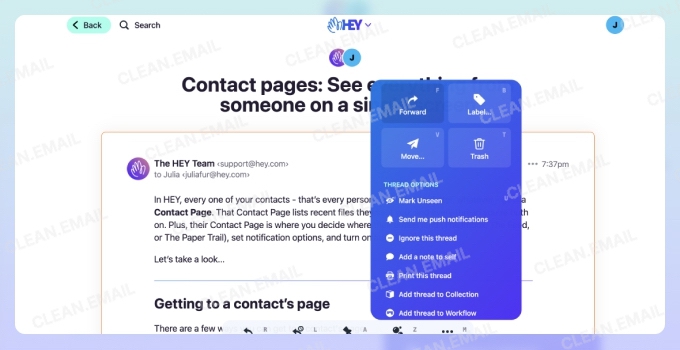
Like Shortwave, Hey Imbox gives users additional sorting and classification options like the ability to thread together multiple messages on the same topic. You can also ignore or remove yourself from threads or newsletters you no longer want.
Privacy and security
A hosted email service that stores and serves your mail, so Basecamp is the custodian of your inbox rather than a layer on top of it. It blocks spy trackers by default and states that it does not sell your data, but it has no IMAP or POP access, which limits export.
Who should use it
- People who want to screen new senders before they reach the inbox
- Anyone open to a fresh inbox model and a dedicated client
- Not for users who need granular rules or to keep their existing setup
How to sort email messages with Hey Imbox:
- Download the mobile app or visit the Hey Imbox web interface at https://www.hey.com/
- Go to your Screener and start marking whether certain senders should be in your Imbox, Paper Trail, or Feed.
- Places all messages from unrecognized addresses into a screener
- Places messages in buckets based on their importance
- Lets you bundle together messages into threads
- No advanced labels or email rules options
- Requires you to use their @hey.com email address unless you pay extra
AI Email Sorters vs Traditional Email Filters
Traditional filters follow fixed rules you set by hand, such as moving messages from one sender into a folder. AI email sorters decide where mail goes by reading patterns instead, and the two approaches often work well together.
How AI sorting works
An AI email sorter classifies, prioritizes, or groups messages using signals like sender behavior, your past actions, message content patterns, and likely intent. Instead of you writing every rule, the tool predicts where a message belongs, and accuracy usually improves as it sees more of how you handle your inbox. It is prediction rather than certainty, so results vary from one inbox to another.
Benefits
- Less manual rule creation
- Better prioritization over time
- Useful for high-volume inboxes
- Can surface important emails faster
Limitations
- AI can misclassify emails
- Setup or training may still be needed
- Some tools mostly affect new incoming mail
- Not every AI email sorter is designed for personal inbox cleanup
Best AI email sorters
- Cora (by Every): screens and groups your mail, keeps only what needs a reply in the inbox, and sends a twice-daily brief summarizing the rest (Gmail)
- NewMail AI: sorts incoming mail with AI and sends daily briefings, adapting to how you handle your messages
- Jotform Gmail Agent: uses AI to auto-label emails inside Gmail and surface only the ones that need your attention
Bonus: Sky Extractor Email Sorter Software
Price: Varies based on features.
If you work with email distribution lists, you may find them to be messy and downright frustrating to use. What’s more, each email provider has its own unique spam settings that require slight variations in your correspondence to not end up in spam. Luckily, Sky Extractor works like email sorting software, but for your mailing lists.
To use this tool, you simply import any lists you have, then let the tool sort them based on the mx exchanger. Once it’s done, you’ll have a list broken down by email provider that you can view breakdowns based on domain and export it that way or into a single list.
You can check out the free trial downloadable to test how Sky Extractor Email Sorter works. However, it is only compatible with Windows devices at this time.
Benefits of Email Sorter Software
Do you know how many emails you receive every day? Given that approximately 350 billion emails are sent and received globally each day, this averages to over 44 emails per individual daily.
People who use email for work often get more than 100 messages a day.
Because not all emails are equally important, it doesn’t make much sense to manage them as if they were, but that’s exactly what most people do. The common approach is to tackle emails chronologically, working from the latest to the oldest. If this sounds familiar, you need bulk mail sorting software in your life.
Tips for Sorting Email
Whether you use an email sorting system or just implement better inbox management yourself, these tips for organizing email will help you sort messages and clean your inbox more effectively.
- Use Folders or Labels: Create folders or labels to categorize emails based on topics, projects, or senders.
- Prioritize with Stars or Flags: Use stars, flags, or other visual markers to highlight important emails that need your attention.
- Unsubscribe and Filter: Unsubscribe from unnecessary newsletters and promotional emails, and set up filters to automatically sort incoming messages.
- Set Up Priority Inbox: Use your email provider's priority inbox feature to automatically categorize important, unread, and less important emails.
- Archive Regularly: Archive or file away emails you've dealt with to keep your main inbox clutter-free.
- Use a Consistent Naming System: Give your folders, labels, and files clear and consistent names to quickly find what you need.
- Utilize Search Effectively: Learn to use search operators to quickly locate specific emails instead of scrolling through your entire inbox.
- Batch Processing: Group similar tasks together and process emails in bundles to improve efficiency.
- Unclutter with Rules: Use email rules to automatically sort, categorize, or forward emails based on predefined criteria.
Conclusion
There is no single best email sorter, because the right choice depends on the problem you are solving.
- For clearing and organizing an overloaded inbox, Clean Email handles bulk sorting, sender and group-based organization, Smart Folders, and automated cleanup rules.
- For keeping new mail triaged automatically, SaneBox filters incoming messages and learns as you go.
- If you run Gmail as a task list, ActiveInbox and Sortd turn messages into to-dos and visual boards.
- For a productivity-focused client, Shortwave and Superhuman speed up triage with bundles, splits, and keyboard shortcuts.
- Reply is the pick for sorting sales campaign replies, and Hey screens senders before they reach you for a different inbox model.
Start from your need: cleanup, AI prioritization, Gmail task management, sales reply sorting, sender screening, or a full email client. That decision points you to the right tool faster than any ranking can.
Follow our guides on how to sort emails in Outlook and how to sort Yahoo Mail by sender.
Frequently Asked Questions
What is an email sorter?
An email sorter is software that organizes incoming or existing mail into groups by sender, topic, importance, date, or size. Some sort automatically, others let you sort by hand, so you can deal with what matters first instead of working through everything in order.
What is the best email sorter for Gmail?
It depends on the goal. ActiveInbox and Sortd suit task and board workflows inside Gmail, Shortwave is good for AI bundling, and Clean Email works well for sorting and cleaning an existing Gmail backlog in bulk. There is no single winner for every Gmail user.
Are email sorter apps safe?
Safety depends on the permissions a tool needs and how much of your mailbox it reads. Some access only headers and metadata, while others need full content access as an email client. Check the provider, the access scope, and the privacy policy before connecting an account.
Can I automatically sort emails by sender?
Yes. Most sorters can group or route mail by sender. Clean Email groups every message from a sender together for bulk actions or Auto Clean rules, and tools like SaneBox can route senders into folders automatically.
Is there a free email sorter?
Yes, some email sorters are free, especially built-in tools like Gmail filters and Outlook rules. Third-party email sorter apps may offer free trials or limited free plans, but advanced automation, bulk cleanup, or AI sorting usually requires a paid subscription.