Can You Sort Gmail by Size?
The short answer is: No, Gmail does not support true sorting by size. So, what does Gmail provide in the way of size sorting?
First, it’s important to distinguish between sorting and filtering because you can filter by size in Gmail. Using the advanced search features, you can select the size as a criterion for matching messages or use search operators to locate emails by size.
Unfortunately, you can’t sort your messages by size, such as largest to smallest or vice versa.
This means that if you’re trying to find and delete your biggest emails to clear out some storage space, you’ll need to perform extra manual steps or consider a cleanup tool other than Gmail, such as Clean Email.

The Fastest Native Gmail Method (Search-Based)
As mentioned, to locate emails by size in Gmail, you’ll need to use the search features. Once you do, you can select multiple messages and hit Delete.
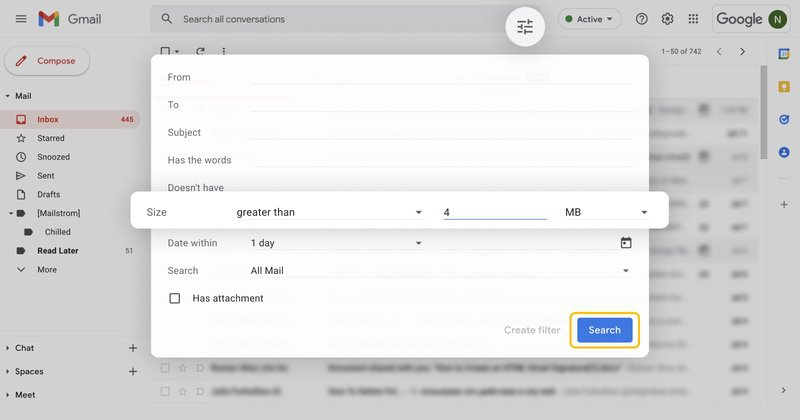
With the advanced search options, you can choose greater than or less than a size you enter. For example, you can find emails greater than 4 MB:
- In Gmail on the web, click Show search options at the right end of the search bar.
- Next to Size, choose greater than, enter a number such as 4, and pick MB.
- Click Search, then select the emails you don’t need and click Delete.
The Gmail mobile app has no advanced search form, but you can type the size operators below into its search box.
As an alternative, you can use one or more search operators to find your messages on the web or mobile device. For instance, you can enter a single operator like larger:5M or combine operators like has:attachment older_than:1y larger:5M. Gmail search skips Spam and Trash, but both count toward your storage, so add in:anywhere to include them.
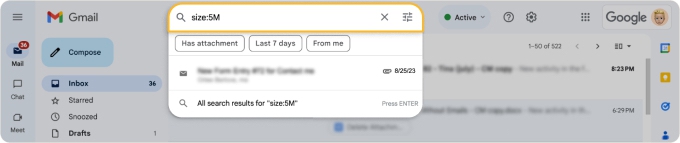
After you receive your results using either of these methods, you cannot sort them in ascending or descending order or even see the sizes of the found emails. To get close to a largest-first view, start with larger:20M, delete what you don’t need, then repeat with larger:10M and larger:5M.
Some users in the Gmail Help community suggest performing calculations or downloading an email to see its size, but there is a better and faster method, which we’ll explain next.
The Fastest Non-Gmail Method
Rather than jump through hoops to find and remove emails by size in Gmail, you can use Clean Email with its grouping, sorting, and bulk action tools to quickly clear out your mailbox and regain space.
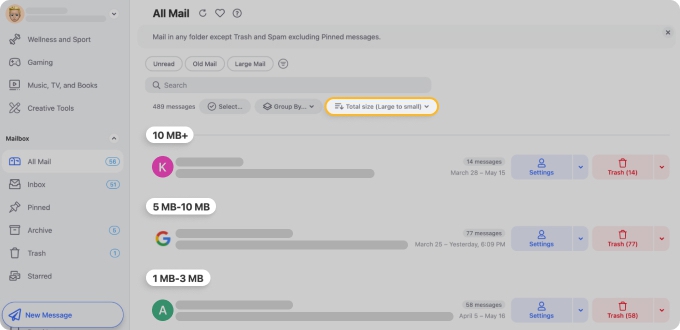
Sort by size: In your Inbox, All Mail, or using a filter such as Unread emails, you can sort your messages from large to small (or small to large). This lets you find big mail quickly and see it right at the top.
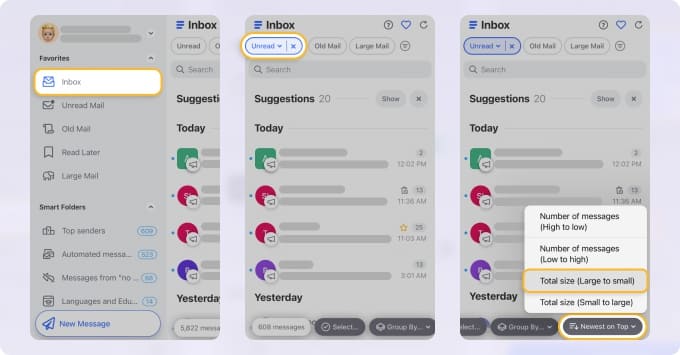
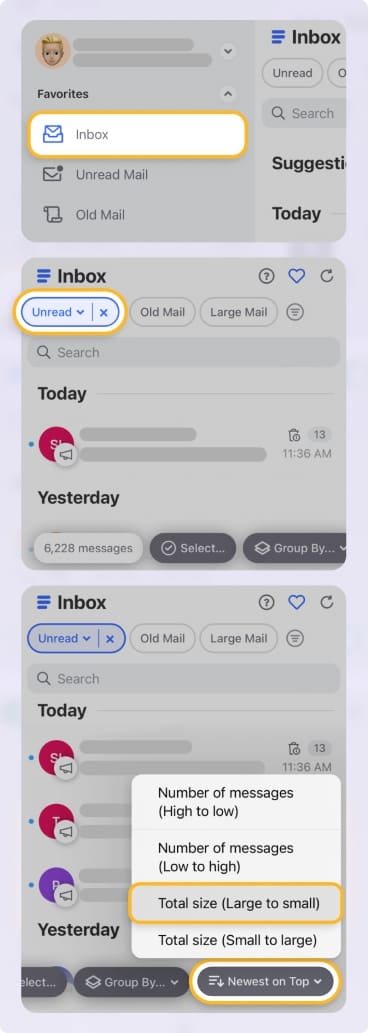
Sort and group: Along with sorting by size, you can add different grouping options. For example, you can find emails larger than 1 MB and then sort Gmail from oldest to newest and group by sender.
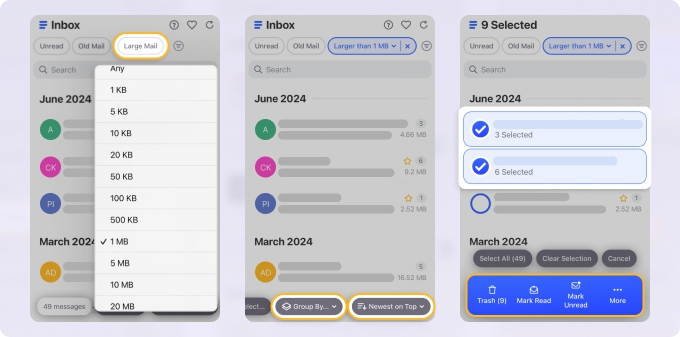
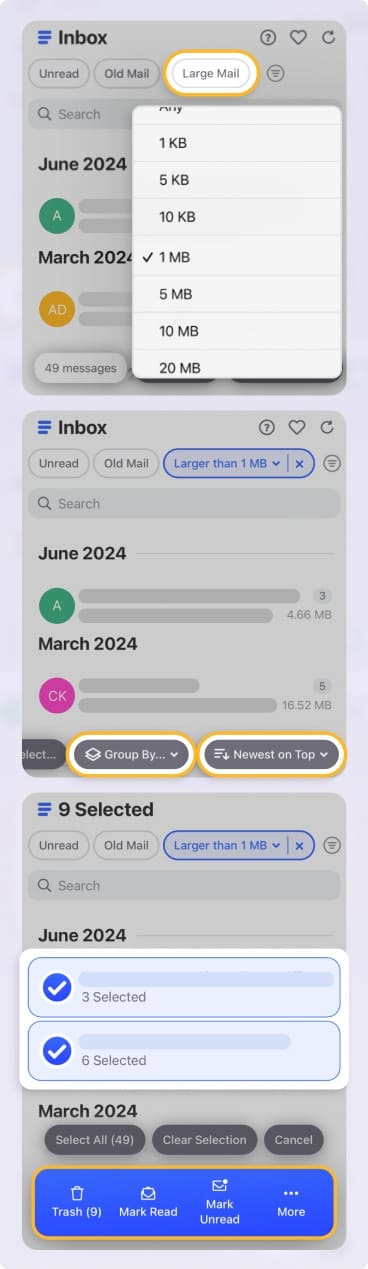
Apply bulk actions: Once you find the emails you want to act on, you can use bulk actions to handle hundreds or even thousands of emails at once without repeated searches. For instance, you can select all found messages and then delete or trash them in a single step.
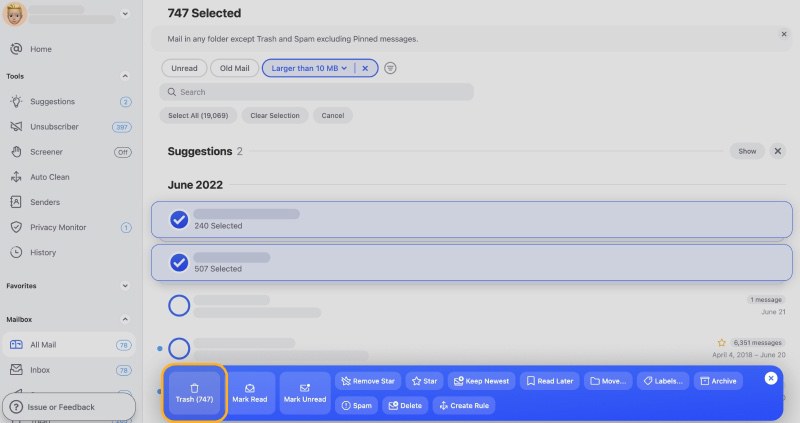
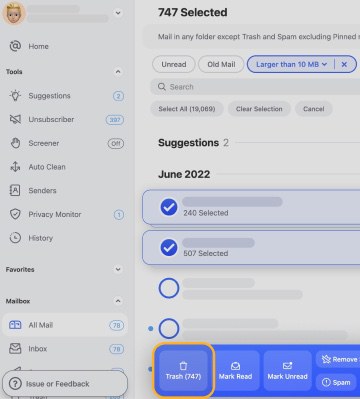
Clean Email isn’t a Gmail replacement --- it works with your email provider to give you advanced features that Gmail and others miss. Plus, the entire feature set is available in both the desktop and mobile apps.
Google One Storage Manager (When Gmail Is Already Full)
If you are totally out of Gmail storage, unable to send or receive emails, and willing to permanently delete large messages, you can consider the Google One Storage Manager. With its cleanup tools, you can clear out your storage in a hurry.
Open the storage manager, choose Gmail, and review the emails with large attachments it lists. Select the ones you don’t need, then choose Delete.
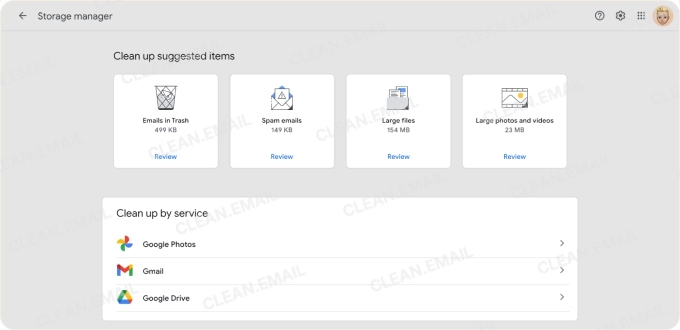
Just remember that deleting emails with this method removes them completely --- you cannot recover the messages you delete with the Google One Storage Manager.
Why Gmail Still Makes Cleanup Hard
Gmail doesn’t provide a Size column like many other providers or offer bulk logic for sorting and grouping such as by sender, age, and size.
That matters because Gmail lets you send up to 25 MB of attachments per email and receive up to 50 MB. If you get a lot of files, photos, and documents, just 100 emails at that size can use 2.5–5 GB of storage.
To avoid extra steps and manual repetition, check out Clean Email for your Gmail storage cleanup. Using its smart features, you can find and remove large emails without extra work. Not only that, but you can create an effective cleaning system so that you won’t be without Gmail storage again.