Why You Need a Third-Party App to Delete Email Subscriptions
Major email services like Gmail, Yahoo, Outlook, and Apple Mail offer built-in unsubscribe buttons. However, these only appear when senders include a valid unsubscribe link or List-Unsubscribe header in the email.
Gmail now has a dedicated "Manage subscriptions" page that groups together frequent senders and lets users unsubscribe directly from that dashboard. However, unsubscribing still happens one sender at a time.
Some senders also ignore unsubscribe requests or continue sending emails from other distribution lists connected to the same domain. This makes manual unsubscribing slow and unreliable.
Third-party unsubscribe apps simplify this process by helping you bulk unsubscribe, block unwanted senders, and automate inbox cleanup.
💡 Note: The tools below only help you unsubscribe from email subscriptions. If you’re searching for “how do I unsubscribe from an app,” you’ll need a different solution to cancel App Store subscriptions or Google Play purchases.
The 9 Best Unsubscribe Apps Available Today
A quick internet search for an email unsubscribe app will yield dozens of possible options. Therefore, I’ve carefully tested the best email unsubscribe app recommendations and am sharing what I’ve learned so you can decide which email unsubscribe tool will work best for you.
When comparing these tools, I looked at the ease of use, unsubscribe accuracy, and other included features before recommending what I feel are the best options.
Based on my testing, these are the top nine apps to unsubscribe from emails available today:
- Clean Email: Best Overall Tool to Mass Unsubscribe from Emails
- Leave Me Alone: Simplest Service to Unsubscribe from Emails
- Mailstrom: Easy-to-Set-Up Email Unsubscribe App
- Chuck Email: Great & Simple for Apple Users
- Shortwave: Best Unsubscribe Tool for Gmail
- Superhuman: Ideal for Professionals Who Rarely Need to Unsubscribe
- Apple Mail App: Native Option for iPhone and Mac Users
- Sanebox: Not Really an Unsubscriber But an Email Sorting App
- Unlistr: Formerly a Popular Outlook Option (No Longer Available)
🎯 I only included options on this list that are privacy-focused because I do not recommend using free apps to cancel email subscriptions as usually these are the services that sell user data, even when it is anonymized and aggregated.
1. Clean Email
Platforms: iOS, macOS, Android, web
Clean Email helps users unsubscribe from newsletters, organize subscription emails, and automate inbox cleanup across multiple devices. On iPhone, get the Clean Email unsubscribe app from the App Store.
The tool uses a high-end algorithm to intelligently bundle related emails together, making it easy to organize, clean, and unsubscribe emails in bulk instead of going through them individually.
How it works
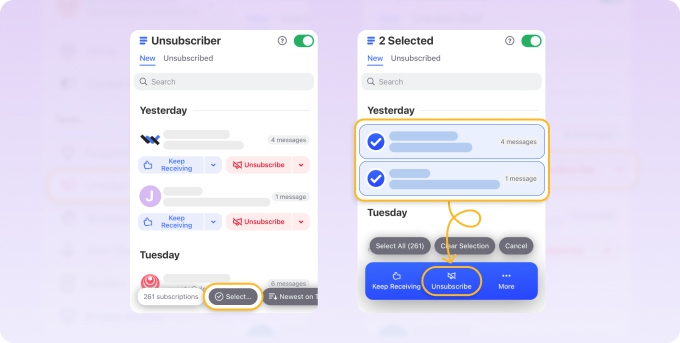
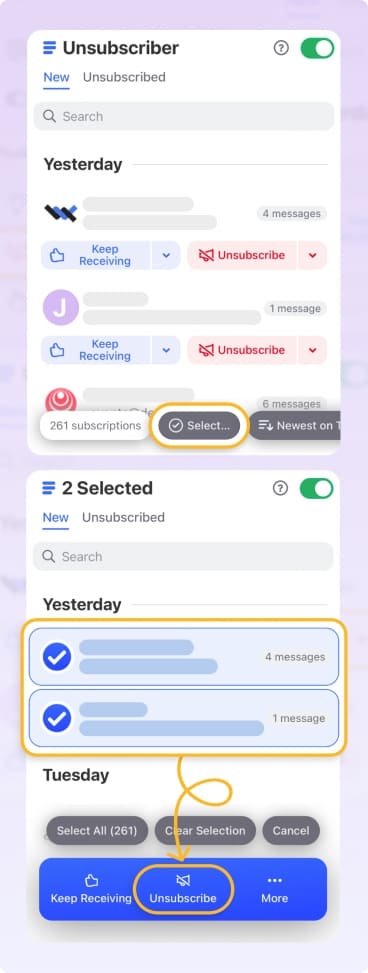
After connecting your mailbox, you can open the Unsubscriber tool from the left-side menu. The tool sorts subscription emails by the date they were received, placing the newest senders at the top.
From there, you can just click Keep Receiving or Unsubscribe. If you choose to opt out, the app will place an unsubscribe request on your behalf and move all new and existing messages from this sender into your Trash folder.
You can also easily select multiple senders and mass unsubscribe from emails no matter which email provider you use.
You can also choose to Pause certain newsletters instead of removing yourself from the distribution list completely.
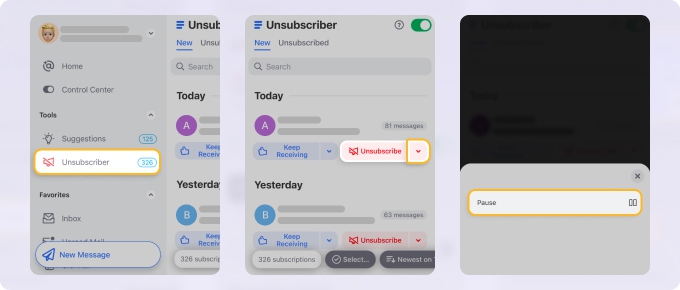
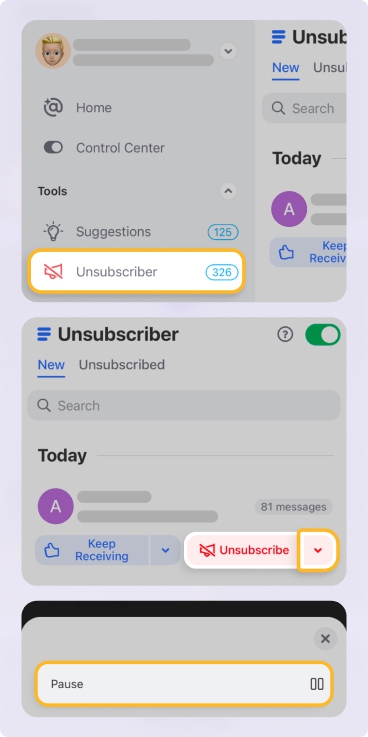
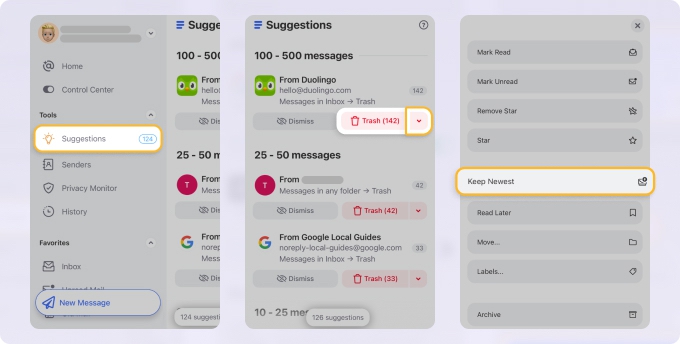
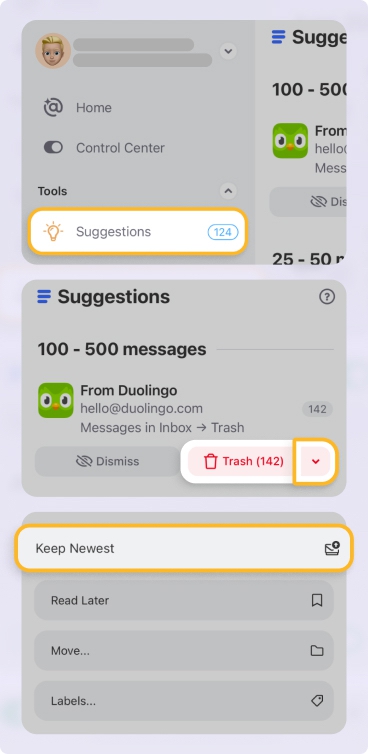
Similarly, you can select to keep only the newest message from a sender or set an automatic cleaning rule to move all messages from that sender to a dedicated folder.
Features beyond unsubscribing
In addition to working as an app that unsubscribes you from emails, Clean Email also offers an array of inbox management tools that make it easy to maintain a clean inbox.
- Its Cleaning Suggestions save you time by recommending quick actions for similar messages you've previously cleaned or ones frequently cleaned by other Clean Email users.
- Auto Clean takes this further, letting you automate repetitive tasks—like deleting promotional emails older than two weeks or blocking entire domains when unsubscribing isn’t an option.
- Screener quarantines emails from unknown senders, helping make Clean Email one of the best apps to stop junk email.
Limitations
- Clean Email includes far more than basic unsubscribe functionality, which may feel overwhelming for users who only want a simple one-click unsubscribe tool.
- The initial setup process can also take longer than lighter alternatives.
- The app doesn’t offer a unified inbox view, so if you connect multiple accounts, you’ll need to switch between them to manage each inbox separately.
- Truly unsubscribes from legitimate senders and blocks spam with Screener
- Numerous unsubscribe options (pause, keep newest, etc.)
- Can unsubscribe from all newsletters at once on any device
- Offers comprehensive mailbox management features
- Advanced features may be too much for users who only need basic unsubscribing
- Doesn’t have a dedicated app for Windows
Price
Offers a free plan for up to 25 unsubscribe actions and a 14-day trial of Premium features under a subscription model.
Email providers supported
The app supports all major service providers including Gmail, Yahoo! Mail, Outlook, Office 365, and any other IMAP-based accounts.
2. Leave Me Alone
Platforms: web, Android
Leave Me Alone is another popular email unsubscribe app that takes the privacy of its users to heart. It also offers users a robust screening tool to effectively manage and filter out incoming emails.
However, it lacks many advanced email management features found in other apps that unsubscribe emails. It can handle existing messages from the senders you unsubscribe from, but it doesn't clean up the rest of your mailbox, so old messages, large attachments, and mail from people you no longer contact stay untouched.
How it works
In Leave Me Alone, most users sign up by connecting their Google, Microsoft, or Yahoo account directly. Only iCloud and some IMAP accounts still require creating an app-specific password.
Once you have verified your email and finished the setup, Leave Me Alone will provide you with a list of subscription messages it found, sorted by sender.
From here, you can mark whether you want to keep the messages from each sender in your inbox, add them to a rollup, or unsubscribe.
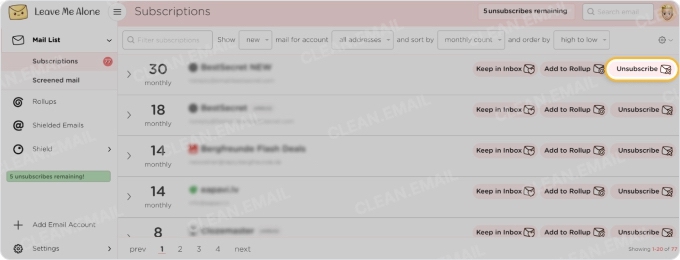
Leave Me Alone sends unsubscribe requests to email senders and lets you choose what happens to existing messages: leave them in place, move them to a selected folder (such as "unsubscribed-mailing-lists"), or send them straight to Trash.
If a sender keeps emailing after you unsubscribe, Leave Me Alone can apply a provider filter or use its Spam Blocker to keep future messages out of your inbox.
Features beyond unsubscribing
- The Rollups feature consolidates selected newsletters and sales offers into scheduled digests (up to 10 categories), delivered at the time you choose. You can even combine newsletters from multiple accounts into Rollups sent to your main account. It only works for subscription emails and doesn’t organize non-subscription emails.
- Along with its user-friendly tool to unsubscribe from emails, Leave Me Alone offers the Screener feature (formerly Inbox Shield), similar to the Screener tool in the Clean Email app. It intercepts messages from new senders and lets you decide whether to allow or block them.
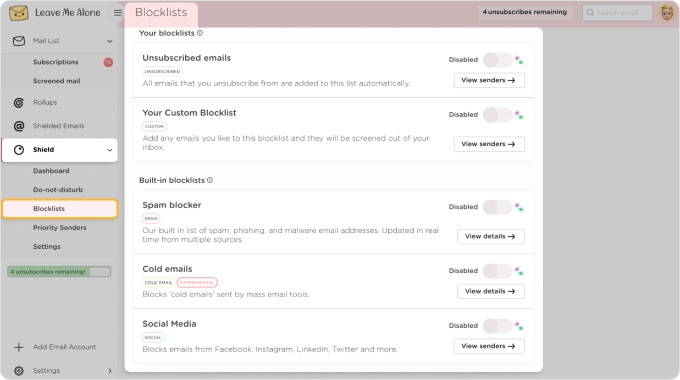
- Spam Blocker, which replaced the old Blocklists in June 2026, automatically classifies and blocks spam, phishing, and cold emails. Your custom block rules and unsubscribe blocklists now live inside Spam Blocker.
- Do Not Disturb holds non-priority mail in a dedicated folder on a schedule you set, while Priority Senders make sure important contacts always reach you. Private Emails (formerly Shielded Emails) create forwarding addresses you can hand out instead of your real one.
💡 To explore more, see our detailed review of Leave Me Alone and its alternatives.
Limitations
- The Screener and Spam Blocker features don’t automatically unsubscribe you from those blocked senders, meaning their emails will continue to take up space.
- Both the Rollups feature and the Screener tool in Leave Me Alone are exclusive to paid subscribers and are not included in the free version.
- Its automations are tied to subscriptions and senders, and it can’t bulk-clean the rest of your mailbox by age, attachment size, or sender.
- Genuinely unsubscribes from emails, rather than just blocking them
- Compiles multiple emails into scheduled digests
- Offers efficient spam-blocking and email filtering
- Identifies spy trackers in emails
- No whole-mailbox cleanup beyond subscriptions
- iCloud and some IMAP accounts still need an app-specific password
- No feature to pause subscriptions or resubscribe
- Lack of advanced email management tools
- iOS app still not available, and the Android app has fewer features than the web version
Price
10 free unsubscribes. $19 for a 7-day full access pass (2 accounts). Yearly plans cost $90/year for Casual Emailer (4 accounts) or $160/year for Inbox Zero Hero (unlimited accounts).
Email providers supported
This email unsubscribe app supports Gmail, Google Workspace, Outlook, Office 365, Live, Hotmail, MSN, Yahoo, iCloud, AOL, and all other mailboxes that work with IMAP.
3. Mailstrom
Platforms: web
Mailstrom offers a web-based unsubscribe service that is compatible with a wide array of email providers. With Mailstrom, you can declutter your inbox, delete messages in bulk, block senders, and unsubscribe from newsletters.
This email unsubscribe tool sorts your messages by size, time, sender, subject, and more, which makes it easier to take action on a group of similar messages all at once.
How it works
To unsubscribe from mailings in Mailstrom, select Mailing Lists in the View Messages By section in the left menu bar. From here, you can select a sender and then choose Unsubscribe from the options in the top menu bar.
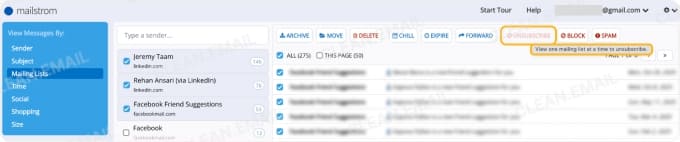
You can choose to unsubscribe only, or to unsubscribe and also delete existing emails from the selected sender.
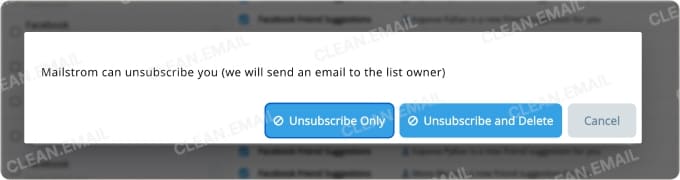
If an unsubscribe email address is present, Mailstrom will send an unsubscribe request to the list owner on your behalf. If no unsubscribe address is available, it opens the sender’s website in a new tab so you can complete the process manually, and creates a Block filter for that sender.
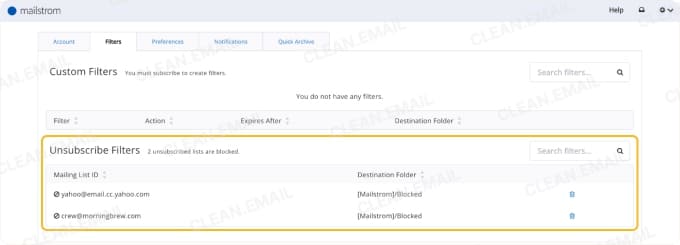
💡 Check out our detailed Mailstrom comparison article for a closer look at how the app works.
Features beyond unsubscribing
You can use this service not only as a website to unsubscribe from emails but also to delete all messages in your mailbox from a single sender, mark the sender as spam, block their address, and more.
Mailstrom keeps track of how many messages you get rid of per day with a handy tracker, and detailed statistics can be reviewed on the Insights page, which can help some people stay motivated when clearing out the clutter.
Other tools include Expire, which automatically removes matching messages from a sender or mailing list after a selected period, Chill, which hides selected emails until a future date, and Quick Archive, which moves all messages received before a chosen date into folders organized by month.
Limitations
- Mailstrom is more focused on inbox cleanup than advanced unsubscribe automation, so some actions still require manual work.
- It organizes only messages in your Inbox folder, and the Block option doesn’t automatically cover new addresses from the same domain.
- The app doesn’t support unsubscribing from multiple senders simultaneously; the Unsubscribe option is disabled when you select multiple senders. That said, the Block button remains functional as an alternative way to manage emails in bulk.
- The service is primarily web-based and lacks the deeper automation and smart inbox management features offered by more modern apps that unsubscribe emails.
- Easy to navigate
- Simple filters by size, sender, subject, or date
- Supports multiple email providers and accounts
- Offers a free trial with manageable limits
- No bulk unsubscribing option
- Redirects to sender’s site without an unsubscribe address
- Only available via the web (iOS cleanup requires the separate Chuck Pro app)
- Interface may seem dated
- Only basic automation (Move, Block, and Expire rules)
Price
Begins at $9/month or $59.95/year for one email account, with a one-month free trial that shows your latest 5,000 emails and lets you delete, archive, or move up to 25% of them. The subscription now also includes Chuck Pro for iOS at no additional cost.
Email providers supported
Mailstrom supports Gmail, Outlook, Yahoo Mail, Live, MSN, and other mailboxes that work with IMAP.
4. Chuck Email
Platforms: iOS
If you are a die-hard fan of Apple products, then Chuck Email may be the right email subscription cleaner for you. This Mailstrom's sibling product is exclusively designed for iPhone and iPad (it can also run on Apple Silicon Macs with macOS 13 or later, though Apple marks it as not verified for macOS), and it makes taking your name off mailing lists a breeze.
How it works
Once you download this email unsubscribe app and connect your inbox, you can use the Unsubscribe feature by clicking on it in the bottom menu bar.
Similarly to Clean Email and Leave Me Alone, the tool will display any senders currently in your inbox that you can unlist from. Simply select the senders, then choose Unsubscribe from [number of selected] lists to remove them from your life! Note that this mass Unsubscribe tool is part of Chuck Pro, while the free version only lets you unsubscribe message by message.
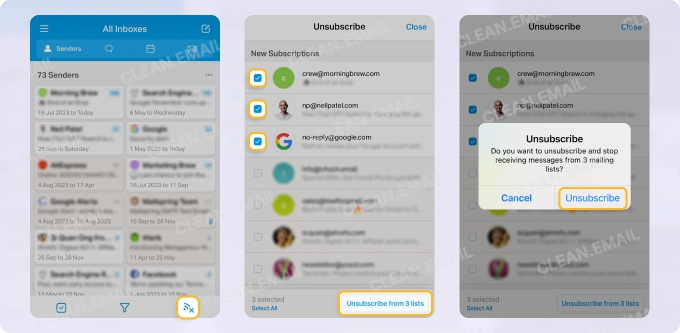
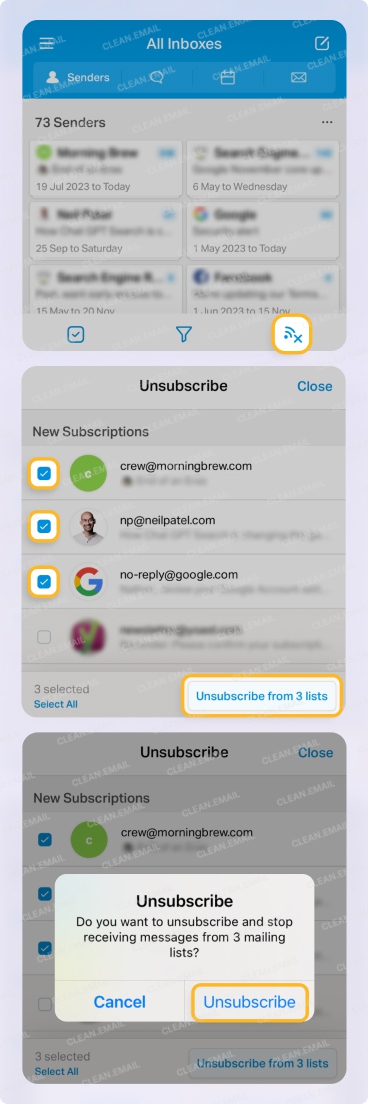
When you unsubscribe, the app sends requests to senders and removes you from lists only if they honor these requests. Similar to other email unsubscribe apps, Chuck’s unsubscribe feature is limited to senders who have provided an Unsubscribe button in their communications.
Chuck doesn’t notify you whether a request was successful (unless the sender emails a confirmation), and there’s no list of unsubscribed senders where you could check the status. You can tap Block after unsubscribing to add the sender to the Blocked list.
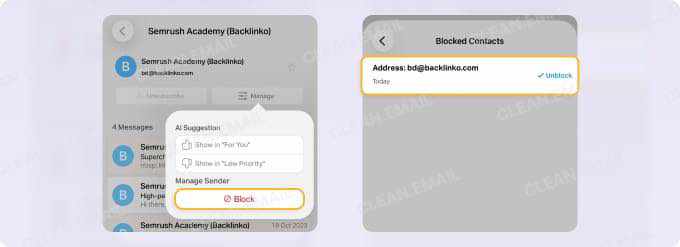
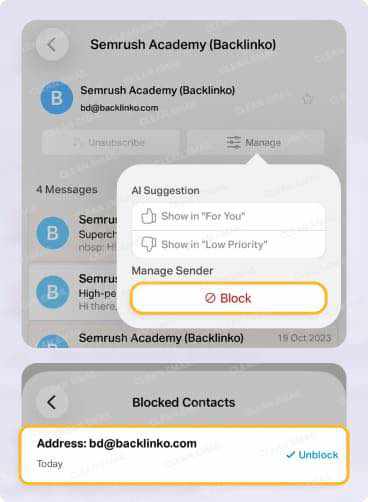
Additionally, Chuck doesn’t automatically delete emails when unsubscribing and has no option to send future emails from that sender to Trash, leaving you to manually manage those unwanted messages.
Features beyond unsubscribing
Chuck groups emails by sender, subject, time, or individual message, and lets you perform bulk actions on an entire group: delete, archive, move to folders, snooze, mark as read or unread, star, or report spam. Chuck Pro adds predefined cleanup filters, such as Mailing Lists and Old Messages.
Chuck also works as a full email client, so you can read, compose, reply to, and forward messages without switching apps. However, it has no automation rules, so every cleanup has to be started manually.
Limitations
- The free version of Chuck allows you to connect one email account with up to 10,000 messages and limited features. For advanced functionality, such as unlimited accounts, bulk unsubscribe, advanced filters, sender blocking, and Cleanup Suggestions, users must upgrade to Chuck Pro.
- Because Chuck processes emails locally on your device, mailboxes with tens or hundreds of thousands of messages may respond more slowly, so large inboxes are best cleaned in smaller batches.
💡 To learn more, read our detailed article about Chuck Email and its best alternative.
- Bulk unsubscribe with one click (Chuck Pro)
- Customizable iOS widgets for quick inbox stats
- Apple product compatibility
- Works as a full email client
- Easy to navigate
- No automatic email deletion during unsubscribe
- No confirmation or list of unsubscribed senders
- Requires handling large inboxes in smaller batches
- Lacks screening for emails from new senders
- No automation for routine email tasks
Price
Chuck Pro pricing varies by channel: $5.99/month or $49/year on Chuck’s website, and $6.99/month or $69.99/year in the iOS app. A 7-day Pro trial is available only with the annual plan. A free version with limited features is also available.
Email providers supported
Compatible with most common email providers, such as Gmail, Outlook, Hotmail, MSN, Fastmail, Yahoo Mail, iCloud, AOL, and all other mailboxes that work with IMAP. Exchange and Kerio accounts aren’t supported.
5. Shortwave
Platforms: iOS, Android, Mac, Windows
Shortwave is an AI-powered email client built specifically for Gmail and Google Workspace users. While it includes unsubscribe tools, the platform focuses more heavily on productivity, collaboration, and inbox organization features.
How it works
Shortwave offers an easy-to-operate, one-click unsubscribe feature. All you have to do is set up your Gmail account with Shortwave, then select a message you want to opt out from. You can press ⌘ + U on Mac, or click on the three dots to see all the available actions for the message, one of which will be Unsubscribe.
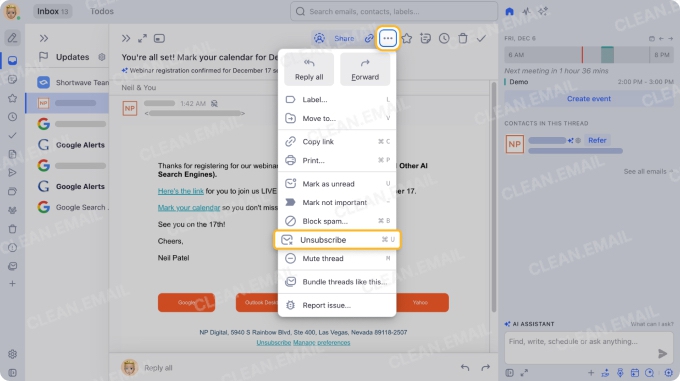
Shortwave’s unsubscribe feature is limited to individual emails and doesn’t support bulk actions. It follows senders’ instructions to unsubscribe but redirects you to a manual unsubscribe page if it cannot complete the process.
Without an unsubscribe link, it requires a keyboard shortcut to trigger the action, and blocking the sender is the only alternative if no option is provided.
I also noticed during my testing that the Unsubscribe button was not available for every message—the same issue I encountered while testing Chuck Email. Only senders who provide a clear path to unsubscribe will be included. If you find a message you don’t want but can’t unsubscribe, you can utilize Shortwave’s Block spam tool instead.
Features beyond unsubscribing
Shortwave enhances email productivity with features like shared labels, AI-powered summaries, and split inbox organization.
Additional tools include to-do list conversion, follow-up reminders, and privacy-focused protections like tracking pixel blocking.
The app developers boast that Shortwave will help users “save an hour a day” when it comes to reading and writing emails.
Limitations
- Shortwave is better suited for users looking for a modern AI email client than a dedicated unsubscribe app.
- Shortwave’s email management features are limited in the free plan. Even with the paid plans, the platform does not support bulk unsubscribing or provide a centralized view of all subscriptions, making large-scale inbox cleanup slower compared to specialized tools.
- The service is limited to Gmail and Google Workspace accounts.
- Pricing increased significantly in 2026, while many advanced AI and collaboration features remain restricted to higher-tier plans.
- Unsubscribe from emails with keyboard shortcuts
- Split inbox for better organization
- Bulk triage for faster inbox cleanup
- Transform emails into to-do lists
- Many other inbox management features
- Doesn’t auto-unsubscribe but redirects to sender's unsubscribe page
- No option to see all newsletters in one place
- No bulk unsubscribing
- Identifies subscriptions only through the sender's provided unsubscribe link
- Only compatible with Gmail
Price
Offers a free plan for individual users. Pro Plan starting at $14 per user/month for personal use (when billed annually). Business plans start at $24/user/month billed annually. A 14-day free trial is available for all paid plans.
Email providers supported
Works exclusively with Gmail. It does, however, support Google Workspace accounts.
6. Superhuman
Platforms: Chrome Extension for web, macOS, iOS, Android
Superhuman is a premium email client designed with professionals in mind, offering speed, advanced features, and a polished interface. For those who need an unsubscribe feature, Superhuman delivers, but it does require some manual effort.
How it works
To unsubscribe, open a message and click the Unsubscribe button, or press ⌘ + U (Mac) / Ctrl + U (Windows).
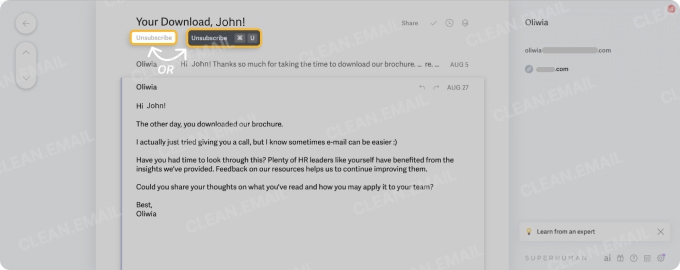
Superhuman’s Unsubscribe feature either sends an email to the sender to process the unsubscription for you or opens the sender’s unsubscribe page for additional action. In some cases, it simply redirects you to the unsubscribe page, leaving you to handle the rest.
Features beyond unsubscribing
Superhuman helps users process their emails by simplifying email triage, a method of quickly deciding what to do with each email. It allows actions like archiving (“done” action), snoozing for later, or keeping emails for immediate attention (“emails for today”).
Superhuman offers Split Inboxes to organize emails into categories like VIP, Team, Calendar, News, and more custom splits. Note that newsletters require manual entry to appear in the News Split.
It also allows snoozing emails, creating reminders, and sharing conversations with team members directly in the app.
Limitations
- The app doesn’t unsubscribe automatically. It extracts unsubscribe links from emails for easy access with shortcuts, but you still need to opt out manually.
- While these options cover most scenarios, I found out that there’s no way to unsubscribe from multiple subscriptions at once—you must handle each sender individually.
- Quick unsubscribe via shortcuts or blocking senders
- Designed for professionals
- Collaboration tools for team communication
- AI-powered functionalities
- Sleek and fast
- No option to check all newsletters in one place
- No bulk unsubscribe feature
- Requires manual effort for certain unsubscribe actions
- High subscription cost
Price
Business plan starting at $33/month when billed annually. Offers a free plan for individuals to get started with AI features, but it does not include email management.
Email providers supported
Supports only Google and Microsoft Outlook-hosted accounts.
7. Apple Mail App
Platforms: iOS, Mac
Most email clients, like Gmail and Outlook, recognize the List-Unsubscribe header and provide an Unsubscribe button for convenience. The Apple Mail app, a native option for iPhone, iPad, and Mac users, also includes this feature, making it easy to opt out of subscriptions while managing your inbox.
How it works
The Unsubscribe button appears directly below the header of subscription emails, allowing you to unsubscribe instantly.
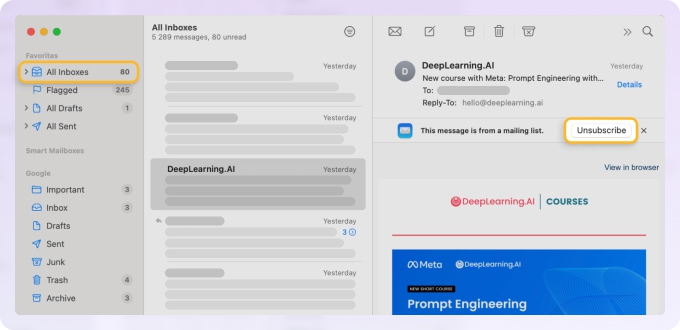
Apple Mail uses the "List-Unsubscribe" header to detect unsubscribe links and send requests or redirect users.
Features beyond unsubscribing
Apple Mail offers several built-in tools for organizing and managing inboxes across Apple devices.
- Smart categorization helps separate promotions, updates, transactions, and primary emails automatically.
- Apple Intelligence features introduced in newer iOS versions can summarize emails and improve message previews.
The app also supports IMAP and POP3 accounts, making it compatible with most major email providers.
Limitations
However, Apple Mail’s functionality is limited:
- It doesn’t support mass unsubscribing, or automatic deletion of emails from unsubscribed senders.
- Compared to other inbox management tools, customization and spam-handling features also remain relatively limited.
While Apple Mail isn't a dedicated email unsubscribe app, I included it in the list because it comes preinstalled on Apple products and offers multiple features to manage and write emails, regardless of your email service provider. It’s a simple choice to unsubscribe from emails for free if you don’t need a bulk email unsubscriber.
- Free service
- Seamless integration with Apple devices
- Supports multiple accounts (iCloud, Gmail, Yahoo, etc.)
- New inbox categorization features in iOS 18.2+
- User-friendly interface
- Limited advanced features
- No mass unsubscribe or strong spam filtering
- Minimal customization options
Price
Free, built-in for macOS and iOS devices.
Email providers supported
iCloud, Gmail, Yahoo, Outlook, AOL, and any IMAP or POP3 email accounts.
8. SaneBox
Platforms: web, iOS
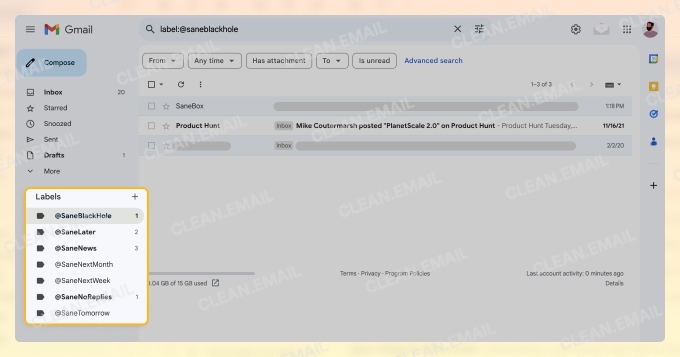
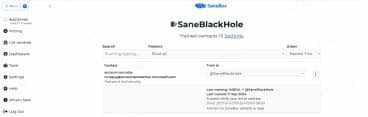
SaneBox is an email management service that works with almost any email provider. One of its most notable features, SaneBlackHole, is designed to help you manage unwanted emails by automatically moving them out of your inbox.
How it works
SaneBlackHole is primarily a folder: when you train a sender to it, SaneBox moves their future emails there, and messages stay in SaneBlackHole for seven days before being moved to Trash.
SaneBox now also includes an optional Auto-Unsubscribe setting that attempts to unsubscribe you from mailing lists trained to SaneBlackHole. The option is disabled by default and must be enabled manually.
⚠️ During my testing, the unsubscribe itself worked, but SaneBox didn’t confirm that the request had been sent or completed. Unless the sender emails you a confirmation, there’s no way to verify the result from within the app. With Auto-Unsubscribe turned off, SaneBox only filters unwanted emails into SaneBlackHole and Trash, so you're not truly unsubscribed and those emails keep taking up space in your mailbox.
Bulk unsubscribing is possible but clunky: you can select several subscriptions and drag them into SaneBlackHole together, but only from the Inbox, and you have to find those subscriptions yourself first. The Email Organize tool also shows unsubscribe recommendations that can be moved to SaneBlackHole in bulk, but it displays only a limited set of tracked emails.
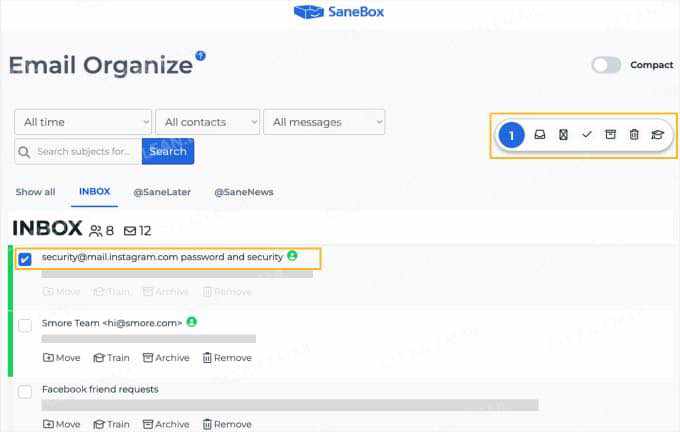
SaneBox doesn't handle existing messages from these senders, so you'll need to manually delete those yourself.
💡 To learn more about SaneBox, read our comprehensive review.
Features beyond unsubscribing
SaneBox includes features like SaneLater to filter less important emails, SaneScreener to hold emails from first-time senders until you decide where they go, SaneNews to defer newsletters into a separate folder, Custom Snooze to temporarily hide messages, and SaneNoReplies to track unanswered emails.
Its Deep Clean tool helps delete old or large messages, as well as emails from high-volume senders. Note that Deep Clean has no undo.
Limitations
One of the main disadvantages of SaneBox, besides limited feedback on unsubscribing, is that the service advertises AI features that are not really present in the app. Instead, it uses smart algorithms to learn from your behavior and train filters to sort incoming messages automatically.
Also, cheaper plans limit access to Power Tools (such as SaneScreener, SaneNews, and Custom Snooze), and only the most expensive plan unlocks all of them.
- Smart automatic email sorting
- Effectively prioritizes important messages
- Offers digest summaries
- Custom snooze folders
- Auto-Unsubscribe is off by default and gives no confirmation of the result
- Requires manual training for each subscription or sender
- Limited spam handling options
- No personalized cleaning suggestions
Price
Begins at $9.49/month (or $65/year) for one email account on the Snack plan, with a 14-day trial available.
Email providers supported
Gmail, Microsoft 365, Apple iCloud, and any IMAP, Microsoft Exchange, or ActiveSync server.
9. Unlistr
⚠️ Warning: Unlistr has been discontinued. It’s no longer available for download in the Microsoft Store or through the Outlook interface, and previously installed versions no longer load. My attempts to contact their support team were also unsuccessful.
Platforms: Outlook plugin (discontinued)
Unlistr was an app to remove email subscriptions that was exclusive to just Outlook. Instead of being a proprietary app that you logged into, Unlistr was a simple plug-in you installed to work alongside your Outlook inbox.
It was popular with Outlook users who loved the look and feel of the Outlook desktop app or web interface, because they didn’t have to relearn a new system, they just needed to know where the button was to unsubscribe.
How it worked
To determine subscription-based messages, Unlistr scanned messages for key information. Then, when you pressed Unsubscribe, Unlistr handled unsubscribe requests on your behalf. Unfortunately, this scanning method didn’t always work, and I found that not all subscription messages got caught.
Unlike other email unsubscribe apps I reviewed, Unlistr wasn’t made to perform other inbox management tasks. It was just made for removing mass mailings from your inbox. It worked exclusively with Outlook and Office365 and cost $19.99/year, with 5 unsubscribe actions for free.
What to use instead
If you used Unlistr, I recommend switching to Clean Email. It works with Outlook, Office 365, Hotmail, and Live accounts (as well as Gmail, Yahoo, iCloud, and any IMAP mailbox), shows all your subscriptions on one screen, and lets you unsubscribe from multiple senders at once. If a sender ignores your request, Clean Email automatically moves their future emails to Trash, and it’s available on the web, macOS, iOS, and Android.
What About Free Unsubscribe Apps?
Free email unsubscribe apps like Unroll.Me and Cleanfox may seem appealing, but they often come with privacy tradeoffs. These services may use inbox-derived data for marketing, advertising, or market research purposes in exchange for free unsubscribe functionality.
⚠️ Unroll.Me has previously faced criticism for collecting and sharing user data. It also mainly filters emails instead of fully removing users from mailing lists. The service is unavailable in the EU due to GDPR-related concerns.
⚠️ Cleanfox also collects anonymized usage data for research and analytics purposes.
If privacy matters to you, paid unsubscribe apps are generally the safer choice. Most premium tools offer stronger privacy policies, better inbox management features, and more reliable unsubscribe functionality.
Read more:
Verdict
The best unsubscribe app depends on:
- how many promotional emails you receive,
- how many inboxes you manage, and
- whether you need advanced inbox organization tools.
For most users, Clean Email is the best app for unsubscribing emails and the strongest overall option. It supports true bulk unsubscribing, removes old emails automatically, works with nearly every email provider, and includes automation tools that help keep inboxes clean long term.
Leave Me Alone is a good alternative for users who prefer a simpler privacy-focused experience. Chuck Email works especially well for Apple users who want an email client with lightweight batch cleanup processed on their device.
If you only receive occasional newsletters, your email provider’s built-in unsubscribe feature may already be enough. Apple Mail, Gmail, and Outlook all support one-click unsubscribing for emails that include valid unsubscribe headers.
However, users with crowded inboxes, multiple email accounts, or thousands of old subscription emails will benefit more from dedicated unsubscribe tools that support bulk actions and automation.
| App | Best For | Biggest Advantage | Main Limitation |
|---|---|---|---|
| Clean Email | Most users | Bulk unsubscribe + inbox automation | No dedicated Windows app |
| Leave Me Alone | Privacy-focused users | Simple unsubscribe workflow | No cleanup beyond subscriptions |
| Mailstrom | Visual inbox cleanup | Strong grouping and filtering | No bulk unsubscribe |
| Chuck Email | Apple users | Email client + batch cleanup | Apple devices only |
| Shortwave | Gmail power users | AI productivity tools | Expensive for unsubscribing |
| Superhuman | Professionals | Fast premium email workflow | High monthly cost |
| Apple Mail | Casual users | Free built-in unsubscribe | No bulk cleanup |
| SaneBox | Inbox sorting | Smart filtering | Unsubscribe is optional, with no confirmation |
| Unlistr | Outlook users (former) | Native Outlook integration | Discontinued, recommended to switch to Clean Email |
FAQs
Is there an app to unsubscribe from emails?
Yes, there are many apps to get rid of email subscriptions. Some of these are simple unsubscribe apps, whereas others offer numerous advanced features to help you organize your inbox.
What is the best free email unsubscribe app?
Most completely free unsubscribe apps come with privacy trade-offs, since some services analyze or monetize inbox data. For better privacy and security, it’s usually safer to use a trusted paid app with a free trial instead. The best options are Clean Email, Leave Me Alone, Mailstrom, and Apple Mail or Gmail’s built-in unsubscribe tools for light one-by-one cleanup.
Are unsubscribe links safe?
Some hackers now use innocent-looking unsubscribe links to lure users into clicking them, which can cause all sorts of issues. Before clicking any links, it’s best to check where the link directs you and check the exact email address of the sender to be sure it’s from a reputable company.
How do I see everything I'm subscribed to?
Some email providers now offer subscription management tools. For example, Gmail’s “Manage subscriptions” view lets users see all active mailing lists. However, it still works one sender at a time. Apps like Clean Email display all subscriptions on one screen and make mass unsubscribing faster and more convenient.
Which unsubscribe apps actually remove you from mailing lists?
Apps like Clean Email, Leave Me Alone, Mailstrom, and Chuck Email send unsubscribe requests to mailing list providers. SaneBox mainly filters emails into folders or Trash (its optional Auto-Unsubscribe setting is off by default), and Unroll.me mainly filters emails instead of removing you from subscriptions completely.
Is Clean Email app safe?
Clean Email is built with your privacy and security in mind. The company never shares, gives away, sells, analyzes, ‘anonymizes’, or otherwise uses your data. For the full privacy policy, click here.