1. “My inbox is 99% marketing – what’s the fastest way to make a dent today?”
If you’ve made the decision to rid your mailbox of promotional emails and are willing to do so in bulk, then mass unsubscribing is the way to go.
To get started, focus on the biggest senders and those you can eliminate the fastest. This should make a huge difference in the number of marketing messages you have today and moving forward.
One thing to keep in mind is that it’s not about perfection. This is a process that takes a bit of time but has a great return.
GOODBYE TO INBOX CLUTTER
Unsubscribe from unwanted emails instantly with one click.
Get started for Free2. “Is there a legit way to mass unsubscribe without doing it one-by-one?”
The short answer is Yes; there are legitimate ways to mass unsubscribe. But what exactly does that mean?
To mass unsubscribe means to remove yourself from multiple mailing lists at once. For instance, you may have email subscriptions from creative networks, online retailers, and job search sites. To stop receiving marketing messages from these companies, you can unsubscribe from them all at once rather than each one individually.
This automated process is offered by some email service providers along with third-party tools and gives you a quick and easy way to curb a chaotic inbox by eliminating emails you no longer want to receive. Most of all, it saves you time from unsubscribing manually and one at a time.
| Approach | Time Required | Risk Level | Removes Existing Emails? | Stops Future Emails? | Main Frustration |
|---|---|---|---|---|---|
| Manual unsubscribe | Very High | Medium | No | Yes | Too slow |
| Search “unsubscribe” + bulk delete | Medium | Medium | Yes | No | Can delete wanted emails |
| Block / mark as spam | Low | Low | No | Sometimes | Doesn’t clean old emails |
| Unsubscribe tools | Low–Medium | Varies | Yes | Yes | Trust concerns |
3. “People say ‘search unsubscribe’ – does that actually work?”
Some people suggest searching your mailbox for the word “unsubscribe” and then deleting the results. The thought is that promotional and marketing emails contain an unsubscribe option in the message body, so this search should return those types of emails that you can then remove.
One issue with this option is that you may end up deleting emails by mistake. If you have messages from essential companies that you want to keep, they could easily get removed in the process.
Another problem is that this doesn’t stop those senders from continuing to email you because you aren’t unsubscribing or blocking them. So, while it may feel good to perform that massive cleanup, it’s short-lived.
If you do decide to search for “unsubscribe,” be sure to review the results before you delete them. Just know that you may end up performing this same search again and again as your mailbox keeps filling up.
4. “Are free unsubscribe tools safe? I keep hearing privacy warnings.”
It’s normal to raise an eyebrow when using a free service. Although free reputable unsubscribe tools are generally safe, this doesn’t mean you shouldn’t take precautions.
Review the permissions they request, check out their privacy policy, and monitor their effectiveness.
If possible, consider a paid unsubscribe service that focuses on your privacy and does not sell or share user data.
5. “How do I avoid unsubscribing from something I actually need?”
If you’re unsubscribing from emails one at a time, you should easily be able to keep the messages you want. But when performing a mass unsubscribe, it’s unlikely you’ll review every single email – especially if you have hundreds or thousands.
A good way to avoid unsubscribing from emails you want is to create a “keep bucket.” This could be a label, tag, or folder for those messages. You can also set up inbox rules or filters to automatically mark or move those emails to the “keep bucket” location where they’ll remain safe.
6. “What if I’m buried in years of promo emails – do I delete first or unsubscribe first?”
For ridding your mailbox of years’ worth of promotional emails, it’s best to use a two-track approach where you:
1) stop the inflow by unsubscribing and
2) clear the backlog by deleting. The order in which you perform these steps is based on your biggest pain point or email application’s options.
If your email application provides:
- A simplistic unsubscribe feature, it’s best to unsubscribe first and then delete the messages. When you delete without unsubscribing, it doesn’t stop future emails.
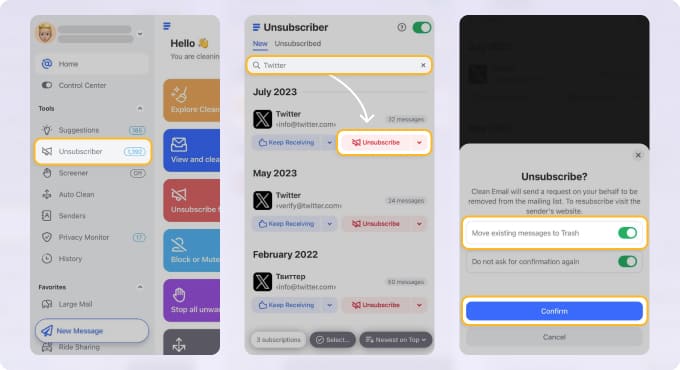
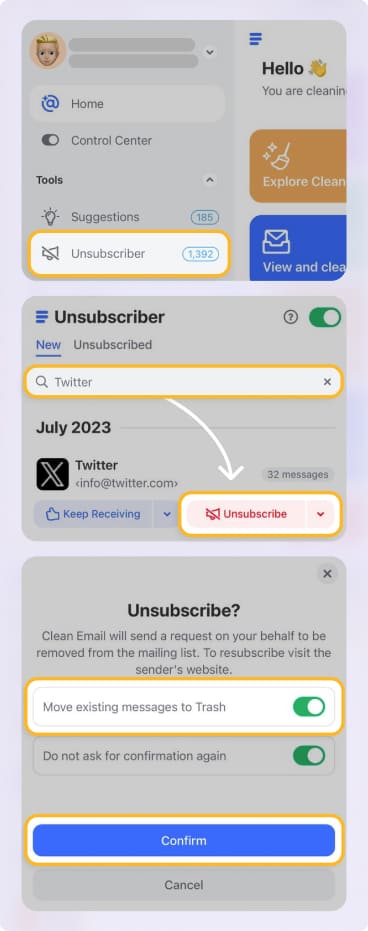
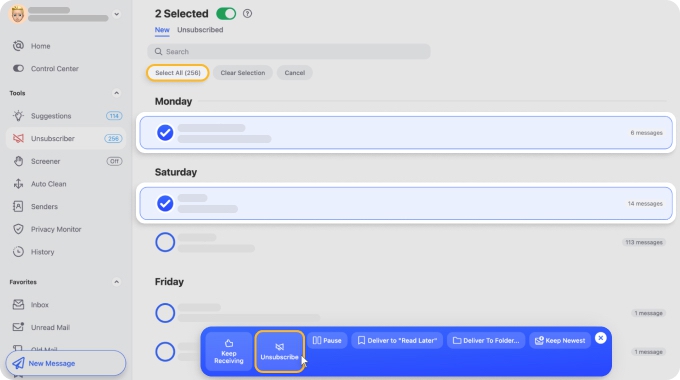
- A robust unsubscribe feature, you may be able to unsubscribe and delete any existing messages at the same time. Dedicated apps like Clean Email provide an Unsubscriber tool that allows you to do exactly that.
- A feature for managing subscriptions, you should be able to delete the emails first for a clean sweep and then use the subscription manager to unsubscribe from future messages.
7. “What’s the best strategy if a few brands send me emails every single day?”
While it’s normally best to visit the website and adjust your preferences to reduce the communications you receive, this can be quite time-consuming if you have many.
To minimize email overload from these companies, consider keeping only the most recent messages. You can normally sort by date or use a search to find current emails. Then, delete the older ones.
8. “How do I keep my inbox from getting ruined again next month?”
Unsubscribing should keep future messages from arriving; however, this process can take time depending on the tool you use and the senders’ willingness to comply within the required 10 business- day timeframe. But there are ways to take control.
First, set up a maintenance routine for your mailbox. Unsubscribe and remove messages from new senders and also delete emails you receive until the (previous) unsubscribe processes complete.
Second, be cautious of opt-ins during any checkout processes and other website signups. You can also consider creating an alias or burner email address for these types of situations.
9. “Why can’t email providers just show me every subscription in one place?”
There are some email providers that offer a subscription management tool. And if the one you use does provide this, you might notice that it’s incomplete – but why?
It seems simple, but unfortunately, subscription detection isn’t foolproof.
Providers use various tools to identify subscription emails. This includes specialized email headers, sender patterns, content analysis, and unsubscribe protocols. While most providers do a good job of detecting subscription messages, just keep in mind that there might be emails that slip through.
10. “Why do I keep getting emails from companies I never signed up for?”
It can be disturbing to start receiving emails from companies out of the blue. Unfortunately, these days it’s not surprising.
Between third-party email sharing, bundled opt-ins during a checkout process, co-marketing lists, giveaways, and data brokers, marketing messages and promotional emails can start arriving from various avenues.
11. “Is it better to unsubscribe, delete, or just ignore?”
When deciding between unsubscribing, deleting, and simply ignoring marketing messages, it comes down to addressing the root cause (unsubscribing) and then cleaning the clutter (deleting). Ignoring these types of emails only increases the volume and mailbox clutter.
| Action | Stops Future Emails? | Reduces Inbox Clutter? | Long-Term Fix? |
|---|---|---|---|
| Ignore | ❌ | ❌ | ❌ |
| Delete | ❌ | ✅ | ❌ |
| Unsubscribe | ✅ | ❌ | ✅ |
| Bulk Tool | ✅ | ✅ | ✅ |
12. “How long should mass unsubscribing realistically take?”
The amount of time mass unsubscribing takes typically depends on the tool you use. For instance, with Clean Email’s Unsubscriber feature, you can unsubscribe from hundreds or thousands of emails in mere minutes (you can try Unsubscriber free with any IMAP-based email provider).
To perform an effective mass unsubscribe with your preferred email provider, consider doing so in short sessions (15- or 20-minute bursts) rather than a lengthy marathon. This allows you to visualize progress as you take care of the task and still have time to tackle more important duties.
13. “Why does it feel like for every email I remove, two more show up?”
With marketing cycles, seasonal promotions, and automated workflows, it’s not unusual to receive more emails after removing some messages. To effectively stop promotional emails, deal with the source --- not the individual message.
| What’s Happening | Why It Feels Worse Than It Is | What It Actually Means |
|---|---|---|
| You removed one sender, but 20 others remain | Volume doesn’t visibly drop | You need to target clusters, not individuals |
| Marketing campaigns run in waves | New promos appear daily | You’re seeing cycles, not growth |
| You’re on multiple lists from one brand | Emails come from different addresses | One “unsubscribe” may not cover all |
| New subscriptions happen silently | Checkouts, trials, downloads add you | The inflow never stopped |
14. “Is there a way to bulk unsubscribe without giving an app full access to my inbox?”
If you’re considering a mass unsubscribe tool, you must be willing to give that tool some sort of access to your inbox in order to perform the task. While this may feel uncomfortable, it’s a trade-off, right?
Be sure to evaluate the application’s scope of permissions to determine necessity ahead of time. If you’re uneasy with what the tool is asking for, consider a different option.
15. “What’s the smartest order to tackle subscriptions?”
There are various strategies you can use to handle your subscriptions, but the most sensible order should be based on your particular pain point.
For instance, if you want fast relief from your highest volume senders, you should unsubscribe from those with the greatest frequency first. But if you’d rather have the satisfaction of a win, you can tackle the most annoying senders first.
The key is taking care of the emails rather than avoiding them.
| Priority Order | Why It Works | Result |
|---|---|---|
| Highest frequency first | Biggest volume impact | Quick relief |
| Biggest brands first | Many messages removed at once | Visible progress |
| Most annoying first | Emotional win | Momentum |
16. “Should I clean my Promotions folder differently from my main inbox?”
Regardless of whether marketing emails show up in your Promotions folder or your inbox, they still add to the clutter that consumes storage space and require your attention.
One key difference is that you may be able to clear out your Promotions folder quicker and easier as these are typically all marketing messages whereas your inbox holds all new emails.
17. “Can I mass unsubscribe from multiple email accounts at once?”
While viewing messages from different email accounts in a single application is common, subscription management is normally separated per account. Think of it as reducing the complexity involved in the subscription detection and unsubscribe processes.
That said, there are many unsubscribe tools that give you easy ways to manage subscriptions for multiple accounts. For example, with Clean Email, you can unsubscribe in bulk and then use a simple switch to access your other email account and do the same.
18. “Is there a point where it’s easier to just start a new email address?”
When dealing with tons of marketing messages, it can feel easier to just create a new email address and start over. And while this is certainly an option, there are, of course, pros and cons to doing this.
Pros: No longer worrying about cleaning a messy mailbox and not being on mailing lists (yet).
Cons: Changing your email address in multiple locations and providing it to all of your contacts, risks of missing important messages during the transition, importing/exporting data and contacts.
Rather than trading in your email address for a different one, consider setting up the new address and providing it only to your contacts. You can then keep the old address for newsletters and marketing messages.
You can also use strategies such as creating an email alias, using Apple’s “Hide My Email” feature, or provide a plus address when signing up for services.