Key Takeaways
- Political emails can arrive due to donations, voter files, signed petitions, data brokers, and other sources.
- Political communications do not have to comply with the CAN-SPAM Act.
- Stop unwanted political emails by blocking the sender, creating a filter, and reporting spam.
- Eliminate political robotext messages by replying once with “STOP.”
- Political emails don’t end when an election is over – clean your inbox now and use tools to stop future unsolicited messages.
Why You’re Drowning in Political Emails
There are several reasons for an onslaught of political emails along with ways that your email address gets into the hands of political organizations.
📌 Donations: You may think that giving a donation requested through an email will not only support your party but stop future requests. However, it can end up feeling more like you’re being punished for your generosity as more and more messages arrive.
There are popular fundraising platforms like ActBlue and WinRed that share contact lists. This can give your information to fundraising committees, allied campaigns, and political action committees (PACs).
📌 Voter files: When you register to vote, you provide your name, phone number, email address, and other information that can be obtained by public parties including political groups.
Although the laws vary by state, your email address and phone number may be available for free or purchase. (See: Voter Lists: Registration, Confidentiality, and Voter List Maintenance)
📌 Petitions: Signing a petition for a cause you believe in can feel satisfying. Unfortunately, it can also lead to an increase in political emails, especially when signing online petitions.
Remember, you’re providing your contact information to an organization with a mailing list and that organization may share, trade, or sell their list to allied campaigns, PACs, and advocacy groups.
📌 Data brokers: Data brokers are companies that gather personal information from online activities, public records, and offline sources.
They then sell or license that information to groups such as marketers, advertisers, financial services, government agencies, and private parties.
📌 Subscription bombing: Subscription bombing is a cyberattack where automated scripts bombard an inbox with (political) newsletters and resulting confirmations. The base premise is to distract from concurrent fraudulent activity that results in email notifications.
Basically, this attack hides crucial alerts of purchases or account activity among hundreds or thousands of emails arriving within minutes.
💡 Learn more about subscription bombing and what to do if you’re a victim.
📌 Wrong-party mismatch: When you receive emails from a political party or candidate that you don’t support, it’s normally because campaign committees obtain data lists or outdated voter files. Political groups often use the same data brokers, and databases of information can be merged or mixed up.
In some cases, the intent is real. Political parties may traverse party lines to persuade voters or raise funds for their campaigns.
Why Unsubscribe Alone Doesn't Work
Maybe you’ve been unsubscribing to no avail or are even wondering if unsubscribing from political communications is safe. Let’s look at why unsubscribing alone isn’t the best course of action.
📌 Political emails do not have to comply with the CAN-SPAM Act.
Unfortunately, this is something many citizens aren’t aware of and should be because of what it means:
- The act applies to commercial emails for promotions and advertising; not political or campaign fundraising messages.
- Political email senders aren’t required to include unsubscribe links or comply with opt-out requests.
- Header rules that commercial companies must honor don’t apply to political communications in this setting.
This doesn’t mean that you shouldn’t try to unsubscribe and hope for the best. It simply means that the unsubscribe option may not work.
As far as safety, it’s similar to unsubscribing with other types of subscription emails:
- If the message is from a trusted sender and legitimate campaign, you can use an unsubscribe link if provided.
- If the message is from an unknown sender or spam PAC, you should not use their unsubscribe link and instead, mark it as spam.
💡 For more, review when and if it’s safe to unsubscribe from spam.
Stop Political Emails in Every Mailbox at Once
Because political emails can continue flooding your inbox with no end in sight, it’s best to take a more controlled approach.
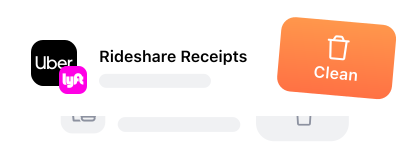
Using tools that allow you to unsubscribe in bulk, filter incoming emails, and screen new senders can save you from political email agony. One such tool is Clean Email and here are the top features that help you take control of your inbox:
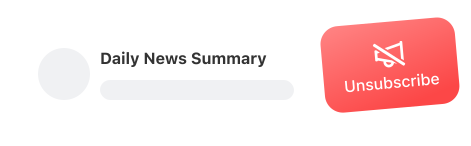
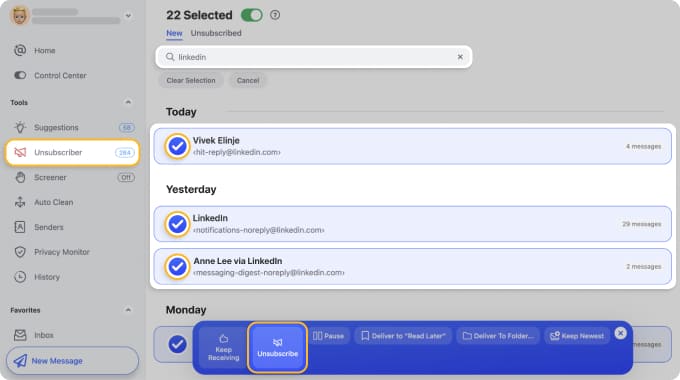
- Unsubscriber lets you remove yourself from multiple mailing lists at once, rather than one at a time as with most email service providers. This gives you a safe and effective way to unsubscribe from all political emails in one fell swoop and without touching any unsubscribe links.
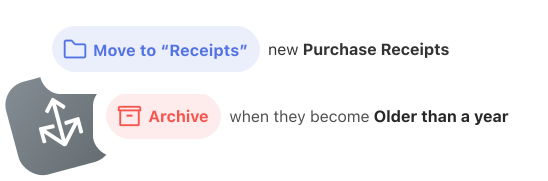
- Auto Clean lets you create mailbox rules to move, mark, or delete emails based on the conditions you choose. For instance, you can automatically delete all emails from the same domain without entry caps (like in Outlook). This solves the rotating address problem where companies use different email addresses within the same organization.
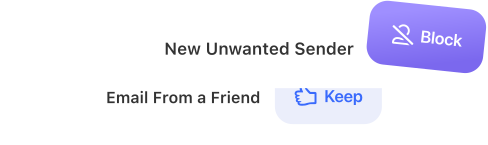
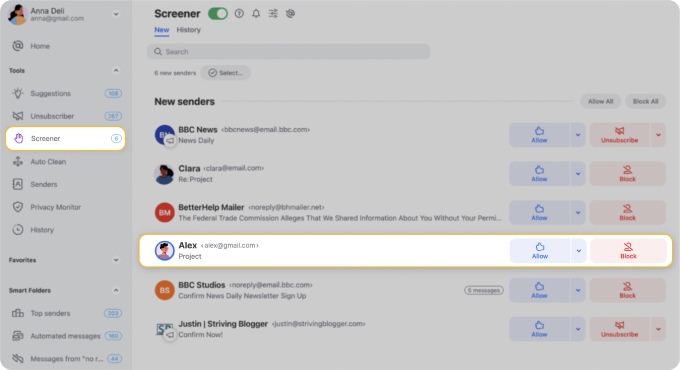
- Screener lets you review emails from unknown senders in one place and then Allow or Block future messages from them. This feature can be a reliable solution to why you’re suddenly receiving a lot of spam via a subscription bomb attack or wrong-party mismatch emails.
- Smart Folders let you see related emails filtered by topic and perform bulk actions like trash or delete. You have folders for convenient items like Top Senders and Finance, but can take advantage of others for unsolicited emails like Messages From “No Reply,” Automated Messages, and Miscellaneous Notifications.
All Clean Email features are available on the web, Mac desktop, and mobile for any IMAP account. The tool provides a simple way to switch between mailboxes for email management across providers.
Manual Steps: Gmail, Outlook, iPhone Mail
To stop daily fundraising requests, fake “final deadline” countdowns, and emails where the CAN-SPAM act is of no help, there’s a simple three-step system that works with most any email service provider:
- Block the sender.
- Build a keyword filter (e.g."donate"/"chip in"/"match").
- Report spam.
Gmail
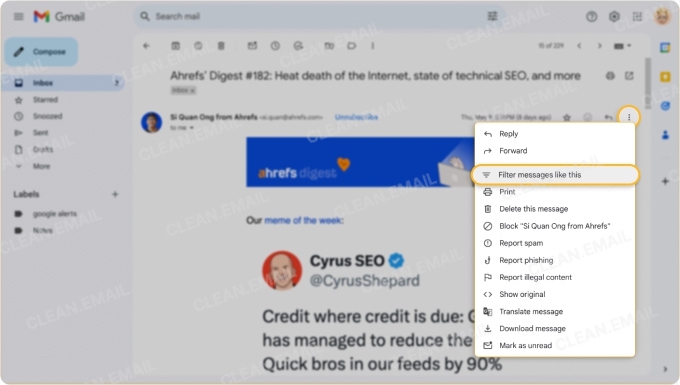
In Gmail, you can block a sender directly from the More (three-dot) menu at the top of the email. Then, use Gmail’s filters to archive, mark as read, or better yet, auto-delete spam. And while you can mark individual messages as spam too, you can also create a Gmail spam filter of your own.
Outlook
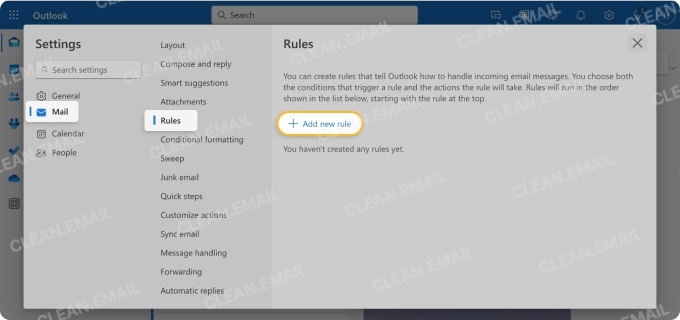
In Outlook, you can block a sender as well as mark emails as spam directly from the top toolbar along with other methods. You can then set up rules to redirect or remove future emails that arrive and use filters in Outlook to make sure you have the email details needed for the rules.
iPhone Mail
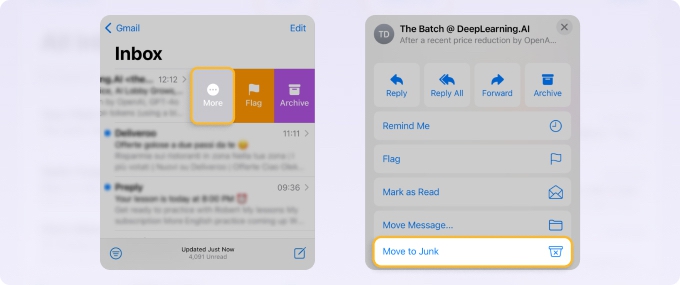
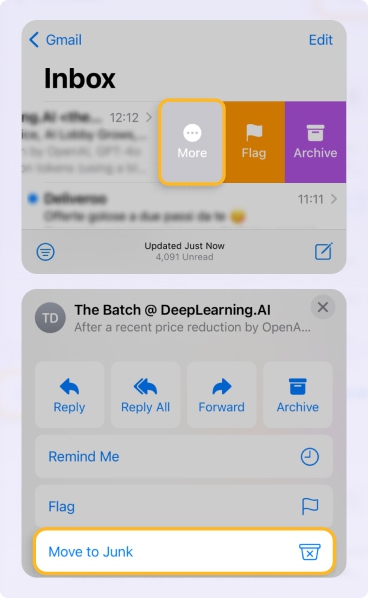
On mobile, you have multiple ways to block a sender on iPhone as well as mark spam in Apple Mail. To set up a keyword filter, you can create a rule for iCloud Mail that also applies to emails on iPad and Mac. Plus, you can use various iPhone email filters for finding those unsolicited messages.
How to Stop Political Texts Too
It would be simpler if political communications were sent solely via email, but unfortunately, campaign text messages are just as popular. And if you feel like every time you block, delete, and report spam for a sender, it only increases the number of political texts you receive, you’re certainly not alone.
Luckily, there are a few remedies for stopping these text messages on iPhone and Android.
The Law
Although political campaigns are exempt from the CAN-SPAM act and Do Not Call Registry, they are expected to comply with the Opt-Out Rule. For a brief overview, the Opt-Out Rule adopted under the Telephone Consumer Protection Act (TCPA), effective April 11, 2025, states:
“Under the TCPA, businesses must obtain ‘prior express written consent’ in order to send marketing text messages, make marketing robocalls, or send fax advertisements.”
This means that if you reply to a robotext campaign message with “STOP,” “CANCEL,” UNSUBSCRIBE,” or similar, this is considered a reasonable manner of revoking consent. The organization must honor the revocation within ten business days of receipt, or otherwise, face statutory damages.
📌 Exception: The rule for political campaign text messages applies to robotexts (from autodialers) not texts sent manually. (See also: Stop Unwanted Robocalls and Texts from the FCC.)
The Solution
With the above in mind, your first course of action to stop political robotext messages is to reply as described using “STOP” and to only reply once.
If the messages continue or are sent manually, use your device’s block and filter features. Both Android and iOS provide ways to block a sender and report spam. Tap the sender on the message and choose the available option.
Additionally, you can enable Spam Protection on Android (Messages → profile icon → Messages settings) and Filter Spam along with Screen Unknown Senders on iOS (Settings → Apps → Messages).
As a last resort, you can also forward spam texts to the FCC at 7726 (“SPAM”) and/or file a complaint on the FCC’s Complaints Center website.
Cut It Off at the Source
There are a couple of other ways to stop or at least decrease political emails now and down the road that you can consider. And these can help ease your frustration and increase your feeling of control.
- Use a data broker removal service. Popular services like Incogni and DeleteMe provide affordable plans that help with high-volume removals and complex opt-outs.
If you live in California, you can take advantage of DROP for all active data brokers which requires the removal of personal information under the Delete Act.
- Use an email alias for future signups and donations. This lets you provide an alternative email address to support your party or candidate, but keeps your primary address private and out of the shared or purchased lists.
You can also consider creating a specific email account for free and use that address for all political-related communications.
Will It Stop After November 3?
While you might be thinking that the bombardment of political emails will stop after the midterm, this unfortunately isn’t the case.
You may receive fewer communications from those candidates on the ballot, but many political groups and PACs continue to send emails. These may ask for donations to resolve campaign debt, to prepare for the next election, or to continue influencing issues.
With this in mind, don’t wait until November to clean up the political email mess that already exists in your inbox. Perform a solid cleanup now and take action to stop the chaos from reappearing.
Remember, Clean Email provides the robust features mentioned earlier to help with current decluttering and future filtering.
💡 Tip: If you’re curious about the communications that political groups send, visit the Archive of Political Emails. You can search for emails and see stats on the top senders with message volume in this political email archive.
Final Words
Political groups want you to see their messages, whether you want to or not. But you can take control!
We’ve explained how to block political emails in Gmail, how to filter unwanted political messages in Outlook, and how to stop political emails on iPhone. You’ve also learned how to opt out of political text messages and even cut off communications at the source.
Of course, you should keep those emails that you want and that help you; however, for the ones that do the opposite, take over your inbox, and cause you aggravation, you can stop them.
And remember to use the tools at your disposal, like Clean Email, to declutter the current mess and curb any future one due to unwanted political messages.
FAQs
Why can’t I unsubscribe from political emails?
Unfortunately, political emails are non-commercial communications and are not required to follow the rules of the CAN-SPAM Act. This means they aren’t obligated to provide unsubscribe links or adhere to opt-out requests.
Do political campaigns have to honor unsubscribe requests?
For emails, political campaigns aren’t required to comply with opt-out requests as they’re exempt from the CAN-SPAM Act. However, as of April 2025, text messages sent via robotext are required to honor such requests.
How did campaigns get my email address or phone number?
Campaign committees can obtain your contact information various ways including donations you’ve given and petitions you’ve signed along with voter files and data brokers.
Does replying STOP to political texts actually work?
Per the Opt-Out Rule in effect as of April 11, 2025, replying with “STOP” or similar to a robotext is supposed to end future messages. However, the rule does not apply to text messages sent manually.
Is it safe to click unsubscribe in political emails?
If the email is from a legitimate political campaign, it’s normally safe to click the unsubscribe link. However, if the email is from an unknown source or PAC, you can be taking a risk, so you should mark it as spam instead.
Why am I getting emails from a party I don't support?
Political groups often obtain lists from the same sources including data brokers and old voter files. This can create a crossover of information; and some political campaigns use this to promote their candidate across party lines.
Someone keeps signing me up for political newsletters – how do I stop it?
If you receive hundreds of political newsletters, especially within a short amount of time, this could be a subscription bomb attack. Use Clean Email’s Screener feature to disallow these messages in your inbox and stop the future inflow of emails from those senders.
Will political emails stop after the election?
Once a political campaign, committee, or group obtains your email address, you can expect to receive messages throughout the year – whether for fundraising, issue lobbying, or party promotion. To control this flow of emails, perform a solid cleanup now and use automated filters to manage future messages.