How We Evaluated Secure Email Providers
A provider can tick the “end-to-end encryption” box and still leak metadata, log your IP, or sit in a data-sharing jurisdiction. We weighed each service on the criteria that actually determine how private your email is:
- Encryption: E2EE, OpenPGP or S/MIME, and whether subject lines are covered.
- Metadata protection: what gets logged (IP, timestamps) and what leaks with each message.
- Jurisdiction & privacy policy: the laws the provider answers to and how much data it can be forced to share.
- Independent audits: whether outside experts have inspected the code and infrastructure.
- Authentication: 2FA, passkeys and hardware security key support.
- Open-source code: can the apps be independently verified?
Why you can trust this ranking
We evaluated each provider based on its encryption methods, metadata handling, privacy policy, jurisdiction, security record, and account protection features.
Where possible, we tested the setup process, core security tools, and user experience across the available web, desktop, and mobile apps. We also checked current prices and security claims against official documentation and privacy policies.
The final ranking reflects the overall balance of privacy, security, usability, and value rather than any single feature.
Secure Email Providers at a Glance
| Provider | Best for | Free plan | E2EE | Open source | Country |
|---|---|---|---|---|---|
| Proton Mail | All-round privacy & ease of use | ✅ Yes (1 GB) | ✅ Yes | ✅ Yes | Switzerland |
| Hushmail | Regulated fields (healthcare, law) | Trial only | ✅ Yes (OpenPGP) | Partial | Canada |
| Tuta | Encrypting everything, incl. subjects | ✅ Yes (1 GB) | ✅ Yes | ✅ Yes | Germany |
| StartMail | Aliases & anonymous signup | Trial only | ✅ Yes (PGP) | ❌ No | Netherlands |
| Mailfence | Built-in productivity suite | ✅ Yes (1 GB) | ✅ Yes (OpenPGP) | Partial | Belgium |
| Zoho Mail | Business suite on a budget | ✅ Yes (5 GB) | Partial | ❌ No | India |
| Neo | Professional email on a custom domain | Trial only | ❌ No | ❌ No | India |
| Mailbox.org | Full-featured daily driver | Trial only | ✅ Yes (PGP/S⁄MIME) | ❌ No | Germany |
8 Most Secure Email Providers
So, what is the most secure email provider today? The only way to reliably assess how secure an email provider is is by examining its security history.
💡 Quick answer: In 2026, the 8 best secure email providers are Proton Mail, Hushmail, Tuta, StartMail, Mailfence, Zoho Mail, Neo, and Mailbox.org. These services are thought to be safe because they use strong encryption (like end-to-end or PGP), have strict privacy policies for sending secure email messages with ease, and have a history of not having major data breaches, while charging very little for their services.
1. Proton Mail
Price: Free for personal use with up to 1 GB of mail storage or paid plans starting from $4.99/month (personal) and $14.99/month (workspace).
More than 100 million people use the Swiss-based secure Proton Mail service, but scale is not what stood out in our testing. Its familiar interface and guided setup make it easier to adopt than many specialist privacy tools. That balance helps it stand out among the most popular email services.
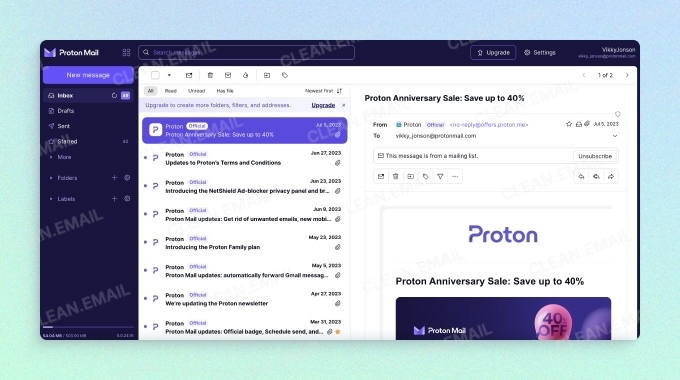
Easy Switch imports existing mail and contacts and can forward new messages from an old account, reducing the disruption of moving to a secure provider.
Messages between Proton Mail users are end-to-end encrypted automatically, while zero-access encryption protects stored mail. Messages sent to external recipients can be password-protected, and sensitive emails can be set to expire. These controls are available through Proton Mail’s web, mobile, and desktop apps.
Metadata and recovery: Proton does not keep permanent IP logs by default, although it may retain temporary IP logs to counter abuse and can record login IPs if authentication logging is enabled. A recovery phrase can reset the password and restore access to encrypted data; an email or SMS reset alone may leave older encrypted messages unreadable.
Security at a glance: Proton Mail automatically applies end-to-end encryption between Proton users and zero-access encryption to stored mail. Its apps are open-source and covered by an independent security audit. The account protection includes 2FA and hardware security keys. Paid plans add aliases and custom domains, and IMAP access requires Proton Bridge. Subject lines are not end-to-end encrypted.
- The most battle-tested secure mail service
- Password-protected and self-destructing messages
- Generous free plan
- Easy to migrate from other services
- Accepts cryptocurrency payments
- Web, mobile, and desktop apps
- Doesn’t encrypt subject lines
2. Hushmail
Price: Yearly plans from $59.99/year for personal use (no free trial), and from $ 10.79 /mo or $118.69/year for business (1 month free with a yearly subscription).
Hushmail has been operating since 1999, and its priorities reflect that history. It is a straightforward encrypted mailbox rather than an all-purpose productivity suite, with OpenPGP support at its core and POP, IMAP, and SMTP access for people who prefer to use another mail client.
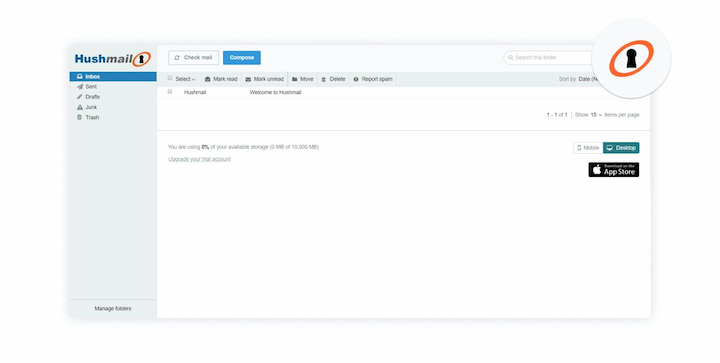
In fact, Hushmail is the only private email service on this list that has plans aimed specifically at certain industries that commonly send highly sensitive messages. Its Healthcare plan, for example, is HIPAA-compliant right out of the box, making it perfect for professionals who need to send and receive confidential patient information securely. Similarly, its Law plan is designed to meet the needs of legal professionals who require a secure and encrypted email service.
The interface looks plain next to Proton Mail or Neo, but we found the essential controls easy to reach and the spam filtering effective. There is no free tier, so Hushmail is easier to recommend for a specific professional workflow than as a general-purpose personal inbox.
Metadata and recovery: Hushmail’s privacy policy says it records login IP addresses and operational data such as sender and recipient addresses, subject lines, attachment names, and account actions; activity records are generally deleted after about 18 months. For individual accounts, Hushmail cannot recover a forgotten passphrase, although an administrator may reset it for a managed user.
Security at a glance: Hushmail provides OpenPGP-based encrypted messaging and 2FA, with custom domains on business plans, alias support, and IMAP, POP, and SMTP access. The service is closed-source, does not support passkeys, and leaves subject lines unencrypted. It is based in Canada under a US parent company. No independent review of the complete service was publicly available when we checked.
- Industry-specific plans
- PGP-encrypted email using OpenPGP standards
- Straightforward user interface
- Support for POP, IMAP, SMTP
- Encrypted messages with non-secure mail users
- Only 10 GB of storage on Basic account plans
- No Android mobile app
3. Tuta
Price: Free plan with 1 GB of storage available, premium personal plans start at €3.60/month with 20 GB of storage for personal use and €7.20/user/month for business use.
Tuta, formerly known as Tutanota, takes a different route from OpenPGP-based services, using its own encryption system across its email, contacts, and calendar tools. This gives the service tighter control over protected data but limits compatibility with outside email applications.
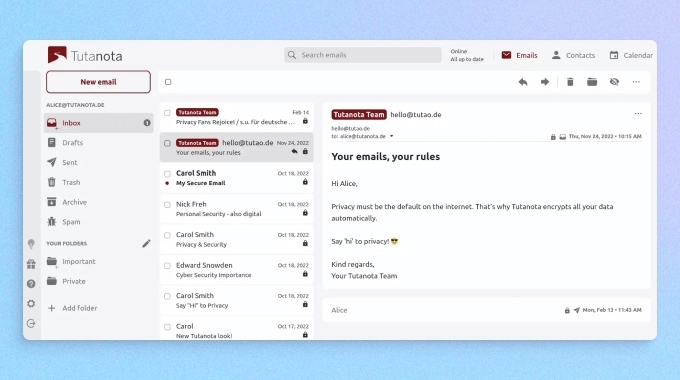
Tuta’s encryption model is strongest when both people use the service: messages between Tuta accounts are encrypted end to end automatically. For an external recipient, the sender must create a password and share it through another channel before the recipient can open the protected message. The process works, but it adds friction and may feel restrictive to anyone who depends on PGP or regularly exchanges encrypted mail across providers.
Once inside Tuta’s own apps, however, the experience feels coherent rather than constrained. During testing, the interface was clean and consistent across mobile and desktop, and the encrypted calendar felt built into the product rather than added later.
The free plan and relatively low paid price are appealing, although slower feature development may frustrate users who prioritize flexibility.
Metadata and recovery: Tuta does not log login or sending IP addresses by default and strips IP addresses from message headers, but sender and recipient addresses remain available for delivery. Its recovery code is the only way to reset a forgotten password, so it should be stored offline.
Security at a glance: Tuta encrypts message bodies and subject lines between Tuta users and in password-protected messages to external recipients. Its apps are open-source, and SySS conducted an independent penetration test before the service’s public release. Tuta supports 2FA and U2F security keys, but not passkeys. It also blocks IMAP by design.
- Strong encryption and privacy protections under German data regulation laws
- No ads or data selling, focusing solely on user privacy
- Clean, minimalist UI with an easy-to-use calendar
- Competitive pricing with a free plan available
- Slow development pace for new features and bug fixes
- Lack of support for PGP
4. StartMail
Price: 7-day free trial, credit card required, paid plans start at $6.99/month (monthly) or $4.99/month when billed annually.
StartMail is aimed at people who want a private inbox without joining a larger productivity ecosystem. The Netherlands-based service remains focused on email and accepts cryptocurrency payments for users who prefer an alternative payment method.
For users who want to send anonymous emails, these aliases provide a practical way to avoid exposing a primary address, although they should not be mistaken for complete anonymity.
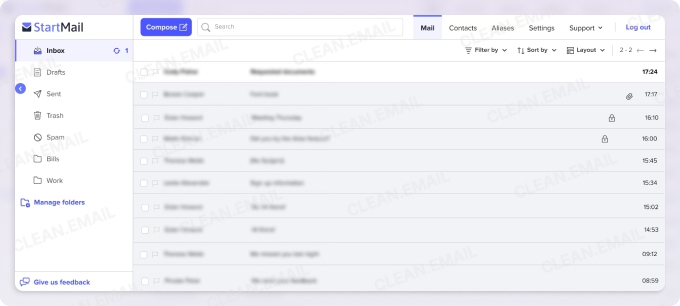
Our Gmail migration was uncomplicated: mail and contacts imported without obvious friction, and the uncluttered, ad-free interface required little adjustment afterward. StartMail stays focused on the basic email workflow, so there are fewer menus and secondary tools competing for attention.
That narrow focus is both its appeal and its main limitation. StartMail offers generous storage but has no calendar, notes, or native mobile and desktop apps. With no permanent free tier and only a seven-day trial, it is best suited to users who already know they want a dedicated private email service rather than a full office suite.
Metadata and recovery: StartMail removes the user’s IP address from outgoing headers and keeps operational logs for seven days, including remote-server IPs and SMTP sender and recipient addresses. Account recovery requires a verified recovery address or a one-time recovery code; without either, access cannot be restored.
Security at a glance: StartMail offers optional PGP encryption, 2FA, signup without personal details, cryptocurrency payments, unlimited aliases, custom domains, and IMAP/SMTP access. The Netherlands-based service keeps its code proprietary, and PGP leaves subject lines outside the encrypted message body.
- Generous 20GB of storage for all your encrypted emails
- PGP end-to-end encryption
- Cryptocurrency payments are accepted
- Unlimited burner aliases
- User-friendly interface with a minimalistic design
- Lacks a free version and offers a relatively short trial period
- Missing additional productivity tools like calendars and notes
- No native mobile or desktop app
5. Mailfence
Price: Free with 1 GB of storage for personal use, or paid plans starting from $2.95/month for the personal Base plan, 11 GB of storage, and from $4.13/month for the business Entry plan, 40 GB of storage.
Mailfence makes a stronger first impression through breadth than design. We liked having email, calendar, documents, contacts, and groups in one privacy-focused account, a combination few providers here match.
For those who want to stop spam emails, Mailfence includes filtering tools for unwanted messages. In testing, they worked as expected, although some controls took time to locate.
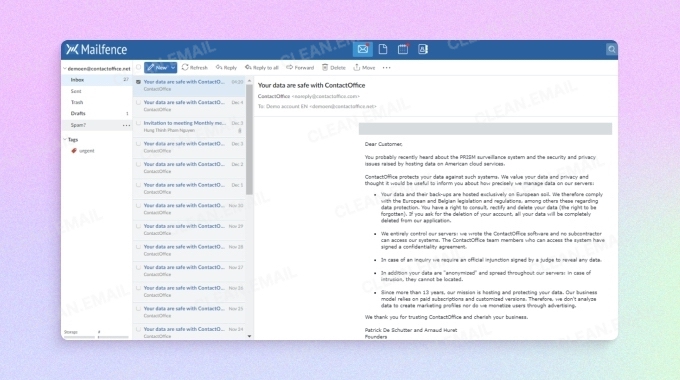
If there’s one thing we didn’t like about Mailfence, it’s the outdated user interface. While functional, the interface simply didn’t make us look forward to opening our inbox, which usability leaders like Neo managed to do. The mail client’s design is reminiscent of older webmail services, and some features are buried in menus. It took longer to learn than Proton Mail or Neo.
Metadata handling: Mailfence’s privacy policy says it collects IP addresses, Message-IDs, sender and recipient addresses, subject lines, browser versions, countries, and timestamps. It strips the sender’s IP from outgoing headers, but this does not eliminate server-side logging.
Security at a glance: Mailfence offers optional OpenPGP encryption and digital signatures, 2FA, up to 200 aliases, custom domains on paid plans, and IMAP, POP, and SMTP access. The app is closed-source and subject lines are not encrypted. Mailfence publishes a threat model and transparency report, but we did not find a public independent audit report for the full service.
- Strong legal and privacy protections under Belgian law
- Comprehensive end-to-end encryption and support for digital signatures
- Integrated productivity tools including calendars, documents, and group sharing
- Ad-free service with a public transparency report
- POP, IMAP, SMTP access
- Lack of a native mobile app, relying on PWA for mobile access
- Smaller user base compared to leaders like Proton Mail
6. Zoho Mail
Price: Free with up to 5 GB of storage space, plus free 15-day trial with no credit card required; paid plans start at $4/user/month (30 GB mail storage) or $12/user/year (5 GB storage).
Zoho Mail is the practical business choice in this ranking rather than the strictest privacy option. During use, its polished interface and integrated calendar, tasks, notes, contacts, and Zia assistant made it feel like a complete work platform. The trade-off is that some protections must be enabled manually, and its privacy model is less restrictive than those of Proton Mail or Tuta.

Calendar, tasks, notes, and contacts sit alongside email, while the Zia assistant can help draft or complete messages. This is useful for teams already using Zoho, but it may feel excessive to someone who wants a simple private inbox.
Metadata handling: Zoho’s privacy policy says its logs may include IP address, browser and device details, access time, features used, errors, storage use, and approximate device location. Zoho says it does not sell personal information or use advertising as its business model.
Security at a glance: Zoho Mail encrypts data at rest and in transit and offers optional PGP on paid organizational plans; S/MIME is limited to higher-tier plans. Both require configuration and recipient key or certificate support, so ordinary Zoho Mail is not automatically end-to-end encrypted or zero-access. Zoho Accounts supports passkeys and MFA. Aliases, custom domains, and IMAP/POP depend on the plan. Zoho is headquartered in India and offers regional data centers.
- Suite of tools beyond just email
- AI assistant, Zia
- End-to-end encryption and two-factor authentication
- Advanced spam filtering and blocking
- Inexpensive paid plans
- Privacy and security are not the main selling points
- Can be overwhelming for users seeking a simple email solution
- Some security features must be manually enabled
7. Neo
Price: Starts at $2.49/mailbox/month (billed monthly) or $1.99 /mailbox/month (billed yearly) with 10 GB of storage.
Neo makes the most sense for a small business that wants a polished email address and practical sales tools in one place. You can connect a domain you already own or use a co.site domain through Neo.space, so setting up a branded inbox does not require rebuilding the rest of your online presence.
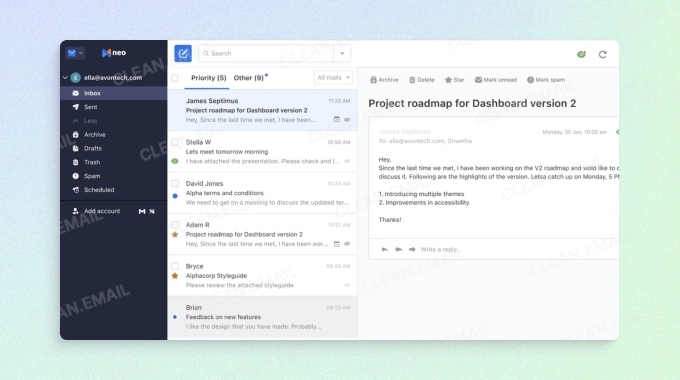
Privacy is part of the package, but it is not Neo’s defining idea. The service is ad-free and GDPR-compliant, while its clearest advantages come from the business features around the inbox. Smart Write AI writing assistant can help shape a draft or adjust its tone, and Email Tracking shows whether a recipient opened a message, and is useful for follow-ups, though not a feature every privacy-focused user will want to enable.
In day-to-day use, Neo felt approachable: the interface is tidy, important controls are easy to locate, and the added tools do not overwhelm the inbox. We would shortlist it for a small team that values branding, speed, and accessible support. Anyone seeking maximum anonymity or a privacy-first architecture should consider Proton Mail or Tuta first.
Security at a glance: Neo encrypts data at rest and in transit but does not provide zero-access end-to-end encryption or subject-line encryption, and it is not open-source. It supports 2FA, up to 10 aliases, and custom domains. IMAP/POP is available, but Neo says third-party clients are blocked when 2FA is enabled. Neo is operated by Cayman Islands-registered Titan Solution Ltd SEZC, and is GDPR-compliant.
- Ad-free and user-friendly interface
- Professional-looking email addresses
- Many extra features
- Advanced spam filtering and blocking capabilities
- Dedicated customer support team
- Aimed mainly at business customers
- The email service does not have an offline mode
8. Mailbox.org
Price: 30-day free trial of your chosen tariff, starting from €4/month for the Standard (20 GB Mail storage) or €12/year for the Light plan (2 GB Mail storage).
Mailbox.org sits between a privacy-focused inbox and a full productivity suite. In testing, the combination of webmail, Drive, Office, Meet, and custom-domain support made it useful as a daily work account. The interface takes some adjustment, but the service offers strong value for users who want both privacy and breadth.
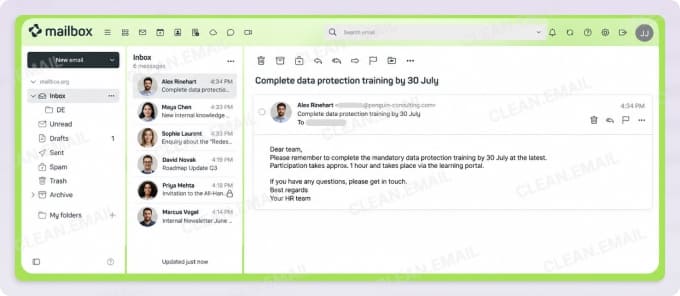
The most practical security feature is mailbox Guard, which handles encryption and decryption inside webmail. It reduces the setup burden for users who want protected correspondence without installing a separate desktop application.
Metadata and recovery: Mailbox.org’s data-protection statement says it logs login IP addresses and delivery metadata, including sender, recipient, Message-ID, and message size, for seven days. A forgotten mailbox Guard password cannot be recovered; a support-assisted reset deletes the stored keys and permanently removes access to messages encrypted with them, so users should back up their keys.
Security at a glance: Germany-based mailbox.org supports optional OpenPGP and S/MIME through mailbox Guard, plus 2FA with hardware security keys, aliases and disposable addresses, custom domains, and IMAP, POP, and SMTP access. Its service code is proprietary, and subject lines remain outside OpenPGP encryption.
- Easy email migration
- Family account support for up to 10 people
- Customizable spam filters
- Ad-free experience
- No native mobile apps
- Receive-only disposable addresses
- Plan-based customer support
Security Features Compared
Before the verdict, here’s how all eight providers stack up on the security features that matter most.
| Provider | Subject encryption | Passkeys | Security audit | Aliases | Custom domains | IMAP |
|---|---|---|---|---|---|---|
| Proton Mail | ❌ No | ❌ No (security keys supported) | ✅ Yes | ✅ Yes | ✅ Yes (paid) | Via Bridge |
| Hushmail | ❌ No | ❌ No | No public report | ✅ Yes | ✅ Yes (business) | ✅ Yes |
| Tuta | ✅ Yes | ❌ No | ✅ Yes (Older SySS penetration test) | ✅ Yes | ✅ Yes | ❌ No (by design) |
| StartMail | ❌ No | ❌ No | ❌ No | ✅ Yes (unlimited) | ✅ Yes | ✅ Yes |
| Mailfence | ❌ No | ❌ No | No public report | ✅ Yes (up to 200) | ✅ Yes | ✅ Yes |
| Zoho Mail | ❌ No | ✅ Yes | No public mail-app report | ✅ Yes | ✅ Yes | ✅ Yes (paid) |
| Neo | ❌ No | ❌ No | ❌ No | ✅ Yes (up to 10) | ✅ Yes | ✅ Yes |
| Mailbox.org | ❌ No | ❌ No | ❌ No | ✅ Yes + disposable | ✅ Yes | ✅ Yes |
How Clean Email Enhances Email Security
Many people turn to a secure mail service out of frustration with unsolicited and spam emails, concerns about data breaches, and other security issues. However, migrating to a new email address may not be necessary, thanks to Clean Email.
This inbox organizer offers a variety of useful features designed to improve your email experience by making it more secure and organized.
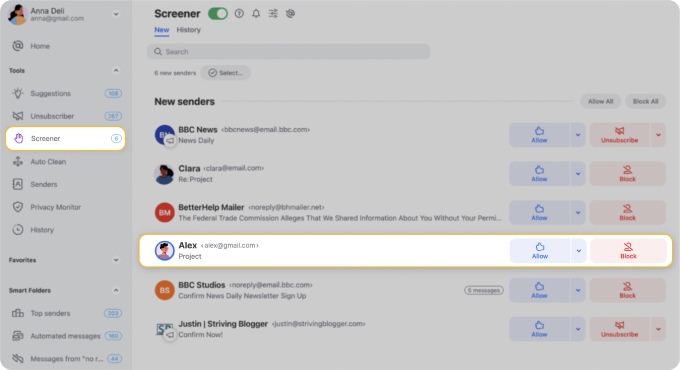
Your first line of defense against spam is Clean Email’s Screener tool. When enabled, it screens emails upon arrival to give users the power to decide what enters their inbox. I personally keep it turned on all the time and quickly go through all screened messages twice a day.
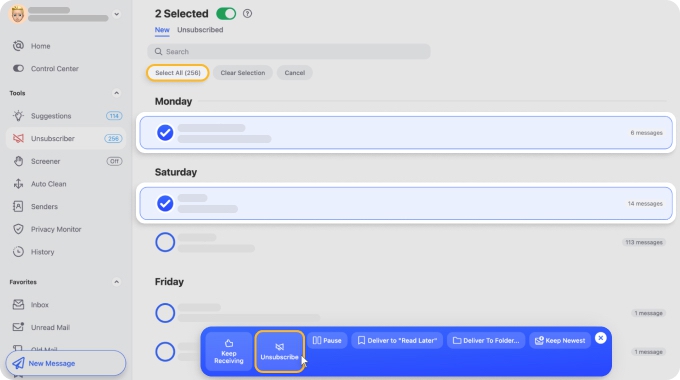
Complementing the Screener tool is Clean Email’s weapon against unwanted subscription emails and newsletters: the Unsubscriber tool. With it, you can unsubscribe from all marketers at one step even when they don’t include an unsubscribe link to their emails.
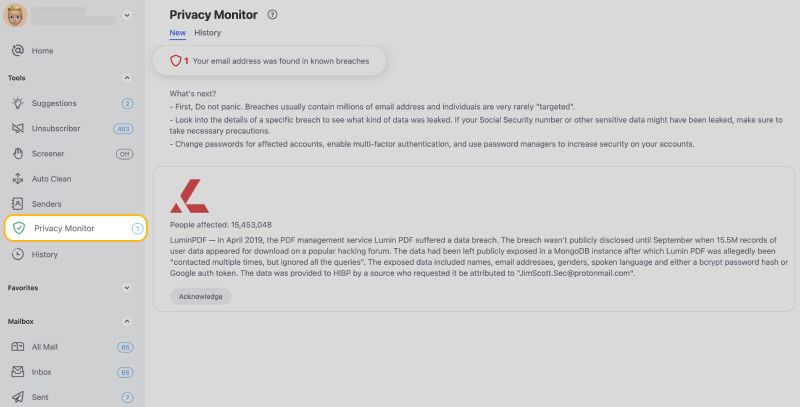
The Privacy Monitor feature regularly checks your email against known data breaches and security incidents, alerting you to potential vulnerabilities.
Users can try Clean Email using its web, mobile apps for iOS and Android, or the Mac desktop app for free, and the inbox organizer supports all IMAP-based email providers.
Bottom Line
There is no single “most secure” email provider. The right pick depends on your threat model and how you work.
- Best all-rounder: Proton Mail, for the strongest privacy with the least friction.
- Most private: Tuta, which encrypts subject lines, not just the message body.
- Regulated work: Hushmail, with HIPAA-ready healthcare and legal plans.
- Business & custom domains: Neo or Zoho Mail.
- EU jurisdiction & aliases: StartMail or Mailfence.
- Full-featured daily driver: Mailbox.org.
Whatever you choose, enable the strongest supported multi-factor method, preferably a passkey or hardware security key, store recovery codes offline, and make sure to keep your inbox decluttered.
Most Secure Email Providers - FAQs
What is the most secure free email service provider?
Proton Mail ranks as one of the most secure free email providers. Note that the free version of Proton Mail offers up to 1 GB of email storage, meaning users will need to regularly clean their inbox or consider subscribing to a paid plan for additional space.
Is Proton Mail safer than Gmail?
Yes, Proton Mail offers more message privacy than Gmail. Messages between Proton Mail users are end-to-end encrypted, while standard Gmail messages are not. Both services still require a strong password, multi-factor authentication, and caution against phishing.
Is Gmail secure?
Gmail provides solid security for everyday use. It protects messages during delivery and storage and includes spam detection, phishing protection, and two-step verification. However, standard Gmail messages are not end-to-end encrypted. Users who want greater privacy should consider an end-to-end encrypted service.
What is the most hacked email provider?
There is no reliable ranking of the most hacked email providers. Companies report breaches differently, and many accounts are compromised through reused passwords or phishing. Yahoo suffered one of the largest reported email breaches, but that does not make it the riskiest service today. Current security measures matter more than the number of past breaches.
Can Proton Mail be hacked?
In short, yes, even your Proton Mail can be hacked. However, if your account does get hacked, chances are, it will not affect your user data. The reason is Proton Mail’s end-to-end encryption and zero-access encryption. While there is always going to be a threat, there are multiple steps to a successful hack. Fortunately, Proton Mail can thwart hacking attacks before they gain any useful information, even if they initially gain access to your account.
Can I get the most secure email free?
You can get strong email security without paying, but there is no single free service that is most secure for every user. Free plans from providers such as Proton Mail and Tuta include meaningful encryption and account-security features, usually with limits on storage, aliases, domains, or support.
What’s the difference between TLS and end-to-end encryption?
TLS only protects an email while it travels between mail servers. Once it arrives, the provider can usually read it. End-to-end encryption (E2EE) lets you encrypt an email on your device so only the recipient can decrypt it, meaning not even the provider can read it. Every provider here uses TLS in transit, but only some add true E2EE (most commonly via OpenPGP), and that’s the distinction that protects your content.
Does secure email hide my metadata?
Not always. Even with E2EE, the sender, recipient, timestamp and, with most PGP-based services, the subject line can stay visible. Tuta is the notable exception. If metadata matters to you, check what each provider logs and whether it stores your IP address.