What Is an Email Organizer?
An email organizer is a tool that sorts incoming messages, filters emails by sender or type, helps you remove clutter in bulk, and can automate repetitive inbox actions. It works on top of your existing mailbox rather than replacing your email app.
You can try most email organization apps for free, and if you like it, you can pay for a premium subscription plan. Considering the average office worker now receives approximately 121 emails a day, email overload is a genuine drain on email productivity, so an inbox organizer quickly becomes essential.
We tested and evaluated each app on this list so you can make an informed decision and start organizing your inbox today. The key decision-making factors were:
- Powerful organization features like advanced sorting and automation
- User-friendly app
- Good customer support
- Support for all major email platforms
- Free trial
- Affordable monthly plans (all prices on this page are per month if billed monthly)
Check out our in-depth video review of the best email organizer tools and keep reading for more details.

Top 8 Best Email Organizer Apps
Here's a quick rundown of the top tools and their key strengths:
- Clean Email: Comprehensive inbox organization.
- Shortwave: AI-driven Gmail organization.
- Mailbutler: Collaborative email enhancement tool.
- Mailstrom: Efficient bulk email management.
- SaneBox: Behavior-based email sorting.
- Drag: Gmail productivity and collaboration.
- ActiveInbox: Gmail task management integration.
- Spark: Multi-platform, feature-rich email organization.
1. Clean Email
How it works
Clean Email is built for people who want to reach Inbox Zero with minimal effort.
The app analyzes email headers that contain subject lines, sender and recipient information, dates, message size, and other metadata. This approach allows grouping your messages and making bulk actions more efficient.
Learning how to organize your email with this app takes just a few minutes. To get started, all you have to do is sign in with your email service provider and authorize the app to access it. Clean Email will automatically analyze your emails and categorize them into easy-to-review bundles by date, sender, or other criteria.
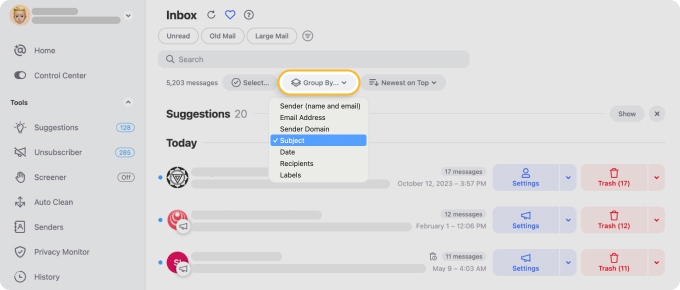
You can then remove, archive, move, label, and do other things with entire groups of emails instead of selecting individual emails one by one.
Key organization features
Two of the standout features of Clean Email are Smart Folders and Auto Clean. Smart Folders automatically organize your inbox into logical categories like Top Senders, Social Notifications, Online Shopping, Finance and Insurance, and more.
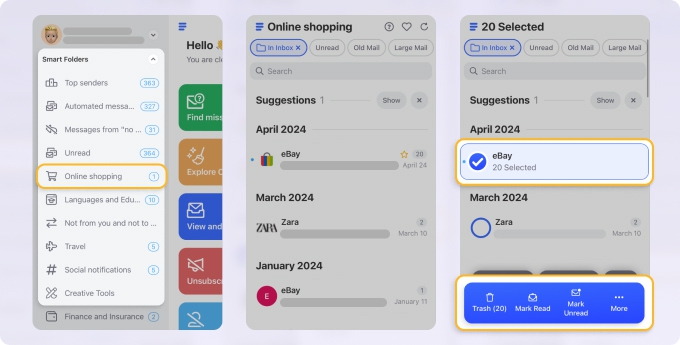
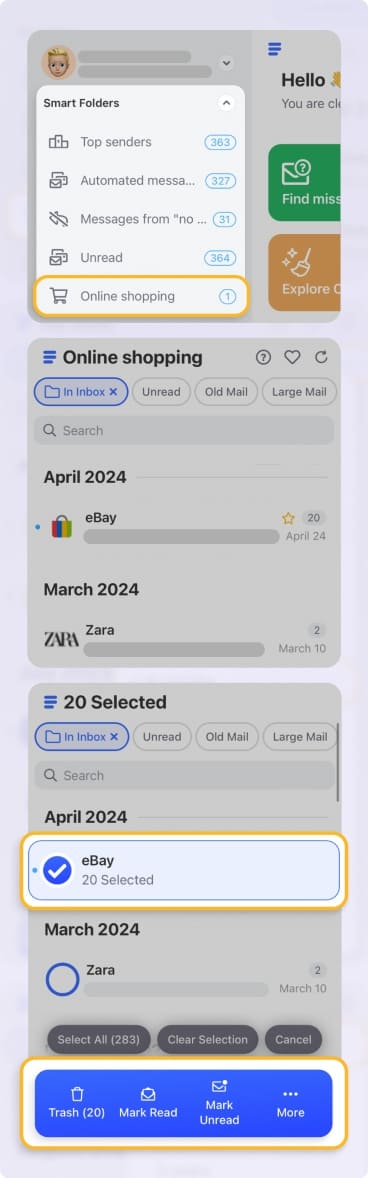
Auto Clean uses automated rules that you set up to filter incoming messages and move them where you want. You can then experience a clean inbox and review your emails on your own time.
Compatibility
Clean Email organizer app works on iPhone, Android, Mac, and any web browser, and supports Gmail, Yahoo, iCloud, Outlook/Hotmail, AOL, and more. There is no native Windows desktop app; Windows users connect through the web.
Best for
All-round bulk organization and decluttering across multiple email accounts.
- Powerful inbox management and organization features
- Advanced email filtering options
- Automatic email organizing with Smart Folders
- Action History Summary to keep track of the actions taken in the app
- Lack of AI-based features
- There is no dedicated app for Windows desktops
Pricing
Free trial, then paid plans for one, five, or ten accounts (monthly or yearly).
2. Shortwave
How it works
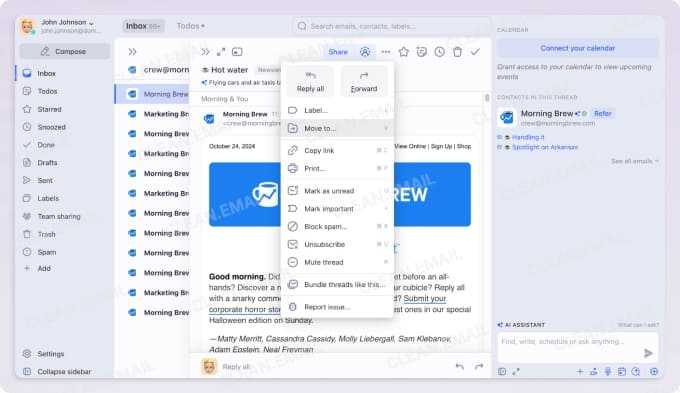
Shortwave is an email organizer client for Gmail and Google Workspace, built by members of the team behind Google Inbox and designed around reaching inbox zero. It walks you through triaging your whole inbox in one pass, then combines manual organization with optional AI assistance to keep it clean.
Key organization features
Shortwave groups related messages into bundles and can auto-file incoming mail with Splits, preset filters for categories like Newsletters, Promotions, Updates, and Calendar. Emails you cannot handle right away can go into a built-in to-do list or be snoozed to resurface at a better time.
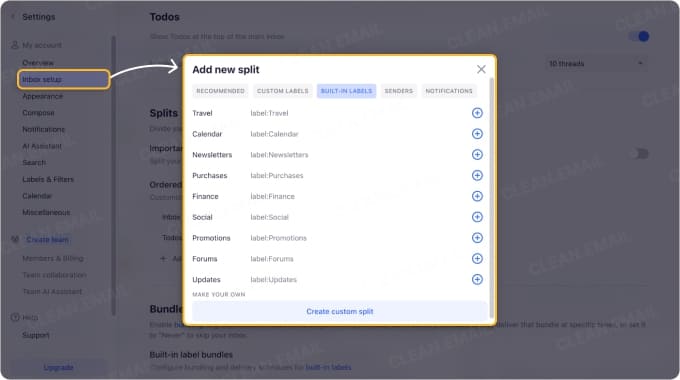
It also layers in AI tools: a short summary at the top of each bundle, writing suggestions as you compose, and an assistant that can search your mail in plain language and schedule events from your Google Calendar, with more to explore.
Compatibility
Gmail and Google Workspace only, not Outlook. Available as web, Mac, Windows, Android, and iOS apps.
Best for
Gmail users who want AI-assisted bundling, search, and drafting.
- Feature-rich
- AI-enabled
- Bundles emails into categories automatically
- Receive messages when you want with schedules
- Keyboard shortcuts
- Limited to the Gmail platform only
- No desktop apps
- Heavily reliant on AI features, which are capped on lower tiers
Pricing
Shortwave has a limited free plan and a 14-day trial. Paid plans start at $30 per seat per month.
3. Mailbutler
How it works
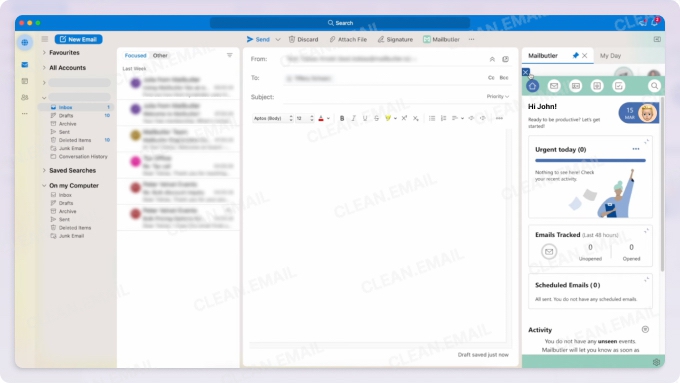
Mailbutler is an email extension that you can use to enhance your mail provider with new features. It works with Outlook, Gmail, and Apple Mail. Some powerful options are email tracking, signatures, scheduled sending, delayed email delivery, notes, contacts, tasks, templates, and an AI-powered email assistant.
Key organization features
Mailbutler aims to be a collaborative environment where you can work on notes, tasks, contacts, and templates with team members. In terms of organizing email, the app uses tags to organize emails into groups. It also offers collaboration features for notes, tasks, contacts, and templates, and complies with European data regulations.
Compared to Clean Email and other inbox organizers, Mailbutler lacks some critical features. Its main focus is productivity add-ons rather than sorting, decluttering, or automating an inbox, so its dedicated organization features are limited.
Compatibility
Works with Outlook, Gmail, and Apple Mail. Not available on iOS or iPadOS.
Best for
Adding tracking, notes, and tasks to an email app you already use, less so for users who mainly want to filter or bulk-clean an inbox.
- Email tracking
- Collaboration features
- AI-empowered for email insights
- Tags to organize emails
- Works on all leading email platforms
- Built-in grammar checker
- Pricey (based on number of users)
- The user interface needs updating
- Doesn’t work on iOS or iPad OS
Pricing
Mailbutler has a free-forever Starter plan and a 14-day trial with all features. Paid plans start at $9 per user per month.
4. Mailstrom
How it works
Mailstrom is a powerful email organization app that cleans your inbox with a few clicks. The app makes unsubscribing and deleting emails a breeze. You can use bulk actions to remove or unsubscribe emails after Mailstrom groups related emails together.
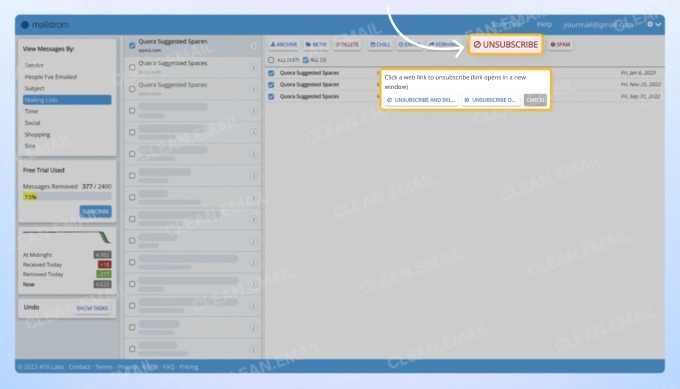
Cleaning out thousands of emails at once is a snap. Mailstrom uses industry-leading encryption to keep your personal information safe, and it works with Gmail, Outlook, Yahoo, and other IMAP-based mail providers.
What sets Mailstrom apart from other inbox organization apps is its flexible tips, tricks, and hacks to make cleaning out your inbox fast and efficient. Some reviewers consider it one of the quickest Gmail organization apps on the market.
Key organization features
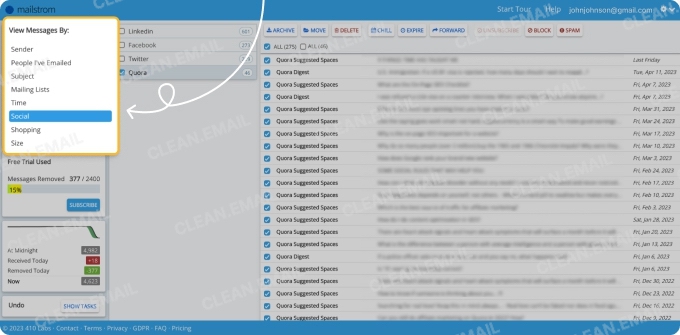
It organizes mail mainly by broad groupings such as sender, subject, time, size, and lists like Social, Shopping, and Mailing Lists, with fewer ready-made categories than some competitors.
Compatibility
Works with Gmail, Outlook, Yahoo, and other IMAP-based providers.
Best for
Fast, manual bulk cleanup and unsubscribing, rather than ongoing automated sorting.
- Works with all IMAP-based mail providers
- Delete thousands of emails with a few clicks
- Strong encryption and never saves your password
- Limited smart email bundles/folders
- Lacks automation features and AI
- Free trial is limited
Pricing
Mailstrom offers a single paid plan at $9.95/month or $59.95/year, with the annual plan including the Chuck Pro iOS app, after a free trial.
💡 Check the detailed comparison of Clean Email with Mailstrom.
5. SaneBox
How it works
SaneBox works quietly in the background behind your email provider. It uses email metadata, your past behavior, and your own actions and preferences to move messages into “Sane” folders (email labels it creates in your mailbox). It learns which senders you regularly engage with and routes lower-priority mail out of your main inbox.
SaneBox is built to run automatically with minimal setup. Compared with other apps on this list, SaneBox has significantly fewer email management features, and users have less control over automation.
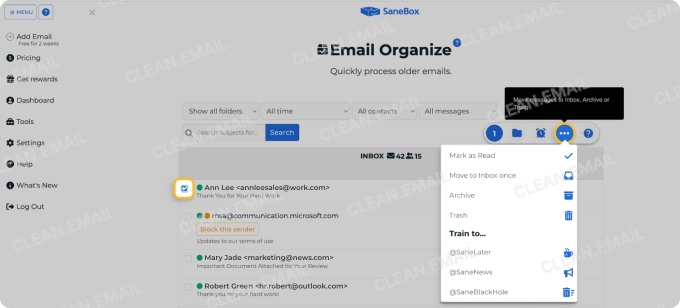
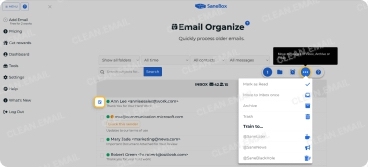
To use SaneBox, sign in with your email address, let it create the Sane folders in your inbox, and let it label incoming mail. You train it by dragging any misplaced message into the correct folder from any webmail or email client, and it adjusts going forward.
Key organization features
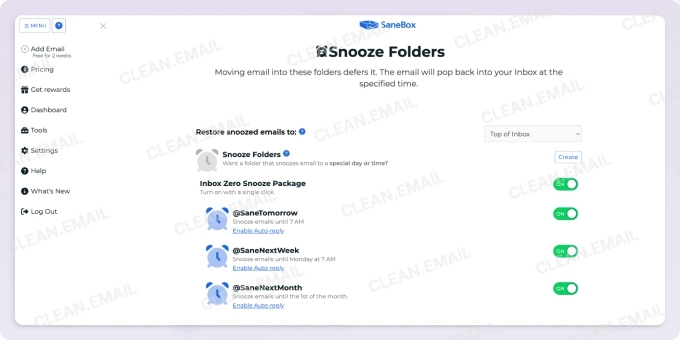
SaneBox organizes mail through named folders and tools you switch on as needed: SaneLater for less urgent mail, SaneNews for newsletters, SaneBlackHole to block unwanted senders, SaneNoReplies and SaneReminders to track follow-ups, SaneCC for messages you are only copied on, plus snooze folders, a daily digest, and custom training folders, with more to explore.
Compatibility
Works with Gmail, Office 365, iCloud, and most email addresses, with nothing to install.
Best for
Hands-off priority email filtering without switching mail apps.
- “Interfaceless” inbox cleaner
- Works with any email address
- Behavior- and metadata-based sorting
- Lacks flexibility and automation
- Only basic organization options
Pricing
After the 14-day trial, you can choose three pricing options from $7/month to $36/month. Pricing is based on features and number of accounts.
6. Drag
How it works
Drag is a Gmail organizer app that adds dozens of new features to Gmail. It’s meant to be a collaborative team tool to enhance Gmail’s productivity. The custom automation feature allows you to organize emails effortlessly, follow up, and track specific emails from particular senders.
Key organization features
One of the most impressive features is setting shared inboxes so you don’t have to forward and cc messages back and forth; you can all work from the same information. Other features include tracking and sequencing, boards, team chat, assignments, and labels for organizing messages into groups.
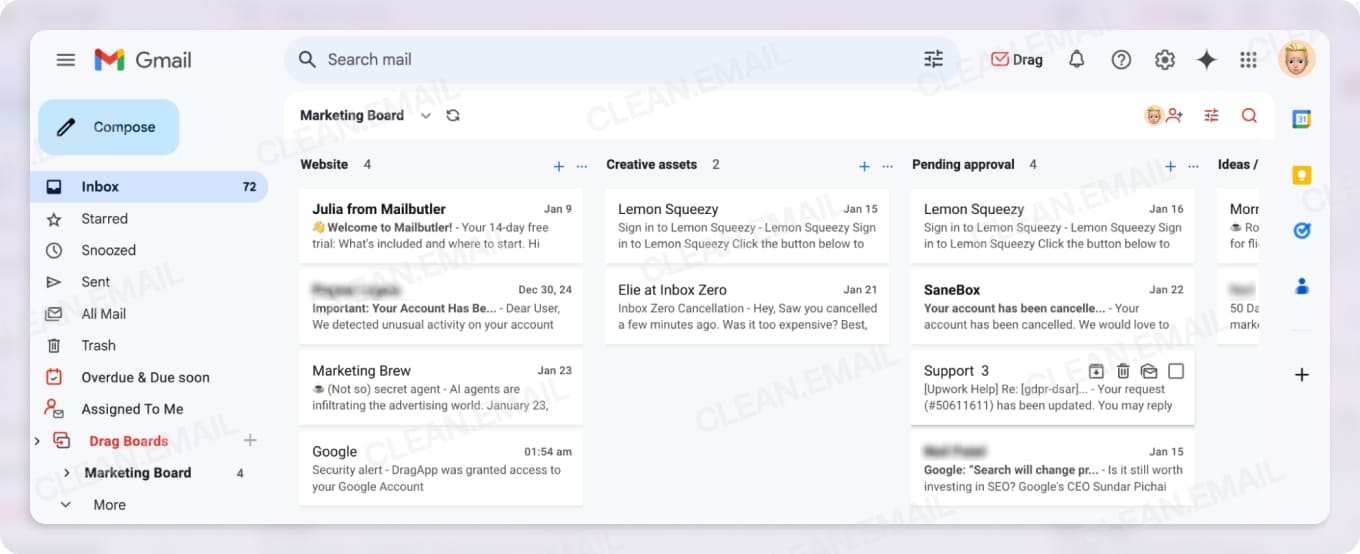
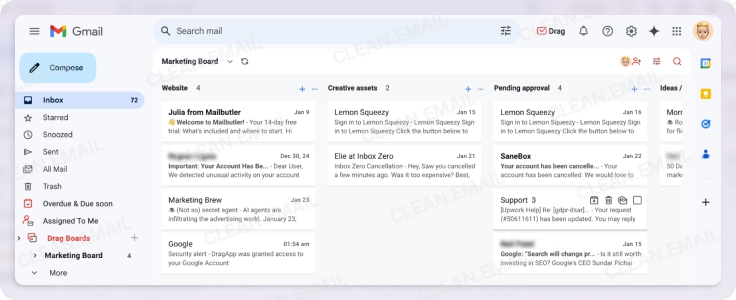
Many of Drag's features are aimed at team collaboration rather than personal inbox organization, so it may be more than a single user needs for simple decluttering. Teams looking for a great way to collaborate will love the comprehensive options, but if you are looking for a simple yet effective app to sort and block emails to keep your inbox clean, this may not be the best email organizer app to choose.
Compatibility
Gmail only. No mobile app.
Best for
Gmail teams that want shared inboxes and Kanban-style boards.
- Collaborative features
- Labels for organization
- Automation
- Integrations
- Kanban boards
- Limited to the Gmail provider
- No mobile version
- Basic inbox organization features
Pricing
Drag has a free plan and a 7-day trial. Paid per-user plans start at $16 and go up to $30/user/month when billed monthly.
7. ActiveInbox
How it works
ActiveInbox aims to convert Gmail into a task manager. Instead of missing a crucial message as it sinks to the bottom of your inbox, ActiveInbox turns it into a task, so you never forget anything. You can track emails you send to follow up with people who didn’t respond. The app calls itself an “email client and task manager” all in one.

Key organization features
You can use automation to move emails into folders so you can review them later. Or allow ActiveInbox to turn them into tasks to address so you won’t forget. The program creates Gmail folders and filters emails into them automatically, so you aren’t wading through 100s of messages a day.
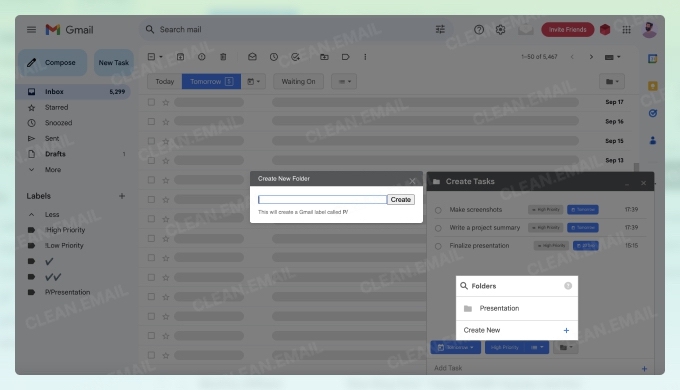
When compared with Clean Email and Mailstrom, ActiveInbox falls short. ActiveInbox lacks automatic email organizing features. This requires users to organize emails manually, a process that can be particularly time-intensive at the outset.
Compatibility
Gmail only.
Best for
Gmail users who want to manage email as tasks and follow-ups.
- Works seamlessly with Gmail
- Enhances Gmail with dozens of features
- Turns emails into tasks
- Add notes to emails
- Sorts emails by sender or priority
- Task manager
- Works only with Gmail
- Lacking email organization features
- Confusing interface
Pricing
You can try a free trial of ActiveInbox and then sign up for their Professional Plan for $5.37/per account/month (billed annually). You must contact them for an enterprise quote if you want business pricing.
8. Spark
How it works
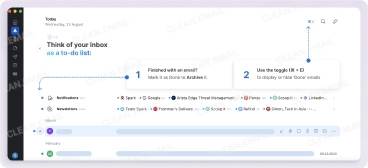
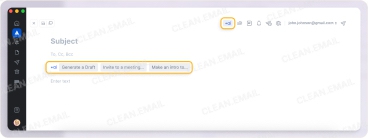
Spark is an email organization app designed to block out distractions and help you focus on what is most important. It groups mail into a smart inbox that separates important messages from noise. You can prioritize certain contacts or pin specific emails to the top of your inbox. You can also group emails by sender, mark them as done, set them aside, or remind yourself to deal with them another time.

Key organization features
Spark is hailed as one of the most comprehensive email-enhancing apps out there. For simple decluttering, however, it may be overkill for some users.
You can block and filter incoming emails to stay focused, and Spark adds team features such as shared drafts and comments on email threads.
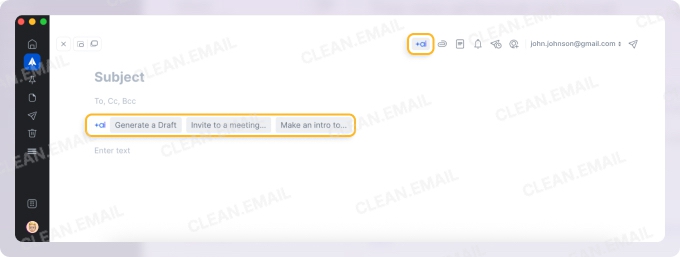
Spark also includes an AI-powered writing assistant, so all your emails are grammatically correct and perfect before you hit send. The app offers helpful insights on improving your workflow and changing your email habits for increased productivity.
Compatibility
Cross-platform: Gmail, Microsoft 365, Outlook, iCloud, and more. The app is available for Mac, iOS, Android, and Windows.
Best for
A cross-provider smart inbox with team email features.
- Automatically identifies important emails and separates them
- Mute threads
- Prioritize emails and contacts
- Screen unwanted emails
- Unified inbox
- Smart search
- Keyboard shortcuts
- No web version
- Could get pricey for teams
- Feature set may be more than light users need
Pricing
Spark has a free tier and a 7-day premium trial. Paid plans start at $10 per user per month.
💡 Follow our guides on how to organize iCloud emails and organize Yahoo Mail.
How to Choose an Email Organizer
Here is how the eight email organizers compare at a glance: what each is best and least suited for, how it organizes mail, its level of automation, and pricing.
| Tool | Best for | Not ideal for | Main organization method | Automation | Free option / pricing |
|---|---|---|---|---|---|
| Clean Email | All-round bulk organization across providers | Users wanting a full-featured email client | Smart Folders + bulk actions on grouped senders/types | High (Auto Clean) | Free trial; paid 1/5/10-account plans |
| Shortwave | Gmail users wanting AI bundling and search | Outlook and non-Gmail users | AI bundles and labels | High (AI) | Free plan; from $30/seat/mo |
| Mailbutler | Adding tracking, notes, tasks to your mail app | People who only need inbox cleanup | Tags within your existing client | Low to medium | Free Starter; from $9/user/mo |
| Mailstrom | Fast manual bulk cleanup and unsubscribing | Ongoing automated sorting | Bundle and bulk-action by sender/list/size | Low | Free trial; $9.95/mo |
| SaneBox | Hands-off priority filtering | Deep manual control or many features | Behavior + metadata routing to Sane folders | Medium | 14-day trial; from $9.99/mo |
| Drag | Gmail teams with shared inboxes | Solo users; mobile users | Boards, labels, custom automations | Medium | 7-day trial; from $16/user/mo |
| ActiveInbox | Managing Gmail as tasks and follow-ups | Automatic sorting and decluttering | Tasks, folders, and filters (mostly manual) | Low | Free plan; $5.37/account/mo (annual only) |
| Spark | Cross-provider smart inbox + team email | Simple one-off cleanup | Smart inbox, grouping, pinning, priority | Medium | Free tier; from $10/user/mo |
Why Should I Use an Email Organizer?
An email organizer allows you to eliminate inbox clutter efficiently with just a few simple clicks. Instead of going through your emails one by one and manually separating them, an app can analyze the headers of your emails and use the information to organize them into easy-to-review bundles.
Manual organizing rarely keeps an inbox clean for long. Email organizers add email automation and ongoing rules so new mail is sorted as it arrives, helping you find important messages faster and reducing routine inbox maintenance.
With automated rules in place, new messages flow into the right folders so you can review them on your own schedule.
💡 Let’s say that each message you receive takes you just 5 seconds to organize manually. If you receive around 100 emails a day, you spend 500 seconds, or a little over 8 minutes, every day on email management alone. Over a year, those 8 minutes a day add up to more than 2 days of wasted time, most of which an email organizer can save you automatically.
Email Organization Makes Sense!
Hopefully, this list of email organizers has helped you decide which is the best email organization system for you. Email isn’t going away anytime soon, and the number of daily spam emails keeps rising. Using a great app to filter emails just makes sense. The right app helps you wake up to a decluttered inbox each day, no matter how much email you receive.
FAQs
Is there a free email organizer?
Most email organizers offer a free trial rather than a permanent free plan, though some, such as Spark and Shortwave, include a limited free tier. Free options let you test sorting, filtering, and bulk cleanup before paying. Check each provider's current plans, since free limits change.
Are email organizers safe?
A reputable email organizer is safe when it connects through your provider's official permissions (OAuth) instead of asking for your password, clearly states what data it accesses, and publishes a privacy policy confirming it does not sell your data. Review the permissions you grant, turn on two-factor authentication for your email account, and revoke access if you stop using the tool.
Do email organizers work with Gmail?
Yes. Most work with Gmail and can complement Gmail categories and built-in filters. Some tools, including Shortwave, ActiveInbox, and Drag, are built specifically for Gmail, while others, such as Clean Email and SaneBox, support Gmail alongside Outlook, Yahoo, iCloud, and other IMAP providers.
What's the difference between an email client and an email organizer?
An email client (such as Outlook, Apple Mail, or Spark) is the app you use to read, write, and send mail. An email organizer focuses on filtering, decluttering, and automating an inbox you already have. Some tools, including Spark and Shortwave, do both.
Can an email organizer help achieve Inbox Zero?
Yes. By grouping messages, automating repetitive actions, and bulk-archiving or deleting low-priority mail, an organizer makes Inbox Zero realistic to reach. Auto-rules and smart folders then keep new mail sorted so the inbox stays clear.
What's the difference between email filters and an email organizer?
Email filters, such as Gmail filters or Outlook rules, are individual rules you create to move or label incoming mail. An email organizer adds intuitive sorting, automated grouping, decluttering, and ongoing maintenance across your whole inbox, so you rely less on building and managing rules by hand.