Key Takeaways
- Classic Outlook for Windows gives you the most detailed junk-filter controls, including protection levels like No Automatic Filtering, Low, and High.
- New Outlook and Outlook on the web use simpler junk-mail controls centered around blocked and allowed senders.
- If Outlook is technically filtering mail but still letting too much through, an added review layer for new senders may help more than repeated manual blocking.
- If your filter suddenly stops behaving normally, that is a troubleshooting issue and belongs on the separate Outlook Spam Filter Not Working page.

Does Outlook Actually Have a Working Spam Filter?
Yes. Outlook has a built-in filter that moves suspected junk email to the Junk Email folder rather than stopping delivery altogether.
Microsoft usually uses Junk Email terminology in Outlook’s interface and support materials.
How the Outlook Junk Email Filter Works
Outlook evaluates incoming mail and moves suspicious messages to the Junk Email folder. In classic Outlook, it also checks senders and domains against lists you control, including:
- Blocked Senders
- Safe Senders
- Safe Recipients
Where to Find Junk Email Options in Classic Outlook
The most detailed controls are available in classic Outlook for Windows.
To find them:
- Open the Outlook desktop app.
- Go to the Home tab.
- Click Junk.
- Select Junk E-mail Options.
From there, you can change the protection level and manage allowed and blocked senders.
How to Change the Protection Level
In classic Outlook, you can choose between:
- No Automatic Filtering
- Low
- High
- Safe Lists Only
For many users, High is the most useful setting when spam keeps reaching the inbox. It catches more junk, but you should monitor the Junk Email folder for a while in case important messages are sent there too.
If your real problem is:
- Outlook suddenly stopped filtering junk
- spam increased after an update
- settings changed or vanished
- you think Microsoft may be having a service issue
then you need the troubleshooting page: Outlook Spam Filter Not Working? How to Fix It.
How to Use Blocked Senders and Safe Senders
If Outlook keeps making mistakes with specific senders, these lists help you correct that.
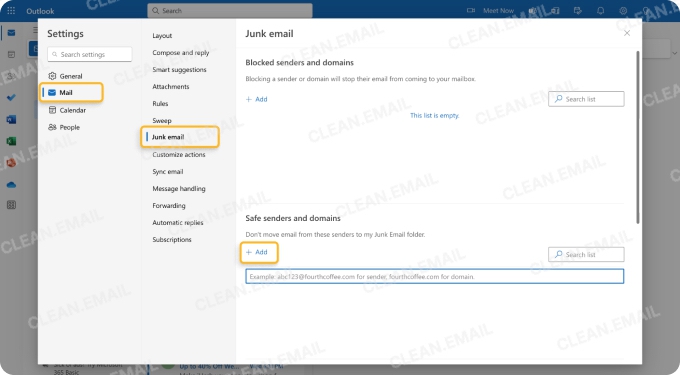
Use Blocked Senders for addresses or domains you never want in your inbox. Use Safe Senders for addresses or domains you trust.
That means the safe list is not just a convenience setting – it can directly affect why some mail bypasses Junk filtering.
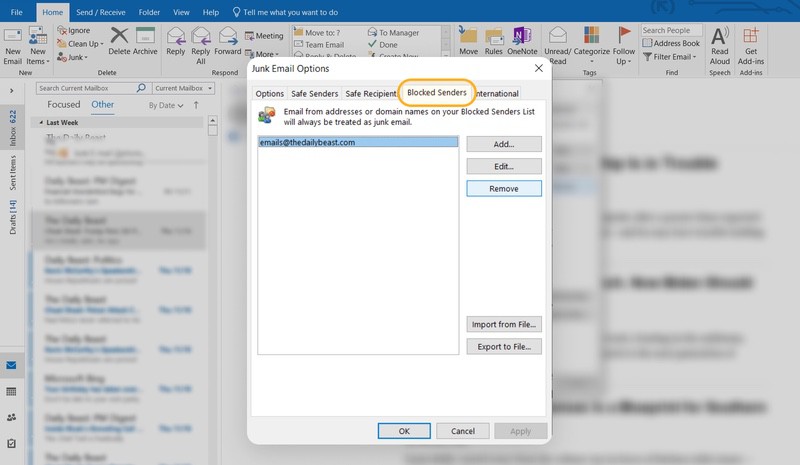
To add a new email address or domain name to the Blocked Senders List:
- Click the Blocked Senders tab in the Junk Email Options window.
- Click the Add button. Enter the email address or domain name you want to block.
- Click OK. Click OK again to close the Junk Email Options window.
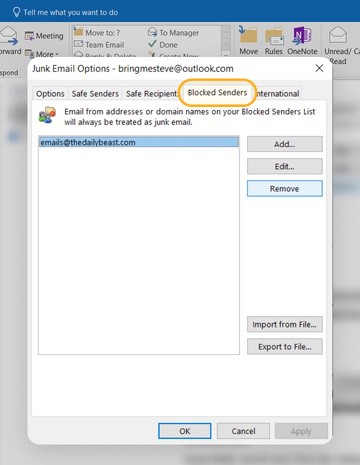
To customize the Safe Senders list:
- Click the Safe Senders tab in the Junk Email Options window.
- Click the Add button. Enter the email address or domain name you never want Outlook to treat as junk email.
- Click on OK, and then click on OK again.
In the Junk Email Options dialog, you can also customize the Safe Recipients list. It’s a list of email addresses or mailing lists that you trust. Emails sent to these addresses are less likely to be marked as spam, even if the sender is unknown (for example, emails sent to a group mailing list).
Classic Outlook vs. New Outlook: What Changed?
This is one of the biggest sources of confusion.
- Classic Outlook gives you deeper junk-filter controls.
- New Outlook gives you simpler junk and blocked-sender controls.
- People often think the spam filter changed or disappeared, when the bigger change is really that the settings moved and became less granular.
Outlook.com and New Outlook Junk Settings
If you use Outlook.com or new Outlook, go to the junk-mail settings in that interface rather than looking for classic desktop options.
So if you cannot find Junk E-mail Options, it may simply mean you are using the new Outlook experience, not that the feature is gone.
Best Third-Party Spam Filter for Outlook
For some users, Outlook’s built-in filtering is enough after basic customization. For others, it is not – especially when spam comes from constantly changing senders, suspicious subscriptions, or waves of lookalike addresses that are tedious to block one by one.
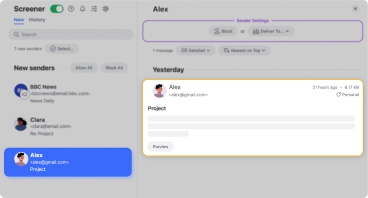
That is where a third-party layer becomes useful. A tool like Clean Email’s Screener is not a replacement for Outlook’s built-in junk filter so much as a second checkpoint: instead of only asking whether a message looks like spam, it can also help you review messages from new senders before they mix into your normal inbox flow.
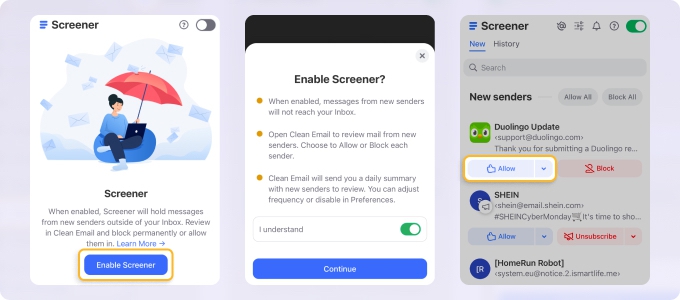
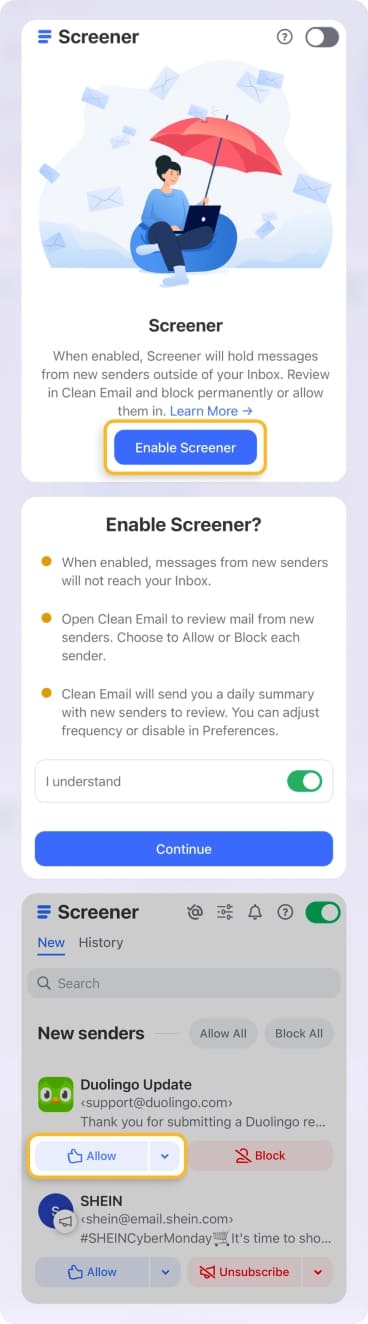
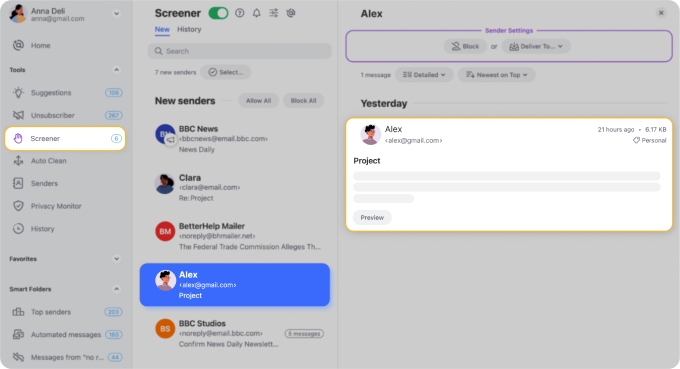
In Screener, you can preview a message without actually opening it, which is important for avoiding spam attacks.
Learn more about how to stop junk emails in Outlook and how to set up automated rules.
FAQs
Is “junk email” the same thing as Outlook’s spam filter?
Yes. Microsoft usually uses the phrase Junk Email, while many users search for the spam filter.
Where are Junk Email Options in Outlook?
In classic Outlook for Windows, go to Home → Junk → Junk E-mail Options. Those exact controls do not apply to the New Outlook.
What is the best Outlook junk filter setting?
For many people, High is the best balance between stronger filtering and a manageable risk of false positives.
Can I block junk email in the New Outlook too?
Yes, but the controls are simpler than in classic Outlook and are based more on blocked and allowed senders.